Recognition: 2 theorem links
· Lean TheoremFlow bistability in non-Newtonian electron fluid
Pith reviewed 2026-05-13 03:52 UTC · model grok-4.3
The pith
In narrow channels, non-Newtonian viscosity from local heating allows two steady electron flows to coexist at the same voltage, producing an S-shaped current-voltage curve.
A machine-rendered reading of the paper's core claim, the machinery that carries it, and where it could break.
Core claim
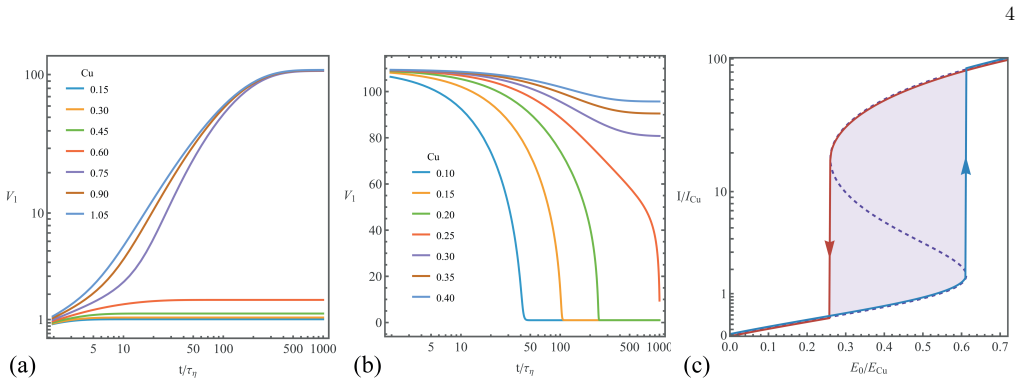
In a certain range of parameters, the two steady-state flow configurations coexist for the narrow channel geometry, and this bistability leads to an S-shaped current-voltage characteristic. Solving the time-dependent dynamic equations shows how current switching and hysteresis occur upon step voltage changes in samples with the non-Newtonian electron fluid.
What carries the argument
Non-Newtonian viscosity depending on spatial gradients of hydrodynamic velocity through local electron heating, which produces multiple stable flow states in confined geometry.
If this is right
- Two distinct flow patterns can be stable at identical applied voltages in narrow channels.
- The current-voltage relation exhibits an S-shape with regions of negative differential resistance.
- Switching between states occurs with hysteresis when voltage is varied.
- Transient dynamics after voltage steps show specific relaxation to one or the other state.
Where Pith is reading between the lines
- Similar bistability could appear in other geometries or with different nonlinearity mechanisms in electron hydrodynamics.
- Experiments in graphene channels might detect the predicted hysteresis to confirm the heating-based viscosity model.
- Device applications could exploit the switching for memory or logic elements based on electron fluid states.
Load-bearing premise
The chosen dependence of viscosity on velocity gradients via local heating, together with the simplified equations, is enough to create stable coexistence of two flows without other effects eliminating the bistability.
What would settle it
Measurement of the current-voltage curve in a narrow 2D electron channel under hydrodynamic conditions either showing or failing to show an S-shape with hysteresis.
Figures

read the original abstract
Modern two dimensional conductors with low defect densities and strong electron-electron scattering are favorable platforms for formation of a viscous fluid of conduction electrons. Electric properties of these systems are determined by the hydrodynamic regime of charge transport distinguished by many experimental signatures: a decrease in sample resistance with increasing temperature (the Ghurzhi effect), strong negative magnetoresistance and others. Here we consider the flow of 2D electron fluid in the nonlinear regime characterized by non-Newtonian viscosity which depends on spatial gradients of hydrodynamic velocity. We derive a simplified version of the dynamic equations for the non-Newtonian electron fluid and consider the specific underlying mechanism associated with local electron heating. Recent works have demonstrated that this may be one of the main mechanisms for nonlinearity in 2D electron fluids. We show that in a certain range of parameters, the two steady-state flow configurations coexist for the narrow channel geometry, and this bistability leads to an S-shaped current-voltage characteristic. By solving the derived time-dependent dynamic equations, we trace the transient response to a step variation of the longitudinal voltage and demonstrate how the current switching and hysteresis occur in samples with the non-Newtonian electron fluid.
Editorial analysis
A structured set of objections, weighed in public.
Referee Report
Summary. The manuscript derives simplified dynamic equations for a non-Newtonian 2D electron fluid where viscosity depends on spatial gradients of velocity due to local electron heating. For narrow channel geometry, it demonstrates that two steady-state flow configurations coexist in a certain parameter range, resulting in bistability that produces an S-shaped current-voltage characteristic. Time-dependent solutions show current switching and hysteresis under step voltage variations.
Significance. If the central result on bistability holds, this work identifies a mechanism for nonlinear I-V characteristics in viscous electron fluids, which could be relevant for interpreting experiments in high-mobility 2D materials and for potential applications in electron fluid devices. The approach of solving time-dependent equations to trace transients is a strength.
major comments (3)
- [Derivation of simplified equations] The reduction to simplified dynamic equations drops higher-order gradient terms from the stress tensor and energy balance arising from the electron-heating mechanism. In the regime where plug-like and parabolic flows compete, these terms are not necessarily small and could shift the effective viscosity to eliminate the bistability window; an explicit error estimate or comparison to the unreduced system is required to support the claim.
- [Results on bistability] The parameter range for which the two steady states coexist is stated qualitatively; quantitative bounds on the viscosity gradient dependence strength, channel width, and driving voltage should be provided along with the specific functional form of η(∇v) used in the numerics.
- [Transient response] While the time-dependent solutions demonstrate switching, the stability analysis of the two steady states (e.g., via linearization around each fixed point) is not shown; this is needed to confirm that the observed hysteresis is due to true bistability rather than slow transients.
minor comments (2)
- [Abstract] The abstract refers to 'simplified dynamic equations' without providing their explicit form or boundary conditions, which hinders immediate assessment of the results.
- [Notation] Ensure consistent use of symbols for viscosity η and its dependence throughout the text.
Simulated Author's Rebuttal
We thank the referee for the careful reading of our manuscript and the constructive comments. We address each major point below and will revise the manuscript accordingly to improve its rigor and clarity.
read point-by-point responses
-
Referee: [Derivation of simplified equations] The reduction to simplified dynamic equations drops higher-order gradient terms from the stress tensor and energy balance arising from the electron-heating mechanism. In the regime where plug-like and parabolic flows compete, these terms are not necessarily small and could shift the effective viscosity to eliminate the bistability window; an explicit error estimate or comparison to the unreduced system is required to support the claim.
Authors: We appreciate this valid concern about the approximation's robustness. The higher-order terms are dropped because the derivation assumes that velocity variations occur on scales much larger than the electron-electron mean free path, consistent with the hydrodynamic regime. In the revised manuscript we will add a scaling analysis showing that the neglected terms are smaller by a factor proportional to (l_mfp / w)^2, where w is the channel width, throughout the parameter window where bistability is found. This estimate confirms that the bistability persists under the controlled approximation. revision: partial
-
Referee: [Results on bistability] The parameter range for which the two steady states coexist is stated qualitatively; quantitative bounds on the viscosity gradient dependence strength, channel width, and driving voltage should be provided along with the specific functional form of η(∇v) used in the numerics.
Authors: We agree that quantitative specification will strengthen the presentation. The functional form employed is the one derived from the local-heating model, η(∇v) = η_0 / (1 + β |∇v|^2), with β the heating coefficient. In the revision we will state this explicitly and provide the numerical ranges explored (e.g., β w^2 / η_0 between 0.5 and 5, channel widths 0.5–5 μm, and bias voltages 0.05–0.5 V) together with the boundaries of the bistability region obtained from the steady-state solutions. revision: yes
-
Referee: [Transient response] While the time-dependent solutions demonstrate switching, the stability analysis of the two steady states (e.g., via linearization around each fixed point) is not shown; this is needed to confirm that the observed hysteresis is due to true bistability rather than slow transients.
Authors: The time-dependent integrations already show that each steady state is attracting from a finite basin of initial conditions and that the system remains in the chosen state after the transient, which is the operational definition of bistability used in the work. Nevertheless, we accept that an explicit linear stability analysis would be more rigorous. In the revised version we will linearize the dynamical system about each fixed point, compute the eigenvalues of the Jacobian, and demonstrate that one branch is stable while the other is unstable outside the bistability interval, thereby confirming the hysteresis mechanism. revision: yes
Circularity Check
No significant circularity; derivation self-contained from standard hydrodynamics plus added viscosity term
full rationale
The paper starts from the standard hydrodynamic equations for 2D electron fluids and augments them with a non-Newtonian viscosity that depends on velocity gradients through local electron heating, citing recent works for the mechanism. It then derives a simplified set of time-dependent equations and solves them to obtain bistability and the S-shaped I-V curve in narrow channels. No step reduces the final bistability result to a fitted parameter, self-citation loop, or input by construction; the coexistence of steady states emerges from explicit solution of the derived system. The simplification is presented as an approximation without error bounds, but this is a modeling choice rather than a definitional reduction. The central claim therefore retains independent content.
Axiom & Free-Parameter Ledger
free parameters (1)
- range of parameters for bistability
axioms (2)
- domain assumption Electron transport occurs in the hydrodynamic regime dominated by electron-electron scattering
- ad hoc to paper Non-Newtonian viscosity arises from local electron heating and depends on spatial gradients of hydrodynamic velocity
Lean theorems connected to this paper
-
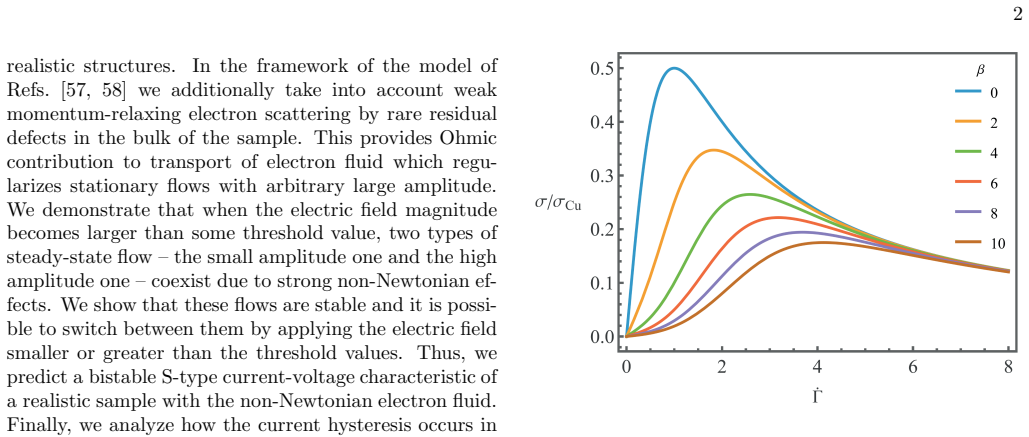
IndisputableMonolith/Cost/FunctionalEquation.leanwashburn_uniqueness_aczel echoesηnl_xx[V] = η0 / [g + (2ω_c τ2)²/g], g = 1 + τ2 τΔ (∂V/∂y)²
Reference graph
Works this paper leans on
-
[1]
Introduction. High-mobility conductors with very low defect densities enable formation of a viscous fluid of conductive electrons which properties are controlled by frequent inter-particle scattering. The corresponding hydrodynamic regime of electric transport was first reli- ably identified in high quality samples of layered metal PdCoO2 [1], in single-laye...
work page internal anchor Pith review Pith/arXiv arXiv 2026
-
[2]
Model of non-Newtonian 2D electron fluid. As a minimal model to study the non-linear behavior of the 2D non-Newtonian electron fluid, we consider the quasi one-dimensional (Poiseuille-like) flows in perpen- dicular magnetic field B in long and relatively narrow samples, with the width W much smaller than the plas- mon wavelength, see Refs. [39, 46, 57, 58]. F...
-
[3]
Approximate discrete model of the fluid flow. Let us introduce the dimensionless variables ˜y = y/W and ˜V = V /V 0, where V0 = eEW 2/ (mη0) is the characteris- tic magnitude of the hydrodynamic velocity in the linear (by E) stationary Poiseuille flow at zero magnetic field. Equation (3) in scaled variables takes the form: ∂ ˜V ∂˜t = 1 + ∂ ∂ ˜y ( ∂ ˜V /∂ ˜y g...
-
[4]
Stationary solutions and their stability. Equation (7) can we written in a general form: ˙v = F ( v ) , F ( v ) = 1 − v ˜τ1 − v 1 + ν′v2 + β 2 1 + ν′v2 , (8) where ˙v = dv/d ˜t, v ≡ ˜V1 and F (v) is the right-hand side of (7) which depends on three dimensionless param- eters ˜τ1 = τ1/τ η , ν′(β ), and β , which are renormalized to exclude the parameters c...
-
[5]
Non-stationary solutions and bistability. Assum- ing that there are no other types of degrees of freedom and instabilities, let us study non-stationary solutions of Eq. (8). Namely, we will be interested in the realization of the bistability regime with the two stable solutions v(1) and v(3) within the transient processes. We solve the Cauchy problem for ...
-
[6]
Conclusion. The flow bistability and the cur- rent hysteresis in the I-V characteristic are predicted in hydrodynamic conductors with the 2D non-Newtonian electron fluid and weak background disorder scattering. Our findings open up the possibility of exploiting this systems as electronic switches and generators of ultra- high-frequency radiation
-
[7]
Acknowledgement. We thank A. A. Greshnov for fruitful discussions. This work was financially supported by the Foundation for the Advancement of Theoretical Physics and Mathe- matics BASIS (Grant No. 23-1-2-25-1). Authors declare no conflict of interests. The data supporting the findings in this manuscript are available from the authors upon reasonable request
-
[8]
P. J. W. Moll, P. Kushwaha, N. Nandi, B. Schmidt, and A. P. Mackenzie, Evidence for hydrodynamic electron flow in PdCoO 2, Science 351, 1061 (2016)
work page 2016
-
[9]
D. A. Bandurin, I. Torre, R. Krishna Kumar, M. Ben Shalom, A. Tomadin, A. Principi, G. H. Auton, E. Khestanova, K. S. NovoseIov, I. V. Grigorieva, L. A. Ponomarenko, A. K. Geim, and M. Polini, Nega- tive local resistance caused by viscous electron backflow in graphene, Science 351, 1055 (2016)
work page 2016
-
[10]
M. Polini and A. Geim, Viscous electron fluids, Physics Today 73, 6, 28 (2020)
work page 2020
-
[11]
L. Levitov and G. Falkovich, Electron viscosity, curren t vortices and negative nonlocal resistance in graphene, Nature Physics 12, 672 (2016)
work page 2016
-
[12]
P. S. Alekseev, Negative magnetoresistance in viscous flow of two-simensional electrons, Phys. Rev. Lett. 117, 166601 (2016)
work page 2016
-
[13]
G. M. Gusev, A. D. Levin, E. V. Levinson, and A. K. Bakarov, Viscous electron flow in meso- scopic two-dimensional electron gas, AIP Advances 8, 025318 (2018)
work page 2018
-
[14]
A. C. Keser, D. Q. Wang, O. Klochan, D. Y. H. Ho, O. A. Tkachenko, V. A. Tkachenko, D. Culcer, S. Adam, I. Farrer D. A. Ritchie, O. P. Sushkov, and A. R. Hamil- ton, Geometric Control of Universal Hydrodynamic Flow in a Two-Dimensional Electron Fluid, Phys. Rev. X 11, 031030 (2021)
work page 2021
-
[15]
X. Wang, P. Jia, R.-R. Du, L. N. Pfeiffer, K. W. Bald- win, and K. W. West, Hydrodynamic charge transport in GaAs/AlGaAs ultrahigh-mobility two-dimensional electron gas, Phys. Rev. B 106, L241302 (2022)
work page 2022
-
[16]
It is noteworthy that the hydrodynamic regime of 2D electron transport was possibly realized even 30 years ago in experiment [M. J. M. de Jong and L. W. Molenkamp, Hydrodynamic electron flow in high-mobility wires Phys. Rev. B 51, 13389 (1995)], where it was detected by a non-linear effect: an unusual dependence of the resistance on the current in the narro...
work page 1995
-
[17]
A. T. Hatke, M. A. Zudov, J. L. Reno, L. N. Pfeiffer, and K. W. West, Giant negative magnetoresistance in high-mobility two-dimensional electron systems, Phys. Rev. B 85, 081304 (2012). 6
work page 2012
-
[18]
R. G. Mani, A. Kriisa, and W. Wegscheider, Size- dependent giant-magnetoresistance in millimeter scale GaAs/AlGaAs 2D electron devices, Scientific Reports 3, 2747 (2013)
work page 2013
-
[19]
L. Bockhorn, P. Barthold, D. Schuh, W. Wegscheider, and R. J. Haug, Magnetoresistance in a high-mobility two-dimensional electron gas, Phys. Rev. B 83, 113301 (2011)
work page 2011
-
[20]
Q. Shi, P. D. Martin, Q. A. Ebner, M. A. Zudov, L. N. Pfeiffer, and K. W. West, Colossal negative magnetoresistance in a two-dimensional electron gas, Phys. Rev. B 89, 201301 (2014)
work page 2014
-
[21]
Similar hydrodynamic mechanism for negative magne- toresistance was proposed for bulk ultra-pure metals with a strong electron-phonon interaction in publication: R. P. Gurzhi and S. I. Shevchenko, Hydrodynamic mech- anism of electric conductivity of metals in a magnetic field, Zh. Eksp. Teor. Fiz. 54, 1613 (1968) [ Sov. Phys. JETP 27, 863 (1968)]
work page 1968
-
[22]
L. Bockhorn, I. V. Gornyi, D. Schuh, C. Reichl, W. Wegscheider, and R. J. Haug, Magnetoresistance in- duced by rare strong scatterers in a high-mobility two-dimensional electron gas, Phys. Rev. B 90, 165434 (2014)
work page 2014
-
[24]
B. Horn-Cosfeld, J. Schluck, J. Lammert, M. Cerchez, T. Heinzel, K. Pierz, H.W. Schumacher, and D. Mailly, Relevance of weak and strong classical scattering for the giant negative magnetoresistance in two-dimensional electron gases, Phys. Rev. B 104, 045306 (2021)
work page 2021
-
[25]
J. Estrada-Alvarez, J. Salvador-Sanchez, A. Perez- Rodriguez, C. Sanchez-Sanchez, V. Clerico, D. Vaquero, K. Watanabe, T. Taniguchi, E. Diez, F. Dominguez- Adame, M. Amado, and E. Diaz, Superballistic Conduction in Hydrodynamic Antidot Graphene Super- lattices, Phys. Rev. X 15, 011039 (2025)
work page 2025
-
[26]
P. S. Alekseev and A. P. Dmitriev, Hydrodynamic mag- netotransport in two-dimensional electron systems with macroscopic obstacles, Phys. Rev. B 108, 205413 (2023)
work page 2023
-
[27]
I. V. Gornyi and D. G. Polyakov, Two-dimensional elec- tron hydrodynamics in a random array of impenetrable obstacles: Magnetoresistivity, hall viscosity, and the landauer dipole, Phys. Rev. B 108, 165429 (2023)
work page 2023
-
[28]
A. N. Afanasiev, P. S. Alekseev, A. A. Greshnov, and M. A. Semina, Ballistic-hydrodynamic phase transition in flow of two-dimensional electrons, Phys. Rev. B 104, 195415 (2021)
work page 2021
- [29]
-
[30]
A. N. Afanasiev, P. S. Alekseev, A. A. Danilenko, A. P. Dmitriev, A. A. Greshnov, and M. A. Semina, Hall effect in Poiseuille flow of two-dimensional electron fluid, Phys. Rev. B 106, 245415 (2022)
work page 2022
-
[31]
J. A. Sulpizio, L. Ella, A. Rozen, J. Birkbeck, D. J. Perello, D. Dutta, M. Ben-Shalom, T. Taniguchi, K. Watanabe, T. Holder, R. Queiroz, A. Principi, A. Stern, T. Scaffidi, A. K. Geim, and S. Ilani, Visualizing Poiseuille flow of hydrodynamic electrons, Nature (Lon- don) 576, 75 (2019)
work page 2019
-
[32]
M. J. H. Ku, T. X. Zhou, Q. Li, Y. J. Shin, J. K. Shi, C. Burch, L. E. Anderson, A. T. Pierce, Y. Xie, A. Hamo, U. Vool, H. Zhang, F. Casola, T. Taniguchi, K. Watanabe, M. M. Fogler, P. Kim, A. Yacoby, and R. L.Walsworth, Imaging viscous flow of the Dirac fluid in graphene, Nature (London) 583, 537 (2020)
work page 2020
- [33]
-
[34]
P. S. Afanasiev, A. N. Alekseev, A. A. Danilenko, A. A. Greshnov, and M. A. Semina, Rotational viscosity in spin resonance of hydrodynamic electrons, Phys. Rev. B 106, L041407 (2022)
work page 2022
-
[35]
K. S. Denisov, K. A. Baryshnikov, and P. S. Alekseev, Spin imaging of poiseuille flow of a viscous electronic fluid, Phys. Rev. B 106, L081113 (2022)
work page 2022
-
[36]
M. M. Glazov, Valley and spin accumulation in ballistic and hydrodynamic channels, 2D Mater. 9, 015027 (2021)
work page 2021
-
[37]
K. S. Denisov, K. A. Baryshnikov, and P. S. Alekseev, Memory effects in the magnetoresistance of twocompo- nent electron systems, JETP Letters, 118, 123 (2023)
work page 2023
-
[38]
P. S. Alekseev, Viscous flow of a two-component electron fluid in a magnetic field, Semiconductors 57, 193 (2023)
work page 2023
-
[39]
A. N. Afanasiev, K. A. Baryshnikov, A. V. Korotchenkov, and P. S. Alekseev, Viscoelastic Resonance in Two- Dimensional Electron Flows with Realistic Boundary Conditions at the Channel Edges, JETP Letters , 122, 609 (2025)
work page 2025
-
[40]
P. S. Alekseev and A. P. Dmitriev, Viscosity of two- dimensional electrons, Phys. Rev. B 102, 241409 (2020)
work page 2020
-
[41]
A. Principi, G. Vignale, M. Carrega, and M. Polini, Bulk and shear viscosities of the 2D electron liquid in a doped graphene sheet, Phys. Rev. B , 93, 125410 (2016)
work page 2016
-
[42]
D. S. Novikov, Viscosity of a two-dimensional fermi liquid, arXiv: cond-mat 0603184 (2006)
work page 2006
-
[43]
A. D. Levin, G. M. Gusev, V. A. Chitta, A. S. Jaroshe- vich, and A. K. Bakarov, Bulk and shear viscosities in a multicomponent two-dimensional electron system, Phys. Rev. B 110, 195402 (2024). 7
work page 2024
-
[44]
F. M. D. Pellegrino, I. Torre, and M. Polini, Nonlocal transport and the Hall viscosity of two-dimensional hydrodynamic electron liquids, Phys. Rev. B 96, 195401 (2017)
work page 2017
-
[45]
P. S. Alekseev, Magnetic resonance in a high-frequency flow of a two-dimensional viscous electron fluid, Phys. Rev. B 98, 165440 (2018)
work page 2018
-
[46]
P. S. Alekseev and A. P. Alekseeva, Transverse magnetosonic waves and viscoelastic resonance in a two-dimensional highly viscous electron fluid, Phys. Rev. Lett. 123, 236801 (2019)
work page 2019
-
[47]
P. S. Alekseev, Magnetosonic Waves in a Two- Dimensional Electron Fermi Liquid, Semiconductors 53, 1367 (2019)
work page 2019
-
[48]
A. N. Afanasiev, P. S. Alekseev, A. A. Greshnov, and M. A. Semina, Shear bernstein modes in a twodimensional electron liquid, Phys. Rev. B 108, 235124 (2023)
work page 2023
-
[49]
J. H. Smet, B. Gorshunov, C. Jiang, L. Pfeiffer, and et al., Circular-polarization-dependent study of the microwave photoconductivity in a two-dimensional electron system, Phys. Rev. Lett. 95, 116804 (2005)
work page 2005
-
[50]
Y. Dai, R. R. Du, L. N. Pfeiffer, and K. W. West, Observation of a cyclotron harmonic spike in microwave- induced resistances in ultraclean gaas/algaas quantum wells, Phys. Rev. Lett. 105, 246802 (2010)
work page 2010
-
[51]
A. T. Hatke, M. A. Zudov, L. N. Pfeiffer, and K. W. West, Giant microwave photoresistivity in highmobility quantum hall systems, Phys. Rev. B. 83, 121301(R) (2011)
work page 2011
-
[52]
D. A. Bandurin, E. Monch, K. Kapralov, and et al., Cyclotron resonance overtones and near-field magne- toabsorption via terahertz bernstein modes in graphene, Nature Physics. 18, 462 (2022)
work page 2022
-
[53]
P. S. Alekseev and A. P. Alekseeva, Highly correlated viscous electron fluid in moderate magnetic field, Phys. Rev. B 111, 235202 (2025)
work page 2025
-
[54]
I. A. Dmitriev, A. D. Mirlin, and D. G. Polyakov, Oscillatory ac conductivity and photoconductivity of a two-dimensional electron gas: Quasiclassical transport beyond the Boltzmann equation, Phys. Rev. B 70, 165305 (2004)
work page 2004
-
[55]
I. A. Dmitriev, A. D. Mirlin, D. G. Polyakov, and M. A. Zudov, Nonequilibrium phenomena in high landau levels, Rev. Mod. Phys. 84, 1709 (2012)
work page 2012
-
[56]
Y. M. Beltukov and M. I. Dyakonov, Microwave-induced resistance oscillations as a classical memory effect, Phys. Rev. Lett. 116, 176801 (2016)
work page 2016
-
[57]
M. G. Vavilov and I. L. Aleiner, Magnetotransport in a two-dimensional electron gas at large filling factors, Phys. Rev. B. 69, 035303 (2004)
work page 2004
-
[58]
Q. Shi, M. A. Zudov, L. N. Pfeiffer, and K. W. West, Nonlinear transport in two-dimensional electron gas exhibiting colossal negative magnetoresistance, Phys. Rev. B 90, 201301 (2014)
work page 2014
-
[59]
Z. T. Wang, M. Hilke, N. Fong, D. G. Austing, S. A Stu- denikin, K. W. West, and L. N. Pfeiffer, Nonlinear transport phenomena and current-induced hydrodynam- ics in ultrahigh mobility two-dimensional electron gas, Phys. Rev. B 107, 195406 (2023)
work page 2023
-
[60]
L. Bockhorn, D. Schuh, C. Reichl, W. Wegscheider, and R. J. Haug, Influence of the electron density on the giant negative magnetoresistance in two-dimensional electron gases, Phys. Rev. B 109, 205416 (2024)
work page 2024
-
[61]
A. D. Levin, G. M. Gusev, and A. K. Bakarov, Viscous electron flow and nonlinear magnetotransport in twodi- mensional channels, Phys. Rev. B , 113 075301 (2026)
work page 2026
-
[62]
Y. Wang, S.-Y. Zheng, L. Lu, K. Chang, C. Zhang, Joule heating and electronic Gurzhi effect in hydro- dynamic differential transport in an electron liquid, arXiv:2603.21346 (2026)
-
[63]
S. Kryhin and L. Levitov, Two-dimensional electron gases as non-Newtonian fluids, Low Temp. Phys. 49, 1402 (2023)
work page 2023
-
[64]
P. S. Alekseev and M. A. Semina, Analytical model for non-linear magnetotransport in viscous electron fluid, Phys. Rev. B 112, L241406 (2025)
work page 2025
-
[65]
P. S. Alekseev and M. A. Semina, Non-Newtonian two-dimensional electron fluid, to be published (2026)
work page 2026
- [66]
-
[67]
We emphasize that hydrodynamic equations (1) omit other inhomogeneous and non-linear effects, such as kinematic term ( V · ∇ )V, thermoelectric effects, heating effect, controlled by the energy balance with phonons and heat transport (see, for reference, works [61–64])
-
[68]
V. A. Volkov and A. A. Zabolotnykh, Bernstein modes and giant microwave response of a two-dimensional electron system, Phys. Rev. B 89, 121410 (2014)
work page 2014
-
[69]
P. S. Alekseev, I. V. Gornyi, A. P. Dmitriev, V. Y. Kachorovskii, and M. A. Semina, Classical magne- toresistance of a two-component system induced by thermoelectric effects, Semiconductors 51, 766 (2017)
work page 2017
-
[70]
V. Karpus, Energy and momentum relaxation of two- dimensional charge carriers due to interaction with deformational acoustic phonons, Semiconductors 20, 12 (1986)
work page 1986
-
[71]
P. S. Alekseev, M. S. Kipa, V. I. Perel, and I. N. Yassievich, Cascade theory of electron capture in quantum wells, J. Exp. Theor. Phys. 106, 806 (2008)
work page 2008
discussion (0)
Sign in with ORCID, Apple, or X to comment. Anyone can read and Pith papers without signing in.