Recognition: no theorem link
Structured input-output analysis of oblique turbulent bands in Waleffe flow
Pith reviewed 2026-05-13 04:06 UTC · model grok-4.3
The pith
Structured input-output analysis identifies the wavelength and inclination angle of oblique turbulent bands in Waleffe flow.
A machine-rendered reading of the paper's core claim, the machinery that carries it, and where it could break.
Core claim
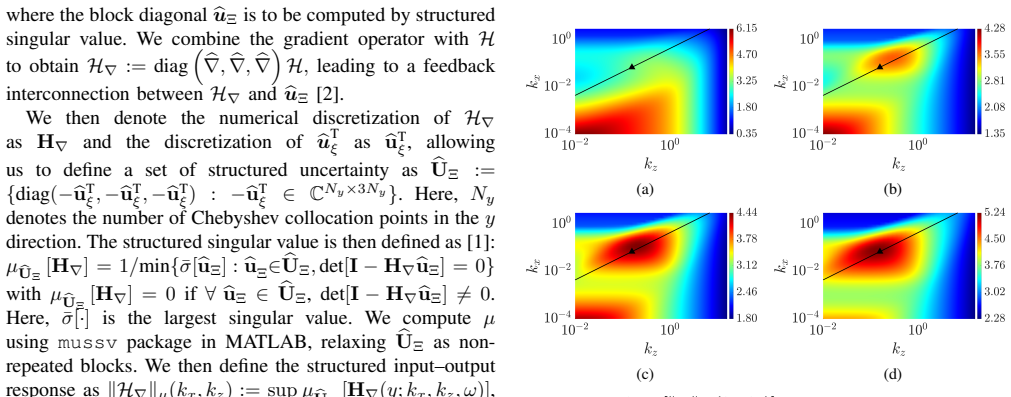
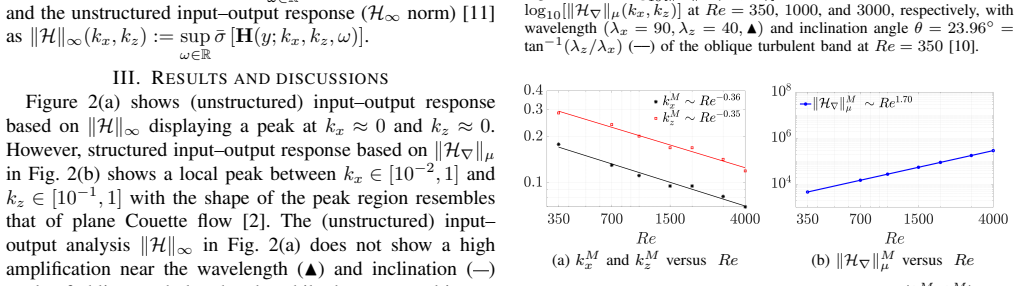
The structured input-output analysis framework employs structured uncertainty to include the componentwise structure of nonlinearity in the Navier-Stokes equations and quantifies the flow response using structured singular values. When applied to Waleffe flow, this framework identifies the wavelength and inclination angle of oblique turbulent bands observed in large-domain direct numerical simulations. The structured input-output response scales over Reynolds number as ∼ Re^{1.7}.
What carries the argument
Structured input-output analysis framework that incorporates structured uncertainty to model the componentwise nonlinearity and measures response via structured singular values.
If this is right
- The identified wavelengths and angles match those appearing in large-domain direct numerical simulations.
- The flow response amplitude grows proportionally to Reynolds number raised to the 1.7 power.
- Oblique bands emerge as the preferred organized structure at the scales captured by the analysis.
- The method supplies a reduced-order route to predicting band geometry without computing the full turbulent field.
Where Pith is reading between the lines
- The same structured approach could be tested on related shear flows to see whether band properties follow analogous scalings.
- If the scaling persists at higher Reynolds numbers, it would imply a consistent mechanism for energy amplification in transitional regimes.
- Matching the predicted bands against controlled laboratory experiments would provide an independent check on the uncertainty model.
Load-bearing premise
The structured uncertainty model accurately incorporates the componentwise structure of nonlinearity from the Navier-Stokes equations for Waleffe flow.
What would settle it
Large-domain simulations or experiments at varying Reynolds numbers in which the observed band wavelength or inclination angle deviates from the values predicted by the structured input-output analysis, or in which the response amplitude fails to follow the Re^{1.7} scaling.
Figures
read the original abstract
This work employs structured input-output analysis (SIOA) to study Waleffe flow. The SIOA framework employs structured uncertainty to include the componentwise structure of nonlinearity in Navier-Stokes equations, and SIOA quantifies the flow response using structured singular values. The structured input-output analysis identifies the wavelength and inclination angle of oblique turbulent bands observed in large-domain direct numerical simulations. The structured input-output response scales over Reynolds number as $\sim Re^{1.7}$.
Editorial analysis
A structured set of objections, weighed in public.
Referee Report
Summary. The manuscript applies structured input-output analysis (SIOA) to Waleffe flow. It employs structured uncertainty blocks to incorporate the componentwise structure of the nonlinearity from the Navier-Stokes equations and uses structured singular values to quantify the flow response. The central claims are that SIOA identifies the wavelength and inclination angle of oblique turbulent bands observed in large-domain DNS and that the structured input-output response scales with Reynolds number as ∼Re^{1.7}.
Significance. If the uncertainty model is shown to be derived directly from the convective nonlinearity and the identification is validated against DNS data with quantitative metrics, the work could provide a reduced-order predictive framework for coherent structures in transitional shear flows. The reported Re^{1.7} scaling, if obtained from the structured singular value analysis rather than post-hoc fitting, would strengthen the case for SIOA as a tool that captures Reynolds-number dependence without full nonlinear simulation.
major comments (2)
- [§3, Eq. (8)–(11)] §3 (SIOA formulation), Eq. (8)–(11): The structured uncertainty blocks Δ are asserted to encode the componentwise structure of the quadratic nonlinearity (u·∇)u projected onto the three velocity components for the Waleffe base flow, but the manuscript does not provide the explicit expansion of the convective term or the resulting block structure. Without this derivation and a verification that the blocks match the exact sparsity pattern of the nonlinearity (rather than a symmetry-based or heuristic partitioning), the location of the peak structured singular value that identifies band wavelength and angle cannot be regarded as a prediction; it risks being an artifact of the chosen uncertainty structure.
- [§4.2, Fig. 5, Table 1] §4.2 (comparison with DNS), Fig. 5 and Table 1: The identification of oblique-band wavelength and inclination angle is presented as a direct outcome of the SIOA peak, yet no quantitative error bars, sensitivity to the uncertainty weights, or cross-validation against multiple Reynolds numbers are reported. The abstract claim of identification therefore rests on visual agreement whose robustness is not quantified.
minor comments (2)
- [Abstract, §4.3] The abstract states the Re^{1.7} scaling without indicating whether the exponent is obtained analytically from the structured singular value or by fitting; this distinction should be clarified in the abstract and §4.3.
- [§2] Notation for the structured singular value μ(·) and the uncertainty set Δ is introduced without a self-contained definition or reference to the precise block-diagonal structure used; a short appendix or inline reminder would improve readability.
Simulated Author's Rebuttal
We thank the referee for the detailed and constructive report. The comments highlight important points for improving the rigor and clarity of the SIOA formulation and its validation. We address each major comment below and indicate the revisions we will make to the manuscript.
read point-by-point responses
-
Referee: [§3, Eq. (8)–(11)] §3 (SIOA formulation), Eq. (8)–(11): The structured uncertainty blocks Δ are asserted to encode the componentwise structure of the quadratic nonlinearity (u·∇)u projected onto the three velocity components for the Waleffe base flow, but the manuscript does not provide the explicit expansion of the convective term or the resulting block structure. Without this derivation and a verification that the blocks match the exact sparsity pattern of the nonlinearity (rather than a symmetry-based or heuristic partitioning), the location of the peak structured singular value that identifies band wavelength and angle cannot be regarded as a prediction; it risks being an artifact of the chosen uncertainty structure.
Authors: We agree that the explicit derivation is necessary to substantiate the claim. In the revised manuscript we will add the componentwise expansion of the convective term (u·∇)u for the Waleffe base flow, showing how the quadratic interactions project onto the three velocity components and produce the precise block-sparse structure employed in the structured uncertainty model. This derivation will confirm that the blocks follow directly from the Navier–Stokes nonlinearity rather than from symmetry arguments alone. revision: yes
-
Referee: [§4.2, Fig. 5, Table 1] §4.2 (comparison with DNS), Fig. 5 and Table 1: The identification of oblique-band wavelength and inclination angle is presented as a direct outcome of the SIOA peak, yet no quantitative error bars, sensitivity to the uncertainty weights, or cross-validation against multiple Reynolds numbers are reported. The abstract claim of identification therefore rests on visual agreement whose robustness is not quantified.
Authors: We acknowledge that quantitative robustness measures would strengthen the validation section. In the revision we will include a sensitivity study of the identified wavelength and inclination angle with respect to the uncertainty weights, together with error bars derived from the width of the structured-singular-value peak. Cross-validation against additional Reynolds numbers will be added by comparing SIOA predictions with existing DNS data at two further Re values; the Re^{1.7} scaling already provides indirect support across the range, but explicit metrics will be reported. revision: partial
Circularity Check
No significant circularity in SIOA derivation chain
full rationale
The paper's central claims rest on applying structured input-output analysis with uncertainty blocks that encode the componentwise convective nonlinearity from the Navier-Stokes equations for Waleffe flow. The resulting structured singular values are used to identify band wavelength and inclination, with response scaling reported as ~Re^{1.7}. No quoted steps show self-definition, fitted parameters renamed as predictions, or load-bearing self-citations that reduce the result to its own inputs by construction. The framework is presented as deriving from the NS equations and validated against independent large-domain DNS observations, making the derivation self-contained.
Axiom & Free-Parameter Ledger
free parameters (1)
- Response scaling exponent =
1.7
axioms (1)
- domain assumption Structured uncertainty captures the componentwise structure of nonlinearity in Navier-Stokes equations
Reference graph
Works this paper leans on
-
[1]
Turbulent--laminar coexistence in wall flows with
Brethouwer, Gert and Duguet, Yohann and Schlatter, Philipp , journal=. Turbulent--laminar coexistence in wall flows with. 2012 , publisher=
work page 2012
-
[2]
Experimental measurements in plane
Klotz, Lukasz and Pavlenko, AM and Wesfreid, JE , journal=. Experimental measurements in plane. 2021 , publisher=
work page 2021
-
[3]
A new method for isolating turbulent states in transitional stratified plane
Taylor, J R and Deusebio, Enrico and Caulfield, C P and Kerswell, Richard R , journal=. A new method for isolating turbulent states in transitional stratified plane. 2016 , publisher=
work page 2016
-
[4]
Patterns in wall-bounded shear flows , author=. Annu. Rev. Fluid Mech. , volume=. 2020 , publisher=
work page 2020
-
[5]
A structured input-output approach to characterizing optimal perturbations in wall-bounded shear flows , author=. 2023 ACC , pages=
work page 2023
-
[6]
Structured input--output analysis of transitional wall-bounded flows , author=. J. Fluid Mech. , volume=. 2021 , publisher=
work page 2021
-
[7]
Structured input--output analysis of oblique laminar--turbulent patterns in plane
Shuai, Yu and Liu, Chang and Gayme, Dennice F , journal=. Structured input--output analysis of oblique laminar--turbulent patterns in plane. 2023 , publisher=
work page 2023
-
[8]
Feedback interconnection based input-output analysis of spatio-temporal response in wall-bounded shear flows , author=. 2021 , school=
work page 2021
-
[9]
Turbulent--laminar patterns in shear flows without walls , author=. J. Fluid Mech. , volume=. 2016 , publisher=
work page 2016
-
[10]
On a self-sustaining process in shear flows , author=. Phys. Fluids , volume=. 1997 , publisher=
work page 1997
-
[11]
Long-wavelength modulation of turbulent shear flows , author=. Physica D , volume=. 2003 , publisher=
work page 2003
-
[12]
Formation of turbulent patterns near the onset of transition in plane
Duguet, Yohann and Schlatter, Philipp and Henningson, Dan S , journal=. Formation of turbulent patterns near the onset of transition in plane. 2010 , publisher=
work page 2010
-
[13]
Physical Review E—Statistical, Nonlinear, and Soft Matter Physics , volume=
Towards minimal perturbations in transitional plane Couette flow , author=. Physical Review E—Statistical, Nonlinear, and Soft Matter Physics , volume=. 2010 , publisher=
work page 2010
-
[14]
Physical review letters , volume=
Nonequilibrium thermodynamics and the optimal path to turbulence in shear flows , author=. Physical review letters , volume=. 2011 , publisher=
work page 2011
-
[15]
Triggering turbulence efficiently in plane Couette flow , author=. J. Fluid Mech. , volume=. 2012 , publisher=
work page 2012
-
[16]
Physical review letters , volume=
Oblique laminar-turbulent interfaces in plane shear flows , author=. Physical review letters , volume=. 2013 , publisher=
work page 2013
-
[17]
Accurate solution of the Orr--Sommerfeld stability equation , author=. J. Fluid Mech. , volume=. 1971 , publisher=
work page 1971
-
[18]
Structured input--output analysis of stably stratified plane
Liu, Chang and Caulfield, C P and Gayme, Dennice F , journal=. Structured input--output analysis of stably stratified plane. 2022 , publisher=
work page 2022
-
[19]
From bypass transition to flow control and data-driven turbulence modeling: an input--output viewpoint , author=. Annu. Rev. Fluid Mech. , volume=. 2021 , publisher=
work page 2021
-
[20]
A critical-layer framework for turbulent pipe flow , author=. J. Fluid Mech. , volume=. 2010 , publisher=
work page 2010
-
[21]
The engine behind (wall) turbulence: perspectives on scale interactions , author=. J. Fluid Mech. , volume=. 2017 , publisher=
work page 2017
-
[22]
The complex structured singular value , author=. Automatica , volume=. 1993 , publisher=
work page 1993
-
[23]
Componentwise energy amplification in channel flows , author=. J. Fluid Mech. , volume=. 2005 , publisher=
work page 2005
-
[24]
Resolvent analysis for turbulent channel flow with riblets , author=. AIAA Journal , volume=. 2020 , publisher=
work page 2020
-
[25]
Biglobal resolvent analysis of separated flow over a NACA0012 airfoil , author=. J. Fluid Mech. , volume=. 2025 , publisher=
work page 2025
-
[26]
Energy growth in viscous channel flows , author=. J. Fluid Mech. , volume=. 1993 , publisher=
work page 1993
-
[27]
Turbulent bands in plane-Poiseuille flow at moderate Reynolds numbers , author=. Physics of Fluids , volume=. 2015 , publisher=
work page 2015
-
[28]
Trigger turbulent bands directly at low
Song, Baofang and Xiao, Xiangkai , journal=. Trigger turbulent bands directly at low. 2020 , publisher=
work page 2020
-
[29]
arXiv preprint arXiv:1406.1378 , year=
An experimental study on turbulent-stripe structure in transitional channel flow , author=. arXiv preprint arXiv:1406.1378 , year=
-
[30]
Oblique stripe solutions of channel flow , author=. J. Fluid Mech. , volume=. 2020 , publisher=
work page 2020
-
[31]
Input-output inspired method for permissible perturbation amplitude of transitional wall-bounded shear flows , author=. Physical Review E , volume=. 2020 , publisher=
work page 2020
discussion (0)
Sign in with ORCID, Apple, or X to comment. Anyone can read and Pith papers without signing in.