Recognition: no theorem link
Proximate damped Lyman-α systems as tracers of quasar feedback
Pith reviewed 2026-05-13 04:21 UTC · model grok-4.3
The pith
Proximate damped Lyman-alpha absorbers show cold gas cycling through inflows and outflows around quasars.
A machine-rendered reading of the paper's core claim, the machinery that carries it, and where it could break.
Core claim
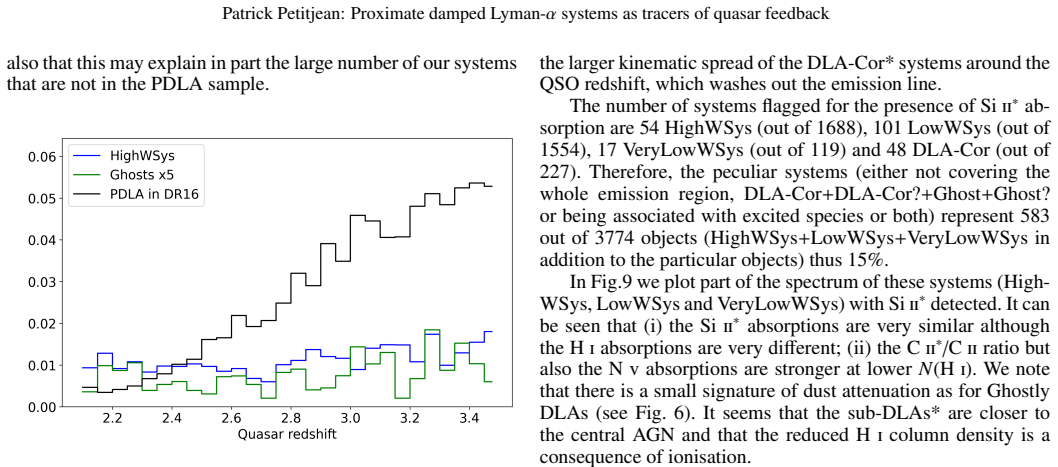
Proximate absorption systems at the quasar redshift include Ghostly and coronagraphic classes that display strong excited species absorption and partial covering. Their kinematics show multiple components, with standard DLAs clustered within 1000 km/s of systemic velocity while Ghostly and SiII*-bearing systems extend to broad outflows reaching -2000 km/s and inflows up to +1200 km/s. Median stacked spectra confirm that the Ghostly and coronagraphic systems arise in dense compact gas. These observations indicate that cold dense clouds participate in a dynamic cycle of inflow and outflow in the vicinity of quasars.
What carries the argument
Classification of proximate absorption systems (ProxSys) into Ghostly, DLA-Cor, standard DLA, and sub-DLA types based on Lyman-alpha absorption strength, partial covering signatures, and presence of excited transitions such as SiII*, together with their velocity offsets from the quasar systemic redshift.
Load-bearing premise
The identified absorption systems are physically associated with the quasar and its feedback processes rather than being unrelated intervening absorbers.
What would settle it
High-resolution spectra showing that Ghostly and SiII*-bearing systems lack the partial covering signatures and excited absorption strengths reported here, or that their velocity distributions contain no net population of outflows beyond 1000 km/s.
Figures





read the original abstract
Active galactic nuclei (AGN) profoundly affect the interstellar medium of their host galaxies through intense radiation fields and powerful winds. Characterising this feedback is essential for understanding galaxy formation and evolution. Here we revisit the origin of proximate damped Lyman-$\alpha$ absorbers (PDLAs), which trace cold gas within 3000 km/s of the quasar redshift, and interpret their kinematics and physical properties within a unified framework. We searched the SDSS DR16 database for low-ionisation metal absorption-line systems at the quasar redshift (referred to as ProxSys). This approach enables us to identify and classify different types of proximate absorbers, including so-called Ghostly systems, coronagraphic DLAs (DLA-Cor), standard DLAs, and sub-DLAs, based on the presence of strong Lyman-alpha absorption, partial covering signatures, or excited atomic transitions such as SiII*. We find that about 13% of ProxSys belong to the Ghostly or DLA-Cor classes and exhibit strong absorption from excited species. The different classes of ProxSys form a continuous sequence characterised by decreasing SiII*, CIV, and NV absorption strengths and dust content. Their velocity distributions reveal multiple kinematic components. Standard DLAs cluster within 1000km/s of the quasar systemic redshift, consistent with gas in the host galaxy, whereas Ghostly and SiII* bearing systems display broader distributions, including outflows reaching -2000 km/s and a smaller population of inflowing clouds up to +1200 km/s. Median stacked spectra confirm that Ghostly and coronagraphic systems arise in dense, compact gas partially covering the quasar emission regions. These results support a scenario in which cold, dense clouds participate in a dynamic cycle of inflow and outflow in the vicinity of quasars, consistent with chaotic cold accretion.
Editorial analysis
A structured set of objections, weighed in public.
Referee Report
Summary. The manuscript analyzes proximate damped Lyman-alpha systems (PDLAs, termed ProxSys) identified within 3000 km/s of quasar redshifts in SDSS DR16 spectra. It classifies them into Ghostly systems, coronagraphic DLAs (DLA-Cor), standard DLAs, and sub-DLAs using criteria based on strong Lyman-alpha absorption, partial covering signatures, and excited transitions such as SiII*. Approximately 13% are reported in the Ghostly or DLA-Cor classes exhibiting strong excited-species absorption. The classes are described as forming a continuous sequence with decreasing SiII*, CIV, NV absorption and dust content. Velocity distributions show standard DLAs clustered within 1000 km/s (consistent with host-galaxy gas), while Ghostly and SiII*-bearing systems extend to outflows of -2000 km/s and inflows of +1200 km/s. Median stacked spectra are presented to confirm that Ghostly and coronagraphic systems arise in dense, compact gas with partial covering of the quasar continuum. These observations are interpreted as evidence that cold, dense clouds participate in a dynamic inflow/outflow cycle near quasars, consistent with chaotic cold accretion.
Significance. If the physical association with quasars holds, the work supplies a useful observational classification scheme and kinematic evidence linking cold gas absorbers to quasar feedback, potentially informing simulations of AGN-driven galaxy evolution and chaotic cold accretion models. Credit is due for leveraging public SDSS DR16 data to examine a large sample and for employing stacked spectra to demonstrate partial-covering signatures in the Ghostly and DLA-Cor classes.
major comments (2)
- [Abstract] Abstract: The central claim that ProxSys trace quasar feedback and participate in inflow/outflow cycles rests on the assumption of physical association rather than chance projection. No comparison is provided between the observed incidence of these systems and the expected rate of intervening DLAs within the 3000 km/s window (using the known dN/dz or a control sample of non-proximate sightlines), leaving the kinematic interpretations and the continuous sequence in absorption properties vulnerable to selection biases or redshift uncertainties.
- [Abstract] Abstract: The reported 13% fraction for Ghostly or DLA-Cor classes, the velocity distributions, and the stacked-spectra results are presented without details on the total sample size, precise selection criteria for the velocity cut, statistical uncertainties, or validation of the post-hoc classifications against false positives. These omissions make it difficult to assess whether the reported trends are robust or could arise from unrelated intervening absorbers.
minor comments (1)
- [Abstract] The abstract introduces the term 'ProxSys' without an immediate definition, which could be clarified on first use for readability.
Simulated Author's Rebuttal
We thank the referee for their careful and constructive review of our manuscript. We address the two major comments point by point below. While we maintain that the combination of excited-state absorption, partial covering, and kinematic clustering provides strong evidence for physical association, we agree that additional quantitative comparisons and clarifications will improve the robustness of the presentation. We will revise the manuscript accordingly.
read point-by-point responses
-
Referee: [Abstract] Abstract: The central claim that ProxSys trace quasar feedback and participate in inflow/outflow cycles rests on the assumption of physical association rather than chance projection. No comparison is provided between the observed incidence of these systems and the expected rate of intervening DLAs within the 3000 km/s window (using the known dN/dz or a control sample of non-proximate sightlines), leaving the kinematic interpretations and the continuous sequence in absorption properties vulnerable to selection biases or redshift uncertainties.
Authors: We acknowledge that an explicit calculation of the expected incidence of intervening DLAs within the 3000 km/s velocity window would provide a useful quantitative check on the physical association. The manuscript already emphasizes that the detection of Si II* and other excited transitions, together with partial-covering signatures in the stacked spectra, are highly improbable for unrelated intervening systems. Nevertheless, we agree that adding a comparison using the known dN/dz for DLAs (or a control sample of non-proximate sightlines) will strengthen the argument and reduce concerns about projection effects or redshift uncertainties. This calculation will be included in the revised manuscript. revision: yes
-
Referee: [Abstract] Abstract: The reported 13% fraction for Ghostly or DLA-Cor classes, the velocity distributions, and the stacked-spectra results are presented without details on the total sample size, precise selection criteria for the velocity cut, statistical uncertainties, or validation of the post-hoc classifications against false positives. These omissions make it difficult to assess whether the reported trends are robust or could arise from unrelated intervening absorbers.
Authors: The full manuscript (Section 2) specifies the parent sample of SDSS DR16 quasars, the precise velocity cut of 3000 km/s, and the criteria used to classify systems into Ghostly, DLA-Cor, standard DLA, and sub-DLA categories. The 13% fraction refers to the subset exhibiting strong Si II* absorption. However, we agree that the abstract is too terse on these points and that an explicit discussion of statistical uncertainties and possible false-positive rates would improve transparency. We will expand the abstract to report the total sample size and add a short paragraph in the methods or results section addressing the robustness of the classifications. revision: yes
Circularity Check
No significant circularity; observational classifications and interpretations are data-driven without self-referential reduction
full rationale
The paper defines ProxSys explicitly as low-ionisation systems within 3000 km/s of the quasar redshift in SDSS DR16, then classifies subtypes (Ghostly, DLA-Cor, standard DLAs) using independent spectral criteria such as Lyman-alpha strength, partial covering, and SiII* excitation. Velocity distributions, stacked spectra, and the continuous sequence in absorption strengths are reported directly from the data. No equations, parameter fits, or predictions are described that reduce to the input definitions by construction. The unified framework interpretation follows from the observed kinematics and properties rather than any self-citation chain or ansatz smuggling. This is a standard observational analysis with no load-bearing circular steps.
Axiom & Free-Parameter Ledger
axioms (1)
- domain assumption Absorption lines in quasar spectra can be reliably identified and their velocities measured to infer gas kinematics and physical conditions.
Reference graph
Works this paper leans on
-
[1]
Ahumada, R., Allende Prieto, C., Almeida, A., et al. 2020, ApJS, 249, 3
work page 2020
- [2]
-
[3]
Arav, N., Xu, X., Miller, T., Kriss, G. A., & Plesha, R. 2020, ApJS, 247, 37
work page 2020
-
[4]
Aromal, P., Srianand, R., & Petitjean, P. 2024, MNRAS, 527, 12298
work page 2024
-
[5]
A., Ledoux, C., Noterdaeme, P., et al
Balashev, S. A., Ledoux, C., Noterdaeme, P., et al. 2023, MNRAS, 524, 5016
work page 2023
-
[6]
A., Ledoux, C., Noterdaeme, P., et al
Balashev, S. A., Ledoux, C., Noterdaeme, P., et al. 2020, MNRAS, 497, 1946
work page 2020
- [7]
-
[8]
Bluck, A. F. L., Piotrowska, J. M., & Maiolino, R. 2023, ApJ, 944, 108
work page 2023
-
[9]
Borguet, B. C. J., Arav, N., Edmonds, D., Chamberlain, C., & Benn, C. 2013, ApJ, 762, 49
work page 2013
- [10]
-
[11]
Cattaneo, A., Faber, S. M., Binney, J., et al. 2009, Nature, 460, 213
work page 2009
-
[12]
Chabanier, S., Etourneau, T., Le Goff, J.-M., et al. 2022, ApJS, 258, 18
work page 2022
- [13]
- [14]
-
[15]
L., Belli, S., Park, M., et al
Davies, R. L., Belli, S., Park, M., et al. 2024, MNRAS, 528, 4976
work page 2024
-
[16]
Dawson, K. S., Kneib, J.-P., Percival, W. J., et al. 2016, AJ, 151, 44
work page 2016
-
[17]
Dubois, Y ., Gavazzi, R., Peirani, S., & Silk, J. 2013, MNRAS, 433, 3297
work page 2013
-
[18]
Dubois, Y ., Peirani, S., Pichon, C., et al. 2016, MNRAS, 463, 3948
work page 2016
-
[19]
Ellison, S. L., Prochaska, J. X., Hennawi, J., et al. 2010, MNRAS, 406, 1435
work page 2010
-
[20]
Ellison, S. L., Prochaska, J. X., & Mendel, J. T. 2011, MNRAS, 412, 448
work page 2011
- [21]
-
[22]
Fabian, A. C., Vasudevan, R. V ., Mushotzky, R. F., Winter, L. M., & Reynolds, C. S. 2009, MNRAS, 394, L89
work page 2009
- [23]
-
[24]
2017, MNRAS, 466, L58 Faucher-Giguère, C.-A
Fathivavsari, H., Petitjean, P., Zou, S., et al. 2017, MNRAS, 466, L58 Faucher-Giguère, C.-A. & Quataert, E. 2012, MNRAS, 425, 605 Filiz Ak, N., Brandt, W. N., Hall, P. B., et al. 2012, ApJ, 757, 114
work page 2017
-
[25]
2013, A&A, 558, A111 Förster Schreiber, N
Finley, H., Petitjean, P., Pâris, I., et al. 2013, A&A, 558, A111 Förster Schreiber, N. M., Übler, H., Davies, R. L., et al. 2019, ApJ, 875, 21
work page 2013
- [26]
- [27]
-
[28]
Gibson, R. R., Jiang, L., Brandt, W. N., et al. 2009, ApJ, 692, 758
work page 2009
-
[29]
Gofford, J., Reeves, J. N., McLaughlin, D. E., et al. 2015, MNRAS, 451, 4169 Guimarães, R., Petitjean, P., Rollinde, E., et al. 2007, MNRAS, 377, 657
work page 2015
- [30]
-
[31]
Han, S., Krogager, J.-K., Ledoux, C., et al. 2026, A&A, 705, A123
work page 2026
-
[32]
Hennawi, J. F. & Prochaska, J. X. 2007, ApJ, 655, 735
work page 2007
-
[33]
Hennawi, J. F., Prochaska, J. X., Kollmeier, J., & Zheng, Z. 2009, ApJ, 693, L49
work page 2009
- [34]
-
[35]
C., Chakravorty, S., & Kembhavi, A
Laha, S., Guainazzi, M., Dewangan, G. C., Chakravorty, S., & Kembhavi, A. K. 2014, MNRAS, 441, 2613
work page 2014
-
[36]
Laha, S., Reynolds, C. S., Reeves, J., et al. 2021, Nature Astronomy, 5, 13
work page 2021
- [37]
-
[38]
Laor, A. & Brandt, W. N. 2002, ApJ, 569, 641 Laužikas, M. & Zubovas, K. 2024, A&A, 690, A396
work page 2002
-
[39]
Leung, G. C. K., Coil, A. L., Aird, J., et al. 2019, ApJ, 886, 11
work page 2019
- [40]
-
[41]
2025, Nature Astronomy, 9, 907
Marconcini, C., Marconi, A., Cresci, G., et al. 2025, Nature Astronomy, 9, 907
work page 2025
-
[42]
Morganti, R., Oosterloo, T., Schulz, R., Tadhunter, C., & Raymond Oonk, J. B. 2020, in IAU Symposium, V ol. 342, Perseus in Sicily: From Black Hole to Cluster Outskirts, ed. K. Asada, E. de Gouveia Dal Pino, M. Giroletti, H. Na- gai, & R. Nemmen, 85–89
work page 2020
- [43]
-
[44]
Noterdaeme, P., Balashev, S., Cuellar, R., et al. 2023, A&A, 673, A89
work page 2023
-
[45]
Noterdaeme, P., Balashev, S., Krogager, J.-K., et al. 2019, A&A, 627, A32
work page 2019
- [46]
-
[47]
2018, ApJ, 863, 198 Pâris, I., Petitjean, P., Aubourg, É., et al
Pan, X., Zhang, S., Zhou, H., et al. 2018, ApJ, 863, 198 Pâris, I., Petitjean, P., Aubourg, É., et al. 2018, A&A, 613, A51
work page 2018
- [48]
-
[49]
Piotrowska, J. M., Bluck, A. F. L., Maiolino, R., & Peng, Y . 2022, MNRAS, 512, 1052
work page 2022
-
[50]
Prochaska, J. X. 2006, ApJ, 650, 272
work page 2006
-
[51]
Prochaska, J. X., Chen, H.-W., & Bloom, J. S. 2006, ApJ, 648, 95
work page 2006
-
[52]
Prochaska, J. X. & Hennawi, J. F. 2009, ApJ, 690, 1558
work page 2009
-
[53]
Prochaska, J. X., Hennawi, J. F., & Herbert-Fort, S. 2008, ApJ, 675, 1002
work page 2008
-
[54]
Rix, S. A., Pettini, M., Steidel, C. C., et al. 2007, ApJ, 670, 15
work page 2007
- [55]
-
[56]
Rupke, D. S. N., Thomas, A. D., & Dopita, M. A. 2021, MNRAS, 503, 4748
work page 2021
-
[57]
Schawinski, K., Koss, M., Berney, S., & Sartori, L. F. 2015, MNRAS, 451, 2517
work page 2015
- [58]
-
[59]
Silva, A. I. & Viegas, S. M. 2002, MNRAS, 329, 135
work page 2002
-
[60]
Springel, V ., Di Matteo, T., & Hernquist, L. 2005, MNRAS, 361, 776
work page 2005
- [61]
-
[62]
Temple, M. J., Rankine, A. L., Banerji, M., et al. 2024, MNRAS, 532, 424
work page 2024
- [63]
- [64]
- [65]
-
[66]
M., Ledoux, C., Smette, A., et al
Vreeswijk, P. M., Ledoux, C., Smette, A., et al. 2007, A&A, 468, 83
work page 2007
- [67]
- [68]
- [69]
- [70]
- [71]
- [72]
-
[73]
L., Hamann, F., Pâris, I., et al
Zakamska, N. L., Hamann, F., Pâris, I., et al. 2016, MNRAS, 459, 3144 Article number, page 12
work page 2016
discussion (0)
Sign in with ORCID, Apple, or X to comment. Anyone can read and Pith papers without signing in.