Recognition: 2 theorem links
· Lean TheoremEfficient Learning of Affine and Rational Dependency LPV Models With Linear Fractional Representation
Pith reviewed 2026-05-13 04:41 UTC · model grok-4.3
The pith
A direct parameterization ensures well-posed rational LPV-LFR models can be learned from input-output data of nonlinear systems.
A machine-rendered reading of the paper's core claim, the machinery that carries it, and where it could break.
Core claim
The paper establishes that a direct parameterization of rational LPV models with linear fractional representation guarantees well-posedness, permitting simultaneous estimation of the LPV plant and the scheduling map from input-output data alone and thereby enabling accurate representation of complex nonlinear systems.
What carries the argument
Direct parameterization of rational-dependency LPV-LFR models that enforces well-posedness without restricting modeling capability.
If this is right
- Rational LPV-LFR models represent complex nonlinear dynamics using fewer scheduling variables than affine LPV models.
- Well-posed models are obtained directly from input-output data without extra constraints or post-processing.
- Joint plant and scheduling-map estimation converges to accurate representations on simulation benchmarks.
- The resulting models remain suitable for subsequent control synthesis because they stay within the LPV framework.
Where Pith is reading between the lines
- Embedding the estimated scheduling map inside a controller could reduce the dimension of the resulting LPV control problem.
- The same parameterization might be adapted for recursive online updates if the batch estimation proves computationally light.
- Comparison on benchmark nonlinear plants could reveal whether the rational form yields lower prediction error than neural or polynomial alternatives at equal scheduling dimension.
Load-bearing premise
The parameterization keeps every possible rational scheduling dependence expressible while automatically guaranteeing that the resulting model remains well-posed.
What would settle it
Running the identification on a nonlinear system whose true dynamics cannot be reproduced by any well-posed rational LPV-LFR model of the chosen order and observing that the estimated model either diverges or fails to match validation data would falsify the claim.
Figures

read the original abstract
Identifying control-friendly models of nonlinear systems remains one of the major challenges at the intersection of system identification and control. The Linear Parameter-Varying (LPV) framework offers a promising solution, but existing identification methods often rely on model structures with affine scheduling dependency. Instead, this work proposes the use of LPV models with Linear Fractional Representation (LFR) admitting a rational scheduling-dependency, capable of modelling complex nonlinear systems with fewer scheduling variables compared to affine models. This work introduces a direct parameterization to ensure well-posedness of rational LPV-LFR models, which by joint-estimation of an LPV plant and scheduling map, using only input-output data, is capable of modelling complex nonlinear systems. Accuracy of the proposed approach is shown on two simulation examples.
Editorial analysis
A structured set of objections, weighed in public.
Referee Report
Summary. The paper introduces a direct parameterization of rational LPV models in LFR form that enforces well-posedness by construction. It further proposes a joint estimation algorithm that identifies both the LPV plant and the scheduling map from input-output data alone, claiming this enables compact modeling of complex nonlinear systems with fewer scheduling variables than affine LPV models. The method is illustrated on two simulation examples.
Significance. If the parameterization is shown to be complete (i.e., to represent every well-posed rational LFR without loss of modeling power) and the estimator is demonstrated to converge reliably, the contribution would be significant for control-oriented identification of nonlinear dynamics, as rational dependencies can capture richer behavior with lower-dimensional scheduling signals.
major comments (2)
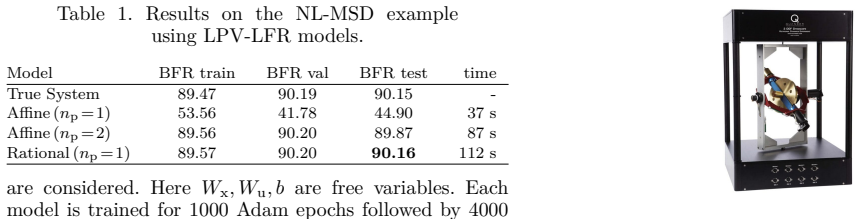
- [Abstract / Simulation results] The abstract states that accuracy is shown on two simulation examples, yet no quantitative metrics, baseline comparisons, error bars, or cross-validation details are supplied. This absence leaves the central performance claim without concrete evidential support and is load-bearing for assessing practical utility.
- [Parameterization development] The direct parameterization is asserted to represent every well-posed rational-dependency LPV-LFR while guaranteeing well-posedness. No explicit proof or counter-example check is provided that the chosen structure (e.g., any normalization or block restrictions) does not exclude input-output maps that cannot be rewritten in the new coordinates without altering the map; this is load-bearing for the claim that full modeling power is preserved.
minor comments (1)
- [Preliminaries] Notation for the LFR blocks (M11, M12, etc.) and the scheduling map should be introduced with a single diagram or table for clarity.
Simulated Author's Rebuttal
We thank the referee for the detailed and constructive report. We address each major comment below and will incorporate revisions to strengthen the evidential support and theoretical completeness of the manuscript.
read point-by-point responses
-
Referee: [Abstract / Simulation results] The abstract states that accuracy is shown on two simulation examples, yet no quantitative metrics, baseline comparisons, error bars, or cross-validation details are supplied. This absence leaves the central performance claim without concrete evidential support and is load-bearing for assessing practical utility.
Authors: We agree that the simulation results require more quantitative detail to substantiate the performance claims. In the revised manuscript we will augment both the abstract and the simulation section with explicit RMSE (and other error) metrics for each example, direct numerical comparisons against affine LPV baselines, error bars obtained from repeated Monte-Carlo runs, and a clear description of the cross-validation protocol employed. These additions will make the practical utility of the approach concrete. revision: yes
-
Referee: [Parameterization development] The direct parameterization is asserted to represent every well-posed rational-dependency LPV-LFR while guaranteeing well-posedness. No explicit proof or counter-example check is provided that the chosen structure (e.g., any normalization or block restrictions) does not exclude input-output maps that cannot be rewritten in the new coordinates without altering the map; this is load-bearing for the claim that full modeling power is preserved.
Authors: The parameterization is obtained by a specific normalization of the LFR blocks that removes the algebraic degrees of freedom associated with well-posedness while preserving the input-output map. We acknowledge that the original submission did not contain an explicit completeness argument. In the revision we will insert a dedicated subsection that proves any well-posed rational LPV-LFR can be rewritten in the proposed coordinates without changing the realized dynamics, together with a verification on standard benchmark systems to confirm that no modeling power is lost. revision: yes
Circularity Check
No significant circularity; parameterization and estimation are presented as independent contributions
full rationale
The paper's core contribution is a direct parameterization ensuring well-posedness for rational LPV-LFR models, followed by joint estimation of the plant and scheduling map from input-output data alone. No equations or claims in the provided abstract or description reduce a prediction or uniqueness result to a fitted quantity defined by the same procedure. No self-citation chains are invoked to justify load-bearing steps, and the method is not shown to be equivalent to its inputs by construction. The derivation chain remains self-contained against external benchmarks such as simulation examples, with the parameterization introduced as a structural choice rather than a renaming or self-referential fit.
Axiom & Free-Parameter Ledger
Lean theorems connected to this paper
-
IndisputableMonolith/Cost/FunctionalEquation.leanwashburn_uniqueness_aczel unclearWe propose a novel method for guaranteeing well-posedness of LPV-LFR models... Dzw = e^{-N}, N ≻ 0... N = Ψ(D_A^T D_A + D_B - D_B^T + εI)
-
IndisputableMonolith/Foundation/RealityFromDistinction.leanreality_from_one_distinction unclearIf Assumptions 2, 3, and Condition 5 hold, the LPV-LFR model (2) is well-posed... ρ(Dzw) < 1
Reference graph
Works this paper leans on
-
[1]
Bemporad, A. (2025). An L-BFGS-B approach for linear and nonlinear system identification under ℓ1 and group- lasso regularization. IEEE Transactions on Automatic Control
work page 2025
-
[2]
Bemporad, A. and Tóth, R. (2025). Efficient identification of linear, parameter-varying, and nonlinear systems with noise models. arXiv preprint arXiv:2504.11982
-
[3]
Bianchi, F.D. and Sánchez-Peña, R.S. (2010). Robust identification/invalidation in an LPV framework. In- ternational Journal of Robust and Nonlinear Control , 20(3), 301–312
work page 2010
-
[4]
Paszke, A., VanderPlas, J., Wanderman-Milne, S., and Zhang, Q. (2018). JAX: composable transformations of python+numpy programs. https://github.com/google/jax
work page 2018
-
[5]
Cheng, Y. and Sznaier, M. (2015). Identification of LPV systems with LFT parametric dependence via convex optimization. In Proc. of the 54th IEEE Conference on Decision and Control , 1459–1464. Osaka, Japan
work page 2015
-
[6]
Cox, P.B. and Tóth, R. (2021). Linear parameter-varying subspace identification: A unified framework. Automat- ica, 123, 109296. den Boef, P., Cox, P.B., and Tóth, R. (2021). LPVcore: MATLAB toolbox for LPV modelling, identification and control. In Proc. of the 19th IF AC Symposium on System Identification, 385–390
work page 2021
-
[7]
Glorot, X. and Bengio, Y. (2010). Understanding the dif- ficulty of training deep feedforward neural networks. In Proc. of the 13th International Conference on Artificial Intelligence and Statistics , 249–256. JMLR Workshop and Conference Proceedings, Sardinia, Italy
work page 2010
-
[8]
He, K., Zhang, X., Ren, S., and Sun, J. (2016). Deep Residual Learning for Image Recognition. In Proc. of the IEEE Conference on Computer Vision and Pattern Recognition, 770–778. Las Vegas, USA
work page 2016
-
[9]
Hjartarson, A., Seiler, P., and Packard, A. (2015). LPV- Tools: A Toolbox for Modeling, Analysis, and Synthesis of Parameter Varying Control Systems. In Proc. of the 1st IF AC Workshop on Linear Parameter Varying Systems, 139–145. Grenoble, France
work page 2015
-
[10]
Hoffmann, C. and Werner, H. (2014). Complexity of Implementation and Synthesis in Linear Parameter- Varying Control. In Proc. 19th IF AC World Congr.Cape
work page 2014
-
[11]
Lee, L.H. and Poolla, K. (1999). Identification of Linear Parameter-Varying Systems Using Nonlinear Program- ming. Journal of Dynamic Systems, Measurement, and Control, 121(1), 71–78
work page 1999
-
[12]
Liu, D.C. and Nocedal, J. (1989). On the limited memory BFGS method for large scale optimization. Mathemati- cal Programming, 45(1-3), 503–528
work page 1989
-
[13]
Mejari, M., Piga, D., Toth, R., and Bemporad, A. (2019). Kernelized Identification of Linear Parameter-Varying Models with Linear Fractional Representation. In Proc. of the 18th European Control Conference , 337–342
work page 2019
-
[14]
Mohammadpour, J. and Scherer, C.W. (eds.) (2012). Con- trol of Linear Parameter Varying Systems with Applica- tions. Springer US, Boston, MA
work page 2012
-
[15]
Nemani, M., Ravikanth, R., and Bamieh, B. (1995). Iden- tification of linear parametrically varying systems. In Proc. of the 34th IEEE Conference on Decision and Control, 2990–2995. New Orleans, LA, USA
work page 1995
- [16]
-
[17]
Scherer, C.W. (2001). LPV control and full block multi- pliers. Automatica, 37, 361–375
work page 2001
-
[18]
Scherer, C. and Weiland, S. (2015). Linear matrix inequal- ities in control. Lecture Notes. Tóth, R. (2010). Modeling and Identification of Lin- ear Parameter-Varying Systems , volume 403 of Lecture Notes in Control and Information Sciences . Springer,
work page 2015
-
[19]
Berlin, Heidelberg. Van Wingerden, J.W. and Verhaegen, M. (2009). Subspace identification of Bilinear and LPV systems for open- and closed-loop data. Automatica, 45(2), 372–381
work page 2009
-
[20]
Verhoek, C., Beintema, G.I., Haesaert, S., Schoukens, M., and Toth, R. (2022). Deep-Learning-Based Identifica- tion of LPV Models for Nonlinear Systems. In Proc. of the 61st IEEE Conference on Decision and Control , 3274–3280. Cancun, Mexico
work page 2022
-
[21]
Verhoek, C., Wang, R., and Tóth, R. (2023). Learning Stable and Robust Linear Parameter-Varying State- Space Models. In Proc. of the 62nd IEEE Conference on Decision and Control , 1348–1353. Singapore
work page 2023
-
[22]
Winston, E. and Kolter, J.Z. (2020). Monotone operator equilibrium networks. Advances in neural information processing systems, 33, 10718–10728
work page 2020
-
[23]
Zhou, K., Doyle, J., and Glover, K. (1996). Robust and optimal control. Control Engineering Practice , 4(8), 1189–1190
work page 1996
discussion (0)
Sign in with ORCID, Apple, or X to comment. Anyone can read and Pith papers without signing in.