Recognition: 1 theorem link
· Lean TheoremComparison of the hadronic vacuum polarization between hadronic τ-decay data and lattice QCD
Pith reviewed 2026-05-13 04:45 UTC · model grok-4.3
The pith
Lattice QCD and tau-decay data agree on hadronic vacuum polarization except for one four-pion mode.
A machine-rendered reading of the paper's core claim, the machinery that carries it, and where it could break.
Core claim
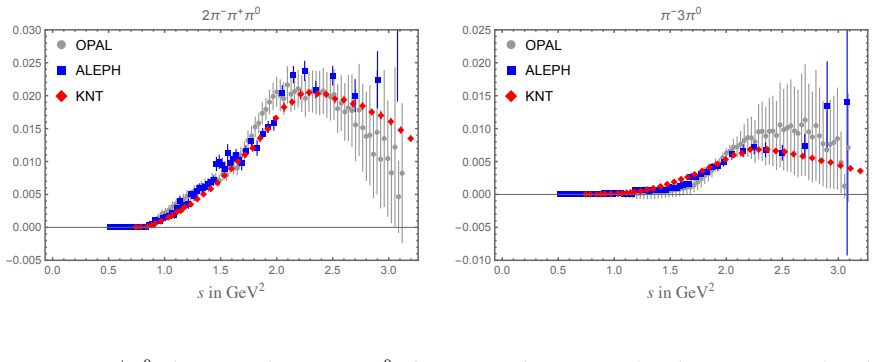
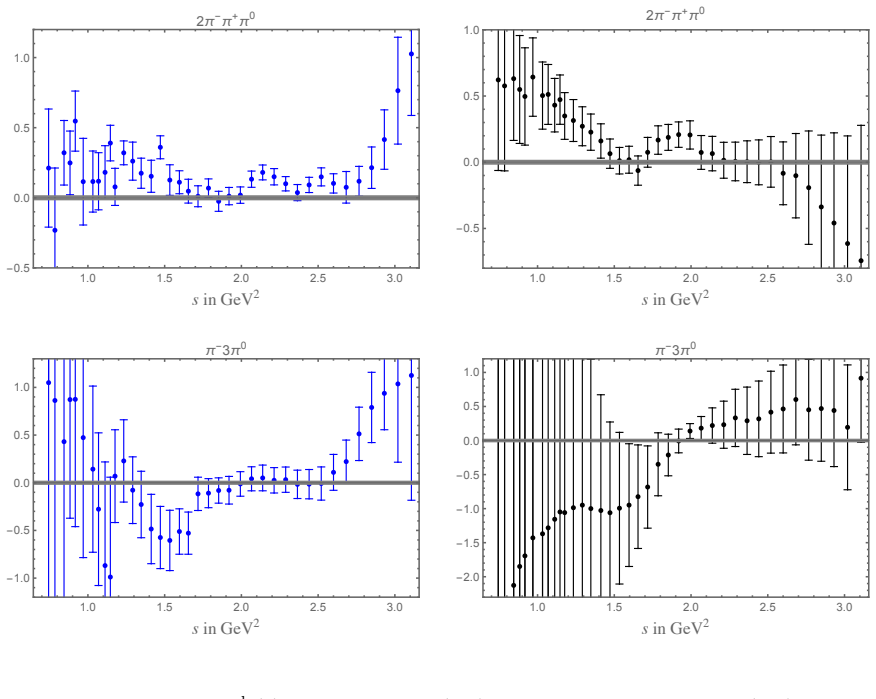
We find generally good agreement between lattice and τ-based results. However, a comparison of τ-based window-quantity contributions for the two four-pion modes to expectations for those contributions based on the Pais relations and e+e− four-pion cross sections reveals significant differences for the 2π−π+π0 mode.
What carries the argument
The subtracted isospin-one vector-current hadronic vacuum polarization evaluated at Euclidean momenta and in RBC/UKQCD windows, obtained via dispersive integrals from inclusive τ-decay spectra corrected for isospin breaking and compared directly to lattice QCD.
If this is right
- The two independent approaches can be used interchangeably for HVP contributions to the muon anomalous magnetic moment.
- Perturbative QCD can be applied reliably above the τ mass for the remaining dispersive tail.
- Restricting τ data to two- and four-pion modes and supplementing with e+e− cross sections reduces reliance on perturbation theory while preserving overall consistency.
- The observed discrepancy isolates to the 2π−π+π0 channel and calls for targeted checks on that mode's spectral function.
Where Pith is reading between the lines
- The mismatch in the 2π−π+π0 channel suggests that current isospin-breaking corrections or branching-fraction inputs for that mode may require re-examination.
- Good global agreement implies that future combined lattice-plus-τ analyses could tighten the HVP uncertainty for muon g-2 without introducing new tensions.
- The result motivates direct experimental re-measurement of the 2π−π+π0 spectral function in τ decays to test the Pais-relation expectation.
Load-bearing premise
The isospin-breaking corrections applied to the inclusive hadronic τ decay data are accurate and the perturbative QCD evaluation for contributions above the τ mass is reliable without introducing significant bias.
What would settle it
A new lattice simulation or refined τ-decay analysis that produces a total subtracted HVP differing by more than the quoted uncertainties at 1 GeV squared, or a 2π−π+π0 window contribution that matches the e+e− expectation, would falsify the reported agreement.
Figures




read the original abstract
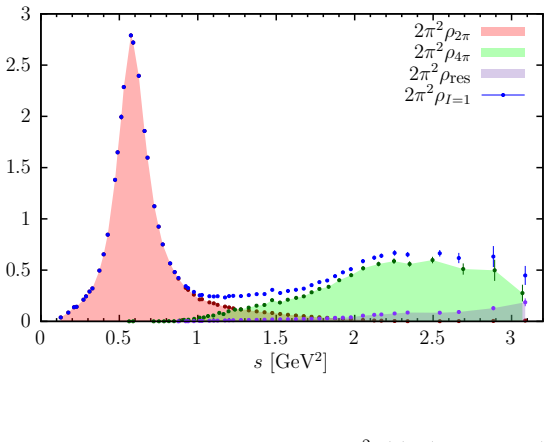
We compare the isospin-one, vector-current hadronic vacuum polarization (HVP) obtained from isospin-symmetric lattice QCD with that obtained from a dispersive representation employing inclusive hadronic $\tau$ decay data corrected for isospin breaking. We consider the subtracted HVP evaluated at squared Euclidean momenta ranging from $0.5$ GeV$^2$ to $12$ GeV$^2$, together with the light-quark-connected HVP contribution to the muon anomalous magnetic moment and the short-, intermediate- and long-distance RBC/UKQCD window components thereof. Dispersive contributions from the region of hadronic invariant masses above the $\tau$ mass are evaluated using perturbative QCD. We also consider dispersive determinations using $\tau$ data only for contributions from two-pion, or two-pion and four-pion, modes, and evaluating the remaining contributions using exclusive-mode $e^+e^-\to\mbox{hadrons}$ cross sections up to about 2 GeV, lessening the dependence on perturbation theory. We find generally good agreement between lattice and $\tau$-based results. However, a comparison of $\tau$-based window-quantity contributions for the two four-pion modes to expectations for those contributions based on the Pais relations and $e^+e^-$ four-pion cross sections, reveals significant differences for the $2\pi^-\pi^+\pi^0$ mode.
Editorial analysis
A structured set of objections, weighed in public.
Referee Report
Summary. The manuscript compares the isospin-one vector-current hadronic vacuum polarization (HVP) from isospin-symmetric lattice QCD with dispersive representations based on inclusive hadronic τ-decay data after isospin-breaking corrections. It evaluates the subtracted HVP at Euclidean momenta from 0.5 to 12 GeV², the light-quark-connected HVP contribution to a_μ, and the RBC/UKQCD short-, intermediate-, and long-distance window components. Contributions above the τ mass use perturbative QCD, with additional hybrid determinations restricting τ data to two-pion or two- plus four-pion modes and using e⁺e⁻ cross sections elsewhere. The authors report generally good agreement between lattice and τ-based results but identify significant differences for the 2π⁻π⁺π⁰ four-pion mode in τ-based window contributions relative to Pais-relation expectations from e⁺e⁻ four-pion cross sections.
Significance. If the agreement holds after accounting for the identified discrepancy, the work provides a useful cross-validation of lattice HVP results against τ-decay data, helping constrain uncertainties relevant to the muon anomalous magnetic moment. The explicit flagging of a channel-specific discrepancy supplies a concrete diagnostic for refining isospin-breaking corrections.
major comments (2)
- [four-pion modes comparison] The significant differences reported for the 2π⁻π⁺π⁰ mode in the τ-based window-quantity contributions (abstract and four-pion comparison) directly test the internal consistency of the isospin-breaking corrections applied to inclusive τ data. This discrepancy, when set against Pais-relation expectations from e⁺e⁻ data, is load-bearing for the central claim of generally good agreement; the manuscript must quantify its propagation into the total subtracted HVP, a_μ, and window sums.
- [hybrid determinations] The hybrid τ + e⁺e⁻ determinations still employ the same IB-corrected τ inputs for the two- and four-pion sectors; the impact of the 2π⁻π⁺π⁰ discrepancy on these hybrid results (and on the claimed reduction in pQCD dependence) is not shown explicitly.
minor comments (2)
- The Pais relations invoked for the four-pion modes should be stated or referenced explicitly to aid readers unfamiliar with the isospin decomposition.
- Error budgets for the τ-based results, especially the four-pion channels, require fuller tabulation or supplementary material to allow assessment of whether the reported agreement lies within combined uncertainties.
Simulated Author's Rebuttal
We thank the referee for the careful reading and constructive comments on our manuscript. We address each major comment point by point below and will revise the manuscript to incorporate the suggested clarifications and quantifications.
read point-by-point responses
-
Referee: [four-pion modes comparison] The significant differences reported for the 2π⁻π⁺π⁰ mode in the τ-based window-quantity contributions (abstract and four-pion comparison) directly test the internal consistency of the isospin-breaking corrections applied to inclusive τ data. This discrepancy, when set against Pais-relation expectations from e⁺e⁻ data, is load-bearing for the central claim of generally good agreement; the manuscript must quantify its propagation into the total subtracted HVP, a_μ, and window sums.
Authors: We agree that an explicit quantification of the impact is necessary to fully assess the robustness of the comparison. In the revised manuscript we will add a new paragraph (or short subsection) that propagates the observed difference in the 2π⁻π⁺π⁰ channel through to the total subtracted HVP at the quoted Euclidean momenta, to the light-quark-connected contribution to a_μ, and to each of the RBC/UKQCD window quantities. This will be done by isolating the four-pion contribution and rescaling it according to the size of the discrepancy relative to the Pais-relation expectation, thereby showing the numerical effect on the overall results. We continue to view the agreement as generally good, with the noted channel-specific difference serving as a diagnostic for future refinements of isospin-breaking corrections. revision: yes
-
Referee: [hybrid determinations] The hybrid τ + e⁺e⁻ determinations still employ the same IB-corrected τ inputs for the two- and four-pion sectors; the impact of the 2π⁻π⁺π⁰ discrepancy on these hybrid results (and on the claimed reduction in pQCD dependence) is not shown explicitly.
Authors: We acknowledge that the hybrid determinations retain the IB-corrected τ data for the two- and four-pion modes. In the revision we will add an explicit statement (and, if space permits, a supplementary table) that isolates the effect of the 2π⁻π⁺π⁰ discrepancy on the hybrid results. This will include a brief comparison of the hybrid a_μ and window values obtained with the current τ four-pion input versus a version in which the 2π⁻π⁺π⁰ contribution is replaced by the Pais-relation expectation from e⁺e⁻ data. We will also clarify that, even with this sensitivity, the hybrid construction still reduces the pQCD contribution relative to the pure τ-based determination by replacing the high-mass region with exclusive e⁺e⁻ cross sections up to ~2 GeV. revision: yes
Circularity Check
No circularity: direct comparison of independent lattice and tau-decay HVP inputs
full rationale
The paper's central results consist of a numerical comparison between subtracted HVP and window quantities computed from lattice QCD simulations on one side and from a dispersive integral over inclusive hadronic tau-decay spectra (with standard isospin-breaking corrections plus pQCD above the tau mass) on the other. No equation in the derivation chain equates a claimed prediction or result to a parameter fitted from the same data or to a self-referential definition. The additional consistency check against Pais relations and e+e- four-pion cross sections is an external cross-validation, not a reduction of the main agreement to the input data. The analysis therefore remains self-contained against external benchmarks.
Axiom & Free-Parameter Ledger
axioms (3)
- domain assumption Isospin symmetry holds for the lattice QCD calculations
- standard math Dispersive representations accurately reconstruct the HVP from tau decay data
- domain assumption Perturbative QCD is reliable for hadronic masses above the tau mass
Lean theorems connected to this paper
-
IndisputableMonolith/Cost/FunctionalEquation.leanwashburn_uniqueness_aczel unclearWe compare the isospin-one, vector-current hadronic vacuum polarization (HVP) obtained from isospin-symmetric lattice QCD with that obtained from a dispersive representation employing inclusive hadronic τ decay data corrected for isospin breaking.
Reference graph
Works this paper leans on
-
[1]
up to the KNT19 exclusive-mode-region endpoint,s=s KNT ≡(1.9375 GeV) 2, including those of the two-pion mode between theτmass squared and the KNT19 endpoint. We also consider the case that in this approach the four-pion data are taken fromτdecays instead of from the KNT19 compilation. Section V contains our conclusions. Two appendices collect some technic...
-
[2]
+ log −m2 1 +m 2 2 −s+λ 1/2(s, m2 1, m2 2) λ1/2(s, m2 1, m2 2) −log m2 1 −m 2 2 +s+λ 1/2(s, m2 1, m2 2) λ1/2(s, m2 1, m2
-
[3]
−log −m2 1 +m 2 2 +s+λ 1/2(s, m2 1, m2 2) λ1/2(s, m2 1, m2 2) . One has to be careful with combining the logarithms in this expression, as both the numer- ators and denominators can have complex phases. Here the logarithm is defined to have a branch cut discontinuity from−∞to 0, and the expressions above need to be evaluated at s+iϵwithϵ >0 in the limitϵ→0
- [4]
- [5]
-
[6]
R. Aliberti, T. Aoyama, E. Balzani, A. Bashir, G. Benton, J. Bijnens, V. Biloshytskyi, T. Blum, D. Boito and M. Bruno,et al. The anomalous magnetic moment of the muon in the Standard Model: an update, Phys. Rept.1143, 1-158 (2025) [arXiv:2505.21476 [hep-ph]]. 24
- [7]
-
[10]
P. Masjuan, A. Miranda and P. Roig,τdata-driven evaluation of Euclidean windows for the hadronic vacuum polarization, Phys. Lett. B850, 138492 (2024) [arXiv:2305.20005 [hep-ph]]
- [11]
-
[12]
G. Colangelo, M. Hoferichter, B. Kubis and P. Stoffer,Isospin-breaking effects in the two- pion contribution to hadronic vacuum polarization, JHEP10, 032 (2022) [arXiv:2208.08993 [hep-ph]]
-
[13]
M. Hoferichter, G. Colangelo, B. L. Hoid, B. Kubis, J. R. de Elvira, D. Schuh, D. Stamen and P. Stoffer,Phenomenological Estimate of Isospin Breaking in Hadronic Vacuum Polarization, Phys. Rev. Lett.131, no.16, 161905 (2023) [arXiv:2307.02532 [hep-ph]]
- [14]
-
[15]
G. Colangelo, M. Cottini, M. Hoferichter and S. Holz,Improved Calculation of Radiative Cor- rections toτ→ππν τ Decays, Phys. Rev. Lett.136, no.10, 101903 (2026) [arXiv:2510.26871 [hep-ph]];Radiative corrections toτ→ππν τ, JHEP02, 181 (2026) [arXiv:2511.07507 [hep- ph]]
-
[16]
T. Blumet al.[RBC and UKQCD],Calculation of the hadronic vacuum polarization contri- bution to the muon anomalous magnetic moment, Phys. Rev. Lett.121, no.2, 022003 (2018) [arXiv:1801.07224 [hep-lat]]
-
[17]
A. Conigli, D. Djukanovic, G. von Hippel, S. Kuberski, H. B. Meyer, K. Miura, K. Ottnad, A. Risch and H. Wittig,Precision lattice calculation of the hadronic contribution to the running of the electroweak gauge couplings, [arXiv:2511.01623 [hep-lat]]
-
[18]
S. Borsanyi, Z. Fodor, J. N. Guenther, C. Hoelbling, S. D. Katz, L. Lellouch, T. Lippert, K. Miura, L. Parato and K. K. Szabo,et al. Leading hadronic contribution to the muon magnetic moment from lattice QCD, Nature593, no.7857, 51-55 (2021) [arXiv:2002.12347 [hep-lat]]
- [19]
-
[20]
D. Bernecker and H. B. Meyer,Vector Correlators in Lattice QCD: Methods and applications, Eur. Phys. J. A47, 148 (2011) [arXiv:1107.4388 [hep-lat]]
-
[21]
P. A. Baikov, K. G. Chetyrkin and J. H. K¨ uhn,Orderα4 s QCD Corrections toZandτDecays, Phys. Rev. Lett.101, 012002 (2008) [arXiv:0801.1821 [hep-ph]]
work page Pith review arXiv 2008
- [22]
-
[23]
R. Barateet al.[ALEPH Collaboration],Measurement of the spectral functions of axial-vector hadronic tau decays and determination of alpha(S)(M**2(tau)), Eur. Phys. J. C4, 409 (1998)
work page 1998
-
[24]
S. Schaelet al.[ALEPH Collaboration],Branching ratios and spectral functions of tau de- cays: Final ALEPH measurements and physics implications, Phys. Rept.421, 191 (2005) [arXiv:hep-ex/0506072]
- [25]
-
[26]
K. Ackerstaffet al.[OPAL Collaboration],Measurement of the strong coupling constant al- pha(s) and the vector and axial-vector spectral functions in hadronic tau decays, Eur. Phys. J. C7, 571 (1999) [arXiv:hep-ex/9808019]
-
[27]
Fujikawaet al.[Belle],High-Statistics Study of theτ − →π −π0ν(τ)Decay, Phys
M. Fujikawaet al.[Belle],High-Statistics Study of theτ − →π −π0ν(τ)Decay, Phys. Rev. D 78, 072006 (2008) [arXiv:0805.3773 [hep-ex]]
- [28]
- [29]
-
[30]
A. Keshavarzi, D. Nomura and T. Teubner,g−2of charged leptons,α(M 2 Z)and the hy- perfine splitting of muonium: a new data-based analysis, Phys. Rev. D101, 014029 (2020) [arXiv:1911.00367 [hep-ph]]
-
[32]
Erler,Electroweak radiative corrections to semileptonic tau decays, Rev
J. Erler,Electroweak radiative corrections to semileptonic tau decays, Rev. Mex. Fis.50, 200 (2004) [hep-ph/0211345]
work page internal anchor Pith review arXiv 2004
-
[33]
Pais,The many pi-meson problem, Annals Phys.9, 548-602 (1960)
A. Pais,The many pi-meson problem, Annals Phys.9, 548-602 (1960)
work page 1960
- [34]
- [35]
-
[36]
M. Beneke and M. Jamin,α s and theτhadronic width: fixed-order, contour-improved and higher-order perturbation theory, JHEP0809, 044 (2008) [arXiv:0806.3156 [hep-ph]]
- [37]
-
[38]
M. Jamin,Contour-improved versus fixed-order perturbation theory in hadronic tau decays, JHEP0509, 058 (2005) [hep-ph/0509001]
- [39]
-
[40]
S. Kuberski, M. C` e, G. von Hippel, H. B. Meyer, K. Ottnad, A. Risch and H. Wittig,Hadronic vacuum polarization in the muon g−2: the short-distance contribution from lattice QCD, JHEP 03, 172 (2024) [arXiv:2401.11895 [hep-lat]]
- [41]
- [42]
-
[43]
E. C. Poggio, H. R. Quinn, S. Weinberg,Smearing the Quark Model, Phys. Rev. D13, 1958 (1976)
work page 1958
- [44]
- [45]
- [46]
- [47]
-
[48]
M. Golterman, S. Peris, B. Phily and E. de Rafael,Testing an approximation to large N(c) QCD with a toy model, JHEP0201, 024 (2002) [hep-ph/0112042]
- [49]
- [50]
-
[51]
M. Della Morte, A. Francis, V. G¨ ulpers, G. Herdo´ ıza, G. von Hippel, H. Horch, B. J¨ ager, H. B. Meyer, A. Nyffeler and H. Wittig,The hadronic vacuum polarization contribution to the muong−2from lattice QCD, JHEP10, 020 (2017) [arXiv:1705.01775 [hep-lat]]
-
[52]
V. Cirigliano, G. Ecker and H. Neufeld,Isospin violation and the magnetic moment of the muon, Phys. Lett. B513, 361-370 (2001) [arXiv:hep-ph/0104267 [hep-ph]]
-
[53]
F. Guerrero and A. Pich,Effective field theory description of the pion form-factor, Phys. Lett. B412, 382-388 (1997) [arXiv:hep-ph/9707347 [hep-ph]]
- [54]
-
[55]
Blumet al.[RBC and UKQCD],Update of Euclidean windows of the hadronic vacuum polarization, Phys
T. Blumet al.[RBC and UKQCD],Update of Euclidean windows of the hadronic vacuum polarization, Phys. Rev. D108, no.5, 054507 (2023) [arXiv:2301.08696 [hep-lat]]
-
[56]
A. Bazavovet al.[MILC, Fermilab Lattice and HPQCD],Hadronic vacuum polarization for the muon g-2 from lattice QCD: Complete short and intermediate windows, Phys. Rev. D111, no.9, 094508 (2025) [arXiv:2411.09656 [hep-lat]]
-
[57]
V. Cirigliano, M. Hoferichter and N. Valori,Pionβdecay andτ→ππν τ beyond leading logarithms, [arXiv:2602.11253 [hep-ph]]
-
[58]
M. Davier, A. Hoecker, G. Lopez Castro, B. Malaescu, X. H. Mo, G. Toledo Sanchez, P. Wang, C. Z. Yuan and Z. Zhang,The Discrepancy Between tau and e+e- Spectral Functions Revisited and the Consequences for the Muon Magnetic Anomaly, Eur. Phys. J. C66, 127-136 (2010) [arXiv:0906.5443 [hep-ph]]
-
[59]
Navaset al.[Particle Data Group],Review of particle physics, Phys
S. Navaset al.[Particle Data Group],Review of particle physics, Phys. Rev. D110, no.3, 030001 (2024)
work page 2024
-
[60]
Aokiet al.(Flavour Lattice Averaging Group (FLAG)), FLAG review 2024, Phys
Y. Aokiet al.[Flavour Lattice Averaging Group (FLAG)],FLAG review 2024, Phys. Rev. D 113, no.1, 014508 (2026) [arXiv:2411.04268 [hep-lat]]
-
[61]
Coanet al.[CLEO],Measurement ofα s from tau decays, Phys
T. Coanet al.[CLEO],Measurement ofα s from tau decays, Phys. Lett. B356, 580 (1995). 27
work page 1995
-
[62]
Andersonet al.[CLEO],Hadronic structure in the decayτ→π −π0ν(tau), Phys
S. Andersonet al.[CLEO],Hadronic structure in the decayτ→π −π0ν(tau), Phys. Rev. D 61, 112002 (2000) [arXiv:hep-ex/9910046 [hep-ex]]
- [63]
-
[64]
R. Alemany, M. Davier and A. Hoecker,Improved determination of the hadronic contribution to the muon (g-2) and to alpha (M(z)) using new data from hadronic tau decays, Eur. Phys. J. C2, 123-135 (1998) [arXiv:hep-ph/9703220 [hep-ph]]
-
[65]
A. del Pino, D. A. Clarke, C. DeTar, A. X. El-Khadra, E. G´ amiz, S. Gottlieb, A. V. Grebe, L. Hostetler, W. I. Jay and A. S. Kronfeld,et al. Hadronic contributions toα(Q 2)and sin2 W (Q2)from spectral reconstruction of lattice-QCD data, PoSLATTICE2025, 518 (2025) [arXiv:2604.22349 [hep-lat]]
work page internal anchor Pith review Pith/arXiv arXiv 2025
- [66]
-
[67]
E. Shintaniet al.[PACS],Hadronic vacuum polarization contribution to the muong−2with 2+1 flavor lattice QCD on a larger than (10 fm) 4 lattice at the physical point, Phys. Rev. D 100, no.3, 034517 (2019) [arXiv:1902.00885 [hep-lat]]
-
[68]
D. Giusti and S. Simula,Lepton anomalous magnetic moments in Lattice QCD+QED, PoS LATTICE2019, 104 (2019) [arXiv:1910.03874 [hep-lat]]
-
[69]
C. Lehner and A. S. Meyer,Consistency of hadronic vacuum polarization between lattice QCD and the R-ratio, Phys. Rev. D101, 074515 (2020) [arXiv:2003.04177 [hep-lat]]
-
[70]
Wanget al.[chiQCD],Muon g-2 with overlap valence fermions, Phys
G. Wanget al.[chiQCD],Muon g-2 with overlap valence fermions, Phys. Rev. D107, no.3, 034513 (2023) [arXiv:2204.01280 [hep-lat]]
- [71]
-
[72]
M. C` e, A. G´ erardin, G. von Hippel, R. J. Hudspith, S. Kuberski, H. B. Meyer, K. Miura, D. Mohler, K. Ottnad and P. Srijit,et al. Window observable for the hadronic vacuum po- larization contribution to the muon g-2 from lattice QCD, Phys. Rev. D106, no.11, 114502 (2022) [arXiv:2206.06582 [hep-lat]]
-
[73]
Hybrid calculation of hadronic vacuum polarization in muon g-2 to 0.48\%
A. Boccaletti, S. Borsanyi, M. Davier, Z. Fodor, F. Frech, A. Gerardin, D. Giusti, A. Y. Ko- tov, L. Lellouch and T. Lippert,et al. High precision calculation of the hadronic vacuum polarisation contribution to the muon anomaly, [arXiv:2407.10913 [hep-lat]]
work page internal anchor Pith review Pith/arXiv arXiv
-
[74]
S. Spiegel and C. Lehner,High-precision continuum limit study of the HVP short-distance window, Phys. Rev. D111, no.11, 114517 (2025) [arXiv:2410.17053 [hep-lat]]
-
[75]
T. Blumet al.[RBC and UKQCD],Long-Distance Window of the Hadronic Vacuum Po- larization for the Muon g-2, Phys. Rev. Lett.134, no.20, 201901 (2025) [arXiv:2410.20590 [hep-lat]]
-
[76]
D. Djukanovic, G. von Hippel, S. Kuberski, H. B. Meyer, N. Miller, K. Ottnad, J. Parrino, A. Risch and H. Wittig,The hadronic vacuum polarization contribution to the muon g−2 at long distances, JHEP04, 098 (2025) [arXiv:2411.07969 [hep-lat]]
-
[77]
C. Alexandrouet al.[Extended Twisted Mass],Strange and charm quark contributions to the muon anomalous magnetic moment in lattice QCD with twisted-mass fermions, Phys. Rev. D 111, no.5, 054502 (2025) doi:10.1103/PhysRevD.111.054502 [arXiv:2411.08852 [hep-lat]]
-
[78]
A. Bazavovet al.[Fermilab Lattice, HPQCD, and MILC],Hadronic Vacuum Polarization for 28 the Muon g-2 from Lattice QCD: Long-Distance and Full Light-Quark Connected Contribution, Phys. Rev. Lett.135, no.1, 011901 (2025) [arXiv:2412.18491 [hep-lat]]
-
[79]
B. Aubert,et al.[BaBar Collaboration],Measurements ofe +e− →K +K−η,K +K−π0 and K0 SK±π∓ cross sections using initial state radiation events, Phys. Rev. D77, 092002 (2008) [arXiv:0710.4451 [hep-ex]]
- [80]
- [81]
- [82]
- [83]
discussion (0)
Sign in with ORCID, Apple, or X to comment. Anyone can read and Pith papers without signing in.