Recognition: no theorem link
Optimal Policy Learning under Budget and Coverage Constraints
Pith reviewed 2026-05-13 04:30 UTC · model grok-4.3
The pith
The optimal policy under budget and coverage constraints is characterized by an affine threshold rule with an O(1) integrality gap in its LP relaxation.
A machine-rendered reading of the paper's core claim, the machinery that carries it, and where it could break.
Core claim
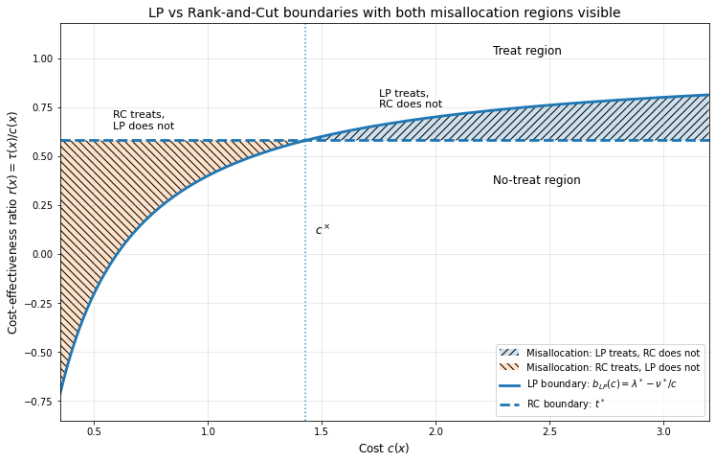
We show that the problem admits a knapsack-type structure and that the optimal policy can be characterized by an affine threshold rule involving both budget and coverage shadow prices. We establish that the linear programming relaxation of the combinatorial solution has an O(1) integrality gap, implying asymptotic equivalence with the optimal discrete allocation. Building on this result, we analyze two implementable approaches: a Greedy-Lagrangian (GLC) and a rank-and-cut (RC) algorithm. We show that the GLC closely approximates the optimal solution and achieves near-optimal performance in finite samples. By contrast, RC is approximately optimal whenever the coverage constraint is slack or 0
What carries the argument
Knapsack-type structure that permits characterization of the optimal policy by an affine threshold rule involving budget and coverage shadow prices.
Load-bearing premise
The optimization problem has a special structure that makes the best policy follow a simple rule based on the costs of violating the budget and coverage limits.
What would settle it
A family of instances where the gap between the LP relaxation value and the true optimal discrete policy grows without bound as the instance size increases.
Figures

read the original abstract
We study optimal policy learning under combined budget and minimum coverage constraints. We show that the problem admits a knapsack-type structure and that the optimal policy can be characterized by an affine threshold rule involving both budget and coverage shadow prices. We establish that the linear programming relaxation of the combinatorial solution has an O(1) integrality gap, implying asymptotic equivalence with the optimal discrete allocation. Building on this result, we analyze two implementable approaches: a Greedy-Lagrangian (GLC) and a rank-and-cut (RC) algorithm. We show that the GLC closely approximates the optimal solution and achieves near-optimal performance in finite samples. By contrast, RC is approximately optimal whenever the coverage constraint is slack or costs are homogeneous, while misallocation arises only when cost heterogeneity interacts with a binding coverage constraint. Monte Carlo evidence supports these findings.
Editorial analysis
A structured set of objections, weighed in public.
Referee Report
Summary. The paper studies optimal policy learning under combined budget and minimum coverage constraints. It shows that the problem admits a knapsack-type structure and that the optimal policy can be characterized by an affine threshold rule involving both budget and coverage shadow prices. The authors establish that the linear programming relaxation of the combinatorial solution has an O(1) integrality gap, implying asymptotic equivalence with the optimal discrete allocation. They analyze two implementable approaches: a Greedy-Lagrangian (GLC) algorithm that closely approximates the optimal solution and achieves near-optimal performance in finite samples, and a rank-and-cut (RC) algorithm that is approximately optimal when the coverage constraint is slack or costs are homogeneous. Monte Carlo evidence is provided to support these findings.
Significance. If the O(1) integrality gap and affine threshold characterization hold, the work provides a theoretically grounded approach to constrained policy optimization that is relevant for applications involving resource allocation under multiple constraints. The distinction between the performance of GLC and RC under different regimes offers practical guidance, and the asymptotic equivalence result strengthens the case for using LP-based approximations in large-scale settings.
minor comments (3)
- The abstract states the O(1) integrality gap but does not specify whether it is additive or multiplicative; this should be clarified with a precise statement and reference to the relevant theorem in the main text.
- The Monte Carlo experiments are mentioned as supporting the findings, but additional details on the data-generating process, policy class, and specific metrics used to evaluate GLC vs. RC would improve reproducibility and clarity.
- Notation for the shadow prices and the affine threshold rule should be introduced consistently in the main body before the algorithmic sections to aid readability.
Simulated Author's Rebuttal
We thank the referee for the careful reading and positive assessment of our manuscript. The summary accurately captures the main contributions regarding the affine threshold characterization, O(1) integrality gap, and the comparative analysis of the GLC and RC algorithms. We are pleased that the referee finds the work relevant for constrained policy optimization and recommends minor revision.
Circularity Check
No significant circularity; derivation follows standard IP/LP theory from problem formulation
full rationale
The paper's core claims—the knapsack-type structure, affine threshold characterization via shadow prices, and O(1) integrality gap for the LP relaxation—are derived directly from the given budget-plus-coverage constrained optimization problem using classical results on knapsack problems and bounded integrality gaps for integer programs with linear relaxations. No parameters are fitted to data and then renamed as predictions; no self-citations are invoked as load-bearing uniqueness theorems; the threshold rule and gap bound follow from the primal-dual structure and standard rounding arguments without self-referential definitions or ansatzes smuggled via prior work. Monte Carlo evidence is presented separately as validation, not as part of the derivation chain. The result is self-contained against external benchmarks in combinatorial optimization.
Axiom & Free-Parameter Ledger
axioms (1)
- domain assumption The problem admits a knapsack-type structure
Reference graph
Works this paper leans on
- [1]
-
[2]
Juan Pablo Vielma , title =. SIAM Review , volume =. 2015 , doi =
work page 2015
- [3]
- [4]
- [5]
-
[6]
Alexander Schrijver , title =
- [7]
-
[8]
Kitagawa, Toru and Tetenov, Aleksey , title =. Econometrica , volume =
-
[9]
Athey, Susan and Wager, Stefan , title =. Econometrica , volume =. 2021 , doi =
work page 2021
-
[10]
Journal of Econometrics , volume =
Bhattacharya, Debopam and Dupas, Pascaline , title =. Journal of Econometrics , volume =. 2012 , doi =
work page 2012
- [11]
-
[12]
Minimax Regret Treatment Choice with Finite Samples , journal =
Stoye, J. Minimax Regret Treatment Choice with Finite Samples , journal =
-
[13]
Minimax Regret Treatment Choice with Covariates , journal =
Stoye, J. Minimax Regret Treatment Choice with Covariates , journal =
-
[14]
Zhao, Yingqi and Zeng, Donglin and Rush, A. John and Kosorok, Michael R. , title =. Journal of the American Statistical Association , volume =
-
[15]
Doubly Robust Policy Evaluation and Learning , booktitle =
Dud. Doubly Robust Policy Evaluation and Learning , booktitle =
-
[16]
Advances in Neural Information Processing Systems , year =
Kallus, Nathan , title =. Advances in Neural Information Processing Systems , year =
- [17]
- [18]
-
[19]
European Journal of Operational Research , volume =
Bengio, Yoshua and Lodi, Andrea and Prouvost, Antoine , title =. European Journal of Operational Research , volume =. 2021 , doi =
work page 2021
-
[20]
arXiv preprint arXiv:2203.02878 , year =
Zhang, Yu and Dietterich, Thomas and Dilkina, Bistra , title =. arXiv preprint arXiv:2203.02878 , year =
-
[21]
Garn, Wolfgang and Amirghasemi, Mahdi , title =. arXiv preprint , year =
-
[22]
The Econometrics Journal , volume =
Carneiro, Pedro and Lee, Sokbae and Wilhelm, Daniel , title =. The Econometrics Journal , volume =. 2020 , doi =
work page 2020
-
[23]
The Oxford Handbook of Bayesian Econometrics , publisher =
Chamberlain, Gary , title =. The Oxford Handbook of Bayesian Econometrics , publisher =. 2011 , pages =
work page 2011
-
[24]
Christoffersen, Peter F. and Diebold, Francis X. , title =. Economic Theory , volume =
- [25]
-
[26]
arXiv preprint arXiv:1905.10116 , year =
Demirer, Mert and Syrgkanis, Vasilis and Lewis, Greg and Chernozhukov, Victor , title =. arXiv preprint arXiv:1905.10116 , year =
- [27]
-
[28]
Education Policy in Developing Countries , publisher =
Dhailiwal, Iqbal and Duflo, Esther and Glennerster, Rachel and Tulloch, Caitlin , title =. Education Policy in Developing Countries , publisher =
-
[29]
New England Journal of Medicine , volume =
Finkelstein, Amy and Gentzkow, Matthew and Hull, Peter and Williams, Heidi , title =. New England Journal of Medicine , volume =. 2017 , doi =
work page 2017
- [30]
-
[31]
Quarterly Journal of Economics , volume =
Hendren, Nathaniel and Sprung-Keyser, Ben , title =. Quarterly Journal of Economics , volume =
-
[32]
arXiv preprint arXiv:2205.08586 , year =
Kitagawa, Toru and Lee, Sokbae and Qiu, Chen , title =. arXiv preprint arXiv:2205.08586 , year =
-
[33]
arXiv preprint arXiv:2401.17909 , year =
Kock, Anders Bredahl and Preinerstorfer, David , title =. arXiv preprint arXiv:2401.17909 , year =
-
[34]
Mbakop, Eric and Tabord-Meehan, Marten , title =. Econometrica , volume =
-
[35]
arXiv preprint arXiv:2103.11066 , year =
Sun, Huanan and Munro, Ewan and Kalashnov, Gleb and Du, Shuo and Wager, Stefan , title =. arXiv preprint arXiv:2103.11066 , year =
-
[36]
arXiv preprint arXiv:2103.15298 , year =
Sun, Liyang , title =. arXiv preprint arXiv:2103.15298 , year =
- [37]
-
[38]
Journal of the American Statistical Association , volume =
Viviano, Davide and Bradic, Jelena , title =. Journal of the American Statistical Association , volume =. 2024 , doi =
work page 2024
-
[39]
arXiv preprint arXiv:2111.04926 , year =
Yata, Kohei , title =. arXiv preprint arXiv:2111.04926 , year =
-
[40]
Journal of Econometrics , volume =
Sun, Liyang , title =. Journal of Econometrics , volume =. 2026 , doi =
work page 2026
discussion (0)
Sign in with ORCID, Apple, or X to comment. Anyone can read and Pith papers without signing in.