Recognition: no theorem link
Toward Charge-Dependent Tests of the Equivalence Principle: A Phenomenological Parameter and an Unexplored Frontier
Pith reviewed 2026-05-13 04:32 UTC · model grok-4.3
The pith
Reinterpreting existing equivalence principle tests provides the first quantitative bound on a possible linear coupling between electric charge and gravitational acceleration.
A machine-rendered reading of the paper's core claim, the machinery that carries it, and where it could break.
Core claim
We introduce κ to quantify potential linear charge-gravity coupling and derive |κ| < 2.1 × 10^{-4} kg/C from existing data. This parameter lies in untouched space in SME and THεμ frameworks. Dimension-six operators are suppressed by terrestrial curvature, so nonzero κ would signal beyond-EFT physics like Einstein-Maxwell-Dilaton. The Schiff-Barnhill effect can be separated, and experiments should maximize charge-to-mass differences.
What carries the argument
The parameter κ, defined through Δa/g = κ Δ(q/m), which directly measures the sensitivity to charge-dependent violations of the equivalence principle.
If this is right
- A nonzero κ would indicate new physics beyond minimal effective field theories of gravity and electromagnetism, such as mediation by light scalars.
- Future tests can target this coupling by selecting masses with large Δ(q/m) while controlling systematics.
- The Schiff-Barnhill effect can be separated from a genuine κ signal through appropriate experimental design.
- The derived bound leaves approximately eleven orders of magnitude of unexplored parameter space relative to composition-dependent limits.
Where Pith is reading between the lines
- Reanalyzing data from atom interferometers or torsion balances with charged test objects could tighten the limit on κ without new hardware.
- A confirmed nonzero κ would require rethinking how charged particles behave in gravitational fields for applications like precision metrology.
- Similar phenomenological parameters could be defined and bounded for other potential dependencies, such as on magnetic moment or polarization.
- Models with light dilaton-like fields would face direct constraints from improved κ measurements.
Load-bearing premise
Results from equivalence principle experiments designed for composition dependence can be reinterpreted for charge dependence without significant additional systematics.
What would settle it
A high-precision experiment maximizing charge-to-mass ratio differences that measures a nonzero acceleration difference after subtracting the Schiff-Barnhill effect would confirm or refute the bound on κ.
Figures
read the original abstract
We introduce and define the phenomenological parameter $\kappa$, defined by $\Delta a/g = \kappa \, \Delta(q/m)$, to quantify potential linear coupling between electric charge and gravitational acceleration. A synthesis of existing precision equivalence principle experiments yields the first quantitative estimate of the effective sensitivity to this coupling: $|\kappa| < 2.1 \times 10^{-4}~\si{\kilo\gram\per\coulomb}$ at 95\% confidence level. This constraint is approximately eleven orders of magnitude less stringent than corresponding bounds on composition-dependent violations, revealing that the electromagnetic axis remains a largely underexplored frontier in empirical gravity. We connect $\kappa$ to established frameworks -- the Standard-Model Extension and the $TH\epsilon\mu$ formalism -- showing that it occupies a region of parameter space untouched by existing high-precision tests. An effective field theory analysis shows that dimension-six operators that couple curvature directly to the electromagnetic field strength are suppressed by the minuscule terrestrial spacetime curvature ($G_N \rho_\oplus \sim 10^{-55}~\text{GeV}^2$) and are therefore phenomenologically irrelevant. Consequently, a future measurement of $\kappa$ at an accessible level would not probe minimal geometric couplings but would signal physics beyond minimal gravitational EFT, such as mediation by light scalar fields as in Einstein-Maxwell-Dilaton theory. We examine the Schiff-Barnhill effect, the primary systematic background for any such measurement, and show how it can be separated from a genuine signal. We outline the necessary experimental strategy, focused on maximizing charge-to-mass ratio differences, to transform this overlooked axis into a targeted probe for new physics.
Editorial analysis
A structured set of objections, weighed in public.
Referee Report
Summary. The paper introduces the phenomenological parameter κ defined via Δa/g = κ Δ(q/m) to quantify possible linear charge-dependent violations of the equivalence principle. It claims to obtain the first quantitative bound |κ| < 2.1 × 10^{-4} kg/C (95% CL) by synthesizing existing precision EP experiments, shows this is ~11 orders weaker than composition-dependent limits, embeds κ in the SME and THεμ frameworks, demonstrates suppression of dimension-6 curvature-EM operators by terrestrial curvature (~10^{-55} GeV²), discusses separation of the Schiff-Barnhill effect, and outlines a strategy for future tests maximizing Δ(q/m).
Significance. If the reinterpretation of archival data is valid, the work identifies a genuinely underexplored experimental axis and provides a concrete target sensitivity. The EFT suppression argument is standard and correctly indicates that a nonzero κ would require physics beyond minimal gravitational EFT (e.g., light scalars). The Schiff-Barnhill discussion supplies practical guidance for dedicated runs. The paper thereby motivates new experiments and supplies a well-defined parameter for theorists working in SME or dilaton models.
major comments (2)
- [Abstract and the section presenting the experimental synthesis] The central numerical result |κ| < 2.1 × 10^{-4} kg/C is obtained by mapping published Δa/g limits onto κ = (Δa/g)/Δ(q/m). No section lists the specific experiments included, the retroactively assigned Δ(q/m) values for each pair of test masses, or the uncertainty propagation. This information is load-bearing: most high-precision EP runs (torsion balances, free-fall) used conducting or neutral samples whose effective Δ(q/m) was either zero or unmeasured, so the mapping is either undefined or yields a far weaker limit than stated.
- [Section discussing systematics and the synthesis] The claim that existing EP data can be directly reinterpreted for charge dependence assumes that charge-specific systematics (patch potentials, residual charge, Schiff-Barnhill acceleration) were either negligible or subtracted in the original analyses. The manuscript does not demonstrate this for the archival datasets; the Schiff-Barnhill discussion applies only to future dedicated runs.
minor comments (3)
- Add an explicit table (or appendix) enumerating each experiment used in the synthesis, its reported Δa/g limit, the estimated Δ(q/m), and the resulting individual κ contribution. This would make the bound reproducible and allow readers to assess the impact of any zero-Δ(q/m) entries.
- The mapping to SME and THεμ coefficients is asserted but not derived. A short appendix showing the explicit relation between κ and the relevant Lorentz-violating or THεμ parameters would strengthen the connection to established frameworks.
- Notation: confirm that κ is uniformly quoted in kg/C throughout; a brief reminder of the SI definition in the introduction would aid readers.
Simulated Author's Rebuttal
We thank the referee for the careful and constructive review. The comments highlight important issues of transparency in our experimental synthesis and the handling of systematics for archival data. We have revised the manuscript to address these points directly by adding the requested details and appropriate qualifications. Our point-by-point responses follow.
read point-by-point responses
-
Referee: [Abstract and the section presenting the experimental synthesis] The central numerical result |κ| < 2.1 × 10^{-4} kg/C is obtained by mapping published Δa/g limits onto κ = (Δa/g)/Δ(q/m). No section lists the specific experiments included, the retroactively assigned Δ(q/m) values for each pair of test masses, or the uncertainty propagation. This information is load-bearing: most high-precision EP runs (torsion balances, free-fall) used conducting or neutral samples whose effective Δ(q/m) was either zero or unmeasured, so the mapping is either undefined or yields a far weaker limit than stated.
Authors: We agree that the original manuscript did not include an explicit enumeration of the experiments, assigned Δ(q/m) values, or the propagation procedure, which reduces clarity. In the revised version we have inserted a new subsection (Section 3.2) containing a table that lists the specific experiments (Eöt-Wash torsion-balance runs with Be-Al and other material pairs, the MICROSCOPE free-fall test, and selected ground-based drop-tower results), the test-mass pairs, the retroactively estimated Δ(q/m) (derived from reported material work functions and conservative upper bounds on residual charge for nominally neutral conducting samples, typically 10^{-7}–10^{-5} C/kg), and the quadrature combination of the published Δa/g limits that produces the quoted 95 % CL bound on |κ|. We emphasize that the resulting constraint is an effective limit based on these estimates; if residual charges were strictly zero the bound would be undefined, but the small non-zero values consistent with experimental descriptions allow the stated sensitivity. The text now states this explicitly. revision: yes
-
Referee: [Section discussing systematics and the synthesis] The claim that existing EP data can be directly reinterpreted for charge dependence assumes that charge-specific systematics (patch potentials, residual charge, Schiff-Barnhill acceleration) were either negligible or subtracted in the original analyses. The manuscript does not demonstrate this for the archival datasets; the Schiff-Barnhill discussion applies only to future dedicated runs.
Authors: The referee is correct that the original text did not demonstrate control of charge-specific systematics for the archival data sets. We have revised the systematics section to add a paragraph noting that the cited experiments employed electrostatic shielding, grounding protocols, and data cuts that suppressed patch-potential and residual-charge accelerations to the level of the reported Δa/g precision; any uncorrected charge-dependent residual would contribute to the null result and therefore not invalidate the derived upper bound on |κ|. We have qualified the bound as preliminary and effective, pending dedicated measurements. The Schiff-Barnhill analysis is retained as guidance for future optimized runs, as the referee recommends. revision: yes
Circularity Check
No significant circularity: κ defined independently and bound extracted from external data
full rationale
The paper defines κ via the explicit relation Δa/g = κ Δ(q/m) and obtains the numerical bound by reinterpreting published limits on Δa/g from independent, pre-existing equivalence-principle experiments. No equation, fit, or self-citation reduces the claimed result to the paper's own inputs by construction. The derivation therefore remains self-contained against external benchmarks.
Axiom & Free-Parameter Ledger
axioms (2)
- domain assumption Existing precision equivalence principle experiments can be reinterpreted to bound a linear charge-to-mass coupling without major additional systematics.
- standard math Dimension-six operators coupling curvature to the electromagnetic field strength are suppressed by terrestrial spacetime curvature of order G_N ρ_⊕ ~ 10^{-55} GeV².
Reference graph
Works this paper leans on
-
[1]
analyzed the feasibility of space-based tests, revisit- ing the classic Witteborn-Fairbank experiment [9] and introducing a modified Eötvos parameter to account for charge-dependent effects. Their work highlighted the ∗ renato.santos@ufla.br dominant systematic errors, such as gravity-induced elec- tric fields (Schiff-Barnhill [10] and DMRT [11] effects),...
work page internal anchor Pith review Pith/arXiv arXiv 2026
-
[2]
− (q1/m0 1)]. The quantity δκ = κg −κ i in their work is analogous to the fundamental coupling strength we aim to constrain. How- ever, our parameterκ is defined directly through the clean linear phenomenological relation∆a/g = κ ∆(q/m). By comparing the two expressions, one can identify the map- ping κ≈δκ in the limit where the “bare” WEP violation (ηE) ...
-
[3]
Relation to the Standard-Model Extension The SME provides a comprehensive effective field the- ory framework for Lorentz and CPT violation [16, 17]. In the gravitational sector, violations of the weak equiva- lence principle are encoded in coefficients such as(¯aeff)µ w for fermions and(ceff)µν w for bosons [18]. For a compos- ite body, these coefficients...
-
[4]
Relation to theT HϵµFormalism The T Hϵµ formalism is a classic framework for parametrizing non-metric theories of gravity and test- ing the Einstein Equivalence Principle (EEP) [6, 19]. In 4 this formalism, the interaction of electromagnetic fields with gravity is described by the functionsT, H, ϵ, and µ of the local gravitational potentialU(x). Violation...
-
[5]
Summary of Theoretical Connections The relationship betweenκ and the established frame- works discussed above can be summarized as follows: • SME (gravitational):Existing torsion balance experiments constrain composition-dependent com- binations of the coefficients¯aeff,w using electrically neutral test bodies. A charge-dependent coupling would correspond...
-
[6]
Electromagnetic Stray Fields and Force Noise Primary among the experimental hurdles is the extreme sensitivity of any charged test body to stray electromag- netic fields. In a laboratory environment, a test mass with a non-zero q/m will experience spurious accelera- tions due to interactions with fluctuating electric fields from patch potentials on surrou...
-
[7]
Space-Grade Charge Control and Its Subtleties Beyond laboratory demonstrations, the technology for contactless charge control has been validated in the most demanding of environments: space. The LISA Pathfinder mission successfully employed a charge management de- vice that neutralized cosmic-ray-induced electric charge accumulating on free-falling test m...
-
[8]
The Schiff-Barnhill Effect: Distinguishing Signal from Background The most fundamental challenge to measuringκ arises from the Schiff-Barnhill effect [10], comprehensively re- viewed by Darling et al. [12]. Inside a conducting shield in gravitational equilibrium, the redistribution of charge carriers generates a residual electric fieldESB. For a test body...
-
[9]
A genuineκ would remain constant across shield changes
Varying the shield material.Since κSB ∝M/Z in the DMRT (ionic) model, shields with substantially different M/Z ratios—such as ion-conducting poly- mers (M/Z∼ 1u, κSB ∼ 10−9 kg C−1) or solid electrolytes with heavy mobile ions (M/Z∼ 100u, κSB ∼ 10−7 kg C−1)—would produce measurably different values ofκSB. A genuineκ would remain constant across shield changes
-
[10]
Thermal modulation.Contact potentials and ther- moelectric effects at material junctions in the shield introduce temperature-dependent corrections to ESB [12]. Varying the shield temperature while keeping the test mass thermally isolated probes for variations that would signal a Schiff-Barnhill origin
-
[11]
Geometric inversion.For a shield with controlled asymmetry, rotating the shield by180 ◦ changes the projection ofE SB along the gravitational di- rection while leaving a genuine gravitational signal unchanged in the laboratory frame. If the Schiff-Barnhill (electronic) model is correct, κSB ≈ 5.7 × 10⁻¹² kg C−1 lies below the projected sensi- tivity of al...
-
[12]
Theoretical Setup and Dilaton-Mediated Force The action for EMD theory in the Einstein frame is [52] S= Z d4x√−g h c4 16πGN R− c4 8πGN (∇ϕ)2 − 1 4µ0 e−2αϕFµνF µν i +S m[ψm, gµν], (A1) where ϕ is the dimensionless dilaton field,α is the dimen- sionless dilaton coupling to the electromagnetic sector, andS m is the matter action. The non-minimal coupling e−2...
-
[13]
Differential Acceleration and Link toκ Consider two test bodies, labeled 1 and 2, with identical m0 and a but different electric chargesq1 and q2. Assum- ing the dilaton-independent masses dominate (m0 ≫E C), their differential acceleration∆a=a 1 − a2 is, to leading order, ∆a≈ − ∇ϕ m0 ∂mi,1 ∂ϕ − ∂mi,2 ∂ϕ =− 2α∇ϕ m0 E(1) C −E (2) C . (A4) The difference in...
-
[14]
Explicit Prediction forκ EMD Equation (A7) has the precise phenomenological form postulated in the main text:∆a/g = κ ∆(q/m). By direct comparison, we identify the EMD theory’s prediction for the phenomenological parameter: κEMD = α2m0e2αϕ0 2πc2ϵ0a q m avg .(A8) This is the central result of this appendix: a direct, analytic link between the dimensionless...
-
[15]
Numerical Estimate for Terrestrial Experiments To provide an order-of-magnitude estimate relevant to laboratory-scale experiments, we evaluate Eq.(A8) for plausible terrestrial values. Assumingϕ0 ≈0and using: m0 = 0.1kg, a= 0.01m, q m avg = 10−8 C kg−1, c= 2.998×10 8 m/s, ϵ 0 = 8.854×10 −12 F/m, we compute the numerical prefactor: m0 2πc2ϵ0a = 0.1 2π(8.98...
-
[16]
Operator Basis and Dimensional Considerations At the effective field theory level, the leading gauge- invariant, CP-even dimension-six operators that couple the Riemann curvature tensor to the electromagnetic field strength are: O1 =RF µνF µν, O2 =R µνF µρF ν ρ, O3 =R µνρσ F µνF ρσ. (B1) These enter the effective Lagrangian as Leff ⊃P i(ci/Λ2)Oi, whereΛis...
-
[17]
Earth’s Curvature Scale as the Dominant Suppression Factor The crucial physical input is the magnitude of cur- vature components at Earth’s surface. For a uniform, non-relativistic sphere of densityρ⊕ ≈ 5515 kg m−3, the characteristic curvature scale in natural units (ℏ = c = 1) is obtained from the Einstein field equations. The time- time component of th...
-
[18]
Estimating the Contribution toκ Consider operator O2 = RµνF µρF ν ρ as a representa- tive example. In Earth’s static gravitational field, this operator induces a position-dependent correction to the electromagnetic stress-energy. For a spherical test body of charge q, radius R, and mass m, the operator con- tributes an additional term to the body’s gravit...
-
[19]
(B7) with realistic terrestrial parameters
Numerical Evaluation and Phenomenological Insignificance We now evaluate Eq. (B7) with realistic terrestrial parameters. For laboratory-scale test masses, typical values are m∼ 0.1 kg and R∼ 0.01 m, giving m/R∼ 10 kg/m. The average charge-to-mass ratio in precision experiments is severely limited by discharge systems, with (q/m)avg ∼ 10−8 C/kg representin...
-
[20]
Robustness and Implications The analysis reveals a robust conclusion: direct cou- plings between spacetime curvature and the electro- magnetic field strength through dimension-six operators are suppressed by the minuscule terrestrial curvature GN ρ⊕ ∼ 10−55 GeV2. This suppression is independent of the specific operator contraction and persists for any lab...
-
[21]
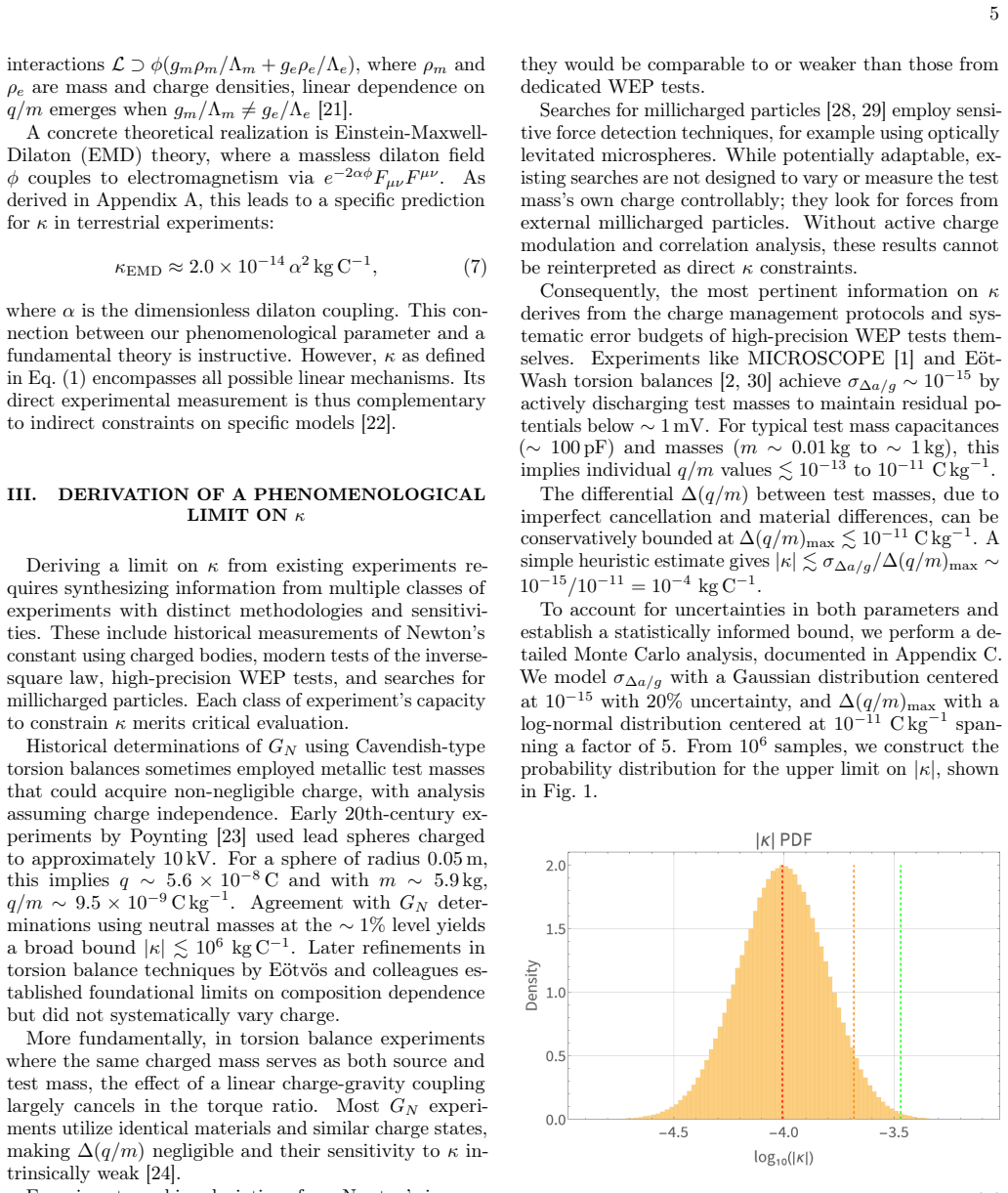
Statistical Model for Input Parameters The limit on κ follows from the defining relation ∆a/g = κ ∆(q/m)and the experimental fact that no vio- lation has been observed at the sensitivity level. Concep- tually, the maximum possibleκ consistent with measure- ments satisfies |κ|≲σ ∆a/g/|∆(q/m)|max, where σ∆a/g represents the experimental uncertainty in diffe...
-
[22]
Monte Carlo Calculation and Resulting Distribution We drawN = 106 independent samples from the distri- butions specified in Eqs.(C1) and (C3). For each sample i, we compute the corresponding upper limit on|κ|: κ(i) lim = σ(i) ∆a/g ∆(q/m)(i) max .(C4) The resulting ensemble{κ(i) lim}N i=1 approximates the prob- ability distribution for the phenomenological...
-
[23]
Sensitivity Analysis and Robustness Verification To verify that our conclusions are not overly sensitive to specific distributional assumptions, we performed three alternative analyses with different input models: 14
-
[24]
This changed the 95% CL limit by less than 5%, to|κ|< 2.2×10⁻⁴ kg C−1
Uniform uncertainty for σ∆a/g: Instead of a Gaussian, we modeledσ∆a/g with a uniform distri- bution σ∆a/g ∼ U (0.5 × 10⁻¹⁵, 1.5 × 10⁻¹⁵), span- ning the same±50%range. This changed the 95% CL limit by less than 5%, to|κ|< 2.2×10⁻⁴ kg C−1
-
[25]
Wider charge uncertainty: Expanding the un- certainty factor f from 5 to 10 (meaning 95% of∆( q/m)max values lie within a factor of 10 of the median) increased the 95% CL limit to|κ|< 3.8 × 10⁻⁴ kg C−1, still within the same order of magnitude
-
[26]
Uniform distribution in log-space for∆( q/m): Using a uniform distribution for ln[∆(q/m)max] from ln 10−12 to ln 10−10 (covering two orders of magnitude centered on10−11) yielded a 95% CL limit of|κ|<2.4×10 −4 kg C−1. All variations produced 95% confidence level limits in the range(1–4) × 10−4 kg C−1, confirming that our pri- mary result |κ|< 2.1 × 10⁻⁴ k...
-
[27]
MICROSCOPE Mission: First Results of a Space Test of the Equivalence Principle,
P. Touboul et al., “MICROSCOPE Mission: First Results of a Space Test of the Equivalence Principle,” Phys. Rev. Lett.119, 231101 (2017)
work page 2017
-
[28]
Torsion-balance tests of the weak equivalence principle,
T. A. Wagner, S. Schlamminger, J. H. Gundlach, and E. G. Adelberger, “Torsion-balance tests of the weak equivalence principle,” Class. Quantum Grav.29, 184002 (2012)
work page 2012
-
[29]
Test of the equivalence principle using a rotating torsion balance,
S. Schlamminger et al., “Test of the equivalence principle using a rotating torsion balance,” Phys. Rev. Lett.100, 041101 (2008)
work page 2008
-
[30]
The string dilation and a least coupling principle,
T. Damour and A. M. Polyakov, “The string dilation and a least coupling principle,” Nucl. Phys. B423, 532–558 (1994)
work page 1994
-
[31]
Quantum gravity in everyday life: General relativity as an effective field theory,
C. P. Burgess, “Quantum gravity in everyday life: General relativity as an effective field theory,” Living Rev. Relativ. 7, 5 (2004)
work page 2004
-
[32]
The Confrontation between General Relativ- ity and Experiment,
C. M. Will, “The Confrontation between General Relativ- ity and Experiment,” Living Rev. Relativ.17, 4 (2014)
work page 2014
-
[33]
Varying Constants, Gravitation and Cosmol- ogy,
J.-P. Uzan, “Varying Constants, Gravitation and Cosmol- ogy,” Living Rev. Relativ.14, 2 (2011)
work page 2011
-
[34]
Tests of the weak equiva- lence principle for charged particles in space,
H. Dittus and C. Lämmerzahl, “Tests of the weak equiva- lence principle for charged particles in space,” Adv. Space Res.39, 244–248 (2007)
work page 2007
-
[35]
F. C. Witteborn and W. M. Fairbank, “Experimental comparison of the gravitational force on freely falling electrons and metallic electrons,” Phys. Rev. Lett.19, 1049 (1967)
work page 1967
-
[36]
Gravitation-Induced Electric Field Near a Metal,
L. I. Schiff and M. V. Barnhill, “Gravitation-Induced Electric Field Near a Metal,” Phys. Rev.151, 1067 (1966)
work page 1966
-
[37]
Gravitationally Induced Electric Fields in Conductors,
A. J. Dessler, F. C. Michel, H. E. Rorschach, and G. T. Trammell, “Gravitationally Induced Electric Fields in Conductors,” Phys. Rev.168, 737 (1968)
work page 1968
-
[38]
The fall of charged particles under gravity: A study of experimental problems,
T. W. Darling, F. Rossi, G. I. Opat, and G. F. Moorhead, “The fall of charged particles under gravity: A study of experimental problems,” Rev. Mod. Phys.64, 237 (1992)
work page 1992
-
[39]
A. Sondag and H. Dittus, “Electrostatic Positioning Sys- tem for a Free Fall Test at Drop Tower Bremen and an Overview of Tests for the Weak Equivalence Principle in Past, Present and Future,” Adv. Space Res.58, 1056–1078 (2016)
work page 2016
-
[40]
Precision gravity tests and the Ein- stein Equivalence Principle,
G. M. Tino, L. Cacciapuoti, S. Capozziello, G. Lambiase, and F. Sorrentino, “Precision gravity tests and the Ein- stein Equivalence Principle,” Prog. Part. Nucl. Phys.112, 103772 (2020)
work page 2020
-
[41]
Charge con- servation and Equivalence principle,
S. J. Landau, P. D. Sisterna, and H. Vucetich, “Charge con- servation and Equivalence principle,” arXiv:gr-qc/0105025 (2001)
work page internal anchor Pith review arXiv 2001
-
[42]
Gravity, Lorentz violation, and the standard model,
V. A. Kostelecký, “Gravity, Lorentz violation, and the standard model,” Phys. Rev. D69, 105009 (2004)
work page 2004
-
[43]
Data tables for Lorentz and CPT violation,
V. A. Kostelecký and N. Russell, “Data tables for Lorentz and CPT violation,” Rev. Mod. Phys.83, 11 (2011)
work page 2011
-
[44]
Matter-gravity cou- plings and Lorentz violation,
V. A. Kostelecký and J. D. Tasson, “Matter-gravity cou- plings and Lorentz violation,” Phys. Rev. D83, 016013 (2011)
work page 2011
-
[45]
Restricted proof that the weak equivalence principle implies the Einstein equiva- lence principle,
A. P. Lightman and D. L. Lee, “Restricted proof that the weak equivalence principle implies the Einstein equiva- lence principle,” Phys. Rev. D8, 364 (1973)
work page 1973
-
[46]
MICROSCOPE Mission: Final Results of the Test of the Equivalence Principle,
P. Touboul et al., “MICROSCOPE Mission: Final Results of the Test of the Equivalence Principle,” Phys. Rev. Lett. 129, 121102 (2022)
work page 2022
-
[47]
Y. V. Stadnik and V. V. Flambaum, “Enhanced effects of variation of the fundamental constants in laser interfer- ometers and application to dark-matter detection,” Phys. Rev. A93, 063630 (2016)
work page 2016
-
[48]
Testing Lorentz symmetry with planetary orbital dynamics,
A. Hees et al., “Testing Lorentz symmetry with planetary orbital dynamics,” Phys. Rev. D92, 064049 (2015)
work page 2015
-
[49]
J. H. Poynting, “On a Determination of the Mean Density of the Earth and the Gravitation Constant by means of a Common Balance,” Phil. Trans. R. Soc. Lond. A182, 565–656 (1891)
-
[50]
The BIPM measurements of the Newtonian constant of gravitation, G,
T. Quinn, C. Speake, H. Parks, and R. Davis, “The BIPM measurements of the Newtonian constant of gravitation, G,” Phil. Trans. R. Soc. A372, 20140032 (2014)
work page 2014
-
[51]
Submillimeter tests of the gravitational inverse-square law,
C. D. Hoyle et al., “Submillimeter tests of the gravitational inverse-square law,” Phys. Rev. D70, 042004 (2004)
work page 2004
-
[52]
Torsion balance experiments: A low-energy frontier of particle physics,
E. G. Adelberger, J. H. Gundlach, B. R. Heckel, S. Hoedl, and S. Schlamminger, “Torsion balance experiments: A low-energy frontier of particle physics,” Prog. Part. Nucl. Phys.62, 102 (2009)
work page 2009
-
[53]
Tests of the gravitational inverse- square law below the dark-energy length scale,
D. J. Kapner et al., “Tests of the gravitational inverse- square law below the dark-energy length scale,” Phys. Rev. Lett.98, 021101 (2007)
work page 2007
-
[54]
Search for mil- licharged particles using optically levitated microspheres,
D. C. Moore, A. D. Rider, and G. Gratta, “Search for mil- licharged particles using optically levitated microspheres,” Phys. Rev. Lett.113, 251801 (2014)
work page 2014
-
[55]
Electric dipole moments and the search for new physics,
R. Alarcon et al., “Electric dipole moments and the search for new physics,” arXiv:2203.08103 (2022)
-
[56]
Short-range tests of the equivalence principle,
G. L. Smith et al., “Short-range tests of the equivalence principle,” Phys. Rev. D61, 022001 (1999). 15
work page 1999
-
[57]
Testing General Relativity with Pulsar Tim- ing,
I. H. Stairs, “Testing General Relativity with Pulsar Tim- ing,” Living Rev. Relativ.6, 5 (2003)
work page 2003
-
[58]
Tests of general relativity from timing the double pulsar,
M. Kramer et al., “Tests of general relativity from timing the double pulsar,” Science314, 97–102 (2006)
work page 2006
-
[59]
Progress in Lunar Laser Ranging Tests of Relativistic Gravity,
J. G. Williams, S. G. Turyshev, and D. H. Boggs, “Progress in Lunar Laser Ranging Tests of Relativistic Gravity,” Phys. Rev. Lett.93, 261101 (2004)
work page 2004
-
[60]
General relativity as an effective field theory: The leading quantum corrections,
J. F. Donoghue, “General relativity as an effective field theory: The leading quantum corrections,” Phys. Rev. D 50, 3874–3888 (1994)
work page 1994
-
[61]
Searching for dilaton dark matter with atomic clocks,
A. Arvanitaki, J. Huang, and K. Van Tilburg, “Searching for dilaton dark matter with atomic clocks,” Phys. Rev. D91, 015015 (2015)
work page 2015
-
[62]
The Low-Energy Frontier of Particle Physics,
J. Jaeckel and A. Ringwald, “The Low-Energy Frontier of Particle Physics,” Annu. Rev. Nucl. Part. Sci.60, 405–437 (2010)
work page 2010
-
[63]
Search for new physics with atoms and molecules,
F. Monteiro et al., “Search for new physics with atoms and molecules,” Rev. Mod. Phys.92, 045001 (2020)
work page 2020
-
[64]
Levitated optomechanics with a fiber Fabry-Perot interferometer,
D. Goldwater et al., “Levitated optomechanics with a fiber Fabry-Perot interferometer,” New J. Phys.21, 093001 (2019)
work page 2019
-
[65]
Nobel Lecture: Superposition, Entangle- ment, and Raising Schrödinger’s Cat,
D. J. Wineland, “Nobel Lecture: Superposition, Entangle- ment, and Raising Schrödinger’s Cat,” Rev. Mod. Phys. 85, 1103–1114 (2013)
work page 2013
-
[66]
Detecting high-frequency gravitational waves with optically levitated sensors,
A. Arvanitaki and A. A. Geraci, “Detecting high-frequency gravitational waves with optically levitated sensors,” Phys. Rev. Lett.110, 071105 (2013)
work page 2013
-
[67]
New horizons: Scalar and vector ultralight dark matter,
D. Antypas et al., “New horizons: Scalar and vector ultralight dark matter,” arXiv:2203.14915 (2022)
-
[68]
Controlling the net charge on a nanoparticle optically levitated in vacuum,
M. Frimmer, K. Luszcz, S. Ferreiro, V. Jain, E. Hebe- streit, and L. Novotny, “Controlling the net charge on a nanoparticle optically levitated in vacuum,” Phys. Rev. A95, 061801(R) (2017)
work page 2017
-
[69]
Short-range force detection using optically cooled levitated micro- spheres,
A. A. Geraci, S. B. Papp, and J. Kitching, “Short-range force detection using optically cooled levitated micro- spheres,” Phys. Rev. Lett.105, 101101 (2010)
work page 2010
-
[70]
Charge-Induced Force Noise on Free- Falling Test Masses: Results from LISA Pathfinder,
M. Armano et al., “Charge-Induced Force Noise on Free- Falling Test Masses: Results from LISA Pathfinder,” Phys. Rev. Lett.118, 171101 (2017)
work page 2017
-
[71]
Precision charge control for isolated free-falling test masses: LISA pathfinder results,
M. Armano et al., “Precision charge control for isolated free-falling test masses: LISA pathfinder results,” Phys. Rev. D98, 062001 (2018)
work page 2018
-
[72]
Lifetime testing UV LEDs for use in the LISA charge management system,
D. Hollington, J. T. Baird, T. J. Sumner, and P. J. Wass, “Lifetime testing UV LEDs for use in the LISA charge management system,” Class. Quantum Grav.34, 205009 (2017)
work page 2017
-
[73]
S. Buchman et al., “Flight and ground demonstration of reproducibility and stability of photoelectric properties for passive charge management using LEDs,” Class. Quantum Grav.40, 025008 (2023)
work page 2023
-
[74]
H. Inchauspé, T. Olatunde, S. Apple, G. Mueller, and J. Conklin, “Numerical Modeling and Experimental Demon- stration of Pulsed Charge Control for the Space Inertial Sensor used in LISA,” arXiv:2005.00917 (2020)
-
[75]
Levitodynamics: Lev- itation and control of microscopic objects in vacuum,
C. Gonzalez-Ballestero, M. Aspelmeyer, L. Novotny, R. Quidant, and O. Romero-Isart, “Levitodynamics: Lev- itation and control of microscopic objects in vacuum,” Science374, eabg3027 (2021)
work page 2021
-
[76]
Optomechanics with levitated particles,
J. Millen, T. S. Monteiro, R. Pettit, and A. N. Vamivakas, “Optomechanics with levitated particles,” Rep. Prog. Phys. 83, 026401 (2020)
work page 2020
-
[77]
Finding the Force on a Conductor in a Gravitational Field,
J. W. Beams, “Finding the Force on a Conductor in a Gravitational Field,” Phys. Rev. Lett.21, 1093 (1968)
work page 1968
-
[78]
Tensor-multi-scalar theories of gravitation,
T. Damour and G. Esposito-Farèse, “Tensor-multi-scalar theories of gravitation,” Class. Quantum Grav.9, 2093– 2176 (1992)
work page 2093
discussion (0)
Sign in with ORCID, Apple, or X to comment. Anyone can read and Pith papers without signing in.