Recognition: 2 theorem links
· Lean TheoremNARA: Anchor-Conditioned Relation-Aware Contextualization of Heterogeneous Geoentities
Pith reviewed 2026-05-13 04:42 UTC · model grok-4.3
The pith
NARA learns context-dependent representations for geospatial entities by jointly modeling semantics, geometry, and spatial relations in a unified self-supervised framework.
A machine-rendered reading of the paper's core claim, the machinery that carries it, and where it could break.
Core claim
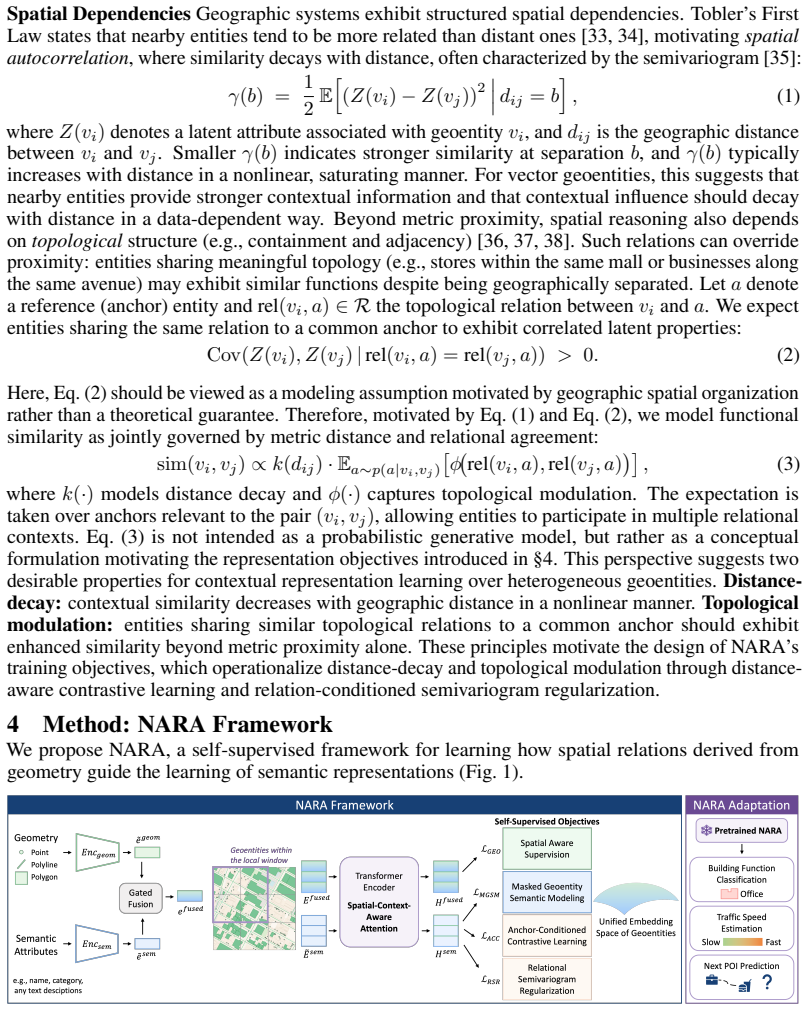
NARA (Neural Anchor-conditioned Relation-Aware representation learning) is a self-supervised framework for vector geoentities. It learns context-dependent representations by jointly modeling semantics, geometry, and spatial relations within a unified framework and captures relational spatial structure beyond proximity alone, enabling rich contextualized representations across heterogeneous geoentities of points, polylines, and polygons. Evaluation on building function classification, traffic speed prediction, and next point-of-interest recommendation shows consistent improvements over prior methods.
What carries the argument
The NARA framework, which uses anchor-conditioned relation-aware modeling to integrate semantics, geometry, and spatial relations for self-supervised learning on heterogeneous vector geoentities.
If this is right
- Consistent performance gains on building function classification tasks.
- Improved accuracy in traffic speed prediction applications.
- Better results for next point-of-interest recommendation systems.
- Unified handling of points, polylines, and polygons without separate models.
Where Pith is reading between the lines
- The framework could serve as a basis for larger-scale geospatial foundation models focused on vector data.
- Extensions might test additional topological relations or integration with raster data sources.
- The joint modeling strategy could apply to other domains with mixed entity types and structured relations.
Load-bearing premise
That jointly modeling semantics, geometry, and spatial relations in a self-supervised manner will produce representations that generalize better than fragmented prior methods on downstream tasks.
What would settle it
If NARA fails to show consistent improvements over prior methods on building function classification, traffic speed prediction, or next point-of-interest recommendation, or if it does not effectively capture relational spatial structures beyond proximity.
Figures
read the original abstract
Geospatial foundation models have primarily focused on raster data such as satellite imagery, where self-supervised learning has been widely studied. Vector geospatial data instead represent the world as discrete geoentities with explicit geometry, semantics, and structured spatial relations, including metric proximity and topological relationships. These relations jointly determine how entities interact within space, yet existing representation learning methods remain fragmented, often restricted to specific geometry types or partial spatial relations, limiting their ability to capture unified spatial context across heterogeneous geoentities. We propose NARA (Neural Anchor-conditioned Relation-Aware representation learning), a self-supervised framework for vector geoentities. NARA learns context-dependent representations by jointly modeling semantics, geometry, and spatial relations within a unified framework and captures relational spatial structure beyond proximity alone, enabling rich contextualized representations across heterogeneous geoentities of points, polylines, and polygons. Evaluation on building function classification, traffic speed prediction, and next point-of-interest recommendation shows consistent improvements over prior methods, highlighting the benefit of unified relational modeling for vector geospatial data.
Editorial analysis
A structured set of objections, weighed in public.
Referee Report
Summary. The manuscript proposes NARA, a self-supervised framework for vector geospatial data that learns context-dependent representations of heterogeneous geoentities (points, polylines, polygons) by jointly modeling semantics, geometry, and spatial relations including topological relationships beyond proximity. It evaluates the approach on three downstream tasks—building function classification, traffic speed prediction, and next point-of-interest recommendation—claiming consistent improvements over prior fragmented methods.
Significance. If the quantitative results and architectural details hold up under scrutiny, the work would address a genuine gap in geospatial foundation models by shifting focus from raster data to structured vector representations with explicit relational modeling. This unified treatment of semantics, geometry, and topology could improve generalization on tasks requiring spatial context, though the abstract provides no metrics to gauge the effect size.
major comments (1)
- [Abstract] Abstract: the central claim of 'consistent improvements over prior methods' is asserted without any quantitative results, baselines, error bars, statistical tests, or even high-level architectural/loss details. This absence makes it impossible to assess whether the data support the claim that joint modeling of semantics, geometry, and spatial relations yields richer representations.
minor comments (1)
- [Abstract] The abstract and title use dense terminology ('anchor-conditioned relation-aware contextualization') without a concise one-sentence definition of the core mechanism; a short illustrative example of how an anchor conditions relations for a polyline would improve accessibility.
Simulated Author's Rebuttal
We thank the referee for their constructive comments. We agree that the abstract would be strengthened by including quantitative highlights and will revise it accordingly to better support our claims while maintaining conciseness.
read point-by-point responses
-
Referee: [Abstract] Abstract: the central claim of 'consistent improvements over prior methods' is asserted without any quantitative results, baselines, error bars, statistical tests, or even high-level architectural/loss details. This absence makes it impossible to assess whether the data support the claim that joint modeling of semantics, geometry, and spatial relations yields richer representations.
Authors: We agree that the abstract should provide quantitative context to support the claim of consistent improvements. In the revised version, we will incorporate specific performance gains (e.g., relative improvements on building classification, traffic prediction, and POI recommendation), reference the main baselines, and note that results include standard error reporting from multiple runs. We will also add a concise high-level description of the anchor-conditioned relation-aware objective and the joint modeling of semantics/geometry/topology. These additions will be kept brief to respect abstract length limits while enabling readers to gauge effect sizes. The full experimental details, tables with error bars, and statistical comparisons remain in the main body and appendix. revision: yes
Circularity Check
No significant circularity in the derivation chain
full rationale
The paper proposes NARA, a new self-supervised framework for learning context-dependent representations of heterogeneous vector geoentities by jointly modeling semantics, geometry, and spatial relations (including topology beyond proximity). The central claims rest on the architecture description and empirical gains on three downstream tasks (building function classification, traffic speed prediction, next POI recommendation) rather than any derivation that reduces to fitted parameters, self-definitions, or self-citation chains. No load-bearing step equates a prediction to its input by construction, and the work is self-contained against external benchmarks.
Axiom & Free-Parameter Ledger
Lean theorems connected to this paper
-
IndisputableMonolith/Cost/FunctionalEquation.leanwashburn_uniqueness_aczel unclear?
unclearRelation between the paper passage and the cited Recognition theorem.
NARA learns context-dependent representations by jointly modeling semantics, geometry, and spatial relations within a unified framework and captures relational spatial structure beyond proximity alone
-
IndisputableMonolith/Foundation/AlexanderDuality.leanalexander_duality_circle_linking unclear?
unclearRelation between the paper passage and the cited Recognition theorem.
semivariogram regularization... sibling groups Sa,r defined by topological relation rel(vi,a)
What do these tags mean?
- matches
- The paper's claim is directly supported by a theorem in the formal canon.
- supports
- The theorem supports part of the paper's argument, but the paper may add assumptions or extra steps.
- extends
- The paper goes beyond the formal theorem; the theorem is a base layer rather than the whole result.
- uses
- The paper appears to rely on the theorem as machinery.
- contradicts
- The paper's claim conflicts with a theorem or certificate in the canon.
- unclear
- Pith found a possible connection, but the passage is too broad, indirect, or ambiguous to say the theorem truly supports the claim.
Reference graph
Works this paper leans on
-
[1]
Planet dump from openstreetmap.https://planet.osm.org,
OpenStreetMap contributors. Planet dump from openstreetmap.https://planet.osm.org,
-
[2]
Accessed: 2026-03-26
work page 2026
-
[3]
Overture maps open data platform
OpenStreetMap contributors, Overture Maps Foundation. Overture maps open data platform. https://overturemaps.org, 2026. Accessed: 2026-03-26
work page 2026
-
[4]
Paul A Longley, Michael F Goodchild, David J Maguire, and David W Rhind.Geographic information science and systems. John Wiley & Sons, 2015
work page 2015
-
[5]
Rethinking transformers pre-training for multi-spectral satellite imagery
Mubashir Noman, Muzammal Naseer, Hisham Cholakkal, Rao Muhammad Anwer, Salman Khan, and Fahad Shahbaz Khan. Rethinking transformers pre-training for multi-spectral satellite imagery. InProceedings of the IEEE/CVF Conference on Computer Vision and Pattern Recognition, pages 27811–27819, 2024
work page 2024
-
[6]
Csp: Self-supervised contrastive spatial pre-training for geospatial-visual representations
Gengchen Mai, Ni Lao, Yutong He, Jiaming Song, and Stefano Ermon. Csp: Self-supervised contrastive spatial pre-training for geospatial-visual representations. InInternational Conference on Machine Learning, pages 23498–23515. PMLR, 2023
work page 2023
-
[7]
Zeping Liu, Lao Ni, Zhangyu Wang, Junfeng Jiao, and Gengchen Mai. Gair: Location-aware self-supervised contrastive pre-training with geo-aligned implicit representations.ISPRS Journal of Photogrammetry and Remote Sensing, 2026
work page 2026
-
[8]
Satclip: Global, general-purpose location embeddings with satellite imagery
Konstantin Klemmer, Esther Rolf, Caleb Robinson, Lester Mackey, and Marc Rußwurm. Satclip: Global, general-purpose location embeddings with satellite imagery. InProceedings of the AAAI Conference on Artificial Intelligence, volume 39, pages 4347–4355, 2025
work page 2025
-
[9]
Daniela Szwarcman, Sujit Roy, Paolo Fraccaro, Orsteinn Elí Gíslason, Benedikt Blumenstiel, Rinki Ghosal, Pedro Henrique De Oliveira, Joao Lucas de Sousa Almeida, Rocco Sedona, Yanghui Kang, et al. Prithvi-eo-2.0: A versatile multi-temporal foundation model for earth observation applications.IEEE Transactions on Geoscience and Remote Sensing, 2025
work page 2025
-
[10]
BERT: Pre-training of deep bidirectional transformers for language understanding
Jacob Devlin, Ming-Wei Chang, Kenton Lee, and Kristina Toutanova. BERT: Pre-training of deep bidirectional transformers for language understanding. In Jill Burstein, Christy Doran, and Thamar Solorio, editors,Proceedings of the 2019 Conference of the North American Chapter of the Association for Computational Linguistics: Human Language Technologies, Volu...
work page 2019
-
[11]
An image is worth 16x16 words: Transformers for image recognition at scale
Alexey Dosovitskiy, Lucas Beyer, Alexander Kolesnikov, Dirk Weissenborn, Xiaohua Zhai, Thomas Unterthiner, Mostafa Dehghani, Matthias Minderer, Georg Heigold, Sylvain Gelly, Jakob Uszkoreit, and Neil Houlsby. An image is worth 16x16 words: Transformers for image recognition at scale. InInternational Conference on Learning Representations, 2021
work page 2021
-
[12]
Multi-scale repre- sentation learning for spatial feature distributions using grid cells
Gengchen Mai, Krzysztof Janowicz, Bo Yan, Rui Zhu, Ling Cai, and Ni Lao. Multi-scale repre- sentation learning for spatial feature distributions using grid cells. InInternational Conference on Learning Representations, 2020
work page 2020
-
[13]
SpaBERT: A pretrained language model from geographic data for geo-entity representation
Zekun Li, Jina Kim, Yao-Yi Chiang, and Muhao Chen. SpaBERT: A pretrained language model from geographic data for geo-entity representation. In Yoav Goldberg, Zornitsa Kozareva, and Yue Zhang, editors,Findings of the Association for Computational Linguistics: EMNLP 2022, pages 2757–2769, Abu Dhabi, United Arab Emirates, December 2022. Association for Compu...
work page 2022
-
[14]
Jiawei Cheng, Jingyuan Wang, Yichuan Zhang, Jiahao Ji, Yuanshao Zhu, Zhibo Zhang, and Xiangyu Zhao. Poi-enhancer: An llm-based semantic enhancement framework for poi represen- tation learning.Proceedings of the AAAI Conference on Artificial Intelligence, 39(11):11509– 11517, Apr. 2025
work page 2025
-
[15]
Liang Zhang and Cheng Long. Road network representation learning: A dual graph-based approach.ACM Transactions on Knowledge Discovery from Data, 17(9):1–25, 2023. 10
work page 2023
-
[16]
Road network representation learning with the third law of geography
Haicang Zhou, Weiming Huang, Yile Chen, Tiantian He, Gao Cong, and Yew-Soon Ong. Road network representation learning with the third law of geography. In A. Globerson, L. Mackey, D. Belgrave, A. Fan, U. Paquet, J. Tomczak, and C. Zhang, editors,Advances in Neural Information Processing Systems, volume 37, pages 11789–11813. Curran Associates, Inc., 2024
work page 2024
-
[17]
Urban region representation learning with openstreetmap building footprints
Yi Li, Weiming Huang, Gao Cong, Hao Wang, and Zheng Wang. Urban region representation learning with openstreetmap building footprints. InProceedings of the 29th ACM SIGKDD Conference on Knowledge Discovery and Data Mining, KDD ’23, page 1363–1373, New York, NY , USA, 2023. Association for Computing Machinery
work page 2023
-
[18]
Geovectors: A linked open corpus of openstreetmap embeddings on world scale
Nicolas Tempelmeier, Simon Gottschalk, and Elena Demidova. Geovectors: A linked open corpus of openstreetmap embeddings on world scale. InProceedings of the 30th ACM Inter- national Conference on Information & Knowledge Management, CIKM ’21, page 4604–4612, New York, NY , USA, 2021. Association for Computing Machinery
work page 2021
-
[19]
City foundation models for learning general purpose representations from openstreetmap
Pasquale Balsebre, Weiming Huang, Gao Cong, and Yi Li. City foundation models for learning general purpose representations from openstreetmap. InProceedings of the 33rd ACM Interna- tional Conference on Information and Knowledge Management, CIKM ’24, page 87–97, New York, NY , USA, 2024. Association for Computing Machinery
work page 2024
-
[20]
Hygmap: representing all types of map entities via heterogeneous hypergraph
Yifan Yang, Jingyuan Wang, Xie Yu, and Yibang Tang. Hygmap: representing all types of map entities via heterogeneous hypergraph. InProceedings of the Thirty-Fourth International Joint Conference on Artificial Intelligence, IJCAI ’25, 2025
work page 2025
-
[21]
Yile Chen, Weiming Huang, Kaiqi Zhao, Yue Jiang, and Gao Cong. Self-supervised representa- tion learning for geospatial objects: A survey.Information Fusion, 123:103265, 2025
work page 2025
-
[22]
node2vec: Scalable feature learning for networks
Aditya Grover and Jure Leskovec. node2vec: Scalable feature learning for networks. In Proceedings of the 22nd ACM SIGKDD International Conference on Knowledge Discovery and Data Mining, KDD ’16, page 855–864, New York, NY , USA, 2016. Association for Computing Machinery
work page 2016
-
[23]
Learning embeddings of intersections on road networks
Meng-xiang Wang, Wang-Chien Lee, Tao-yang Fu, and Ge Yu. Learning embeddings of intersections on road networks. InProceedings of the 27th ACM SIGSPATIAL International Conference on Advances in Geographic Information Systems, SIGSPATIAL ’19, page 309–318, New York, NY , USA, 2019. Association for Computing Machinery
work page 2019
-
[24]
Jensen, and Thomas Dyhre Nielsen
Tobias Skovgaard Jepsen, Christian S. Jensen, and Thomas Dyhre Nielsen. Relational fusion networks: Graph convolutional networks for road networks.IEEE Transactions on Intelligent Transportation Systems, 23(1):418–429, 2022
work page 2022
-
[25]
Gengchen Mai, Chiyu Jiang, Weiwei Sun, Rui Zhu, Yao Xuan, Ling Cai, Krzysztof Janowicz, Stefano Ermon, and Ni Lao. Towards general-purpose representation learning of polygonal geometries.GeoInformatica, 27(2):289–340, 2023
work page 2023
-
[26]
Poly2vec: Polymorphic fourier-based encoding of geospatial objects for geoAI applications
Maria Despoina Siampou, Jialiang Li, John Krumm, Cyrus Shahabi, and Hua Lu. Poly2vec: Polymorphic fourier-based encoding of geospatial objects for geoAI applications. InForty- second International Conference on Machine Learning, 2025
work page 2025
-
[27]
Geo2vec: Shape-and distance-aware neural representation of geospatial entities
Chen Chu and Cyrus Shahabi. Geo2vec: Shape-and distance-aware neural representation of geospatial entities. InProceedings of the AAAI Conference on Artificial Intelligence, volume 40, pages 18985–18993, 2026
work page 2026
-
[28]
Bo Yan, Krzysztof Janowicz, Gengchen Mai, and Song Gao. From itdl to place2vec: Reasoning about place type similarity and relatedness by learning embeddings from augmented spatial contexts. InProceedings of the 25th ACM SIGSPATIAL international conference on advances in geographic information systems, pages 1–10, 2017
work page 2017
-
[29]
Gengchen Mai, Bo Yan, Krzysztof Janowicz, and Rui Zhu. Relaxing unanswerable geographic questions using a spatially explicit knowledge graph embedding model. InInternational conference on geographic information science, pages 21–39. Springer, 2019. 11
work page 2019
-
[30]
Weiming Huang, Lizhen Cui, Meng Chen, Daokun Zhang, and Yao Yao. Estimating urban functional distributions with semantics preserved poi embedding.International Journal of Geographical Information Science, 36(10):1905–1930, 2022
work page 1905
-
[31]
Tile2vec: Unsupervised representation learning for spatially distributed data
Neal Jean, Sherrie Wang, Anshul Samar, George Azzari, David Lobell, and Stefano Ermon. Tile2vec: Unsupervised representation learning for spatially distributed data. InProceedings of the AAAI Conference on Artificial Intelligence, volume 33, pages 3967–3974, 2019
work page 2019
-
[32]
Mc-gta: Metric-constrained model-based clustering using goodness-of-fit tests with autocorrelations
Zhangyu Wang, Gengchen Mai, Krzysztof Janowicz, and Ni Lao. Mc-gta: Metric-constrained model-based clustering using goodness-of-fit tests with autocorrelations. In41st International Conference on Machine Learning, ICML 2024, 2024
work page 2024
-
[33]
Hao Li, Jiapan Wang, Johann Maximilian Zollner, Gengchen Mai, Ni Lao, and Martin Werner. Rethink geographical generalizability with unsupervised self-attention model ensemble: A case study of openstreetmap missing building detection in africa. InProceedings of the 31st ACM International Conference on Advances in Geographic Information Systems, pages 1–9, 2023
work page 2023
-
[34]
Waldo R Tobler. A computer movie simulating urban growth in the detroit region.Economic geography, 46(sup1):234–240, 1970
work page 1970
-
[35]
Waldo Tobler. On the first law of geography: A reply.Annals of the association of American geographers, 94(2):304–310, 2004
work page 2004
-
[36]
Martin Bachmaier and Matthias Backes. Variogram or semivariogram? variance or semivari- ance? allan variance or introducing a new term?Mathematical Geosciences, 43(6):735–740, 2011
work page 2011
-
[37]
A mathematical framework for the definition of topological relations
Max Egenhofer. A mathematical framework for the definition of topological relations. InProc. the fourth international symposium on spatial data handing, pages 803–813, 1990
work page 1990
-
[38]
A spatial logic based on regions and connection.KR, 92(165-176):40–40, 1992
David A Randell, Zhan Cui, Anthony G Cohn, et al. A spatial logic based on regions and connection.KR, 92(165-176):40–40, 1992
work page 1992
-
[39]
Blake Regalia, Krzysztof Janowicz, and Grant McKenzie. Computing and querying strict, approximate, and metrically refined topological relations in linked geographic data.Transactions in GIS, 23(3):601–619, 2019
work page 2019
-
[40]
GeoLM: Empowering language models for geospatially grounded language understanding
Zekun Li, Wenxuan Zhou, Yao-Yi Chiang, and Muhao Chen. GeoLM: Empowering language models for geospatially grounded language understanding. In Houda Bouamor, Juan Pino, and Kalika Bali, editors,Proceedings of the 2023 Conference on Empirical Methods in Nat- ural Language Processing, pages 5227–5240, Singapore, December 2023. Association for Computational L...
work page 2023
-
[41]
Yijun Lin, Yao-Yi Chiang, Meredith Franklin, Sandrah P. Eckel, and José Luis Ambite. Building autocorrelation-aware representations for fine-scale spatiotemporal prediction. In2020 IEEE International Conference on Data Mining (ICDM), pages 352–361, 2020
work page 2020
-
[42]
Jilin Hu, Chenjuan Guo, Bin Yang, and Christian S. Jensen. Stochastic weight completion for road networks using graph convolutional networks. In2019 IEEE 35th International Conference on Data Engineering (ICDE), pages 1274–1285, 2019
work page 2019
-
[43]
Dingqi Yang, Daqing Zhang, Vincent W Zheng, and Zhiyong Yu. Modeling user activity preference by leveraging user spatial temporal characteristics in lbsns.IEEE Transactions on Systems, Man, and Cybernetics: Systems, 45(1):129–142, 2014
work page 2014
-
[44]
Llama 2: Open Foundation and Fine-Tuned Chat Models
Hugo Touvron, Louis Martin, Kevin Stone, Peter Albert, Amjad Almahairi, Yasmine Babaei, Nikolay Bashlykov, Soumya Batra, Prajjwal Bhargava, Shruti Bhosale, et al. Llama 2: Open foundation and fine-tuned chat models.arXiv preprint arXiv:2307.09288, 2023
work page internal anchor Pith review Pith/arXiv arXiv 2023
-
[45]
Huaiyu Wan, Yan Lin, Shengnan Guo, and Youfang Lin. Pre-training time-aware location embeddings from spatial-temporal trajectories.IEEE Transactions on Knowledge and Data Engineering, 34(11):5510–5523, 2022. 12
work page 2022
-
[46]
Yan Lin, Huaiyu Wan, Shengnan Guo, and Youfang Lin. Pre-training context and time aware location embeddings from spatial-temporal trajectories for user next location prediction.Pro- ceedings of the AAAI Conference on Artificial Intelligence, 35(5):4241–4248, May 2021
work page 2021
-
[47]
Mordechai Haklay. How good is volunteered geographical information? a comparative study of openstreetmap and ordnance survey datasets.Environment and planning B: Planning and design, 37(4):682–703, 2010
work page 2010
-
[48]
Ilya Loshchilov and Frank Hutter. Decoupled weight decay regularization. InInternational Conference on Learning Representations, 2019. 13 A Limitations & Broader Impact LimitationsNARA is pretrained on a specific geographic region; as with most geospatial mod- els [20], spatial variability across cities with different urban structures may limit transferab...
work page 2019
discussion (0)
Sign in with ORCID, Apple, or X to comment. Anyone can read and Pith papers without signing in.