Recognition: unknown
Large-Small Model Collaboration for Farmland Semantic Change Detection
Pith reviewed 2026-05-13 05:52 UTC · model grok-4.3
The pith
A small Mamba model collaborates with a frozen large vision-language model to reach 97.63% F1 on farmland semantic change detection using only 6.65 million trainable parameters.
A machine-rendered reading of the paper's core claim, the machinery that carries it, and where it could break.
Core claim
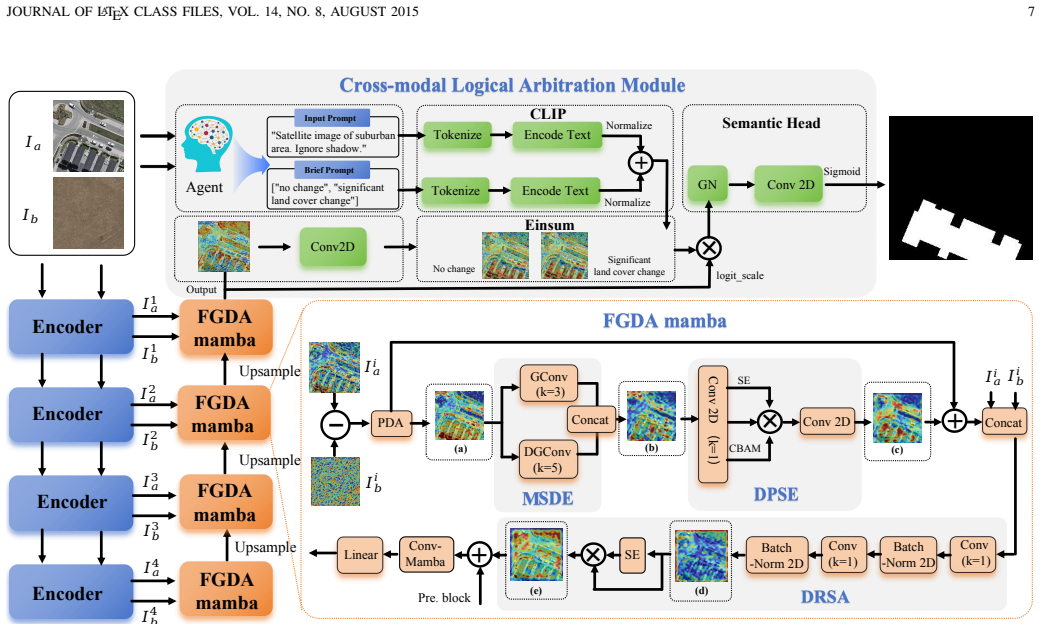
The central claim is that integrating Fine-grained Difference-aware Mamba for dense change features with Cross-modal Logical Arbitration from a frozen CLIP-based model, guided by hard-region co-training on low-confidence pixels, produces accurate semantic change maps for farmland that outperform prior multimodal approaches while requiring far fewer trainable weights.
What carries the argument
The hard-region co-training strategy, which supervises the large model's semantic score map exclusively on low-confidence pixels to enable collaboration between the small visual model and the frozen vision-language model.
If this is right
- Farmland conversion can be monitored at fine semantic granularity despite phenology-induced appearance shifts.
- Boundary accuracy and small-object localization improve because the small model focuses on dense local differences.
- Textual priors from the large model reduce false positives from illumination and crop rotation.
- The approach generalizes to standard change-detection datasets such as LEVIR-CD and WHU-CD.
- Only 6.65 million parameters need training, enabling deployment on resource-limited hardware.
Where Pith is reading between the lines
- The same collaboration pattern could be tested on non-farmland remote-sensing tasks where semantic priors help distinguish subtle conversions.
- Replacing the Mamba backbone with an even lighter architecture might preserve accuracy if co-training remains stable.
- Extending the framework to multi-date sequences rather than strict bitemporal pairs would allow tracking gradual land-use shifts.
- Public release of the HZNU-FCD benchmark invites direct comparisons that could accelerate progress on farmland-specific SCD.
Load-bearing premise
Low-confidence pixels identified by the small model can safely supervise the large model's semantic scores without injecting bias from the new dataset's annotation rules or causing overfitting.
What would settle it
A controlled experiment on a fresh farmland dataset that uses different seasonal timing or annotation conventions where the proposed method shows no F1 improvement over strong baselines.
Figures




read the original abstract
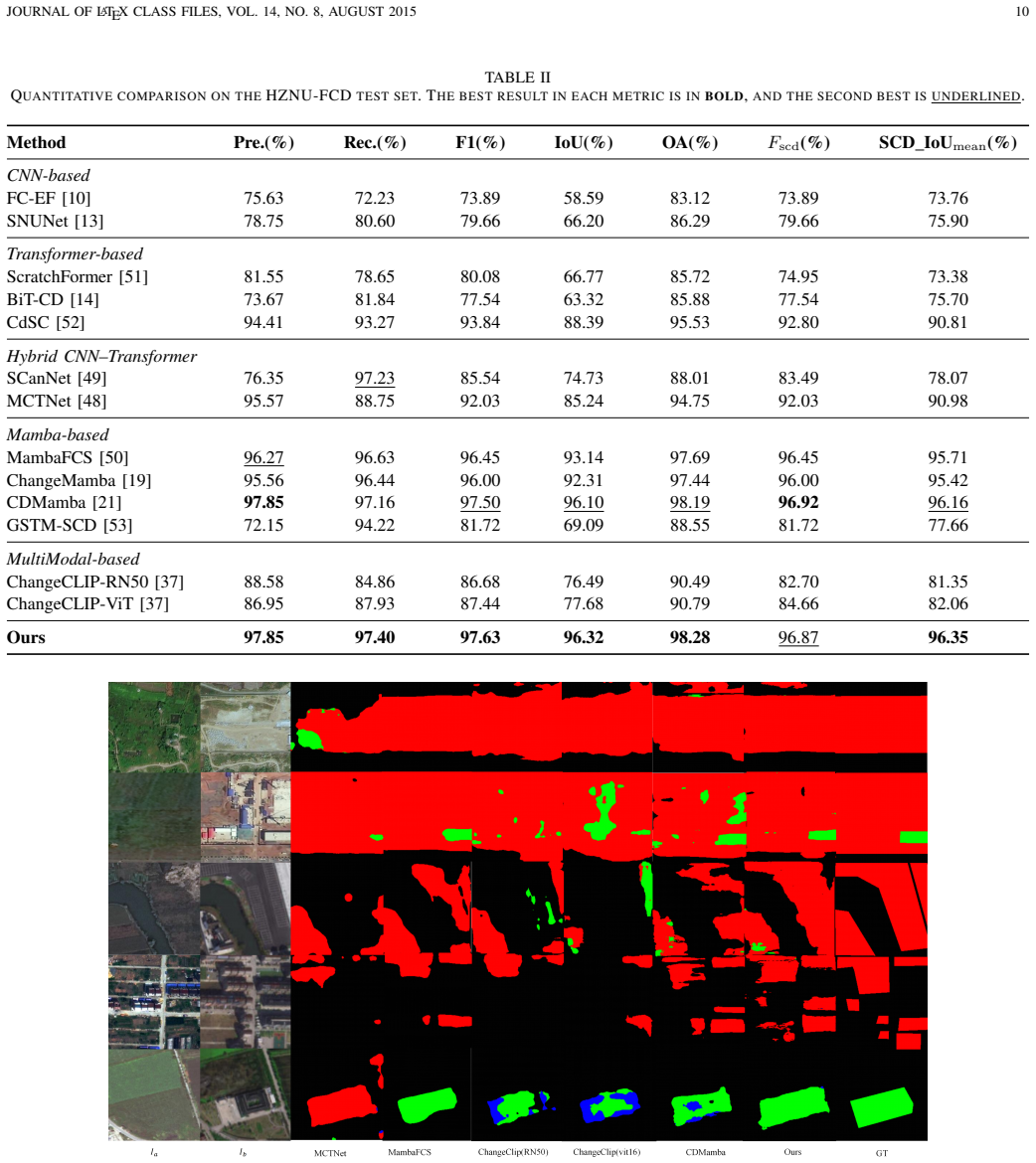
Farmland Semantic Change Detection (SCD) is essential for cultivated land protection, yet existing benchmarks and models remain insufficient for fine-grained farmland conversion monitoring. Current datasets often lack dedicated "from-to" annotations, while visual change detection models are easily disturbed by phenology-induced pseudo-changes caused by crop rotation, seasonal variation, and illumination differences. To address these challenges, we construct HZNU-FCD, a large-scale fine-grained farmland SCD benchmark with a unified five-class farmland-to-non-farmland annotation protocol. It contains 4,588 bitemporal image pairs with pixel-level labels for practical farmland protection. Based on this benchmark, we propose a large-small collaborative SCD framework that integrates a task-driven small visual model with a frozen large vision-language model. The small model, Fine-grained Difference-aware Mamba (FD-Mamba), learns dense change representations for boundary preservation and small-region localization. The large-model pathway, Cross-modal Logical Arbitration (CMLA), introduces CLIP-based textual priors for prompt-guided semantic arbitration and pseudo-change suppression. To enable effective collaboration, we design a hard-region co-training strategy that supervises the CMLA semantic score map only on low-confidence pixels. Experiments show that our method achieves 97.63% F1, 96.32% IoU, and 96.35% SCD_IoU_mean on HZNU-FCD with only 6.65M trainable parameters. Compared with the multimodal ChangeCLIP-ViT, which leverages vision-language information for change detection, our method improves F1 by 10.19 percentage points on HZNU-FCD. It also achieves 91.43% F1 and 84.21% IoU on LEVIR-CD, and 93.85% F1 and 88.41% IoU on WHU-CD, demonstrating strong robustness and generalization. The code is available at https://github.com/Lovelymili/FD-Mamba.
Editorial analysis
A structured set of objections, weighed in public.
Referee Report
Summary. The paper introduces the HZNU-FCD benchmark dataset for fine-grained farmland semantic change detection (SCD) with a five-class 'from-to' annotation protocol and proposes a large-small collaborative framework. A small Fine-grained Difference-aware Mamba (FD-Mamba) model handles dense change representations, while a frozen CLIP-based Cross-modal Logical Arbitration (CMLA) pathway supplies textual priors for semantic arbitration and pseudo-change suppression. These are combined via a hard-region co-training strategy that supervises the large model's semantic scores only on low-confidence pixels. The method reports 97.63% F1, 96.32% IoU, and 96.35% SCD_IoU_mean on HZNU-FCD (6.65M trainable parameters), a 10.19 pp F1 gain over ChangeCLIP-ViT, plus competitive results on LEVIR-CD and WHU-CD; code is released.
Significance. If substantiated, the work offers a practical advance for farmland monitoring by explicitly targeting phenology-induced pseudo-changes through vision-language priors and an efficient hybrid architecture. The new dataset and released code are clear strengths that could support follow-on research; the parameter efficiency and reported generalization across public benchmarks add to the potential impact in remote-sensing change detection.
major comments (2)
- [Abstract / Method] The hard-region co-training strategy (described in the abstract and method overview) is load-bearing for the central performance claims yet lacks any specification of the confidence threshold, the precise loss formulation used to supervise CMLA on FD-Mamba-identified low-confidence pixels, or ablation studies that isolate its contribution. Without these, it is impossible to verify that the reported 97.63% F1 and +10.19 pp gain do not arise from circular reinforcement of HZNU-FCD-specific label artifacts rather than robust cross-modal arbitration.
- [Experiments] Experimental section provides headline metrics but omits details on train/validation/test splits for HZNU-FCD, any cross-validation protocol, or error analysis (e.g., per-class IoU or confusion matrices for the five farmland-to-non-farmland transitions). These omissions directly affect assessment of whether the generalization claims on LEVIR-CD (91.43% F1) and WHU-CD hold under the same annotation conventions.
minor comments (2)
- [Abstract] The metric 'SCD_IoU_mean' is introduced without an explicit definition; clarify whether it denotes the mean IoU over semantic change classes or another aggregation.
- [Experiments] Figure and table captions should explicitly state the number of runs or random seeds used to obtain the reported means and standard deviations (if any).
Simulated Author's Rebuttal
We thank the referee for the constructive and detailed feedback. The comments highlight important areas for improving clarity and reproducibility, and we have revised the manuscript accordingly to strengthen the presentation of the hard-region co-training strategy and the experimental reporting.
read point-by-point responses
-
Referee: [Abstract / Method] The hard-region co-training strategy (described in the abstract and method overview) is load-bearing for the central performance claims yet lacks any specification of the confidence threshold, the precise loss formulation used to supervise CMLA on FD-Mamba-identified low-confidence pixels, or ablation studies that isolate its contribution. Without these, it is impossible to verify that the reported 97.63% F1 and +10.19 pp gain do not arise from circular reinforcement of HZNU-FCD-specific label artifacts rather than robust cross-modal arbitration.
Authors: We agree that the hard-region co-training strategy is central to the performance claims and that its description in the abstract and method overview requires greater precision for verification. In the revised manuscript, we have expanded the method section with the exact confidence threshold used to select low-confidence pixels, the precise loss formulation (masked supervision of CMLA semantic scores via cross-entropy on those pixels only), and dedicated ablation studies that isolate the co-training component. These additions demonstrate that the reported gains arise from the cross-modal arbitration and pseudo-change suppression rather than dataset-specific artifacts, and we have added a brief discussion of robustness to potential label noise. revision: yes
-
Referee: [Experiments] Experimental section provides headline metrics but omits details on train/validation/test splits for HZNU-FCD, any cross-validation protocol, or error analysis (e.g., per-class IoU or confusion matrices for the five farmland-to-non-farmland transitions). These omissions directly affect assessment of whether the generalization claims on LEVIR-CD (91.43% F1) and WHU-CD hold under the same annotation conventions.
Authors: We acknowledge that the experimental section would benefit from additional reporting details. In the revised manuscript, we have added a dedicated paragraph specifying the train/validation/test splits for HZNU-FCD, the cross-validation protocol, and comprehensive error analysis including per-class IoU scores and confusion matrices across the five farmland-to-non-farmland transitions. These updates enable direct assessment of the generalization results on LEVIR-CD and WHU-CD under consistent evaluation practices. revision: yes
Circularity Check
No significant circularity in the derivation or claims.
full rationale
The paper introduces a new dataset (HZNU-FCD) and a collaborative architecture (FD-Mamba + frozen CLIP-based CMLA with hard-region co-training) whose performance numbers are obtained via standard empirical evaluation on held-out test splits and external public benchmarks (LEVIR-CD, WHU-CD). No equations, parameters, or central claims reduce by construction to fitted inputs, self-definitions, or load-bearing self-citations; the reported F1/IoU gains are falsifiable measurements rather than tautological renamings or predictions.
Axiom & Free-Parameter Ledger
free parameters (1)
- training hyperparameters and hard-region thresholds
axioms (1)
- domain assumption CLIP textual priors provide reliable semantic guidance for distinguishing real farmland changes from phenology-induced pseudo-changes.
Reference graph
Works this paper leans on
-
[1]
Land-cover change detection using multi-temporal MODIS NDVI data,
R. S. Lunetta, J. F. Knight, J. Ediriwickrema, J. G. Lyon, and L. D. Worthy, “Land-cover change detection using multi-temporal MODIS NDVI data,”Remote Sensing of Environment, vol. 105, no. 2, pp. 142– 154, 2006
work page 2006
-
[2]
Z. Sun, Y . Zhong, X. Wang, and L. Zhang, “Identifying cropland non-agriculturalization with high representational consistency from bi- temporal high-resolution remote sensing images: From benchmark datasets to real-world application,”ISPRS Journal of Photogrammetry and Remote Sensing, vol. 212, pp. 454–474, 2024
work page 2024
-
[3]
Multitask learning for large-scale semantic change detection,
R. C. Daudt, B. Le Saux, A. Boulch, and Y . Gousseau, “Multitask learning for large-scale semantic change detection,”Computer Vision and Image Understanding, vol. 187, p. 102783, 2019
work page 2019
-
[4]
Asymmetric siamese networks for semantic change detection in aerial images,
K. Yang, G.-S. Xia, Z. Liu, B. Du, W. Yang, M. Pelillo, and L. Zhang, “Asymmetric siamese networks for semantic change detection in aerial images,”IEEE Transactions on Geoscience and Remote Sensing, vol. 60, pp. 1–18, 2022
work page 2022
-
[5]
H. Chen and Z. Shi, “A spatial-temporal attention-based method and a new dataset for remote sensing image change detection,”Remote Sensing, vol. 12, no. 10, p. 1662, 2020
work page 2020
-
[6]
Q. Shi, M. Liu, S. Li, X. Liu, F. Wang, and L. Zhang, “A deeply supervised attention metric-based network and an open aerial image dataset for remote sensing change detection,”IEEE Transactions on Geoscience and Remote Sensing, vol. 60, pp. 1–16, 2022
work page 2022
-
[7]
S. Ji, S. Wei, and M. Lu, “Fully convolutional networks for multisource building extraction from an open aerial and satellite imagery dataset,” in IEEE Transactions on Geoscience and Remote Sensing, vol. 57, no. 1, 2018, pp. 574–586
work page 2018
-
[8]
Chang Guang Satellite Technology Co., Ltd., “Jilin-1 cup 2024 remote sensing image intelligent processing competition, track 2: Farmland semantic change detection,” 2024, accessed: 2026-05-
work page 2024
-
[9]
Available: https://www.jl1mall.com/contest/match/info? id=1645664411716952066
[Online]. Available: https://www.jl1mall.com/contest/match/info? id=1645664411716952066
-
[10]
S. Sui, J. Zhang, H. Gu, and Y . Chang, “Panet: A multi-scale temporal decoupling network and its high-resolution benchmark dataset for detect- ing pseudo changes in cropland non-agriculturalization,”ISPRS Journal of Photogrammetry and Remote Sensing, vol. 233, pp. 126–143, 2026
work page 2026
-
[11]
Fully convolutional siamese networks for change detection,
R. C. Daudt, B. Le Saux, and A. Boulch, “Fully convolutional siamese networks for change detection,” in2018 25th IEEE International Con- ference on Image Processing (ICIP), 2018, pp. 4063–4067
work page 2018
-
[12]
Change detection based on deep siamese convolutional network for optical aerial images,
Y . Zhan, K. Fu, M. Yan, X. Sun, H. Wang, and X. Qiu, “Change detection based on deep siamese convolutional network for optical aerial images,”IEEE Geoscience and Remote Sensing Letters, vol. 14, no. 10, pp. 1845–1849, 2017
work page 2017
-
[13]
C. Zhang, P. Yue, D. Tapete, L. Jiang, B. Shangguan, L. Huang, and G. Liu, “A deeply supervised image fusion network for change detection in high resolution bi-temporal remote sensing images,”ISPRS Journal of Photogrammetry and Remote Sensing, vol. 166, pp. 183–200, 2020
work page 2020
-
[14]
Snunet-cd: A densely connected siamese network for change detection of vhr images,
S. Fang, K. Li, J. Shao, and Z. Li, “Snunet-cd: A densely connected siamese network for change detection of vhr images,”IEEE Geoscience and Remote Sensing Letters, vol. 19, pp. 1–5, 2021
work page 2021
-
[15]
Remote sensing image change detection with transformers,
H. Chen, Z. Qi, and Z. Shi, “Remote sensing image change detection with transformers,”IEEE Transactions on Geoscience and Remote Sensing, vol. 60, pp. 1–14, 2022
work page 2022
-
[16]
A transformer-based siamese network for change detection,
W. G. C. Bandara and V . M. Patel, “A transformer-based siamese network for change detection,” in2022 IEEE International Geoscience and Remote Sensing Symposium (IGARSS), 2022, pp. 207–210
work page 2022
-
[17]
Swinsunet: Pure transformer network for remote sensing image change detection,
C. Zhang, L. Wang, S. Cheng, and Y . Li, “Swinsunet: Pure transformer network for remote sensing image change detection,”IEEE Transactions on Geoscience and Remote Sensing, vol. 60, pp. 1–13, 2022
work page 2022
-
[18]
K. Zhang, L. T. Luppino, X. X. Zhu, and L. Bruzzone, “Relation changes matter: Cross-temporal difference transformer for change detection in remote sensing images,”IEEE Transactions on Geoscience and Remote Sensing, vol. 61, pp. 1–15, 2023
work page 2023
-
[19]
Lightweight structure-aware transformer network for remote sensing image change detection,
T. Lei, Y . Xu, H. Ning, Z. Lv, C. Min, Y . Jin, and A. K. Nandi, “Lightweight structure-aware transformer network for remote sensing image change detection,”IEEE Geoscience and Remote Sensing Letters, vol. 21, no. 6000305, pp. 1–5, 2024
work page 2024
-
[20]
Changemamba: Re- mote sensing change detection with spatiotemporal state space model,
H. Chen, J. Song, C. Han, J. Xia, and N. Yokoya, “Changemamba: Re- mote sensing change detection with spatiotemporal state space model,” IEEE Transactions on Geoscience and Remote Sensing, vol. 62, pp. 1– 20, 2024
work page 2024
-
[21]
Rs-mamba for large remote sensing image dense prediction,
S. Zhao, H. Chen, X. Zhang, P. Xiao, L. Bai, and W. Ouyang, “Rs-mamba for large remote sensing image dense prediction,”IEEE Transactions on Geoscience and Remote Sensing, vol. 62, pp. 1–14, 2024
work page 2024
-
[22]
Cdmamba: Incorporating local clues into mamba for remote sensing image binary change detection,
H. Zhang, K. Chen, C. Liu, H. Chen, Z. Zou, and Z. Shi, “Cdmamba: Incorporating local clues into mamba for remote sensing image binary change detection,”IEEE Transactions on Geoscience and Remote Sens- ing, vol. 63, pp. 1–16, 2025
work page 2025
-
[23]
Conmamba: Cnn and ssm high- performance hybrid network for remote sensing change detection,
Z. Dong, G. Yuan, Z. Hua, and J. Li, “Conmamba: Cnn and ssm high- performance hybrid network for remote sensing change detection,”IEEE Transactions on Geoscience and Remote Sensing, vol. 62, pp. 1–15, 2024
work page 2024
-
[24]
Multi-modal medical diagnosis via large-small model collaboration,
W. Chen, Z. Zhao, J. Yao, Y . Zhang, J. Bu, and H. Wang, “Multi-modal medical diagnosis via large-small model collaboration,” inProceedings of the Computer Vision and Pattern Recognition Conference, 2025, pp. 30 763–30 773
work page 2025
-
[25]
Z. Liu, K. Liu, M. Guo, S. Zhang, and Y . Wang, “Cotuning: A large- small model collaborating distillation framework for better model gen- eralization,” inProceedings of the 32nd ACM International Conference on Multimedia, 2024, pp. 10 487–10 496
work page 2024
-
[26]
Collab- orative training of tiny-large vision language models,
S. Lu, L. Guo, W. Wang, Z. Zhao, T. Yue, J. Liu, and S. Liu, “Collab- orative training of tiny-large vision language models,” inProceedings of the 32nd ACM International Conference on Multimedia, 2024, pp. 4928–4937
work page 2024
-
[27]
S. Wang, Y . Liu, X. Tang, and W. Chen, “Collaborative enhancement of large and small models for question answering via dual knowledge trans- fer,” inProceedings of the AAAI Conference on Artificial Intelligence, vol. 40, no. 40, 2026, pp. 33 630–33 638
work page 2026
-
[28]
Multimodal adaptive distilla- tion for leveraging unimodal encoders for vision-language tasks,
Z. Wang, N. Codella, Y .-C. Chen, L. Zhou, X. Dai, B. Xiao, J. Yang, H. You, K.-W. Chang, S.-f. Changet al., “Multimodal adaptive distilla- tion for leveraging unimodal encoders for vision-language tasks,”arXiv preprint arXiv:2204.10496, 2022
-
[29]
Data shunt: Collaboration of small and large models for lower costs and better performance,
D. Chen, Y . Zhuang, S. Zhang, J. Liu, S. Dong, and S. Tang, “Data shunt: Collaboration of small and large models for lower costs and better performance,” inProceedings of the AAAI Conference on Artificial Intelligence, vol. 38, no. 10, 2024, pp. 11 249–11 257
work page 2024
-
[30]
H. Wang, N. Wang, and X. Li, “FarmCD: Agricultural information- guided gated network for farmland change detection from remote sensing images,”IEEE Transactions on Geoscience and Remote Sensing, vol. 61, pp. 1–14, 2026
work page 2026
-
[31]
Bi- Temporal semantic reasoning for the semantic change detection in HR remote sensing images,
L. Ding, H. Guo, S. Liu, L. Mou, J. Zhang, and L. Bruzzone, “Bi- Temporal semantic reasoning for the semantic change detection in HR remote sensing images,”IEEE Transactions on Geoscience and Remote Sensing, vol. 60, pp. 1–14, 2022
work page 2022
-
[32]
Mamba: Linear-time sequence modeling with selective state spaces,
A. Gu and T. Dao, “Mamba: Linear-time sequence modeling with selective state spaces,” 2023
work page 2023
-
[33]
B. Wijenayake, A. Ratnayake, P. Sumanasekara, R. Godaliyadda, P. Ekanayake, V . Herath, and N. Wasalathilaka, “Mamba-fcs: Joint spatio-frequency feature fusion, change-guided attention, and sek in- spired loss for enhanced semantic change detection in remote sensing,” IEEE Journal of Selected Topics in Applied Earth Observations and Remote Sensing, 2026. ...
work page 2026
-
[34]
Ham-cd: Hybrid attention mamba for remote sensing change detection,
G. Li, P. Han, W. Wang, T. Mu, Z. Xiao, and X. Li, “Ham-cd: Hybrid attention mamba for remote sensing change detection,”IEEE Transactions on Geoscience and Remote Sensing, vol. 64, p. 5609518, 2026
work page 2026
-
[35]
C. Fang, S. Cheng, A. Du, C. Wu, and Y . Ding, “Lgmm-net: A local–global encoder and mask mamba decoder network for remote sens- ing change detection,”IEEE Transactions on Geoscience and Remote Sensing, vol. 64, p. 2000923, 2026
work page 2026
-
[36]
Z. Zheng, Q. Wan, Y . Zhang, Y . Zhong, and L. Zhang, “HGINet: Hierarchical graph interaction transformer with edge-indicated attention for semantic change detection,”IEEE Transactions on Geoscience and Remote Sensing, vol. 62, pp. 1–16, 2024
work page 2024
-
[37]
L. Ding, H. Tang, and L. Bruzzone, “Landscd: Change detection based on change of land surface characteristics under semantic constraints,” IEEE Transactions on Geoscience and Remote Sensing, vol. 60, pp. 1– 14, 2022
work page 2022
-
[38]
W. Shi, M. Zhang, R. Zhang, S. Chen, and Z. Zhan, “Changeclip: Remote sensing change detection with sample-efficient vision-language semantic alignment,”ISPRS Journal of Photogrammetry and Remote Sensing, vol. 208, pp. 1–14, 2024
work page 2024
-
[39]
Semantic change detection via bidirectional vision-language feature alignment,
Y . Liu, D. Peng, X. Zhang, Q. Guo, Y . Zhong, and L. Zhang, “Semantic change detection via bidirectional vision-language feature alignment,” IEEE Transactions on Geoscience and Remote Sensing, vol. 62, pp. 1– 14, 2024
work page 2024
-
[40]
A novel change detection method based on visual language from high-resolution remote sensing images,
J. Qiu, W. Liu, H. Zhang, E. Li, L. Zhang, and X. Li, “A novel change detection method based on visual language from high-resolution remote sensing images,”IEEE Journal of Selected Topics in Applied Earth Observations and Remote Sensing, vol. 18, pp. 4554–4567, 2024
work page 2024
-
[41]
Z. Wu, L. Zan, Z. Chen, M. Cai, Y . Li, Z. Wang, J. Xie, and X. Shi, “A remote sensing image change detection network with feature constraints from a visual foundation model,”IEEE Journal of Selected Topics in Applied Earth Observations and Remote Sensing, vol. 18, pp. 28 939– 28 956, 2025
work page 2025
-
[42]
Change-lisa: Language-guided reasoning for remote sensing change detection,
X. Jia, Z. Chen, S. Zhang, and X. Xue, “Change-lisa: Language-guided reasoning for remote sensing change detection,”IEEE Transactions on Geoscience and Remote Sensing, vol. 64, p. 3001415, 2026
work page 2026
-
[43]
Wfcdclip: A clip-based framework for weakly supervised farmland change detection,
Z. Cao, Y . Huang, L. Ma, Y . Zhou, P. Zhou, and W. Shi, “Wfcdclip: A clip-based framework for weakly supervised farmland change detection,” IEEE Transactions on Geoscience and Remote Sensing, vol. 64, p. 3684850, 2026
work page 2026
-
[44]
S. Dong, C. Lu, S. Fu, and X. Meng, “Synergy of content and style: Enhanced remote sensing change detection via disentanglement and refinement,”IEEE Transactions on Geoscience and Remote Sensing, vol. 64, p. 5610316, 2026
work page 2026
-
[45]
X. Yuan, L. Chen, J. Zhang, G. Zhou, M. Wang, and L. Li, “Imea-net: An edge-sensitive network for cropland change detection in high-resolution remote sensing images,”ISPRS Journal of Photogrammetry and Remote Sensing, vol. 236, pp. 175–196, 2026
work page 2026
-
[46]
M. Liu, Z. Chai, H. Deng, and R. Liu, “A CNN-transformer network with multiscale context aggregation for fine-grained cropland change de- tection,”IEEE Journal of Selected Topics in Applied Earth Observations and Remote Sensing, vol. 15, pp. 4297–4306, 2022
work page 2022
-
[47]
Learning transferable visual models from natural language supervi- sion,
A. Radford, J. W. Kim, C. Hallacy, A. Ramesh, G. Goh, S. Agarwal, G. Sastry, A. Askell, P. Mishkin, J. Clark, G. Krueger, and I. Sutskever, “Learning transferable visual models from natural language supervi- sion,” inProceedings of the International Conference on Machine Learning, 2021, pp. 8748–8763
work page 2021
-
[48]
Gemini: A Family of Highly Capable Multimodal Models
Gemini Team, R. Anil, S. Borgeaud, J.-B. Alayrac, J. Yu, R. Soricut, J. Schalkwyk, A. M. Dai, A. Hauth, K. Millican, D. Silver, M. Johnson, I. Antonoglou, J. Schrittwieser, A. Glaese, J. Chen, E. Pitler, T. Lillicrap, A. Lazaridou, O. Firatet al., “Gemini: A family of highly capable multimodal models,”arXiv preprint arXiv:2312.11805, 2024
work page internal anchor Pith review Pith/arXiv arXiv 2024
-
[49]
MCTNet: Multi- context transformer network for semantic change detection of remote sensing images,
T. Song, X. Zhang, J. Li, L. Gao, B. Li, and M. Peng, “MCTNet: Multi- context transformer network for semantic change detection of remote sensing images,”IEEE Transactions on Geoscience and Remote Sensing, vol. 61, pp. 1–15, 2023
work page 2023
-
[50]
SCanNet: Joint spatiotempo- ral convolutional-and-attention network for semantic change detection,
Y . Du, J. Xu, X. Zhu, X. Qiu, and Z. Wei, “SCanNet: Joint spatiotempo- ral convolutional-and-attention network for semantic change detection,” IEEE Transactions on Geoscience and Remote Sensing, vol. 61, pp. 1– 15, 2023
work page 2023
-
[51]
Z. Zhao, H. Zhang, Y . He, Y . Zhou, and Z. Shi, “MambaFCS: Selective state space model with frequency-domain cues for remote sensing image change detection,”IEEE Transactions on Geoscience and Remote Sensing, vol. 62, pp. 1–15, 2024
work page 2024
-
[52]
Remote sensing change detection with transformers trained from scratch,
M. Noman, M. Fiaz, H. Cholakkal, S. Narayan, R. Muhammad Anwer, S. Khan, and F. Shahbaz Khan, “Remote sensing change detection with transformers trained from scratch,”IEEE Transactions on Geoscience and Remote Sensing, vol. 62, pp. 1–14, 2024
work page 2024
-
[53]
Cross-difference semantic consistency network for semantic change detection,
Q. Wang, W. Jing, K. Chi, and Y . Yuan, “Cross-difference semantic consistency network for semantic change detection,”IEEE Transactions on Geoscience and Remote Sensing, vol. 62, pp. 1–12, 2024
work page 2024
-
[54]
X. Liu, C. Dai, L. Ding, Z. Zhang, Y . Li, X. Zuo, M. Li, H. Wang, and Y . Miao, “GSTM-SCD: Graph-enhanced spatio-temporal state space model for semantic change detection in multi-temporal remote sensing images,”ISPRS Journal of Photogrammetry and Remote Sensing, vol. 230, pp. 73–91, 2025
work page 2025
-
[55]
J. Chen, Z. Yuan, J. Peng, L. Chen, H. Han, J. Chu, X. Fan, and H. Li, “IFNet: Deep fusion of multi-scale and multi-spectral information for change detection in optical and SAR images,”IEEE Transactions on Geoscience and Remote Sensing, vol. 60, pp. 1–13, 2022
work page 2022
-
[56]
PaFormer: Parallel attentional transformer for remote sensing change detection,
X. Liu, Z. Li, W. Zhao, J. Shi, and J. Zhou, “PaFormer: Parallel attentional transformer for remote sensing change detection,”IEEE Geoscience and Remote Sensing Letters, vol. 20, pp. 1–5, 2023
work page 2023
-
[57]
Z. Mao, Y . Zhong, X. Hu, L. Cao, J. Gao, and L. Zhang, “DARNet: Semantic supervised dense attention retargeting network for change detection in remote sensing images,”IEEE Transactions on Geoscience and Remote Sensing, vol. 61, pp. 1–15, 2023
work page 2023
-
[58]
ACABFNet: Attentional class-aware background features for remote sensing image change detection,
J. Li, Z. Su, J. Geng, and Y . Yin, “ACABFNet: Attentional class-aware background features for remote sensing image change detection,”IEEE Geoscience and Remote Sensing Letters, vol. 19, pp. 1–5, 2022
work page 2022
discussion (0)
Sign in with ORCID, Apple, or X to comment. Anyone can read and Pith papers without signing in.