Recognition: 2 theorem links
· Lean TheoremA Grid-Rate Condition for Valid Uniform Inference
Pith reviewed 2026-05-13 02:36 UTC · model grok-4.3
The pith
For functions in a Donsker class, the grid-growth condition L_n = ω(r_n^{1/4}) suffices for valid uniform inference on twice continuously differentiable functions.
A machine-rendered reading of the paper's core claim, the machinery that carries it, and where it could break.
Core claim
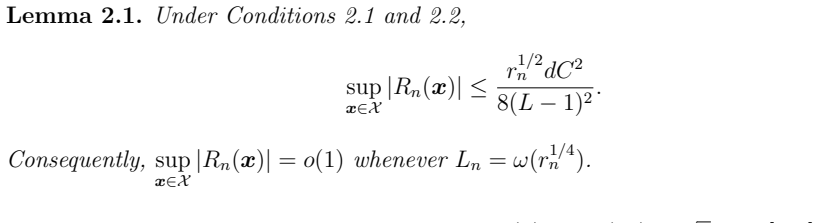
The paper shows that for functions within a Donsker class the simple grid-growth condition L_n=ω(r_n^{1/4}) is sufficient for valid inference for twice continuously differentiable functions estimable at the r_n^{1/2} rate. This condition ensures that the approximation error is asymptotically negligible relative to the stochastic variation of the empirical process.
What carries the argument
The grid-rate condition L_n = ω(r_n^{1/4}), which forces the discretization error from the L_n^d nodes to be o_p(r_n^{-1/2}) and thus negligible compared with the empirical process term.
If this is right
- Uniform inference procedures become asymptotically valid under a single, easily verifiable growth rule instead of fixed-L or data-driven heuristics.
- The discretization error is made smaller than the leading statistical term for any twice continuously differentiable function in the Donsker class.
- Researchers can choose L_n directly from the known convergence rate without further tuning.
- The result applies to any continuous functional estimated at the r_n^{1/2} rate on a compact domain.
Where Pith is reading between the lines
- The same rate condition could be checked in Monte Carlo experiments to see how quickly coverage converges to nominal levels.
- The argument may extend to other smoothness classes if analogous approximation bounds replace the twice-differentiable assumption.
- Software implementations of uniform inference could adopt the rule as a default grid-sizing formula.
- The condition links grid-based numerical methods directly to empirical-process rates in a way that might apply to other discretization problems.
Load-bearing premise
The target function is twice continuously differentiable and belongs to a Donsker class, so that grid approximation error vanishes faster than the statistical error.
What would settle it
A concrete counter-example or simulation in which L_n grows faster than r_n to the one-fourth power yet uniform coverage fails, or a direct calculation showing that the grid-induced bias is not o_p(r_n^{-1/2}).
Figures
read the original abstract
Estimating a continuous functional $F: \X \to \R$ involves specifying $L_n^d$ nodes on $\X \subset \R^d$ for estimation and uniform inference. While asymptotically valid inference requires $L_n$ to increase with $n$, existing fixed-$L$ rules of thumb and heuristic data-driven approaches lack formal justification. This paper shows that, for functions within a Donsker class, the simple grid-growth condition \(L_n=\omega(r_n^{1/4})\) is sufficient for valid inference for twice continuously differentiable functions estimable at the \(r_n^{1/2}\) rate. This condition ensures that the approximation error is asymptotically negligible relative to the stochastic variation of the empirical process.
Editorial analysis
A structured set of objections, weighed in public.
Referee Report
Summary. The manuscript shows that for twice continuously differentiable functions belonging to a Donsker class and estimable at the r_n^{1/2} rate, the grid-growth condition L_n = ω(r_n^{1/4}) suffices for valid uniform inference. This ensures the discretization approximation error O(L_n^{-2}) is asymptotically negligible relative to the stochastic variation of the empirical process indexed by the function class.
Significance. If the result holds, it supplies a simple, theoretically justified growth rate for the number of grid points in uniform inference on continuous functionals, replacing heuristic or fixed-L rules of thumb with a condition directly tied to the estimation rate and smoothness. The argument relies only on standard Donsker tightness and twice-continuous differentiability, without extra entropy or boundedness restrictions.
minor comments (2)
- Abstract: the notation r_n is introduced without an explicit definition or link to sample size; a parenthetical clarification would help readers immediately connect it to the estimation rate.
- The manuscript would benefit from a short remark comparing the proposed L_n = ω(r_n^{1/4}) rate to common practical choices (e.g., L_n ~ n^{1/5} or cross-validated grids) to illustrate how much faster the grid must grow.
Simulated Author's Rebuttal
We thank the referee for the positive summary, significance assessment, and recommendation of minor revision. No specific major comments appear in the report, so we have no points requiring point-by-point rebuttal or revision.
Circularity Check
No significant circularity; derivation is direct asymptotic comparison
full rationale
The paper establishes sufficiency of the grid-growth condition L_n = ω(r_n^{1/4}) by direct comparison of the deterministic uniform approximation error O(L_n^{-2}) (from twice continuous differentiability) against the stochastic term of order r_n^{-1/2} (from the estimation rate), under the Donsker-class tightness that makes the grid supremum asymptotically equivalent to the continuous-domain supremum once the bias term is o_p(r_n^{-1/2}). This is a standard, self-contained application of empirical-process theory with no reduction to fitted parameters, self-referential definitions, or load-bearing self-citations. The central claim therefore does not collapse to its inputs by construction.
Axiom & Free-Parameter Ledger
axioms (2)
- domain assumption The target function belongs to a Donsker class
- domain assumption The target function is twice continuously differentiable
Reference graph
Works this paper leans on
-
[1]
Atkinson, Kendall and Weimin Han.Theoretical Numerical Analysis: A Functional Analysis Framework. Third. Vol. 39. Texts in Applied Mathematics. (c) Springer Sci- 11 ence+Business Media, LLC 2009. New York: Springer Science+Business Media, LLC, 2009.url:https://link.springer.com/book/10.1007/978-0-387-76635-1
-
[2]
Quantile treatment effects in difference in differences models with panel data
Callaway, Brantly and Tong Li. “Quantile treatment effects in difference in differences models with panel data”.Quantitative Economics10.4 (2019), pp. 1579–1618
work page 2019
-
[3]
Inference on counter- factual distributions
Chernozhukov, Victor, Iv´ an Fern´ andez-Val, and Blaise Melly. “Inference on counter- factual distributions”.Econometrica81.6 (2013), pp. 2205–2268
work page 2013
-
[4]
Quantile and Distribution Treat- ment Effects on the Treated with Possibly Non-Continuous Outcomes
Djuazon, Nelly K and Emmanuel Selorm Tsyawo. “Quantile and Distribution Treat- ment Effects on the Treated with Possibly Non-Continuous Outcomes”.arXiv preprint arXiv:2408.07842(2024)
-
[5]
Epperson, James F.An Introduction to Numerical Methods and Analysis. 2nd. Wiley, 2013
work page 2013
-
[6]
Accuracy of Uniform Inference on Fine Grid Points
Imai, Shunsuke. “Accuracy of Uniform Inference on Fine Grid Points”.arXiv preprint arXiv:2512.18627(2025)
-
[7]
Difference-in-differences Estimator of Quan- tile Treatment Effect on the Treated
Kim, Doosoo and Jeffrey M Wooldridge. “Difference-in-differences Estimator of Quan- tile Treatment Effect on the Treated”.Journal of Business & Economic Statistics just-accepted (2024), pp. 1–26
work page 2024
-
[8]
Kosorok, Michael R.Introduction to empirical processes and semiparametric inference. Vol. 61. Springer, 2008
work page 2008
-
[9]
Multivariate distribution regression
Meier, Jonas. “Multivariate distribution regression”.Econometric Reviews(2025), pp. 1–22
work page 2025
-
[10]
van der Vaart, Aad.Asymptotic Statistics. Vol. 3. Cambridge University Press, 2000
work page 2000
-
[11]
A note on piecewise linear and multilinear table interpolation in many dimensions
Weiser, Alan and Sergio E Zarantonello. “A note on piecewise linear and multilinear table interpolation in many dimensions”.Mathematics of Computation50.181 (1988), pp. 189–196. 12 S.1 Proofs of Results S.1.1 Proof of Lemma 2.1 By Theorem 2.2 of Weiser and Zarantonello (1988) under Conditions 2.1 and 2.2, sup x∈X F(x)−F L(x) ≤ d 8 max 1≤k≤d ε2 k sup x∈X m...
work page 1988
-
[12]
This implementation is a weighted bootstrap based on multinomial frequency weights
in the univariate case and Meier (2025, Algorithm 1) in the multivariate case. This implementation is a weighted bootstrap based on multinomial frequency weights. As in Algorithm 1, the bootstrap draws are used to compute the grid-point sup-tcritical value tL m,n,1−α, and the grid-point endpoints are then interpolated to form CL m,n,1−α(x) = bLm,L(x),bUm,...
work page 2025
discussion (0)
Sign in with ORCID, Apple, or X to comment. Anyone can read and Pith papers without signing in.