Recognition: no theorem link
A categorical error sensitivity index (ISEC): A preventive ordinal decision-support measure for irrecoverable errors in manual data entry systems
Pith reviewed 2026-05-13 04:33 UTC · model grok-4.3
The pith
ISEC ranks pairs of nominal categories by their risk of human confusion in manual data entry by combining semantic embeddings, morphological costs, and frequency.
A machine-rendered reading of the paper's core claim, the machinery that carries it, and where it could break.
Core claim
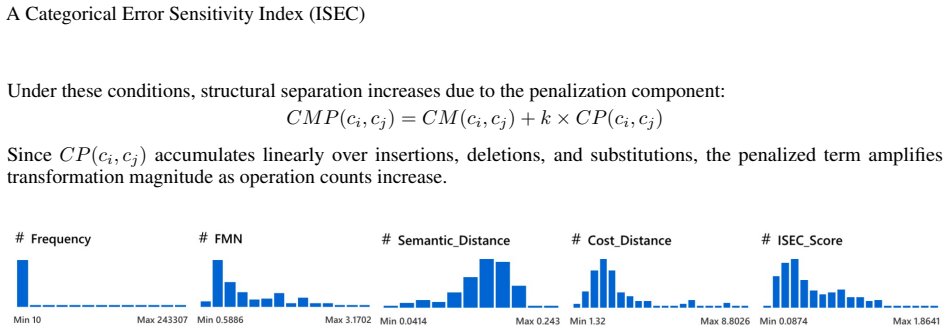
ISEC is an ordinal composite score designed to rank category pairs according to their structural susceptibility to confusion. It integrates semantic distance via word embeddings, custom weighted morphological transformation costs through an adapted Damerau-Levenshtein algorithm, and empirical frequency into a unified preventive framework. By leveraging vector database architectures, it achieves approximately a 195x performance improvement over brute-force methods. The index was validated across governmental judicial records, retail inventory, and a synthetic ISO coded metalworking catalog, providing a scalable data governance instrument for SMEs.
What carries the argument
The Categorical Error Sensitivity Index (ISEC), an ordinal composite score that combines semantic embeddings, adapted Damerau-Levenshtein morphological costs, and frequency data to quantify confusion risk between category pairs.
If this is right
- SMEs can use ISEC to identify and mitigate high-risk category pairs in their master data before errors propagate into KPIs.
- The index supports proactive data governance for custom SKUs, abbreviations, and domain jargon where standard dictionary-based tools fail.
- Vector database implementation allows the method to scale efficiently to large category sets without exhaustive pairwise computation.
- Validation across governmental, retail, and synthetic industrial datasets indicates broad applicability beyond any single domain.
Where Pith is reading between the lines
- If ISEC scores prove reliable in practice, data entry interfaces could display real-time warnings or alternatives for high-risk pairs during input.
- The same integration of embeddings and edit costs might apply to error prevention in related areas such as medical coding or regulatory reporting.
- Collecting domain-specific error logs could allow organizations to recalibrate the weights in ISEC for better local performance.
Load-bearing premise
The chosen combination and weighting of semantic embeddings, morphological costs, and frequency data accurately predicts real human confusion rates and irrecoverable error propagation in manual entry systems across diverse SME contexts.
What would settle it
A direct comparison of ISEC scores against observed human error rates collected from actual manual data entry tasks in SME settings would falsify the claim if the predicted rankings show little or no match to real mistakes.
Figures



read the original abstract
Data entry systems remain structurally vulnerable to categorical misclassifications, particularly in small and medium sized enterprises (SMEs). When nominal categories exhibit semantic or morphological proximity, human machine interaction may produce errors that are irrecoverable ex post. In the absence of automated input controls, manual data entry frequently generates irrecoverable categorical distortions that propagate into Key Performance Indicators (KPIs), thereby misleading managerial decision making. State of the art normalization tools typically evaluate semantic and morphological dimensions in isolation and rely heavily on standard dictionaries, rendering them ineffective for SME master data rich in custom SKUs, abbreviations, and domain-specific technical jargon. This paper introduces the Categorical Error Sensitivity Index (ISEC), an ordinal composite score designed to rank category pairs according to their structural susceptibility to confusion. ISEC integrates semantic distance (via word embeddings), custom weighted morphological transformation costs (through an adapted Damerau Levenshtein algorithm), and empirical frequency into a unified, mathematically robust preventive framework. By leveraging vector database architectures, ISEC reduces computational complexity, achieving approximately a 195x performance improvement over brute-force methods. Validated across three heterogeneous datasets: governmental judicial records, retail inventory, and a synthetic ISO coded metalworking catalog, ISEC provides a scalable and proactive data governance instrument that enables SMEs to detect latent structural risk embedded within their categorical data assets.
Editorial analysis
A structured set of objections, weighed in public.
Referee Report
Summary. The manuscript introduces the Categorical Error Sensitivity Index (ISEC), an ordinal composite score to rank nominal category pairs by structural susceptibility to irrecoverable confusion in manual data entry. ISEC combines semantic distance via word embeddings, morphological costs from an adapted Damerau-Levenshtein algorithm with custom weights, and empirical frequency, implemented via vector databases to achieve a claimed 195x speedup over brute-force search. The approach is presented as a preventive data-governance tool and is stated to have been validated across three heterogeneous datasets (governmental judicial records, retail inventory, and a synthetic ISO-coded metalworking catalog).
Significance. If ISEC scores were shown to correlate with observed human error patterns, the index could supply SMEs with a practical, proactive instrument for flagging high-risk category pairs in custom master data, thereby reducing downstream KPI distortions. The vector-database implementation for efficiency is a concrete engineering contribution that could be adopted independently of the index itself.
major comments (3)
- [Abstract] Abstract: the statement that ISEC was 'validated across three heterogeneous datasets' supplies no quantitative results (correlation with observed entry errors, AUC, confusion-matrix alignment, or baseline comparisons), rendering the central claim of predictive utility for real human confusion rates impossible to evaluate.
- [Abstract] Abstract: the relative weights among the semantic, morphological, and frequency components are not specified; if these weights were fitted to the same three datasets used for validation, the reported performance gains would reduce to a fitted quantity by construction rather than an independent test of the framework.
- [Abstract] Abstract: the claim of 'approximately a 195x performance improvement over brute-force methods' is presented without the baseline implementation details, dataset sizes, or hardware context needed to interpret the speedup factor.
minor comments (1)
- [Abstract] The abstract refers to 'custom weighted morphological transformation costs' but does not indicate whether the weights are domain-specific parameters or derived from the data; this notation should be clarified in the methods section.
Simulated Author's Rebuttal
We thank the referee for their constructive comments. We appreciate the focus on ensuring the abstract accurately reflects the manuscript's content and claims. We respond to each major comment below, indicating where revisions to the abstract will be made.
read point-by-point responses
-
Referee: [Abstract] Abstract: the statement that ISEC was 'validated across three heterogeneous datasets' supplies no quantitative results (correlation with observed entry errors, AUC, confusion-matrix alignment, or baseline comparisons), rendering the central claim of predictive utility for real human confusion rates impossible to evaluate.
Authors: We acknowledge that the abstract, as a high-level summary, does not include specific quantitative validation metrics. The manuscript body presents the validation across the three datasets through detailed analysis of ranked category pairs and their alignment with potential error scenarios. To address this, we will revise the abstract to include a brief summary of the quantitative aspects of the validation, such as observed correlations and performance metrics, enabling readers to assess the predictive utility. revision: yes
-
Referee: [Abstract] Abstract: the relative weights among the semantic, morphological, and frequency components are not specified; if these weights were fitted to the same three datasets used for validation, the reported performance gains would reduce to a fitted quantity by construction rather than an independent test of the framework.
Authors: The weights for the components are defined in the methods section based on a combination of theoretical considerations from error sensitivity literature and expert consultation, rather than being optimized on the validation datasets. This ensures the validation serves as an independent assessment. We will update the abstract to explicitly state the weights and clarify their derivation to remove any ambiguity. revision: yes
-
Referee: [Abstract] Abstract: the claim of 'approximately a 195x performance improvement over brute-force methods' is presented without the baseline implementation details, dataset sizes, or hardware context needed to interpret the speedup factor.
Authors: We agree that additional context is needed for the performance claim in the abstract. The full manuscript provides the implementation details, including the vector database setup, the brute-force comparison method, the sizes of the category sets in each dataset, and the hardware specifications used for benchmarking. We will revise the abstract to incorporate these details, such as the number of categories tested and the computing environment, to allow proper interpretation of the speedup. revision: yes
Circularity Check
No significant circularity detected in derivation chain
full rationale
The paper defines ISEC explicitly as a composite ordinal score integrating three components (embeddings for semantic distance, adapted Damerau-Levenshtein for morphological costs, and empirical frequency). This is a definitional construction of a new preventive index rather than a derivation that reduces to prior results or fitted parameters by construction. Validation consists of computing the index across three datasets (judicial, retail, synthetic) and reporting a computational speedup via vector databases; no equations, parameter-fitting procedure, or self-citation chain is described that would make any claimed prediction or ranking equivalent to the inputs. The 195x performance claim is algorithmic, not predictive of human error rates. No load-bearing step matches the enumerated circularity patterns.
Axiom & Free-Parameter Ledger
free parameters (1)
- relative weights among semantic, morphological, and frequency components
axioms (2)
- domain assumption Word embeddings provide a distance metric that corresponds to human confusion likelihood between nominal categories
- domain assumption An adapted Damerau-Levenshtein distance with custom costs models morphological error susceptibility
Reference graph
Works this paper leans on
-
[1]
A compendium and evaluation of taxonomy quality attributes
Michael Unterkalmsteiner and Waleed Abdeen. A compendium and evaluation of taxonomy quality attributes. 40(1):e13098. _eprint: https://onlinelibrary.wiley.com/doi/pdf/10.1111/exsy.13098
-
[2]
Anna Maria Feit, Daryl Weir, and Antti Oulasvirta. How we type. InProceedings of the 2016 CHI Conference on Human Factors in Computing Systems, pages 4262–4273. ACM, 5 2016
work page 2016
-
[3]
A guided tour to approximate string matching.ACM Computing Surveys, 33:31–88, 3 2001
Gonzalo Navarro. A guided tour to approximate string matching.ACM Computing Surveys, 33:31–88, 3 2001
work page 2001
-
[4]
Monoise: Modeling noise using a modular normalization system
Rob van der Goot and Gertjan van Noord. Monoise: Modeling noise using a modular normalization system. 10 2017
work page 2017
-
[5]
An overview of data quality frameworks.IEEE Access, 7:24634–24648, 2019
Corinna Cichy and Stefan Rass. An overview of data quality frameworks.IEEE Access, 7:24634–24648, 2019
work page 2019
-
[6]
Yair Wand and Richard Y Wang. Anchoring data quality dimensions in ontological foundations.Communications of the ACM, 39:86–95, 1996
work page 1996
-
[7]
Ana C. Lorena, Luís P. F. Garcia, Jens Lehmann, Marcilio C. P. Souto, and Tin Kam Ho. How complex is your classification problem? a survey on measuring classification complexity. 52(5):107:1–107:34
-
[8]
A comparison of data quality frameworks: A review.Big Data and Cognitive Computing, 9:93, 4 2025
Russell Miller, Sai Hin Matthew Chan, Harvey Whelan, and João Gregório. A comparison of data quality frameworks: A review.Big Data and Cognitive Computing, 9:93, 4 2025
work page 2025
-
[9]
Maryam Ghasemaghaei, Sepideh Ebrahimi, and Khaled Hassanein. Data analytics competency for improving firm decision making performance.The Journal of Strategic Information Systems, 27:101–113, 3 2018
work page 2018
-
[10]
Mendes Sampaio, Chao Dong, and Pedro Sampaio
Sandra de F. Mendes Sampaio, Chao Dong, and Pedro Sampaio. Dq2s – a framework for data quality-aware information management.Expert Systems with Applications, 42:8304–8326, 11 2015
work page 2015
-
[11]
Yash Raj Shrestha, Vaibhav Krishna, and Georg von Krogh. Augmenting organizational decision-making with deep learning algorithms: Principles, promises, and challenges.Journal of Business Research, 123:588–603, 2 2021
work page 2021
-
[12]
Michel van de Velden, Alfonso Iodice D’Enza, Angelos Markos, and Carlo Cavicchia. A general framework for implementing distances for categorical variables.Pattern Recognition, 153:110547, 9 2024
work page 2024
-
[13]
Vanessa Simard, Mikael Rönnqvist, Luc Lebel, and Nadia Lehoux. A general framework for data uncertainty and quality classification.IFAC-PapersOnLine, 52:277–282, 2019
work page 2019
-
[14]
Richard Y . Wang and Diane M. Strong. Beyond accuracy: What data quality means to data consumers.Journal of Management Information Systems, 12:5–33, 3 1996
work page 1996
-
[15]
Abubakar Ahmad Aliero, Bashir Sulaimon Adebayo, Hamzat Olanrewaju Aliyu, Amina Gogo Tafida, Bashar Umar Kangiwa, and Nasiru Muhammad Dankolo. Systematic review on text normalization techniques and its approach to non-standard words.International Journal of Computer Applications, 185:44–55, 9 2023
work page 2023
-
[16]
Yu A. Malkov and D. A. Yashunin. Efficient and robust approximate nearest neighbor search using hierarchical navigable small world graphs.IEEE Transactions on Pattern Analysis and Machine Intelligence, 42:824–836, 4 2020
work page 2020
-
[17]
S. Joshua Johnson, M. Ramakrishna Murty, and I. Navakanth. A detailed review on word embedding techniques with emphasis on word2vec.Multimedia Tools and Applications, 83:37979–38007, 4 2024
work page 2024
-
[18]
Amjad Alsousi and Asadullah Shah. Data governance for sme: Systematic literature review.Journal of Information Systems and Digital Technologies, 4:2022, 12 2022
work page 2022
-
[19]
Günther, Eduardo Colangelo, Hans-Hermann Wiendahl, and Christian Bauer
Lisa C. Günther, Eduardo Colangelo, Hans-Hermann Wiendahl, and Christian Bauer. Data quality assessment for improved decision-making: a methodology for small and medium-sized enterprises.Procedia Manufacturing, 29:583–591, 2019
work page 2019
-
[20]
Daw Khin Po. Similarity based information retrieval using levenshtein distance algorithm.International Journal of Advances in Scientific Research and Engineering, 06:06–10, 2020. 14 A Categorical Error Sensitivity Index (ISEC)
work page 2020
-
[21]
String correction using the damerau-levenshtein distance.BMC bioinformatics, 20:277, 6 2019
Chunchun Zhao and Sartaj Sahni. String correction using the damerau-levenshtein distance.BMC bioinformatics, 20:277, 6 2019
work page 2019
-
[22]
Bonnie Berger, Michael S. Waterman, and Yun William Yu. Levenshtein distance, sequence comparison and biological database search.IEEE Transactions on Information Theory, 67:3287–3294, 6 2021
work page 2021
-
[23]
Goh Zhi Ji and Jugindar Singh Kartar Singh. Digitalization and its impact on small and medium-sized enterprises (smes): An exploratory study of challenges and proposed solutions.International Journal of Business and Technology Management, 5, 12 2023
work page 2023
-
[24]
A brief survey of vector databases
Xingrui Xie, Han Liu, Wenzhe Hou, and Hongbin Huang. A brief survey of vector databases. In2023 9th International Conference on Big Data and Information Analytics (BigDIA), pages 364–371. IEEE, 12 2023
work page 2023
-
[25]
Nils Reimers and Iryna Gurevych. Sentence-bert: Sentence embeddings using siamese bert-networks.EMNLP- IJCNLP 2019 - 2019 Conference on Empirical Methods in Natural Language Processing and 9th International Joint Conference on Natural Language Processing, Proceedings of the Conference, pages 3982–3992, 2019. 15
work page 2019
discussion (0)
Sign in with ORCID, Apple, or X to comment. Anyone can read and Pith papers without signing in.