Recognition: 2 theorem links
· Lean TheoremGeneral and concise operator approach to the dyadic Green's function of layered media
Pith reviewed 2026-05-13 03:10 UTC · model grok-4.3
The pith
An operator method derives the dyadic Green's function for anisotropic layered media using evolution operators and surface impedance tensors.
A machine-rendered reading of the paper's core claim, the machinery that carries it, and where it could break.
Core claim
The central claim is that the dyadic Green's function of a generic anisotropic planarly-layered medium for electric and magnetic fields is expressed through the evolution operators of the comprising layers and the surface impedance tensors, with the singular term naturally separated from the remaining terms.
What carries the argument
Evolution operators of the layers combined with surface impedance tensors, which together construct the full Green's function and isolate the singular term without separate regularization steps.
If this is right
- The Green's function applies equally to electric and magnetic fields in anisotropic planar layers.
- The singular term separates automatically, avoiding separate handling in applications.
- The same operator structure extends to spherical and cylindrical layered geometries.
- Conceptual understanding and practical computations in nanophotonics become simpler.
Where Pith is reading between the lines
- The operator form may integrate more readily into numerical solvers for multilayer devices than traditional component expansions.
- Generalization to curved layers suggests the method could apply to modeling fields around spherical nanoparticles or cylindrical waveguides.
Load-bearing premise
Evolution operators of the layers can be combined with surface impedance tensors to yield the complete Green's function while automatically separating the singular term without extra ad-hoc regularization or component-wise algebra.
What would settle it
A direct comparison for a single isotropic layer in which the operator-derived Green's function fails to reproduce the known closed-form expression or violates the required boundary conditions at the interfaces.
Figures

read the original abstract
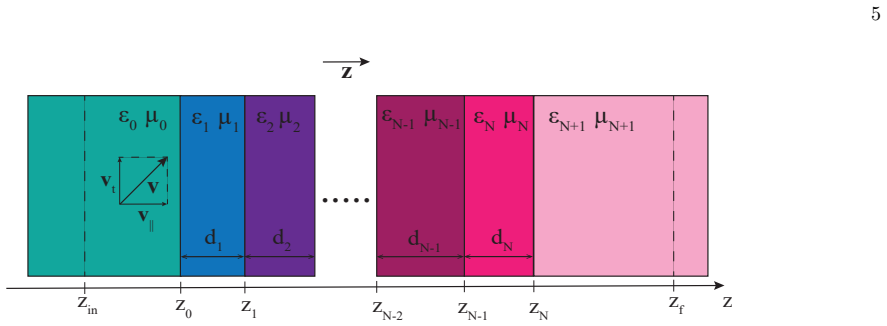
Dyadic Green's function is an important tool of computational photonics, giving deeper insights into light-matter interaction. We present an operator approach to the derivation of the dyadic Green's function of a generic anisotropic planarly-layered medium for both electric and magnetic fields. The resulting Green's function is expressed through the evolution operators (a kind of transfer matrices) of the comprising layers and the surface impedance tensors, the singular term being naturally separated from other terms. The operator approach to the Green's function simplifies both the conceptual understanding of the problem and the subsequent practical applications, some of which are demonstrated here. The proposed approach can be easily generalized to the case of spherical and cylindrical layers. The obtained results can be applied in nanophotonics engineering problems.
Editorial analysis
A structured set of objections, weighed in public.
Referee Report
Summary. The paper presents an operator approach to derive the dyadic Green's function (for both electric and magnetic fields) of a generic anisotropic planarly-layered medium. The Green's function is expressed via the evolution operators of the individual layers combined with surface impedance tensors, with the singular (delta-function) term emerging naturally from the algebra without additional regularization. The method is claimed to simplify both conceptual understanding and practical computations, with suggested extensions to spherical and cylindrical geometries.
Significance. If the derivation is valid, the work supplies a compact, unified framework for Green's functions in layered media that avoids component-wise algebra and ad-hoc steps. The explicit operator construction, impedance matching at interfaces, and automatic separation of the singular term are clear strengths that could streamline applications in nanophotonics and computational electromagnetics. The internal consistency for the planar case and the direct path to curved-geometry generalizations add value for engineering problems.
minor comments (2)
- The notation for evolution operators, impedance tensors, and field components should be introduced with a dedicated definitions subsection or table to improve accessibility for readers new to transfer-matrix methods.
- While the abstract and introduction mention demonstrated applications, the manuscript would benefit from a brief, self-contained example (with explicit numerical comparison to a known case) to illustrate the practical simplification.
Simulated Author's Rebuttal
We thank the referee for the positive assessment of our work on the operator approach to the dyadic Green's function in anisotropic layered media. The recognition of the method's conceptual clarity, natural separation of the singular term, and potential for generalization to curved geometries is appreciated. No specific major comments were provided in the report.
Circularity Check
Derivation is self-contained; no circularity detected
full rationale
The manuscript presents a direct operator-based derivation of the dyadic Green's function for anisotropic layered media, starting from Maxwell's equations and composing layer evolution operators with interface impedance tensors. The singular delta-function term is stated to emerge automatically from the operator algebra rather than being inserted by hand or fitted. No step reduces the target Green's function to a parameter fit, a self-citation chain, or a redefinition of the input quantities. The approach re-uses standard transfer-matrix concepts but does not presuppose the final Green's function expression; the construction is therefore independent of the claimed result and remains falsifiable against known planar-media benchmarks.
Axiom & Free-Parameter Ledger
axioms (2)
- standard math Maxwell's equations hold inside each anisotropic layer and at interfaces.
- domain assumption Evolution operators (transfer matrices) exist and can be multiplied across layers.
Lean theorems connected to this paper
-
IndisputableMonolith/Foundation/RealityFromDistinction.leanreality_from_one_distinction unclearWe derive the DGF of a generic planarly layered medium in an operator-based way
Reference graph
Works this paper leans on
-
[1]
restore the EM field vectors in the physical space us- ing an analog of (A11) and compare the result with the definition of the DGF (3). A suitable orthogonal transformation for cylindrically symmetric layers would be E(r) = ∞X m=−∞ Z ˜Em(ξ, bz)ei(k0bzz+mφ)d(k0bz),(D1) and for spherically symmetric layers it would be E(r) = ∞X l=0 lX m=−l Flm(θ, φ)˜Elm(ξ)...
-
[2]
as functions of polarθand azimuthalφangles (same for ˜Hand ˜j). After substituting these into Maxwell’s equations, one obtains the evolution equations of the same form as (8) (ξnow playing the role of thezco- ordinate used for planar media), with ˜Ucyl = 4π c 1 εq q×ε(q⊗q) −Pt b× q + m k0ξ e× φ (q⊗q) − q× 0 ˜j,(D3) ˜Usph = 4π c 1 εq ...
-
[3]
A. L. Kuzemsky,Statistical Mechanics and The Physics of Many-Particle Model Systems(World Scientific Pub- lishing Company, 2017)
work page 2017
-
[4]
Rother,Green’s Functions in Classical Physics (Springer International Publishing, 2017)
T. Rother,Green’s Functions in Classical Physics (Springer International Publishing, 2017)
work page 2017
-
[5]
Tai,Dyadic Green Functions in Electromagnetic Theory(IEEE, 1994)
C.-T. Tai,Dyadic Green Functions in Electromagnetic Theory(IEEE, 1994)
work page 1994
-
[6]
M. Faryad and A. Lakhtakia,Infinite-Space Dyadic Green Functions in Electromagnetism(Morgan & Clay- pool Publishers, 2018)
work page 2018
-
[7]
W. L. Barnes et al., J. Opt.22, 1 (2020)
work page 2020
- [8]
- [9]
-
[10]
K. Jain, L. Ruks, F. le Kien, and T. Busch, Phys. Rev. Research6, 033311 (2024)
work page 2024
-
[11]
J. Ren, S. Franke, B. Van Drunen, and S. Hughes, Phys. Rev. A109, 013513 (2024)
work page 2024
-
[12]
C. Qi, S. Zeng, N. J. A. Egarguin, D. Onofrei, and J. Chen, Journal of Electromagnetic Waves and Applica- tions38(1), 66 (2023)
work page 2023
-
[13]
L. Novotny and B. Hecht,Principles of Nano-Optics, 2nd ed. (Cambridge University Press, 2012)
work page 2012
-
[14]
W. C. Chew,Waves and Fields in Inhomogeneous Media (Wiley-IEEE Press, 1999)
work page 1999
-
[15]
M. H. Cho and W. Cai, J. Sci. Comp.71, 1319–1350 (2016)
work page 2016
- [16]
-
[17]
J. E. Sipe, J. Opt. Soc. Am. B4, 481 (1987)
work page 1987
-
[18]
Hohenester,Nano and Quantum Optics(Springer Cham, 2021)
U. Hohenester,Nano and Quantum Optics(Springer Cham, 2021)
work page 2021
-
[19]
Koh, IEEE Transactions on Antennas and Propaga- tion72, 4410 (2024)
I.-S. Koh, IEEE Transactions on Antennas and Propaga- tion72, 4410 (2024)
work page 2024
-
[20]
S. Lambot, K. Wu, A. Sluyters, and J. Vanderdonckt, The Full-Wave Radar Equation for Wave Propagation 12 in Multilayered Media and Its Applications. In “Ground Penetrating Radar: From Theoretical Endeavors to Com- putational Electromagnetics, Signal Processing, Antenna Design and Field Applications” (eds. M. Serhir and D. Lesselier)(Wiley, 2024)
work page 2024
-
[21]
S. M. Ali, T. M. Habashy, and J. A. Kong, J. Opt. Soc. Am. A9, 413 (1992)
work page 1992
-
[22]
V. Okhmatovski and S. Zheng,Theory and Computation of Electromagnetic Fields in Layered Media(Wiley-IEEE Press, 2024)
work page 2024
-
[23]
Koh, IET Microwaves, Antennas & Propagation16, 405 (2022)
I.-S. Koh, IET Microwaves, Antennas & Propagation16, 405 (2022)
work page 2022
-
[24]
A. S. Potemkin, A. N. Poddubny, P. A. Belov, and Y. S. Kivshar, Phys. Rev. A86, 023848 (2012)
work page 2012
-
[25]
F. I. Fedorov,Optics of Anisotropic Media(Akademia Nauk BSSR, 1958)
work page 1958
-
[26]
F. I. Fedorov,Theory of Gyrotropy(Nauka i Tehnika, 1976)
work page 1976
-
[27]
L. M. Barkovsky and A. N. Furs,Operator methods for describing optical fields in complex environments(Be- laruskaya Navuka, 2003)
work page 2003
- [28]
-
[29]
Hassani,Mathematical Physics: A Modern Introduc- tion to Its Foundations, 2nd ed
S. Hassani,Mathematical Physics: A Modern Introduc- tion to Its Foundations, 2nd ed. (Springer, 2013)
work page 2013
-
[30]
M. Stone and P. Goldbart,Mathematics for Physics: A Guided Tour for Graduate Students, 1st ed. (Cambridge University Press, 2009)
work page 2009
-
[31]
The inhomogeneous term can be obtained either by the variation of parameter, or by using the Green’s function of Eq. (8), which has the formg(z, z ′) =θ(z−z ′) Ω z z′, θbeing the Heaviside step function: R z z0 Ωz z′ ˜U(z′)dz′ =R g(z, z ′) ˜U(z′)dz′. The usual definition of the Green’s functiong(z, z ′) isLg(z, , z ′) =δ(z−z ′), whereLis the differential ...
-
[32]
We could have expressed ˜W(N+1) zf instead of ˜W(0) zin and use it in the expressions to follow, which would result in a slightly different form of the DGF, but it would be just as good for practical purposes
-
[33]
L. Shaposhnikov, M. Mazanov, D. A. Bobylev, F. Wilczek, and M. A. Gorlach, Phys. Rev. B108, 115101 (2023)
work page 2023
-
[34]
G. N. Borzdov, J. Math. Phys.38, 6328 (1997)
work page 1997
-
[35]
M. Born and E. Wolf,Principles of Optics, 4th ed. (Perg- amon Press, 1970)
work page 1970
-
[36]
F. J. Dyson, Phys. Rev.75, 486 (1949)
work page 1949
-
[37]
N. P. Armitage, E. J. Mele, and A. Vishwanath, Rev. Mod. Phys.90, 015001 (2018)
work page 2018
-
[38]
C. Guo, V. S. Asadchy, B. Zhao, and S. Fan, eLight3, 2 (2023)
work page 2023
-
[39]
Gantmacher,The Theory of Matrices, 2nd ed
F. Gantmacher,The Theory of Matrices, 2nd ed. (Nauka, Moscow, 1966)
work page 1966
- [40]
-
[41]
A. V. Novitsky and L. M. Barkovsky, J. Phys. A38, 391 (2005)
work page 2005
discussion (0)
Sign in with ORCID, Apple, or X to comment. Anyone can read and Pith papers without signing in.