Recognition: 2 theorem links
· Lean TheoremTransmission of signals in the 300 GHz band with a bit-error rate below {10}⁻⁹ using a soliton comb
Pith reviewed 2026-05-13 02:56 UTC · model grok-4.3
The pith
A soliton microcomb in a silicon nitride microring enables error-free 10 Gbps transmission at 300 GHz using simple intensity modulation.
A machine-rendered reading of the paper's core claim, the machinery that carries it, and where it could break.
Core claim
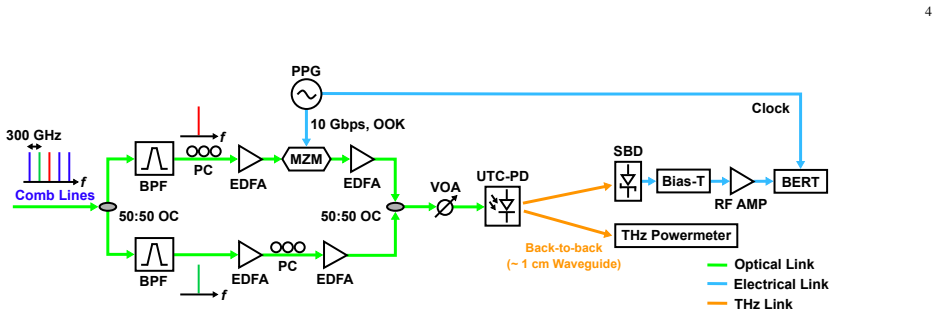
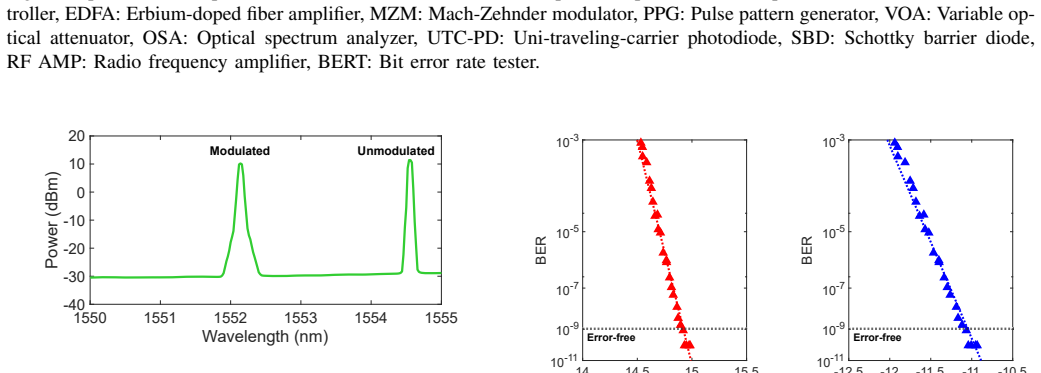
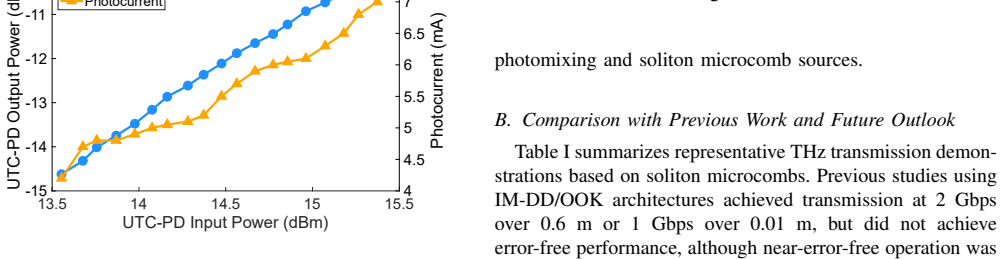
The central claim is the first experimental demonstration of error-free (BER < 1×10^{-9}) 10 Gbps transmission in the 300 GHz band using a soliton microcomb generated in an integrated silicon nitride microring resonator with a simple IM-DD OOK architecture. Although performed in a back-to-back waveguide configuration, the generated THz wave supported stable low-BER transmission without FEC or offline processing, and threshold-power analysis indicates feasibility for free-space transmission over several tens of meters with high-gain antennas and THz amplifiers.
What carries the argument
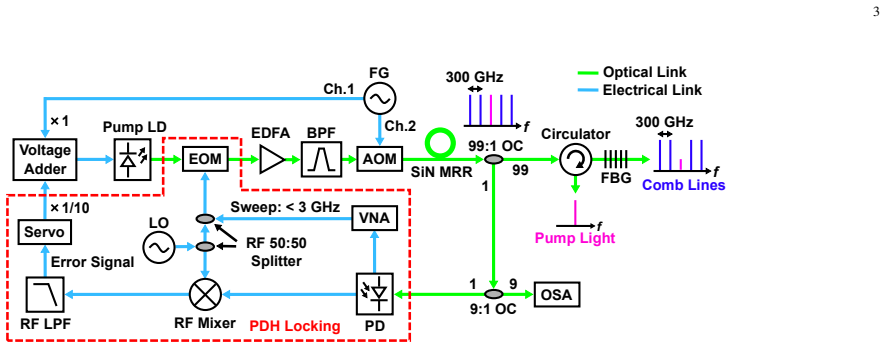
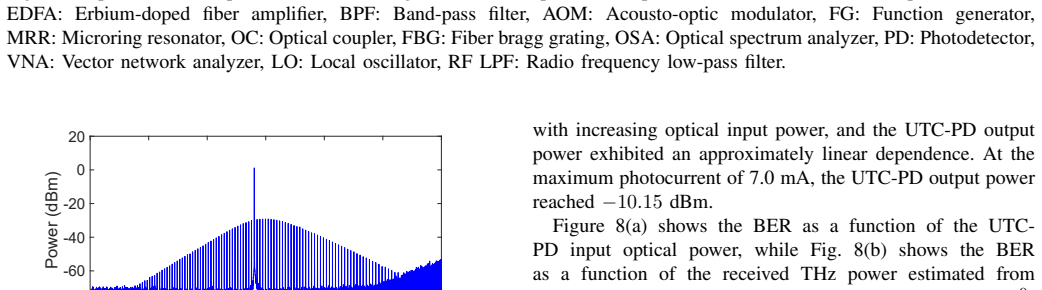
The soliton microcomb generated inside a silicon nitride microring resonator, which supplies a stable, multi-frequency optical source that is photomixed to produce the 300 GHz carrier wave.
If this is right
- Low-complexity IM-DD OOK becomes viable for short-range terahertz links without forward error correction.
- Fiber-wireless integrated systems can use the same soliton comb source for both optical and THz segments.
- The approach scales to multi-channel transmission by selecting different lines from the comb.
- System complexity drops because coherent modulation and heavy digital signal processing are not required.
Where Pith is reading between the lines
- If the power budget holds in real propagation, the same comb could support 20–40 Gbps by increasing modulation speed or using multiple comb lines in parallel.
- Atmospheric absorption windows near 300 GHz would set a practical range limit even with high-gain antennas, suggesting hybrid indoor-outdoor use cases.
- Integration of the silicon nitride resonator with existing silicon photonics platforms could reduce size and cost for mass deployment.
Load-bearing premise
That short back-to-back waveguide measurements and power-threshold analysis will translate directly to free-space links of tens of meters without additional impairments from antennas, amplifiers, or propagation effects.
What would settle it
A bit-error-rate measurement performed during actual free-space propagation over 20–50 meters at 300 GHz using the same soliton comb, high-gain antennas, and THz amplifiers.
Figures


read the original abstract
To address the increasing demand for ultra-high-capacity wireless communication, terahertz (THz) frequencies near 300 GHz are attracting attention as a new spectral frontier. This work presents the first experimental demonstration of error-free (BER $< 1\times10^{-9}$) 10 Gbps transmission in the 300 GHz band using a soliton microcomb generated in an integrated silicon nitride (SiN) microring resonator. While many previous microcomb-based THz demonstrations have focused on coherent modulation formats and operation near the forward-error-correction (FEC) limit, this work investigates a simple intensity-modulation/direct-detection (IM-DD) on-off keying (OOK) architecture suitable for low-complexity THz links and fiber-wireless integrated systems. Although the experiment was conducted in a short back-to-back waveguide configuration, the generated THz wave enabled stable low-BER transmission without FEC or advanced offline signal processing. Analysis of the error-free threshold power indicates the feasibility of free-space transmission over several tens of meters with high-gain antennas and THz-band amplifiers. These results demonstrate the feasibility of robust low-complexity THz photonic links based on soliton microcombs for short-range fiber-wireless integrated systems.
Editorial analysis
A structured set of objections, weighed in public.
Referee Report
Summary. The paper reports the first experimental demonstration of error-free (BER < 10^{-9}) 10 Gbps IM-DD OOK transmission at 300 GHz using a soliton microcomb generated in an integrated SiN microring resonator. The experiment is performed in a short back-to-back waveguide configuration without FEC or advanced signal processing, and the measured error-free power threshold is used to analyze the feasibility of free-space transmission over several tens of meters with high-gain antennas and THz amplifiers.
Significance. If the core experimental result holds, this provides a valuable benchmark for low-complexity photonic THz links, demonstrating stable low-BER performance with an integrated soliton comb and simple IM-DD architecture. The direct experimental measurements of BER and power thresholds (with no fitted parameters or circular derivations) are a clear strength. This advances prospects for fiber-wireless integrated systems, though the free-space extrapolation remains unvalidated.
major comments (1)
- [Free-space feasibility analysis] In the analysis of free-space transmission feasibility (abstract and discussion): the claim that the measured error-free power threshold indicates viability for free-space links over several tens of meters relies on an unvalidated extrapolation. No quantitative link budget is provided that accounts for atmospheric absorption (~few dB/km at 300 GHz), beam spreading, pointing jitter, or added noise from THz amplifiers. This does not undermine the back-to-back experimental result but is load-bearing for the broader applicability asserted in the title and abstract.
minor comments (1)
- [Abstract] The abstract and title could more explicitly distinguish the demonstrated back-to-back waveguide result from the analyzed (but untested) free-space scenario to prevent reader ambiguity.
Simulated Author's Rebuttal
We thank the referee for the constructive review and the recommendation for minor revision. The primary contribution of the work is the experimental demonstration of error-free 10 Gbps IM-DD OOK transmission at 300 GHz using an integrated soliton microcomb in a back-to-back configuration. We address the single major comment below and will revise the manuscript accordingly.
read point-by-point responses
-
Referee: In the analysis of free-space transmission feasibility (abstract and discussion): the claim that the measured error-free power threshold indicates viability for free-space links over several tens of meters relies on an unvalidated extrapolation. No quantitative link budget is provided that accounts for atmospheric absorption (~few dB/km at 300 GHz), beam spreading, pointing jitter, or added noise from THz amplifiers. This does not undermine the back-to-back experimental result but is load-bearing for the broader applicability asserted in the title and abstract.
Authors: We agree that the free-space feasibility discussion relies on a simplified extrapolation from the measured error-free power threshold without a full quantitative link budget. In the revised manuscript we will (i) tone down the language in the abstract and discussion to present the estimate as indicative rather than definitive, (ii) add a short link-budget paragraph that incorporates standard values for atmospheric absorption at 300 GHz (~1–5 dB/km), free-space path loss, and assumed high-gain antenna and low-noise amplifier parameters, and (iii) explicitly state that experimental free-space validation lies outside the scope of the present back-to-back demonstration. revision: yes
Circularity Check
No significant circularity; results rest on direct experimental measurements
full rationale
The paper reports experimental BER measurements in a back-to-back waveguide setup using a soliton microcomb source and IM-DD OOK modulation. The central claim of error-free 10 Gbps transmission at 300 GHz is supported by measured power thresholds and BER curves, not by any mathematical derivation or fitted model that reduces to its own inputs. The brief extrapolation to free-space viability over tens of meters is presented as a qualitative indication based on the measured threshold power, without equations, parameter fitting, or self-citation chains that would create circularity. No self-definitional steps, fitted-input predictions, or load-bearing self-citations appear in the provided text. This is a standard experimental result with an optimistic but non-circular forward-looking statement.
Axiom & Free-Parameter Ledger
Lean theorems connected to this paper
-
IndisputableMonolith/Cost/FunctionalEquation.leanwashburn_uniqueness_aczel unclearfirst experimental demonstration of error-free (BER<1×10^{-9}) 10 Gbps transmission in the 300 GHz band using a soliton microcomb generated in an integrated silicon nitride (SiN) microring resonator... simple IM-DD OOK architecture
-
IndisputableMonolith/Foundation/DimensionForcing.leanalexander_duality_circle_linking unclearAnalysis of the error-free threshold power indicates the feasibility of free-space transmission over several tens of meters with high-gain antennas and THz-band amplifiers... Friis equation
discussion (0)
Sign in with ORCID, Apple, or X to comment. Anyone can read and Pith papers without signing in.