Recognition: no theorem link
Will My Favorite Chases Terminate if Evaluating Conjunctive Queries Does? One Does Not Simply Decide This
Pith reviewed 2026-05-13 02:49 UTC · model grok-4.3
The pith
It remains undecidable whether existential rules belong to chase-termination classes or the bounded treewidth set even when conjunctive query entailment is decidable.
A machine-rendered reading of the paper's core claim, the machinery that carries it, and where it could break.
Core claim
Within any class of existential rules for which conjunctive query entailment is decidable, it remains undecidable to determine whether a given set of rules belongs to the classes on which every classical chase variant terminates or to the bounded treewidth set class.
What carries the argument
Reductions from undecidable problems that preserve both non-membership in the target abstract classes and the property that conjunctive query entailment remains decidable.
Load-bearing premise
The reductions used to prove undecidability can be carried out while preserving membership in a class that already guarantees decidable conjunctive query entailment.
What would settle it
An algorithm that takes a set of existential rules for which conjunctive query entailment is decidable and correctly decides whether the chase terminates on all instances would falsify the claim for the chase-based classes.
Figures
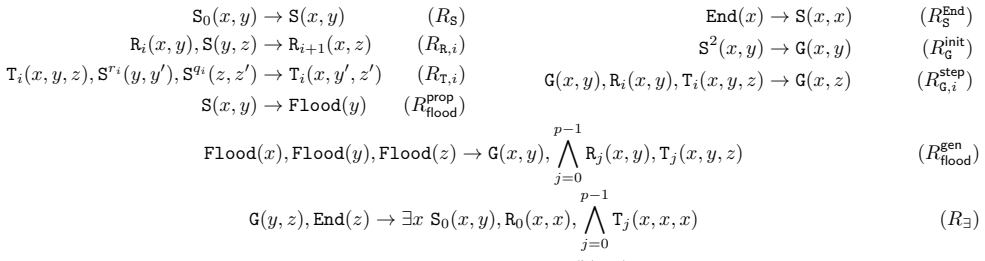


read the original abstract
Existential rules are a prominent formalism to enrich a database with knowledge from the domain of interest, but make even basic reasoning tasks on the resulting knowledge base undecidable. To circumvent this, several classes of rules offering various useful properties have been identified. One such class, for instance, contains all sets of rules on which the chase algorithm always terminates, which guarantees the existence of a finite universal model. However, these classes are often abstract rather than concrete: it may be undecidable to check whether a given set of rules belongs to them. Given that the most studied classes of existential rules are designed for reasoning on databases, thus ensuring decidable conjunctive query entailment, we ask: Within a class that supports decidable query entailment, do the usual abstract classes become concrete? We answer in the negative for classes based upon the termination of all classical chase variants and for the bounded treewidth set (BTS) class.
Editorial analysis
A structured set of objections, weighed in public.
Referee Report
Summary. The paper asks whether membership in abstract classes of existential rules (chase-terminating variants and the bounded treewidth set) becomes decidable when the rule sets are restricted to those for which conjunctive query entailment is already known to be decidable. It answers negatively, establishing undecidability results via reductions from known undecidable problems while claiming to preserve the CQ-decidability restriction.
Significance. If the reductions correctly preserve membership in a CQ-decidable class, the result is significant: it shows that the meta-properties guaranteeing decidable reasoning remain undecidable even inside the decidable fragment, sharpening the boundary between abstract and concrete classes of existential rules and informing the design of practical syntactic restrictions in database and knowledge-representation systems.
major comments (1)
- [Reduction construction (throughout the proofs of the negative results)] The central reductions (from halting or similar undecidable problems to chase non-termination or non-BTS membership) must map into rule sets that lie inside some class C already known to have decidable CQ entailment. The manuscript should explicitly identify the syntactic or semantic restrictions used to enforce this membership and prove that the constructed rule sets satisfy them (e.g., by avoiding unguarded cycles or unbounded treewidth that would render CQ entailment undecidable). Without this verification, the reduction only establishes undecidability in the unrestricted case rather than inside the targeted restricted classes.
Simulated Author's Rebuttal
We thank the referee for the careful review and for emphasizing the need to rigorously verify that our reductions remain inside CQ-decidable classes. We address the concern directly below and will revise the manuscript to make the preservation arguments fully explicit.
read point-by-point responses
-
Referee: [Reduction construction (throughout the proofs of the negative results)] The central reductions (from halting or similar undecidable problems to chase non-termination or non-BTS membership) must map into rule sets that lie inside some class C already known to have decidable CQ entailment. The manuscript should explicitly identify the syntactic or semantic restrictions used to enforce this membership and prove that the constructed rule sets satisfy them (e.g., by avoiding unguarded cycles or unbounded treewidth that would render CQ entailment undecidable). Without this verification, the reduction only establishes undecidability in the unrestricted case rather than inside the targeted restricted classes.
Authors: We agree that explicit verification is required. Each reduction in the paper is constructed so that the resulting rule sets belong to a concrete CQ-decidable class (specifically, the class of linear existential rules for the chase-termination results and the class of guarded rules with acyclic dependency graphs for the BTS results). These classes are known to admit decidable CQ entailment via existing results in the literature. The constructions deliberately avoid unguarded cycles, ensure the rule dependency graph remains acyclic, and produce only rules whose associated hypergraphs have bounded treewidth. To make this fully rigorous, we will add a new subsection (or appendix) in the revised version that, for each theorem, (i) recalls the precise syntactic definition of the target CQ-decidable class, (ii) states the invariant maintained by the reduction, and (iii) proves by induction on the construction that every generated rule set satisfies the invariant. This will confirm that the undecidability statements hold inside the restricted classes rather than only in the unrestricted setting. revision: yes
Circularity Check
No significant circularity in undecidability reduction
full rationale
The paper establishes undecidability results for membership in chase-termination classes and the BTS class, restricted to settings where CQ entailment remains decidable, via reductions from known undecidable problems. No self-definitional steps, fitted inputs renamed as predictions, or load-bearing self-citations appear in the abstract or described derivation chain. The central claim rests on external reductions that are independent of the target property, making the proof self-contained without circular reduction to its own inputs.
Axiom & Free-Parameter Ledger
axioms (1)
- standard math Chase termination and BTS membership are undecidable in the unrestricted existential-rules setting
Reference graph
Works this paper leans on
- [1]
-
[2]
Extending de- cidable cases for rules with existential variables
[Bagetet al., 2009] Jean-François Baget, Michel Leclère, Marie-Laure Mugnier, and Êric Salvat. Extending de- cidable cases for rules with existential variables. In Proceedings of the 21st International Joint Confer- ence on Artificial Intelligence, IJCAI’09, page 677–682. Morgan Kaufmann Publishers Inc.,
work page 2009
-
[3]
[Beeri and Vardi, 1981] Catriel Beeri and Moshe Y. Vardi. The implication problem for data dependencies. InProceedings of the 8th Colloquium on Automata, Languages and Programming, ICALP’81, page 73–85. Springer-Verlag,
work page 1981
-
[4]
Oblivious chase termination: The sticky case
[Calautti and Pieris, 2019] Marco Calautti and Andreas Pieris. Oblivious chase termination: The sticky case. InProceedings of the 22nd International Conference on Database Theory, ICDT’19, pages 17:1–17:18. Schloss Dagstuhl – Leibniz-Zentrum für Informatik,
work page 2019
-
[5]
Chase termination for guarded existential rules
[Calauttiet al., 2015] Marco Calautti, Georg Gottlob, and Andreas Pieris. Chase termination for guarded existential rules. InProceedings of the 34th ACM SIGMOD-SIGACT-SIGAI Symposium on Principles of Database Systems, PODS’15, page 91–103. Association for Computing Machinery,
work page 2015
-
[6]
Taming the infinite chase: Query an- sweringunderexpressiverelationalconstraints.J
[Calìet al., 2013] Andrea Calì, Georg Gottlob, and Michael Kifer. Taming the infinite chase: Query an- sweringunderexpressiverelationalconstraints.J. Artif. Intell. Res., 48:115–174,
work page 2013
-
[7]
A general datalog-based frame- work for tractable query answering over ontologies
[Calìet al., 2012] Andrea Calì, Georg Gottlob, and Thomas Lukasiewicz. A general datalog-based frame- work for tractable query answering over ontologies. Journal of Web Semantics, 14:57–83,
work page 2012
-
[8]
[Carralet al., 2022] David Carral, Lucas Larroque, Marie-Laure Mugnier, and Michaël Thomazo. Nor- malisations of existential rules: Not so innocuous! In Proceedings of the 19th International Conference on Principles of Knowledge Representation and Reasoning, KR’22, pages 102–111,
work page 2022
-
[9]
The monadic second- order logic of graphs
[Courcelle, 1990] Bruno Courcelle. The monadic second- order logic of graphs. I. recognizable sets of finite graphs.Inf. Comput., 85(1):12–75,
work page 1990
-
[10]
Characterizing boundedness in chase variants.Theory Pract
[Delivoriaset al., 2021] Stathis Delivorias, Michel Leclère, Marie-Laure Mugnier, and Federico Ulliana. Characterizing boundedness in chase variants.Theory Pract. Log. Program., 21(1):51–79,
work page 2021
-
[11]
[Deutschet al., 2008] Alin Deutsch, Alan Nash, and Jeff Remmel. The chase revisited. InProceedings of the 27th ACM SIGMOD-SIGACT-SIGART Symposium on Principles of Database Systems, PODS’08, page 149–158. Association for Computing Machinery,
work page 2008
-
[12]
Tuple-generating dependen- cies
[Fagin, 2018] Ronald Fagin. Tuple-generating dependen- cies. InEncyclopedia of Database Systems, Second Edition. Springer,
work page 2018
-
[13]
Answer counting under guarded tgds.Log
[Feieret al., 2023] Cristina Feier, Carsten Lutz, and Marcin Przybylko. Answer counting under guarded tgds.Log. Methods Comput. Sci., 19(3),
work page 2023
-
[14]
Mairson, Yehoshua Sagiv, and Moshe Y
[Gaifmanet al., 1993] Haim Gaifman, Harry G. Mairson, Yehoshua Sagiv, and Moshe Y. Vardi. Undecidable optimization problems for database logic programs.J. ACM, 40(3):683–713,
work page 1993
-
[15]
About the multi-head linear restricted chase termina- tion
[Gerlachet al., 2025] Lukas Gerlach, Lucas Larroque, Jerzy Marcinkowski, and Piotr Ostropolski-Nalewaja. About the multi-head linear restricted chase termina- tion. InProceedings of the 22nd International Confer- ence on Principles of Knowledge Representation and Reasoning, KR’25, pages 346–355,
work page 2025
-
[16]
All-instances termination of chase is undecidable
[Gogacz and Marcinkowski, 2014] Tomasz Gogacz and Jerzy Marcinkowski. All-instances termination of chase is undecidable. InProceedings of the 41st International Colloquium on Automata, Languages, and Program- ming, ICALP’14, pages 293–304. Springer,
work page 2014
-
[17]
All-instances restricted chase termination
[Gogaczet al., 2020] Tomasz Gogacz, Jerzy Marcinkowski, and Andreas Pieris. All-instances restricted chase termination. InProceedings of the 39th ACM SIGMOD-SIGACT-SIGAI Symposium on Principles of Database Systems, PODS’20, page 245–258. Association for Computing Machinery,
work page 2020
-
[18]
Computing universal models under guarded tgds
[Hernich, 2012] André Hernich. Computing universal models under guarded tgds. InProceedings of the 15th International Conference on Database Theory, ICDT’12, page 222–235. Association for Computing Machinery,
work page 2012
-
[19]
[Maieret al., 1979] David Maier, Alberto O. Mendelzon, and Yehoshua Sagiv. Testing implications of data de- pendencies.ACM Trans. Database Syst., 4(4):455–469,
work page 1979
-
[20]
Generalized schema- mappings: from termination to tractability
[Marnette, 2009] Bruno Marnette. Generalized schema- mappings: from termination to tractability. In Proceedings of the 28th ACM SIGMOD-SIGACT- SIGART Symposium on Principles of Database Sys- tems, PODS’09, page 13–22. Association for Comput- ing Machinery,
work page 2009
-
[21]
Minsky.Computation: Finite and Infinite Machines
[Minsky, 1967] Marvin L. Minsky.Computation: Finite and Infinite Machines. Prentice-Hall,
work page 1967
-
[22]
Stream reasoning in temporal datalog
[Roncaet al., 2018] Alessandro Ronca, Mark Kaminski, Bernardo Cuenca Grau, Boris Motik, and Ian Horrocks. Stream reasoning in temporal datalog. InProceedings of the 32nd AAAI Conference on Artificial Intelligence, AAAI’18, pages 1941–1948. AAAI Press,
work page 2018
-
[23]
Then, sinceEnd(𝑤)∈ ChX 𝑛+1(ℐE), Rule𝑅∃is applicable onChX 𝑛+1(ℐE)by map- ping 𝑦to 𝑡𝑔𝑘(2)
Hence, by Item (iii) of Lemma 13, G(𝑡0,𝑤)∈ChX 𝑛+1(ℐE). Then, sinceEnd(𝑤)∈ ChX 𝑛+1(ℐE), Rule𝑅∃is applicable onChX 𝑛+1(ℐE)by map- ping 𝑦to 𝑡𝑔𝑘(2). Since by construction, theS0-atoms of ChX 𝑛+1(ℐE)are exactly{S0(𝑡𝑖,𝑡𝑖+1)|0≤𝑖<𝑛}, there is no way to homomorphically map the result of applying 𝑅∃intoCh X 𝑛+1(ℐE), so the rule is indeedE-applicable. Thus, this pro...
work page 2008
discussion (0)
Sign in with ORCID, Apple, or X to comment. Anyone can read and Pith papers without signing in.