Recognition: 2 theorem links
· Lean TheoremAgent-Based Post-Hoc Correction of Agricultural Yield Forecasts
Pith reviewed 2026-05-13 05:49 UTC · model grok-4.3
The pith
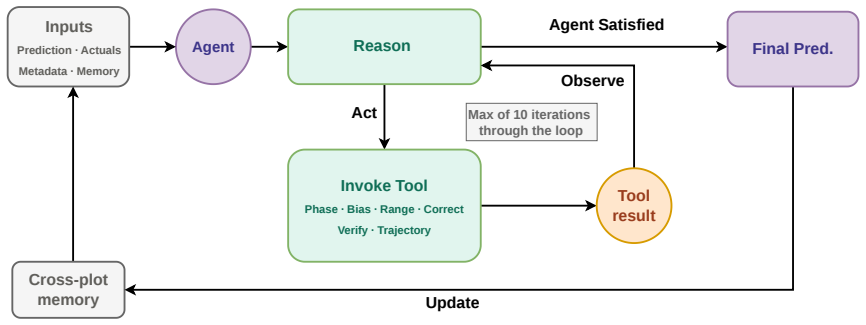
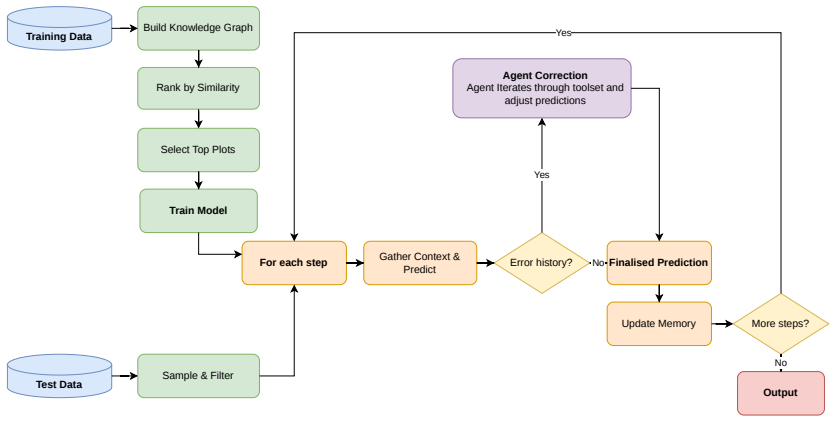
A structured LLM agent refines machine learning crop yield forecasts by applying agricultural knowledge through targeted tools after the initial prediction.
A machine-rendered reading of the paper's core claim, the machinery that carries it, and where it could break.
Core claim
The central claim is that a structured LLM agent equipped with phase-detection, bias-learning, and range-validation tools performs post-hoc correction of existing yield forecasts, delivering measurable accuracy gains on both a proprietary strawberry dataset and a public USDA corn dataset when applied to XGBoost, Random Forest, and Moirai2 baselines.
What carries the argument
The structured LLM agent framework whose tools encode domain knowledge for phase detection, bias learning, and range validation to adjust base-model outputs.
If this is right
- The same agent tools produce error reductions for multiple base forecasters, not just one.
- Strongest gains occur when the refinement model is Llama 3.1 8B rather than LLaVA 13B.
- Improvements appear on both proprietary commercial records and public harvest statistics.
- Post-hoc correction works with only standard farm data and does not require added sensors.
Where Pith is reading between the lines
- The method could be tried on other crops or geographies where yield records are similarly sparse to test whether the reported error drops generalize.
- If the phase and bias tools prove reliable, forecasters might shift resources away from building dense sensor networks toward refining lighter models.
- The observed sensitivity to the choice of agent model suggests that future work could compare additional open-weight models on the same correction tasks.
Load-bearing premise
The agent must correctly interpret and apply real agricultural patterns about growth stages and yield influences without fabricating adjustments that create new errors.
What would settle it
Re-running the agent on a fresh hold-out partition of the strawberry or corn records and finding that mean absolute error or mean absolute scaled error increases rather than decreases compared with the uncorrected baseline.
Figures



read the original abstract
Accurate crop yield forecasting in commercial soft fruit production is constrained by the data available in typical commercial farm records, which lack the sensor networks, satellite imagery, and high-resolution meteorological inputs that most state-of-the-art approaches assume. We propose a structured LLM agent framework that performs post-hoc correction of existing model predictions, encoding agricultural domain knowledge across tools for phase detection, bias learning, and range validation. Evaluated on a proprietary strawberry yield dataset and a public USDA corn harvest dataset, agent refinement of XGBoost reduced MAE by 20% and MASE by 56% on strawberry, with consistent improvements across Moirai2 (MAE 24%, MASE 22%) and Random Forest (MAE 28%, MASE 66%) baselines. Using Llama 3.1 8B as the agent produced the strongest corrections across all configurations; LLaVA 13B showed inconsistent gains, highlighting sensitivity to the choice of refinement model.
Editorial analysis
A structured set of objections, weighed in public.
Referee Report
Summary. The paper proposes a structured LLM agent framework for post-hoc correction of agricultural yield forecasts. The agent encodes domain knowledge via three tools (phase detection, bias learning, and range validation) and is evaluated on a proprietary strawberry yield dataset and a public USDA corn harvest dataset. It reports consistent MAE and MASE reductions when refining predictions from XGBoost (20% MAE / 56% MASE on strawberry), Moirai2, and Random Forest baselines, with Llama 3.1 8B as the strongest agent model.
Significance. If the gains prove robust and attributable to the domain-specific tools rather than generic LLM post-processing, the work could provide a practical route to improving forecasts in commercial settings that lack sensor or satellite data. The multi-baseline evaluation and inclusion of a public dataset are positive features. However, the current evidence is too preliminary to establish this contribution clearly.
major comments (3)
- [Abstract] Abstract: the headline improvements (20% MAE and 56% MASE on strawberry with XGBoost; 24-28% MAE and 22-66% MASE on other baselines) are stated without any description of dataset size, number of seasons or forecast horizons, train/test split, cross-validation procedure, or statistical significance testing, leaving the central empirical claim only weakly supported.
- [Evaluation] Evaluation: no ablation is presented that replaces the phase-detection / bias-learning / range-validation tools with a generic LLM corrector given identical historical yields and residuals. Without this control it is impossible to determine whether the reported deltas require the agricultural encoding or would arise from any capable LLM under the same correction budget.
- [Datasets] Datasets and reproducibility: the primary results rely on a proprietary strawberry dataset whose size, characteristics, and ground-truth labels cannot be inspected. This prevents external verification that the agent's tool outputs are faithful to agronomic priors rather than learned from the limited seasons or introduced as new systematic biases.
minor comments (2)
- [Abstract] The abstract refers to 'Moirai2' as a baseline without defining the model or its training regime; a brief description or citation should be added.
- [Methods] Clarify the exact prompting strategy, tool-calling protocol, and output format of the structured agent so that the framework can be reproduced even if the strawberry data remain private.
Simulated Author's Rebuttal
We thank the referee for the constructive feedback. We address each major comment below, agreeing where the manuscript requires strengthening and outlining specific revisions to improve empirical support and reproducibility.
read point-by-point responses
-
Referee: [Abstract] Abstract: the headline improvements (20% MAE and 56% MASE on strawberry with XGBoost; 24-28% MAE and 22-66% MASE on other baselines) are stated without any description of dataset size, number of seasons or forecast horizons, train/test split, cross-validation procedure, or statistical significance testing, leaving the central empirical claim only weakly supported.
Authors: We agree that the abstract omits critical experimental details needed to contextualize the reported gains. In the revised manuscript we will expand the abstract (within length constraints) and the evaluation section to specify dataset sizes, number of seasons, forecast horizons, train/test splits, cross-validation procedure, and results of statistical significance testing (e.g., paired t-tests on MAE/MASE). revision: yes
-
Referee: [Evaluation] Evaluation: no ablation is presented that replaces the phase-detection / bias-learning / range-validation tools with a generic LLM corrector given identical historical yields and residuals. Without this control it is impossible to determine whether the reported deltas require the agricultural encoding or would arise from any capable LLM under the same correction budget.
Authors: We accept this criticism and will add the requested ablation. The revised paper will include a control experiment in which a generic LLM corrector receives identical historical yields and residuals but lacks the three domain-specific tools. Performance deltas will be reported across the same baselines and datasets to isolate the contribution of the agricultural encoding. revision: yes
-
Referee: [Datasets] Datasets and reproducibility: the primary results rely on a proprietary strawberry dataset whose size, characteristics, and ground-truth labels cannot be inspected. This prevents external verification that the agent's tool outputs are faithful to agronomic priors rather than learned from the limited seasons or introduced as new systematic biases.
Authors: We acknowledge the verification challenge created by the proprietary strawberry dataset. While raw data cannot be released for commercial reasons, the revised manuscript will include expanded dataset descriptions (size, seasons, yield distributions, label verification process) and will highlight the fully reproducible public USDA corn results. We will also release the complete agent code, tool implementations, and evaluation scripts. revision: partial
Circularity Check
No circularity: empirical comparisons are externally measured
full rationale
The paper reports direct empirical gains from an LLM agent post-hoc correction framework on two datasets, measured as MAE and MASE reductions against fixed baselines (XGBoost, Moirai2, Random Forest). No equations, fitted parameters, or procedural definitions are shown that reduce these deltas to quantities defined by the agent's own outputs or by self-referential construction. The three tools (phase detection, bias learning, range validation) are described as input procedures whose contribution is tested via end-to-end evaluation rather than assumed or derived tautologically. Any self-citations are incidental and not invoked to justify uniqueness or forbid alternatives.
Axiom & Free-Parameter Ledger
axioms (1)
- domain assumption Agricultural domain knowledge for growth phases, systematic biases, and plausible yield ranges can be encoded and applied via LLM tool calls.
invented entities (1)
-
Structured LLM agent framework with phase detection, bias learning, and range validation tools
no independent evidence
Lean theorems connected to this paper
-
IndisputableMonolith/Cost/FunctionalEquation.leanwashburn_uniqueness_aczel unclear?
unclearRelation between the paper passage and the cited Recognition theorem.
structured LLM agent framework that performs post-hoc correction... tools for phase detection, bias learning, and range validation
-
IndisputableMonolith/Foundation/ArithmeticFromLogic.leanLogicNat recovery unclear?
unclearRelation between the paper passage and the cited Recognition theorem.
ReAct loop... detect phase... learn bias... validate range
What do these tags mean?
- matches
- The paper's claim is directly supported by a theorem in the formal canon.
- supports
- The theorem supports part of the paper's argument, but the paper may add assumptions or extra steps.
- extends
- The paper goes beyond the formal theorem; the theorem is a base layer rather than the whole result.
- uses
- The paper appears to rely on the theorem as machinery.
- contradicts
- The paper's claim conflicts with a theorem or certificate in the canon.
- unclear
- Pith found a possible connection, but the passage is too broad, indirect, or ambiguous to say the theorem truly supports the claim.
Reference graph
Works this paper leans on
-
[1]
Using deep learning to predict plant growth and yield in greenhouse environments
Bashar Alhnaity, Simon Pearson, Georgios Leontidis, and Stefanos Kollias. Using deep learning to predict plant growth and yield in greenhouse environments. InInterna- tional Symposium on Advanced Technologies and Management for Innovative Greenhouses: GreenSys2019 1296, pages 425–432, 2019
work page 2019
-
[2]
Mirxat Alim, Guo-Hua Ye, Peng Guan, De-Sheng Huang, Bao-Sen Zhou, and Wei Wu. Comparison of arima model and xgboost model for prediction of human brucellosis in mainland china: a time-series study.BMJ open, 10(12):e039676, 2020
work page 2020
-
[3]
Javier Ar´ evalo-Royo, Francisco-Javier Flor-Montalvo, Juan-Ignacio Latorre-Biel, Rub´ en Tino-Ramos, Eduardo Mart´ ınez-C´ amara, and Julio Blanco-Fern´ andez. Ai algorithms in the agrifood industry: Application potential in the spanish agrifood context.Applied Sci- ences, 15(4):2096, 2025
work page 2096
-
[4]
Sven Batke, Nathan Thomas, Nathalie Key, and Phil Morley. Protected and productive: How greenhouses should deliver uk food security.Plants, People, Planet, 2025
work page 2025
-
[5]
Matthew Beddows, Aiden Durrant, and Georgios Leontidis. Visiontrees: A hybrid tree- based visual masked autoencoder approach for strawberry yield forecasting from low- resolution data.IEEE Transactions on AgriFood Electronics, 2025
work page 2025
-
[6]
Matthew Beddows and Georgios Leontidis. A multi-farm global-to-local expert-informed machine learning system for strawberry yield forecasting.Agriculture, 14(6):883, 2024
work page 2024
-
[7]
Jorge Celis, Xiangming Xiao, Pradeep Wagle, Paul R Adler, and Paul White. A review of yield forecasting techniques and their impact on sustainable agriculture.Transformation Towards Circular Food Systems, pages 139–168, 2024
work page 2024
-
[8]
Mohita Chaudhary, Mohamed Sadok Gastli, Lobna Nassar, and Fakhri Karray. Deep learning approaches for forecasting strawberry yields and prices using satellite images and station-based soil parameters.arXiv preprint arXiv:2102.09024, 2021
-
[9]
Tao Chen, Liang Lv, Di Wang, Jing Zhang, Yue Yang, Zeyang Zhao, Chen Wang, Xiaowei Guo, Hao Chen, Qingye Wang, et al. Empowering agrifood system with artificial intelli- gence: A survey of the progress, challenges and opportunities.ACM Computing Surveys, 57(2):1–37, 2024
work page 2024
-
[10]
Zihan Chen, Lei Nico Zheng, Cheng Lu, Jialu Yuan, and Di Zhu. Chatgpt informed graph neural network for stock movement prediction.arXiv preprint arXiv:2306.03763, 2023. 19
-
[11]
Technological innovation in agri- food supply chains.British Food Journal, 126(5):1852–1869, 2024
Livio Cricelli, Roberto Mauriello, and Serena Strazzullo. Technological innovation in agri- food supply chains.British Food Journal, 126(5):1852–1869, 2024
work page 2024
-
[12]
Aiden Durrant, Milan Markovic, David Matthews, David May, Jessica Enright, and Geor- gios Leontidis. The role of cross-silo federated learning in facilitating data sharing in the agri-food sector.Computers and Electronics in Agriculture, 193:106648, 2022
work page 2022
-
[13]
Empowering time series analysis with large language models: A survey
Ming Jin et al. Empowering time series analysis with large language models: A survey. IJCAI, 2024
work page 2024
-
[14]
arXiv preprint arXiv:2310.01728 , year=
Ming Jin, Shiyu Wang, Lintao Ma, Zhixuan Chu, James Y Zhang, Xiaoming Shi, Pin-Yu Chen, Yuxuan Liang, Yuan-Fang Li, Shirui Pan, et al. Time-llm: Time series forecasting by reprogramming large language models.arXiv preprint arXiv:2310.01728, 2023
-
[15]
Mark A Lee, Angelo Monteiro, Andrew Barclay, Jon Marcar, Mirena Miteva-Neagu, and Joe Parker. A framework for predicting soft-fruit yields and phenology using embedded, networked microsensors, coupled weather models and machine-learning techniques.Com- puters and Electronics in Agriculture, 168:105103, 2020
work page 2020
-
[16]
Zhiming Li, Yushi Cao, Xiufeng Xu, Junzhe Jiang, Xu Liu, Yon Shin Teo, Shang-Wei Lin, and Yang Liu. Llms for relational reasoning: How far are we? InProceedings of the 1st international workshop on large language models for code, pages 119–126, 2024
work page 2024
-
[17]
Fudong Lin, Summer Crawford, Kaleb Guillot, Yihe Zhang, Yan Chen, Xu Yuan, Li Chen, Shelby Williams, Robert Minvielle, Xiangming Xiao, et al. Mmst-vit: Climate change-aware crop yield prediction via multi-modal spatial-temporal vision transformer. InProceedings of the IEEE/CVF International Conference on Computer Vision, pages 5774–5784, 2023
work page 2023
-
[18]
arXiv preprint arXiv:2511.11698 , year=
Chenghao Liu, Taha Aksu, Juncheng Liu, Xu Liu, Hanshu Yan, Quang Pham, Silvio Savarese, Doyen Sahoo, Caiming Xiong, and Junnan Li. Moirai 2.0: When less is more for time series forecasting.arXiv preprint arXiv:2511.11698, 2025
-
[19]
Shiyu Liu, Yiannis Ampatzidis, Congliang Zhou, and Won Suk Lee. Ai-driven time series analysis for predicting strawberry weekly yields integrating fruit monitoring and weather data for optimized harvest planning.Computers and Electronics in Agriculture, 233:110212, 2025
work page 2025
-
[20]
Aravind Mandiga, June Hyeok Yoon, Bhargavi Kasireddy, Oluyinka A Olukosi, and Guom- ing Li. Nutrichat: A reasoning-driven large language model agent with expert-designed tools for knowledge-grounded poultry nutrition assistance.Computers and Electronics in Agriculture, 245:111564, 2026
work page 2026
-
[21]
Rosana Cavalcante de Oliveira and Rog´ erio Diogne de Souza e Silva. Artificial intelligence in agriculture: benefits, challenges, and trends.Applied Sciences, 13(13):7405, 2023
work page 2023
-
[22]
George Onoufriou, Marc Hanheide, and Georgios Leontidis. Premonition net, a multi- timeline transformer network architecture towards strawberry tabletop yield forecasting. Computers and Electronics in Agriculture, 208:107784, 2023
work page 2023
-
[23]
NR Prasad, NR Patel, and Abhishek Danodia. Crop yield prediction in cotton for regional level using random forest approach.spatial information research, 29:195–206, 2021
work page 2021
-
[24]
LA Suarez, Melanie Robertson-Dean, J Brinkhoff, and A Robson. Forecasting carrot yield with optimal timing of sentinel 2 image acquisition.Precision Agriculture, 25(2):570–588, 2024. 20
work page 2024
-
[25]
Sudhakar Uppalapati, Prabhu Paramasivam, Naveen Kilari, Jasgurpreet Singh Chohan, Praveen Kumar Kanti, Harinadh Vemanaboina, Leliso Hobicho Dabelo, and Rupesh Gupta. Precision biochar yield forecasting employing random forest and xgboost with taylor dia- gram visualization.Scientific Reports, 15(1):7105, 2025
work page 2025
-
[26]
Unified training of universal time series forecasting transformers
Gerald Woo, Chenghao Liu, Akshat Kumar, Caiming Xiong, Silvio Savarese, and Doyen Sahoo. Unified training of universal time series forecasting transformers. InProceedings of the 41st International Conference on Machine Learning, 2024
work page 2024
-
[27]
Guilong Xiao, Jianxi Huang, Wen Zhuo, Hai Huang, Jianjian Song, Kaiqi Du, Jingwen Wang, Wenping Yuan, Liang Sun, Yelu Zeng, et al. Progress and perspectives of crop yield forecasting with remote sensing: A review.IEEE Geoscience and Remote Sensing Magazine, 2025
work page 2025
-
[28]
React: Synergizing reasoning and acting in language models
Shunyu Yao, Jeffrey Zhao, Dian Yu, Nan Du, Izhak Shafran, Karthik R Narasimhan, and Yuan Cao. React: Synergizing reasoning and acting in language models. InThe eleventh international conference on learning representations, 2022
work page 2022
-
[29]
Empowering time series forecasting with llm-agents
Chin-Chia Michael Yeh, Vivian Lai, Uday Singh Saini, Xiran Fan, Yujie Fan, Junpeng Wang, Xin Dai, and Yan Zheng. Empowering time series forecasting with llm-agents. arXiv preprint arXiv:2508.04231, 2025
-
[30]
Harnessing llms for temporal data-a study on ex- plainable financial time series forecasting
Xinli Yu, Zheng Chen, and Yanbin Lu. Harnessing llms for temporal data-a study on ex- plainable financial time series forecasting. InProceedings of the 2023 conference on empirical methods in natural language processing: industry track, pages 739–753, 2023
work page 2023
-
[31]
Caiwang Zheng, Amr Abd-Elrahman, Vance Whitaker, and Cheryl Dalid. Prediction of strawberry dry biomass from uav multispectral imagery using multiple machine learning methods.Remote Sensing, 14(18):4511, 2022. 21
work page 2022
discussion (0)
Sign in with ORCID, Apple, or X to comment. Anyone can read and Pith papers without signing in.