Recognition: 2 theorem links
· Lean TheoremA Least-Squares Weak Galerkin Method for Second-Order Elliptic Equations in Non-Divergence Form
Pith reviewed 2026-05-13 02:51 UTC · model grok-4.3
The pith
A least-squares weak Galerkin method for second-order elliptic equations in non-divergence form achieves optimal-order error estimates in a discrete H²-equivalent norm.
A machine-rendered reading of the paper's core claim, the machinery that carries it, and where it could break.
Core claim
We propose a least-squares weak Galerkin method for second-order elliptic equations in non-divergence form using a locally defined discrete weak Hessian operator. The method produces a symmetric positive definite system on general meshes. We establish optimal-order error estimates for the approximation in a discrete H²-equivalent norm and present numerical experiments to validate the analysis.
What carries the argument
The locally defined discrete weak Hessian operator constructed within the weak Galerkin framework that enables the least-squares formulation, symmetry, positive definiteness, and error analysis.
If this is right
- The algorithm applies to general polygonal and polyhedral meshes without special conditions.
- The resulting linear system is symmetric and positive definite.
- Optimal-order error estimates hold in the discrete H²-equivalent norm.
- Numerical experiments demonstrate efficiency and robustness on various test cases.
Where Pith is reading between the lines
- The symmetry and positive definiteness open the possibility of using standard iterative solvers such as conjugate gradient without extra stabilization.
- The avoidance of divergence-form requirements broadens applicability to elliptic problems that lack that structure.
- General mesh flexibility suggests direct use on domains with complex or irregular boundaries.
Load-bearing premise
The locally defined discrete weak Hessian operator is well-defined and allows the error analysis to yield optimal rates while ensuring the system matrix is symmetric and positive definite.
What would settle it
Numerical experiments on refined meshes where the observed convergence rate in the discrete H² norm falls below the optimal order predicted by the theory would falsify the error estimate.
Figures
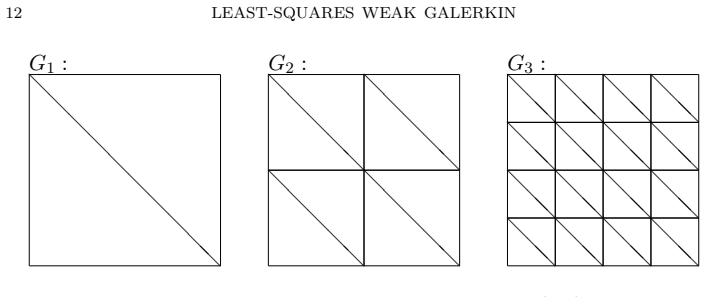
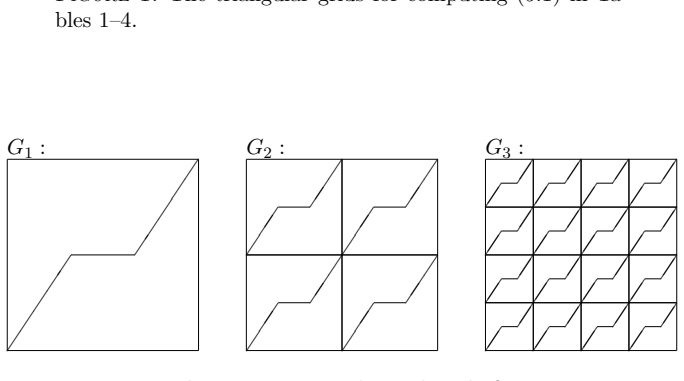
read the original abstract
This article proposes a novel least-squares weak Galerkin (LS-WG) method for second-order elliptic equations in non-divergence form. The approach leverages a locally defined discrete weak Hessian operator constructed within the weak Galerkin framework. A key feature of the resulting algorithm is that it yields a symmetric and positive definite linear system while remaining applicable to general polygonal and polyhedral meshes. We establish optimal-order error estimates for the approximation in a discrete $H^2$-equivalent norm. Finally, comprehensive numerical experiments are presented to validate the theoretical analysis and demonstrate the efficiency and robustness of the method.
Editorial analysis
A structured set of objections, weighed in public.
Circularity Check
No significant circularity detected
full rationale
The paper explicitly constructs the locally defined discrete weak Hessian via polynomial projections on elements and faces plus stabilization terms inside the weak Galerkin framework. It then proves coercivity and continuity of the least-squares bilinear form directly in the discrete H²-equivalent norm (yielding SPD algebraic systems) and obtains optimal error bounds via standard Strang-type arguments under stated regularity assumptions on coefficients and solution. None of these steps reduce by construction to self-definitions, fitted inputs renamed as predictions, or load-bearing self-citations; the central claims rest on independent consistency, stability, and approximation properties that are verified within the manuscript itself.
Axiom & Free-Parameter Ledger
axioms (1)
- domain assumption The solution possesses sufficient regularity (at least H2) for the discrete H2-equivalent norm error estimates to hold.
invented entities (1)
-
locally defined discrete weak Hessian operator
no independent evidence
Reference graph
Works this paper leans on
-
[1]
Babu s ka , The finite element method with Lagrange multipliers , Numer
I. Babu s ka , The finite element method with Lagrange multipliers , Numer. Math., 20 (1973), pp. 179-192
work page 1973
-
[2]
S. C. Brenner, T. Gudi, M. Neilan, and L.-Y. Sung , C^0 penalty methods for the fully nonlinear Monge-Amp\` e re equation , Math. Comp., 80:1979-1995, 2011
work page 1979
-
[3]
S. C. Brenner and L. R. Scott , The Mathematical Theory of Finite Element Methods , 3rd ed., Texts Appl. Math. 15, Springer, New York, 2008
work page 2008
-
[4]
F. Brezzi , On the existence, uniqueness, and approximation of saddle point problems arising from Lagrange multipliers , RAIRO, 8 (1974), pp. 129-151
work page 1974
-
[5]
M. Chicco , Dirichlet problem for a class of linear second order elliptic partial differential equations with discontinuous coefficients , Ann. Mat. Pura Appl. (4), 92 (1972), pp. 13-22
work page 1972
-
[6]
P. G. Ciarlet , The Finite Element Method for Elliptic Problems, North-Holland, 1978
work page 1978
-
[7]
M. Crouzeix and V. Thom\'ee , The stability in L_p and W_p^1 of the L_2 -projection onto finite element function spaces , Mathematics of Computation, Vol 48, No. 178 (1987), pp. 521-532
work page 1987
-
[8]
W. Cao, C. Wang and J. Wang , An L^p -Primal-Dual Weak Galerkin Method for div-curl Systems , Journal of Computational and Applied Mathematics, vol. 422, 114881, 2023
work page 2023
-
[9]
W. Cao, C. Wang and J. Wang , An L^p -Primal-Dual Weak Galerkin Method for Convection-Diffusion Equations , Journal of Computational and Applied Mathematics, vol. 419, 114698, 2023
work page 2023
-
[10]
W. Cao, C. Wang and J. Wang , A New Primal-Dual Weak Galerkin Method for Elliptic Interface Problems with Low Regularity Assumptions , Journal of Computational Physics, vol. 470, 111538, 2022
work page 2022
-
[11]
S. Cao, C. Wang and J. Wang , A new numerical method for div-curl Systems with Low Regularity Assumptions , Computers and Mathematics with Applications, vol. 144, pp. 47-59, 2022
work page 2022
- [12]
- [13]
- [14]
-
[15]
W. H. Fleming and H. M. Soner , Controlled Markov Processes and Viscosity Solutions , 2nd ed., Stoch. Model. Appl. Probab. 25, Springer, New York, 2006
work page 2006
- [16]
-
[17]
Grisvard , Elliptic Problems in Nonsmooth Domains , Classics Appl
P. Grisvard , Elliptic Problems in Nonsmooth Domains , Classics Appl. Math. 69, SIAM, Philadelphia, 2011
work page 2011
-
[18]
O. Lakkis and T. Pryer , A finite element method for second order nonvariational elliptic problems , SIAM J. Sci. Comput., 33(2):786-801, 2011
work page 2011
-
[19]
D. Li, Y. Nie, and C. Wang , Superconvergence of Numerical Gradient for Weak Galerkin Finite Element Methods on Nonuniform Cartesian Partitions in Three Dimensions , Computers and Mathematics with Applications, vol 78(3), pp. 905-928, 2019
work page 2019
-
[20]
D. Li, C. Wang and J. Wang , An Extension of the Morley Element on General Polytopal Partitions Using Weak Galerkin Methods , Journal of Scientific Computing, 100, vol 27, 2024
work page 2024
-
[21]
D. Li, C. Wang and S. Zhang , Weak Galerkin methods for elliptic interface problems on curved polygonal partitions , Journal of Computational and Applied Mathematics, pp. 115995, 2024
work page 2024
-
[22]
D. Li, C. Wang, J. Wang and X. Ye , Generalized weak Galerkin finite element methods for second order elliptic problems , Journal of Computational and Applied Mathematics, vol. 445, pp. 115833, 2024
work page 2024
-
[23]
D. Li, C. Wang, J. Wang and S. Zhang , High Order Morley Elements for Biharmonic Equations on Polytopal Partitions , Journal of Computational and Applied Mathematics, Vol. 443, pp. 115757, 2024
work page 2024
-
[24]
D. Li, C. Wang and J. Wang , Curved Elements in Weak Galerkin Finite Element Methods , Computers and Mathematics with Applications, Vol. 153, pp. 20-32, 2024
work page 2024
-
[25]
D. Li, C. Wang and J. Wang , Generalized Weak Galerkin Finite Element Methods for Biharmonic Equations , Journal of Computational and Applied Mathematics, vol. 434, 115353, 2023
work page 2023
-
[26]
D. Li, C. Wang and J. Wang , An L^p -primal-dual finite element method for first-order transport problems , Journal of Computational and Applied Mathematics, vol. 434, 115345, 2023
work page 2023
- [27]
-
[28]
D. Li, C. Wang and J. Wang , Primal-Dual Weak Galerkin Finite Element Methods for Transport Equations in Non-Divergence Form , Journal of Computational and Applied Mathematics, vol. 412, 114313, 2022
work page 2022
-
[29]
D. Li, C. Wang, and J. Wang , Superconvergence of the Gradient Approximation for Weak Galerkin Finite Element Methods on Rectangular Partitions , Applied Numerical Mathematics, vol. 150, pp. 396-417, 2020
work page 2020
- [30]
-
[31]
Neilan , Quadratic finite element methods for the Monge-Amp\`ere equation , J
M. Neilan , Quadratic finite element methods for the Monge-Amp\`ere equation , J. Sci. Comput., 54(1):200-226, 2013
work page 2013
-
[32]
I. Smears and E. S\"uli , Discontinuous Galerking finite element approximation of nondivergence form elliptic equations with Cord\`es coefficients , SIAM J Numer. Anal., Vol. 51, No. 4, 2013, pp. 2088-2106
work page 2013
-
[33]
I. Smears and E. S\"uli , Discontinuous Galerkin finite element approximation of Hamilton-Jacobi-Bellman equations with Cord\`es coefficients , http://eprints.maths.ox.ac.uk/1671/
-
[34]
C. Wang , New Discretization Schemes for Time-Harmonic Maxwell Equations by Weak Galerkin Finite Element Methods , Journal of Computational and Applied Mathematics, Vol. 341, pp. 127-143, 2018
work page 2018
-
[35]
C. Wang , Low Regularity Primal-Dual Weak Galerkin Finite Element Methods for Ill-Posed Elliptic Cauchy Problems , Int. J. Numer. Anal. Mod., vol. 19(1), pp. 33-51, 2022
work page 2022
-
[36]
C. Wang , A Modified Primal-Dual Weak Galerkin Finite Element Method for Second Order Elliptic Equations in Non-Divergence Form , Int. J. Numer. Anal. Mod., vol. 18(4), pp. 500-523, 2021
work page 2021
-
[37]
C. Wang , A New Primal-Dual Weak Galerkin Finite Element Method for Ill-posed Elliptic Cauchy Problems , Journal of Computational and Applied Mathematics, vol 371, 112629, 2020
work page 2020
-
[38]
C. Wang and J. Wang , A Primal-Dual Weak Galerkin Finite Element Method for Second Order Elliptic Equations in Non-Divergence form , Mathematics of Computation, Vol. 87, pp. 515-545, 2018
work page 2018
-
[39]
C. Wang and J. Wang , An efficient numerical scheme for the biharmonic equation by weak Galerkin finite element methods on polygonal or polyhedral meshes , available at arXiv:1303.0927v1. Computers and Mathematics with Applications, 68 (2014), 2314-2330
-
[40]
C. Wang and J. Wang , A Primal-Dual Weak Galerkin Finite Element Method for Fokker-Planck Type Equations , SIAM Numerical Analysis, vol. 58(5), pp. 2632-2661, 2020
work page 2020
-
[41]
C. Wang and J. Wang , A Primal-Dual Finite Element Method for First-Order Transport Problems , Journal of Computational Physics, Vol. 417, 109571, 2020
work page 2020
-
[42]
C. Wang and J. Wang , Primal-Dual Weak Galerkin Finite Element Methods for Elliptic Cauchy Problems , Computers and Mathematics with Applications, vol 79(3), pp. 746-763, 2020
work page 2020
-
[43]
C. Wang and J. Wang , Discretization of Div-Curl Systems by Weak Galerkin Finite Element Methods on Polyhedral Partitions , Journal of Scientific Computing, Vol. 68, pp. 1144-1171, 2016
work page 2016
-
[44]
C. Wang and J. Wang , A Hybridized Formulation for Weak Galerkin Finite Element Methods for Biharmonic Equation on Polygonal or Polyhedral Meshes , International Journal of Numerical Analysis and Modeling, Vol. 12, pp. 302-317, 2015
work page 2015
-
[45]
J. Wang and C. Wang , Weak Galerkin Finite Element Methods for Elliptic PDEs , Science China, Vol. 45, pp. 1061-1092, 2015
work page 2015
-
[46]
C. Wang and J. Wang , An Efficient Numerical Scheme for the Biharmonic Equation by Weak Galerkin Finite Element Methods on Polygonal or Polyhedral Meshes , Journal of Computers and Mathematics with Applications, Vol. 68, 12, pp. 2314-2330, 2014
work page 2014
-
[47]
C. Wang, J. Wang, R. Wang and R. Zhang , A Locking-Free Weak Galerkin Finite Element Method for Elasticity Problems in the Primal Formulation , Journal of Computational and Applied Mathematics, Vol. 307, pp. 346-366, 2016
work page 2016
-
[48]
C. Wang, J. Wang, X. Ye and S. Zhang , De Rham Complexes for Weak Galerkin Finite Element Spaces , Journal of Computational and Applied Mathematics, vol. 397, pp. 113645, 2021
work page 2021
-
[49]
C. Wang, J. Wang and S. Zhang , Weak Galerkin Finite Element Methods for Optimal Control Problems Governed by Second Order Elliptic Partial Differential Equations , Journal of Computational and Applied Mathematics, in press, 2024
work page 2024
-
[50]
C. Wang, J. Wang and S. Zhang , A parallel iterative procedure for weak Galerkin methods for second order elliptic problems , International Journal of Numerical Analysis and Modeling, vol. 21(1), pp. 1-19, 2023
work page 2023
-
[51]
C. Wang, J. Wang and S. Zhang , Weak Galerkin Finite Element Methods for Quad-Curl Problems , Journal of Computational and Applied Mathematics, vol. 428, pp. 115186, 2023
work page 2023
-
[52]
J. Wang, and X. Ye , A weak Galerkin mixed finite element method for second-order elliptic problems , Math. Comp., vol. 83, pp. 2101-2126, 2014
work page 2014
-
[53]
C. Wang, X. Ye and S. Zhang , A Modified weak Galerkin finite element method for the Maxwell equations on polyhedral meshes , Journal of Computational and Applied Mathematics, vol. 448, pp. 115918, 2024
work page 2024
-
[54]
C. Wang and S. Zhang , A Weak Galerkin Method for Elasticity Interface Problems , Journal of Computational and Applied Mathematics, vol. 419, 114726, 2023
work page 2023
-
[55]
C. Wang and L. Zikatanov , Low Regularity Primal-Dual Weak Galerkin Finite Element Methods for Convection-Diffusion Equations , Journal of Computational and Applied Mathematics, vol 394, 113543, 2021
work page 2021
-
[56]
C. Wang and H. Zhou , A Weak Galerkin Finite Element Method for a Type of Fourth Order Problem arising from Fluorescence Tomography , Journal of Scientific Computing, Vol. 71(3), pp. 897-918, 2017
work page 2017
discussion (0)
Sign in with ORCID, Apple, or X to comment. Anyone can read and Pith papers without signing in.