Recognition: 2 theorem links
· Lean TheoremLarge N factorization of families of tensor trace-invariants
Pith reviewed 2026-05-13 02:38 UTC · model grok-4.3
The pith
Any trace-invariant admitting tree-like dominant pairings factorizes at large N.
A machine-rendered reading of the paper's core claim, the machinery that carries it, and where it could break.
Core claim
Any compatible trace-invariant that admits tree-like dominant pairings in its Wick expansion factorizes at large N. This follows from three theorems: a simple combinatorial bound that ensures factorization, the proof that compatible invariants are dominated by tree-like pairings, and the demonstration that the presence of such dominant pairings implies factorization over connected components.
What carries the argument
Tree-like dominant pairings: the combinatorial Wick pairings of tensor indices that dominate the large-N expectation value and carry the factorization argument.
If this is right
- Many families of trace-invariants previously studied in the literature factorize at large N.
- The multipartite generalization of Rényi entanglement entropy for any such trace-invariant has an explicitly computable typical value in the uniform random quantum state.
- Explicit non-factorizing examples exist for complex tensors, confirming the contrast with matrix models.
Where Pith is reading between the lines
- The tree-like pairing condition may classify which tensor models behave like matrix models at large N.
- The same combinatorial test could apply to non-Gaussian tensor distributions.
- Factorization would simplify calculations of typical entanglement properties in random tensor networks.
Load-bearing premise
The trace-invariant must be compatible so that its large-N asymptotics are controlled by the identified tree-like pairings.
What would settle it
An explicit compatible trace-invariant whose dominant pairings are tree-like but whose expectation value does not factorize at large N would refute the third theorem.
Figures



read the original abstract
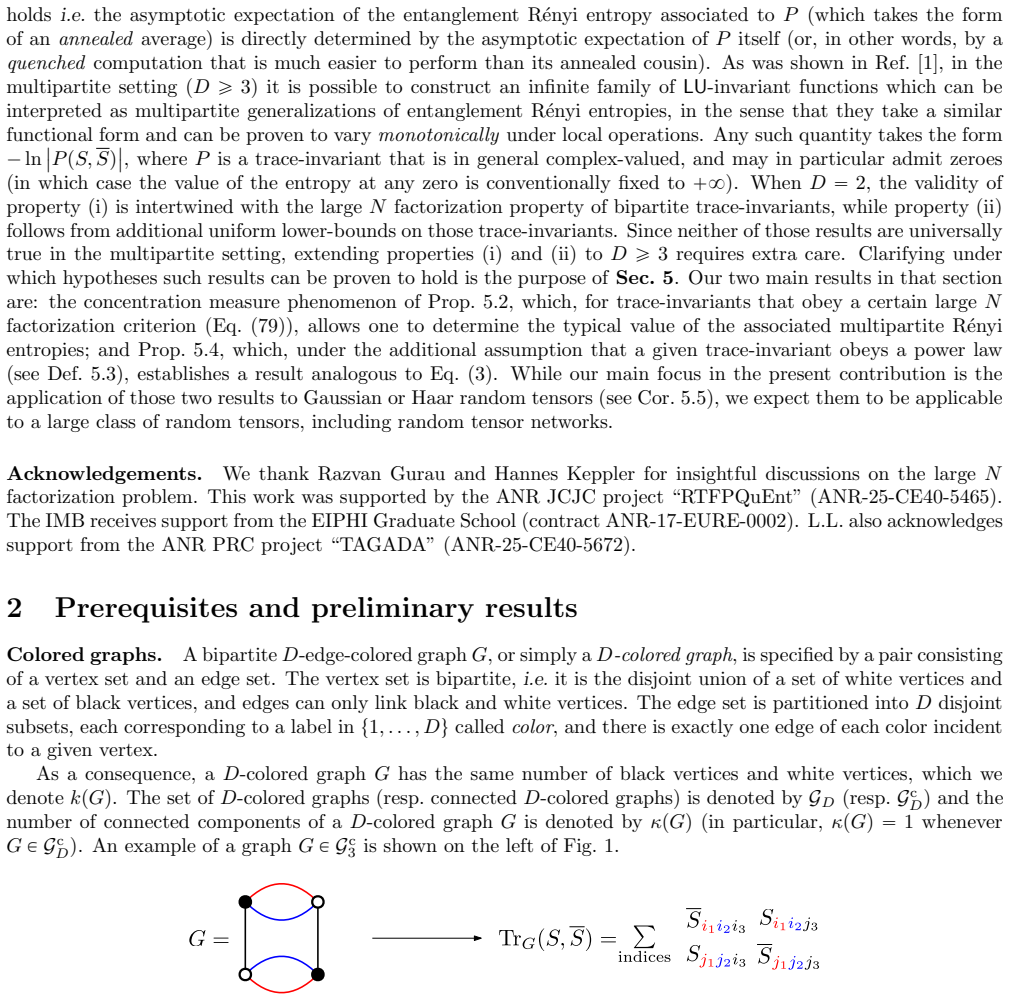
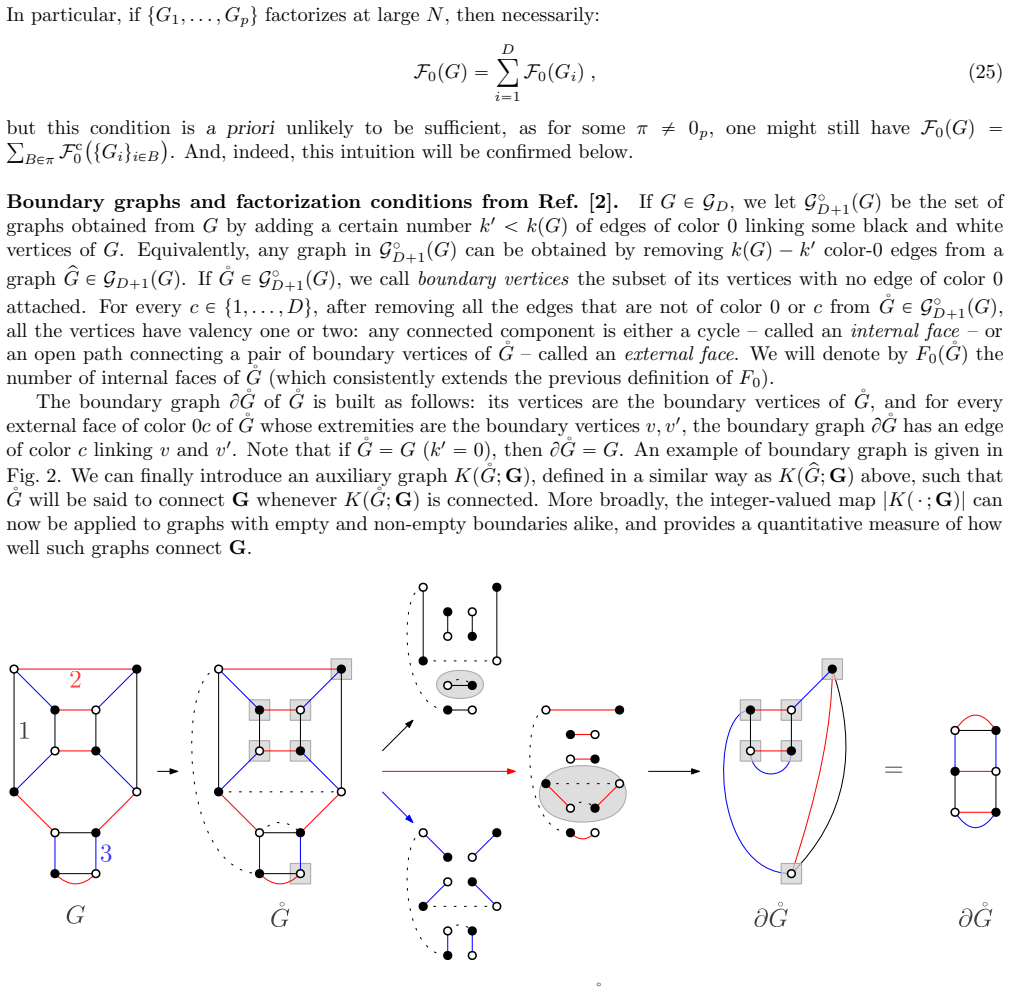
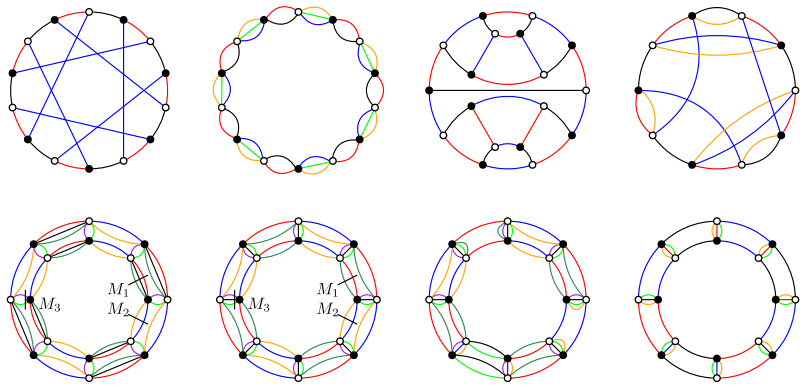
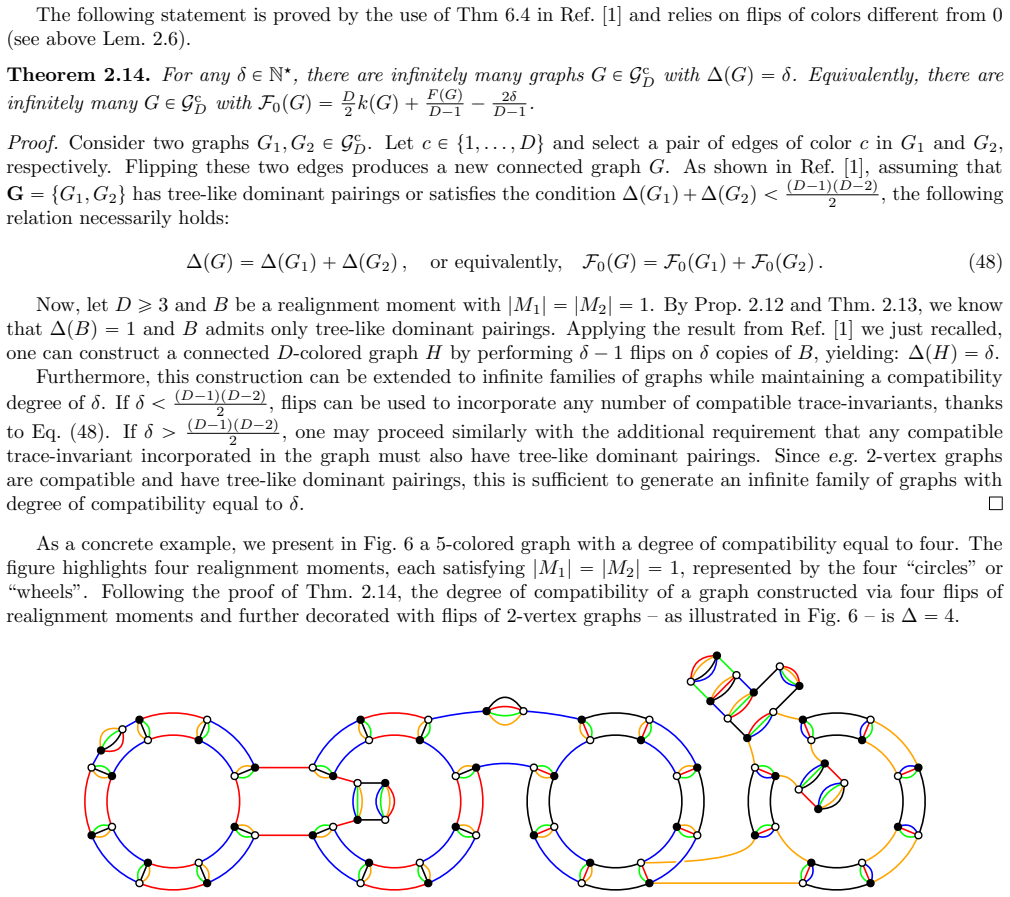
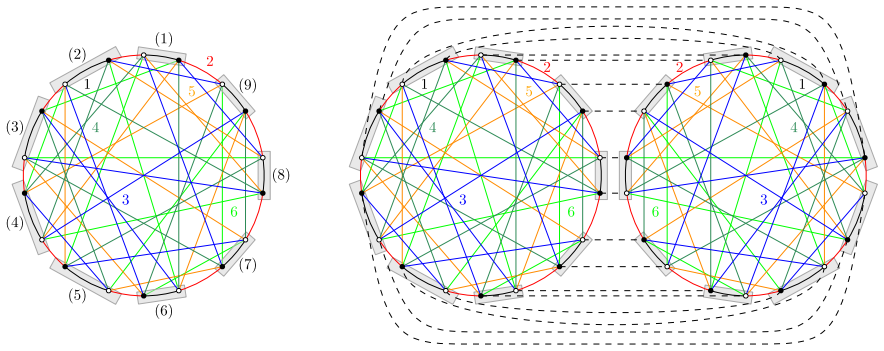
It was recently proven that, in contrast to their matrix analogues, the moments of a real Gaussian tensor of size N do not in general factorize over their connected components in the asymptotic large N limit. While the original proof of this rather surprising result was not constructive, explicit examples of non-factorizing moments, which are expectation values of trace-invariants, have since then been discovered. We explore further aspects of this problem, with a focus on Haar-distributed (or Gaussian) complex random tensors, which are more directly relevant to quantum information. We start out by exhibiting an explicit example of non-factorizing trace-invariant, thereby filling a gap in the recent literature. We then turn to the opposite question: that of finding interesting families of trace-invariants that do in fact factorize at large N. We establish three main theorems in this regard. The first one provides a sufficient combinatorial bound ensuring large N factorization, that is also simple enough to be applicable to various cases of practical relevance. Our second main result shows that the expectation value of any compatible trace-invariant is dominated by certain tree-like combinatorial structures at large N, which we refer to as tree-like dominant pairings. Our third main theorem establishes that any trace-invariant admitting tree-like dominant pairings does actually factorize at large N. In this way, we are able to prove that various families of trace-invariants that have been previously studied in the literature do factorize at large N. We apply our findings to the theory of multipartite quantum entanglement: to any trace-invariant is associated a multipartite generalization of R\'enyi entanglement entropy, whose typical expectation value in the uniform random quantum state can be explicitly computed assuming large N factorization.
Editorial analysis
A structured set of objections, weighed in public.
Referee Report
Summary. The manuscript examines large-N factorization of trace-invariants for complex Gaussian or Haar random tensors. It supplies an explicit non-factorizing example, then proves three theorems: a sufficient combinatorial bound on pairings that guarantees factorization, a dominance result showing that compatible trace-invariants are controlled by tree-like pairings at large N, and a factorization theorem for any invariant admitting such dominant pairings. These criteria are applied to several previously studied families and used to compute the typical value of a multipartite generalization of Rényi entanglement entropy for uniform random quantum states.
Significance. If the combinatorial arguments are correct, the work supplies a concrete, checkable criterion for identifying factorizing families of tensor invariants, addressing an open question left by the known non-factorization results for tensors. The explicit construction of tree-like dominant pairings and the resulting factorization theorems constitute a useful technical contribution to the combinatorial analysis of tensor models. The direct application to multipartite Rényi entropy yields explicit large-N formulas under the stated assumptions, which is of interest in quantum information.
major comments (2)
- [Theorem 2] Theorem 2 (dominance by tree-like pairings): the definition of a 'compatible' trace-invariant is not given a self-contained combinatorial characterization in the main text; it appears to import conditions from earlier works without restating the precise counting constraints that make the bound on non-tree pairings hold. This affects the scope of the subsequent factorization claim.
- [Theorem 3 and §4] Theorem 3 and its application in §4: while the factorization is shown under the tree-like dominance assumption, the error term controlling the approach to the large-N limit is not bounded explicitly. This leaves the 'explicit computation' of the typical multipartite Rényi entropy without a rate of convergence, which is load-bearing for the claimed practicality of the result.
minor comments (3)
- [§2–3] The combinatorial notation for pairings (e.g., the distinction between tree-like and non-tree structures) would benefit from an additional schematic diagram or table summarizing the counting arguments used in the proofs of Theorems 1 and 2.
- [Introduction] The introduction should include a brief comparison table or paragraph contrasting the new sufficient conditions with the earlier non-factorizing examples, to clarify the boundary between the two regimes.
- [§1] A few typographical inconsistencies appear in the indexing of multi-index contractions in the definition of trace-invariants; these do not affect the logic but should be standardized.
Simulated Author's Rebuttal
We thank the referee for their careful reading of the manuscript, the positive assessment of its significance, and the constructive major comments. We address each point below and indicate the revisions we will make.
read point-by-point responses
-
Referee: [Theorem 2] Theorem 2 (dominance by tree-like pairings): the definition of a 'compatible' trace-invariant is not given a self-contained combinatorial characterization in the main text; it appears to import conditions from earlier works without restating the precise counting constraints that make the bound on non-tree pairings hold. This affects the scope of the subsequent factorization claim.
Authors: We agree that a self-contained characterization would improve clarity. In the revised manuscript we will add, immediately preceding Theorem 2, a concise combinatorial definition of compatibility that restates the relevant counting constraints on pairings (the precise bounds on the number of non-tree-like contributions that were imported from the earlier literature). This will make the scope of the dominance result and the subsequent factorization theorem fully explicit without requiring the reader to consult prior works. revision: yes
-
Referee: [Theorem 3 and §4] Theorem 3 and its application in §4: while the factorization is shown under the tree-like dominance assumption, the error term controlling the approach to the large-N limit is not bounded explicitly. This leaves the 'explicit computation' of the typical multipartite Rényi entropy without a rate of convergence, which is load-bearing for the claimed practicality of the result.
Authors: We acknowledge that Theorem 3 establishes that the expectation value converges to the factorized expression but does not derive an explicit rate. In the revised version we will insert a short remark after the statement of Theorem 3 and again in §4 noting that the error is o(1) as N→∞ under the tree-like dominance hypothesis, while an explicit uniform bound on the rate would require additional estimates on the sub-leading pairings and is left for future work. The leading large-N value itself remains explicitly computable from the factorized expression, which is the quantity needed for the typical multipartite Rényi entropy. revision: partial
Circularity Check
No significant circularity; theorems are self-contained combinatorial derivations
full rationale
The paper's core results consist of three explicit theorems proven via direct combinatorial counting of pairings, bounds on dominant structures, and explicit verification that tree-like pairings imply factorization at large N. These steps rely on internal definitions of compatibility and dominant pairings that are introduced and bounded within the paper itself, without reducing to fitted parameters, self-referential definitions, or load-bearing self-citations whose validity depends on the current claims. The non-factorizing example is presented as a contrast case outside the sufficient conditions, and applications to entanglement entropy follow as direct corollaries. The derivation chain is independent and externally falsifiable through the stated combinatorial criteria.
Axiom & Free-Parameter Ledger
axioms (1)
- domain assumption Expectation values of trace-invariants are computed via Wick-type contractions for Gaussian or Haar measures
invented entities (1)
-
tree-like dominant pairings
no independent evidence
Lean theorems connected to this paper
-
IndisputableMonolith/Foundation/AlexanderDuality.leanalexander_duality_circle_linking unclearIf G consists of connected planar 3-colored graphs, then G factorizes at large N (Cor 4.8).
Reference graph
Works this paper leans on
-
[1]
Tensor invariants for multipartite entanglement clas- sification
Sylvain Carrozza, Johann Chevrier, and Luca Lionni. “Tensor invariants for multipartite entanglement clas- sification”. In: (Apr. 2026). arXiv:2604.02269 [math-ph]
-
[2]
The large N factorization does not hold for arbitrary multi-trace observables in random tensors
Razvan Gurau, Felix Joos, and Benjamin Sudakov. “The large N factorization does not hold for arbitrary multi-trace observables in random tensors”. In:Lett. Math. Phys.115.4 (2025), p. 93.doi:10.1007/s11005- 025-01983-4. arXiv:2506.15362 [math-ph]
-
[3]
Jonathan Berthold and Hannes Keppler. “Low order maximally single-trace graphs as the first counterexam- ples to large N factorization in random tensors”. In: (Mar. 2026). arXiv:2603.08638 [math-ph]
-
[4]
Razvan Gurau. “Invitation to Random Tensors”. In:SIGMA12 (2016), p. 094.doi:10.3842/SIGMA.2016
- [5]
-
[6]
H., Jedamzik, K., & Pogosian, L
Valentin Bonzom, Razvan Gurau, and Vincent Rivasseau. “Random tensor models in the largeNlimit: Uncoloring the colored tensor models”. In:Phys. Rev. D85 (8 Apr. 2012), p. 084037.doi:10.1103/PhysRevD. 85.084037.url:https://link.aps.org/doi/10.1103/PhysRevD.85.084037
-
[7]
Critical behavior of colored tensor models in the large N limit
Valentin Bonzom et al. “Critical behavior of colored tensor models in the large N limit”. In:Nucl. Phys. B 853 (2011), pp. 174–195.doi:10.1016/j.nuclphysb.2011.07.022. arXiv:1105.3122 [hep-th]
-
[8]
Revisiting random tensor models at large N via the Schwinger-Dyson equations
Valentin Bonzom. “Revisiting random tensor models at large N via the Schwinger-Dyson equations”. In:JHEP 03 (2013), p. 160.doi:10.1007/JHEP03(2013)160. arXiv:1208.6216 [hep-th]
-
[9]
Enhancing non-melonic triangulations: A tensor model mixing melonic and planar maps
Valentin Bonzom, Thibault Delepouve, and Vincent Rivasseau. “Enhancing non-melonic triangulations: A tensor model mixing melonic and planar maps”. In:Nucl. Phys. B895 (2015), pp. 161–191.doi:10.1016/ j.nuclphysb.2015.04.004. arXiv:1502.01365 [math-ph]
-
[10]
Oxford university press, 2017.isbn: 9780198787938
Razvan Gurau.Random tensors. Oxford university press, 2017.isbn: 9780198787938
work page 2017
-
[11]
Topology- Agnostic Detection of Temporal Money Laundering Flows in Billion-Scale Transactions
Luca Lionni.Colored Discrete Spaces: Higher Dimensional Combinatorial Maps and Quantum Gravity. Springer Theses. Cham: Springer International Publishing, 2018.isbn: 9783319960227.doi:10.1007/978- 3- 319- 96023-4.url:http://link.springer.com/10.1007/978-3-319-96023-4
-
[12]
Quantum Gravity and Random Tensors
Razvan Gurau and Vincent Rivasseau. “Quantum Gravity and Random Tensors”. In: Jan. 2024. arXiv:2401. 13510 [hep-th]
work page 2024
-
[13]
Tensor models and group field theories: combinatorics, largeNand renormalization
Sylvain Carrozza. “Tensor models and group field theories: combinatorics, largeNand renormalization”. In: Encyclpodia of Mathematical Physics, 2nd Edition(2025).doi:10.1016/B978- 0- 323- 95703- 8.00112- 9. arXiv:2404.07834 [math-ph]
-
[14]
Average entropy of a subsystem
Don N. Page. “Average entropy of a subsystem”. In:Phys. Rev. Lett.71 (1993), pp. 1291–1294.doi:10. 1103/PhysRevLett.71.1291. arXiv:gr-qc/9305007
-
[15]
Proof of Page’s conjecture on the average entropy of a subsystem
S. K. Foong and S. Kanno. “Proof of Page’s conjecture on the average entropy of a subsystem”. In:Phys. Rev. Lett.72 (8 1994), pp. 1148–1151.doi:10.1103/PhysRevLett.72.1148.url:https://link.aps.org/ doi/10.1103/PhysRevLett.72.1148
work page doi:10.1103/physrevlett.72.1148.url:https://link.aps.org/ 1994
-
[16]
Simple proof of Page’s conjecture on the average entropy of a subsystem
Jorge S´ anchez-Ruiz. “Simple proof of Page’s conjecture on the average entropy of a subsystem”. In:Phys. Rev. E52.5 (1995), p. 5653.doi:10.1103/PhysRevE.52.5653. 15Indeed, one finds ş`8 0 ρpxqlnpxqdx“lnµ c G ´γifρis an exponential distribution (caseF c 0 pH\Hq ăF c 0 pH\ Hq) andş`8 0 ρpxqlnpxqdx“lnµ c G ´γ´2 ln 2 ifρis a Gamma distribution (caseF c 0 pH\...
-
[17]
Average entropy of a subsystem
Siddhartha Sen. “Average entropy of a subsystem”. In:Phys. Rev. Lett.77 (1996), pp. 1–3.doi:10.1103/ PhysRevLett.77.1. arXiv:hep-th/9601132
-
[18]
Aspects of Generic Entanglement
Patrick Hayden, Debbie W. Leung, and Andreas Winter. “Aspects of Generic Entanglement”. In:Commun. Math. Phys.265.1 (2006), pp. 95–117.doi:10.1007/s00220-006-1535-6. arXiv:quant-ph/0407049
-
[19]
Black hole multi-entropy curves — secret entanglement between Hawking particles
Norihiro Iizuka, Simon Lin, and Mitsuhiro Nishida. “Black hole multi-entropy curves — secret entanglement between Hawking particles”. In:JHEP03 (2025), p. 037.doi:10.1007/JHEP03(2025)037. arXiv:2412.07549 [hep-th]
-
[20]
Stephane Dartois and Benjamin McKenna.Injective Norm of Real and Complex Random Tensors I: From Spin Glasses to Geometric Entanglement. Apr. 4, 2024.url:https : / / arxiv . org / abs / 2404 . 03627v1. Pre-published
work page 2024
-
[21]
Free cumulants and freeness for unitarily invariant random tensors
Benoit Collins, Razvan Gurau, and Luca Lionni. “Free cumulants and freeness for unitarily invariant random tensors”. In: (Oct. 2024). arXiv:2410.00908 [math-ph]
-
[22]
Thomas Buc-d’Alch´ e and Luca Lionni.Properties of tensorial free cumulants. 2026. arXiv:2605 . 01887 [math-ph].url:https://arxiv.org/abs/2605.01887
work page internal anchor Pith review Pith/arXiv arXiv 2026
-
[23]
The joint distribution of the marginals of multipartite random quantum states
Stephane Dartois, Luca Lionni, and Ion Nechita. “The joint distribution of the marginals of multipartite random quantum states”. In:Random Matrices: Theory and Applications09.03 (2020), p. 2050010.doi: 10 . 1142 / S2010326320500100. eprint:https : / / doi . org / 10 . 1142 / S2010326320500100.url:https : //doi.org/10.1142/S2010326320500100
-
[24]
Random matrix techniques in quantum information theory
Benoˆit Collins and Ion Nechita. “Random matrix techniques in quantum information theory”. In:Journal of Mathematical Physics57.1 (Dec. 2015), p. 015215.issn: 0022-2488.doi:10.1063/1.4936880. eprint:https: //pubs.aip.org/aip/jmp/article-pdf/doi/10.1063/1.4936880/11140598/015215_1_online.pdf.url: https://doi.org/10.1063/1.4936880
-
[25]
Holographic duality from random tensor networks
Patrick Hayden et al. “Holographic duality from random tensor networks”. In:JHEP11 (2016), p. 009.doi: 10.1007/JHEP11(2016)009. arXiv:1601.01694 [hep-th]
-
[26]
Negativity spectra in random tensor networks and holography
Jonah Kudler-Flam, Vladimir Narovlansky, and Shinsei Ryu. “Negativity spectra in random tensor networks and holography”. In:JHEP02 (2022), p. 076.doi:10.1007/JHEP02(2022)076. arXiv:2109.02649 [hep-th]
-
[27]
Fun with replicas: tripartitions in tensor networks and gravity
Geoff Penington, Michael Walter, and Freek Witteveen. “Fun with replicas: tripartitions in tensor networks and gravity”. In:JHEP05 (2023), p. 008.doi:10.1007/JHEP05(2023)008. arXiv:2211.16045 [hep-th]
-
[28]
Random tensor networks with non-trivial links
Newton Cheng et al. “Random tensor networks with non-trivial links”. In:Annales Henri Poincare. Vol. 25
- [29]
-
[30]
LargeNLimits as Classical Mechanics
Laurence G. Yaffe. “LargeNLimits as Classical Mechanics”. In:Rev. Mod. Phys.54 (1982), p. 407.doi: 10.1103/RevModPhys.54.407
-
[31]
The Large N expansion of unitary matrix models
Paolo Rossi, Massimo Campostrini, and Ettore Vicari. “The Large N expansion of unitary matrix models”. In:Phys. Rept.302 (1998), pp. 143–209.doi:10.1016/S0370-1573(98)00003-9. arXiv:hep-lat/9609003
-
[32]
SU(N) gauge theories at large N
Biagio Lucini and Marco Panero. “SU(N) gauge theories at large N”. In:Phys. Rept.526 (2013), pp. 93–163. doi:10.1016/j.physrep.2013.01.001. arXiv:1210.4997 [hep-th]
-
[33]
LargeNscaling and factorization in SU(N) Yang-Mills gauge theory
Miguel Garc´ia Vera and Rainer Sommer. “LargeNscaling and factorization in SU(N) Yang-Mills gauge theory”. In:Eur. Phys. J. C79.1 (2019), p. 35.doi:10.1140/epjc/s10052-019-6539-4. arXiv:1805.11070 [hep-lat]
-
[34]
TASI Lectures on LargeNTensor Models
Igor R. Klebanov, Fedor Popov, and Grigory Tarnopolsky. “TASI Lectures on LargeNTensor Models”. In: PoSTASI2017 (2018), p. 004.doi:10.22323/1.305.0004. arXiv:1808.09434 [hep-th]
-
[35]
Notes on tensor models and tensor field theories
Razvan G. Gurau. “Notes on tensor models and tensor field theories”. In:Ann. Inst. H. Poincare D Comb. Phys. Interact.9.1 (2022), pp. 159–218.doi:10.4171/aihpd/117. arXiv:1907.03531 [hep-th]
-
[36]
Dario Benedetti. “Melonic CFTs”. In:PoSCORFU2019 (2020), p. 168.doi:10.22323/1.376.0168. arXiv: 2004.08616 [hep-th]
-
[37]
Phase diagram and fixed points of tensorial Gross-Neveu models in three dimensions
Dario Benedetti and Nicolas Delporte. “Phase diagram and fixed points of tensorial Gross-Neveu models in three dimensions”. In:JHEP01 (2019), p. 218.doi:10 . 1007 / JHEP01(2019 ) 218. arXiv:1810 . 04583 [hep-th]
work page 2019
-
[38]
The 1/N expansion of colored tensor models
Razvan Gurau. “The 1/N expansion of colored tensor models”. In:Annales Henri Poincare12 (2011), pp. 829– 847.doi:10.1007/s00023-011-0101-8. arXiv:1011.2726 [gr-qc]. 29
-
[39]
Sylvain Carrozza and Adrian Tanasa. “OpNqRandom Tensor Models”. In:Lett. Math. Phys.106.11 (2016), pp. 1531–1559.doi:10.1007/s11005-016-0879-x. arXiv:1512.06718 [math-ph]
-
[40]
A New LargeNExpansion for General Ma- trix–Tensor Models
Frank Ferrari, Vincent Rivasseau, and Guillaume Valette. “A New LargeNExpansion for General Ma- trix–Tensor Models”. In:Commun. Math. Phys.370.2 (2019), pp. 403–448.doi:10 . 1007 / s00220 - 019 - 03511-7. arXiv:1709.07366 [hep-th]
-
[41]
The 1{Nexpansion of tensor models with two symmetric tensors
Razvan Gurau. “The 1{Nexpansion of tensor models with two symmetric tensors”. In:Commun. Math. Phys. 360.3 (2018), pp. 985–1007.doi:10.1007/s00220-017-3055-y. arXiv:1706.05328 [hep-th]
-
[42]
The 1{Nexpansion of the symmetric traceless and the antisymmetric tensor models in rank three
Dario Benedetti et al. “The 1{Nexpansion of the symmetric traceless and the antisymmetric tensor models in rank three”. In:Commun. Math. Phys.371.1 (2019), pp. 55–97.doi:10.1007/s00220- 019- 03551- z. arXiv:1712.00249 [hep-th]
-
[43]
LargeNlimit of irreducible tensor models:OpNqrank-3 tensors with mixed permutation symmetry
Sylvain Carrozza. “LargeNlimit of irreducible tensor models:OpNqrank-3 tensors with mixed permutation symmetry”. In:JHEP06 (2018), p. 039.doi:10.1007/JHEP06(2018)039. arXiv:1803.02496 [hep-th]
-
[44]
Melonic LargeNLimit of 5-Index Irreducible Random Tensors
Sylvain Carrozza and Sabine Harribey. “Melonic LargeNLimit of 5-Index Irreducible Random Tensors”. In: Commun. Math. Phys.390.3 (2022), pp. 1219–1270.doi:10.1007/s00220-021-04299-1. arXiv:2104.03665 [math-ph]
-
[45]
An SYK-Like Model Without Disorder
Edward Witten. “An SYK-Like Model Without Disorder”. In:J. Phys. A52.47 (2019), p. 474002.doi: 10.1088/1751-8121/ab3752. arXiv:1610.09758 [hep-th]
-
[46]
Uncolored random tensors, melon diagrams, and the Sachdev- Ye-Kitaev models
Igor R. Klebanov and Grigory Tarnopolsky. “Uncolored random tensors, melon diagrams, and the Sachdev- Ye-Kitaev models”. In:Phys. Rev. D95.4 (2017), p. 046004.doi:10.1103/PhysRevD.95.046004. arXiv: 1611.08915 [hep-th]
-
[47]
Dario Benedetti et al. “Tensorial Gross-Neveu models”. In:JHEP01 (2018), p. 003.doi:10.1007/JHEP01(2018)
- [48]
-
[49]
Prismatic LargeNModels for Bosonic Tensors
Simone Giombi et al. “Prismatic LargeNModels for Bosonic Tensors”. In:Phys. Rev. D98.10 (2018), p. 105005.doi:10.1103/PhysRevD.98.105005. arXiv:1808.04344 [hep-th]
-
[50]
Line of fixed points in a bosonic tensor model
Dario Benedetti, Razvan Gurau, and Sabine Harribey. “Line of fixed points in a bosonic tensor model”. In: JHEP06 (2019), p. 053.doi:10.1007/JHEP06(2019)053. arXiv:1903.03578 [hep-th]
-
[51]
Hints of unitarity at largeNin theOpNq 3 tensor field theory
Dario Benedetti et al. “Hints of unitarity at largeNin theOpNq 3 tensor field theory”. In:JHEP02 (2020). [Erratum: JHEP 08, 167 (2020)], p. 072.doi:10.1007/JHEP02(2020)072. arXiv:1909.07767 [hep-th]
-
[52]
Conformal symmetry and composite operators in the OpNq 3 tensor field theory
Dario Benedetti, Razvan Gurau, and Kenta Suzuki. “Conformal symmetry and composite operators in the OpNq 3 tensor field theory”. In:JHEP06 (2020), p. 113.doi:10.1007/JHEP06(2020)113. arXiv:2002.07652 [hep-th]
-
[53]
Random Tensor Networks with Non-trivial Links
Newton Cheng et al. “Random Tensor Networks with Non-trivial Links”. In:Annales Henri Poincare25.4 (2024), pp. 2107–2212.doi:10.1007/s00023-023-01358-2. arXiv:2206.10482 [quant-ph]
-
[54]
A generalization of the Virasoro algebra to arbitrary dimensions
Razvan Gurau. “A generalization of the Virasoro algebra to arbitrary dimensions”. In:Nuclear Physics B 852.3 (2011), pp. 592–614.issn: 0550-3213.doi:https://doi.org/10.1016/j.nuclphysb.2011.07.009. url:https://www.sciencedirect.com/science/article/pii/S0550321311003816
-
[55]
Counting tensor model observables and branched covers of the 2-sphere
Joseph Ben Geloun and Sanjaye Ramgoolam. “Counting tensor model observables and branched covers of the 2-sphere”. In:Ann. Inst. H. Poincare D Comb. Phys. Interact.1.1 (2014), pp. 77–138.doi:10.4171/aihpd/4. arXiv:1307.6490 [hep-th]
-
[56]
Asymptotics of random density matrices
Ion Nechita. “Asymptotics of random density matrices”. In:Pacific J. Math.8 (2007), p. 8.doi:10.1007/ s00023-007-0345-5. arXiv:quant-ph/0702154
-
[57]
Valentin Bonzom. “Maximizing the number of edges in three-dimensional colored triangulations whose building blocks are balls”. In: (Feb. 2018). arXiv:1802.06419 [math.CO]
-
[58]
Colored Triangulations of Arbitrary Dimensions are Stuffed Walsh Maps
Valentin Bonzom, Luca Lionni, and Vincent Rivasseau. “Colored Triangulations of Arbitrary Dimensions are Stuffed Walsh Maps”. In:The Electronic Journal of Combinatorics24.1 (Mar. 2017), #P1.56.doi:10.37236/ 5614.url:https://www.combinatorics.org/ojs/index.php/eljc/article/view/v24i1p56
work page 2017
-
[59]
Valentin Bonzom and Fr´ ed´ eric Combes. “Tensor models from the viewpoint of matrix models: the cases of loop models on random surfaces and of the Gaussian distribution”. en. In:Annales de l’Institut Henri Poincar´ e D 2.1 (2015), pp. 1–47.doi:10.4171/aihpd/14.url:https://www.numdam.org/articles/10.4171/aihpd/ 14/. 30
work page doi:10.4171/aihpd/14.url:https://www.numdam.org/articles/10.4171/aihpd/ 2015
- [60]
-
[61]
Valentin Bonzom and Luca Lionni. “Counting Gluings of Octahedra”. In:The Electronic Journal of Com- binatorics24.3 (Aug. 2017), #P3.36.doi:10.37236/6503.url:https://www.combinatorics.org/ojs/ index.php/eljc/article/view/v24i3p36
work page doi:10.37236/6503.url:https://www.combinatorics.org/ojs/ 2017
-
[62]
Multi-critical behaviour of 4-dimensional tensor models up to or- der 6
Luca Lionni and Johannes Th¨ urigen. “Multi-critical behaviour of 4-dimensional tensor models up to or- der 6”. In:Nuclear Physics B941 (2019), pp. 600–635.issn: 0550-3213.doi:https : / / doi . org / 10 . 1016 / j . nuclphysb . 2019 . 02 . 026.url:https : / / www . sciencedirect . com / science / article / pii / S0550321319300604
work page 2019
-
[63]
Luis Alvarez-Gaume, J. L. F. Barbon, and C. Crnkovic. “A Proposal for strings at Dą1”. In:Nucl. Phys. B 394 (1993), pp. 383–422.doi:10.1016/0550-3213(93)90020-P. arXiv:hep-th/9208026
-
[64]
Probabilistic enumeration and equivalence of nonisomorphic trees
Benedikt Stufler. “Probabilistic enumeration and equivalence of nonisomorphic trees”. In:Discrete Mathe- matics & Theoretical Computer Science27.Combinatorics (2026)
work page 2026
-
[65]
Multi-partite entanglement monotones
Abhijit Gadde, Shraiyance Jain, and Harshal Kulkarni. “Multi-partite entanglement monotones”. In:SciPost Phys.20 (2026), p. 086.doi:10.21468/SciPostPhys.20.3.086. arXiv:2406.17447 [quant-ph]
-
[66]
Towards a classification of holographic multi-partite entanglement measures
Abhijit Gadde, Vineeth Krishna, and Trakshu Sharma. “Towards a classification of holographic multi-partite entanglement measures”. In:JHEP08 (2023), p. 202.doi:10.1007/JHEP08(2023)202. arXiv:2304.06082 [hep-th]
-
[67]
Multi-entropy at low Renyi index in 2d CFTs
Jonathan Harper, Tadashi Takayanagi, and Takashi Tsuda. “Multi-entropy at low Renyi index in 2d CFTs”. In:SciPost Phys.16.5 (2024), p. 125.doi:10.21468/SciPostPhys.16.5.125. arXiv:2401.04236 [hep-th]
-
[68]
Monotonicity conjecture for multi-party entanglement. Part I
Abhijit Gadde et al. “Monotonicity conjecture for multi-party entanglement. Part I”. In:JHEP02 (2024), p. 025.doi:10.1007/JHEP02(2024)025. arXiv:2308.16247 [hep-th]
-
[69]
A New Genuine Multipartite Entanglement Measure: from Qubits to Multiboundary Wormholes
Jaydeep Kumar Basak, Vinay Malvimat, and Junggi Yoon. “A New Genuine Multipartite Entanglement Measure: from Qubits to Multiboundary Wormholes”. In: (Nov. 2024). arXiv:2411.11961 [hep-th]
-
[70]
LEntropy: A New Genuine Multipartite En- tanglement Measure
Jaydeep Kumar Basak, Vinay Malvimat, and Junggi Yoon. “LEntropy: A New Genuine Multipartite En- tanglement Measure”. In:Phys. Rev. Lett.136 (8 Feb. 2026), p. 080202.doi:10 .1103 /kmpl - mdbx.url: https://link.aps.org/doi/10.1103/kmpl-mdbx
-
[71]
Genuine multientropy and holography
Norihiro Iizuka and Mitsuhiro Nishida. “Genuine multientropy and holography”. In:Phys. Rev. D112.2 (2025), p. 026011.doi:10.1103/714c-byxq. arXiv:2502.07995 [hep-th]
-
[72]
More on genuine multientropy and holography
Norihiro Iizuka, Simon Lin, and Mitsuhiro Nishida. “More on genuine multientropy and holography”. In: Phys. Rev. D112.6 (2025), p. 066014.doi:10.1103/x76v-mr6n. arXiv:2504.16589 [hep-th]
-
[73]
Oscar C. O. Dahlsten et al. “Entanglement Typicality”. In:J. Phys. A47 (2014), p. 363001.doi:10.1088/ 1751-8113/47/36/363001. arXiv:1404.1444 [quant-ph]
-
[74]
Average coherence and its typicality for random pure states
Uttam Singh, Lin Zhang, and Arun Kumar Pati. “Average coherence and its typicality for random pure states”. In:Phys. Rev. A93 (2016), p. 032125.doi:10.1103/PhysRevA.93.032125. arXiv:1509.08939 [quant-ph]
-
[75]
Volume-Law Entanglement Entropy of Typical Pure Quantum States
Eugenio Bianchi et al. “Volume-Law Entanglement Entropy of Typical Pure Quantum States”. In:PRX Quantum3.3 (2022), p. 030201.doi:10.1103/PRXQuantum.3.030201. arXiv:2112.06959 [quant-ph]. 31
discussion (0)
Sign in with ORCID, Apple, or X to comment. Anyone can read and Pith papers without signing in.