Recognition: 2 theorem links
· Lean TheoremEffects of global core-mantle boundary topography on outer-core convection and topographic torques
Pith reviewed 2026-05-13 02:04 UTC · model grok-4.3
The pith
Core-mantle boundary topography triggers convection below the usual onset threshold and generates torques large enough to explain observed decadal length-of-day variations when scaled to Earth conditions.
A machine-rendered reading of the paper's core claim, the machinery that carries it, and where it could break.
Core claim
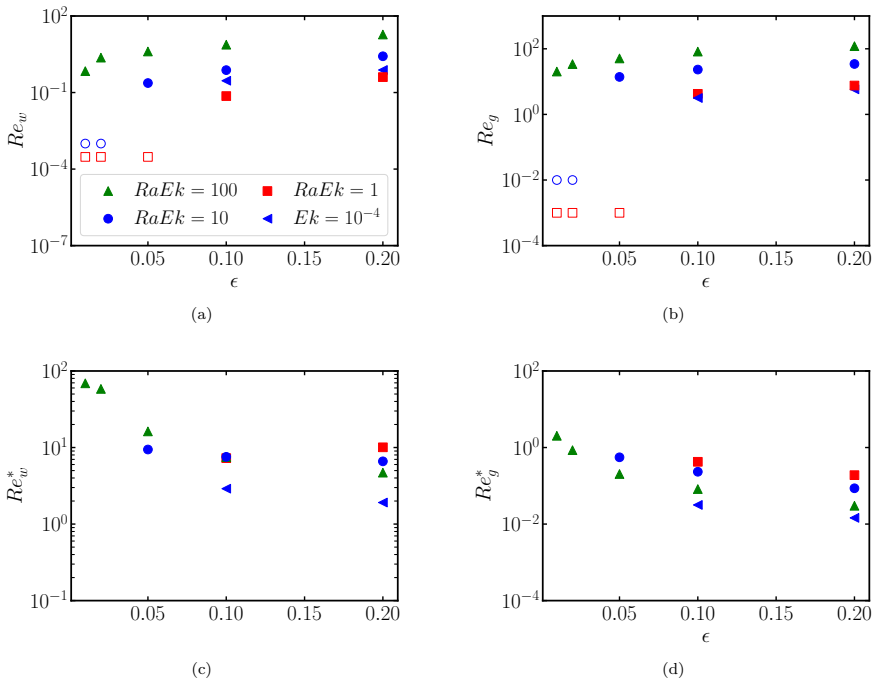
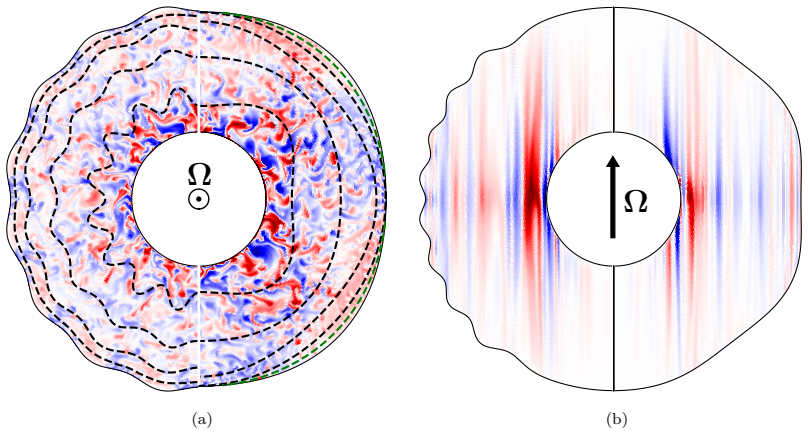
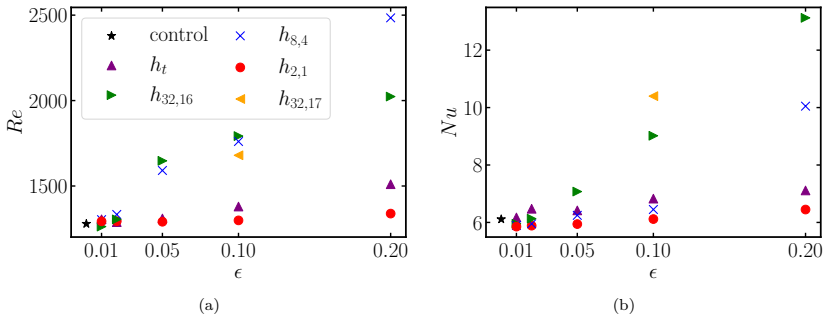
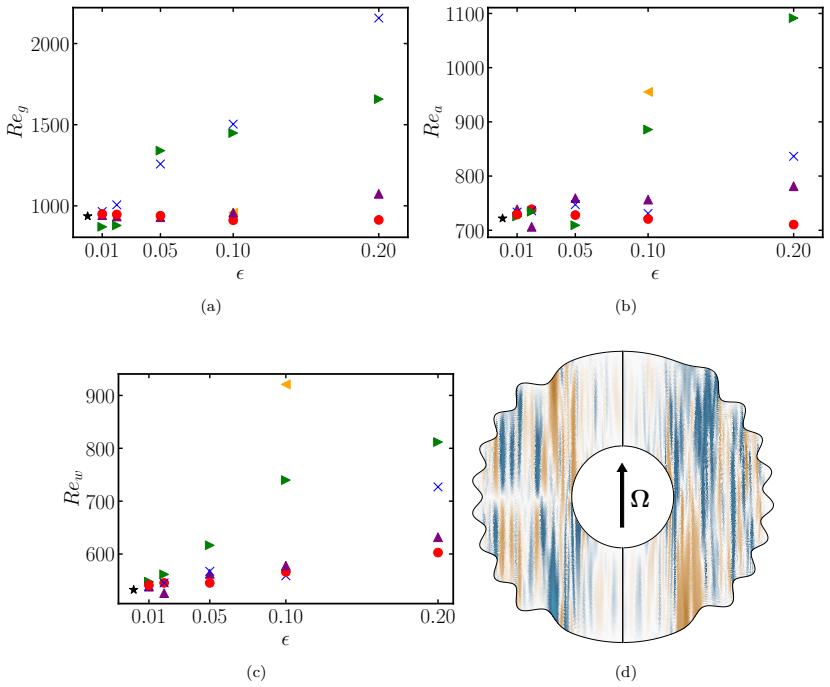
Finite-amplitude topography at the core-mantle boundary induces a new instability below the critical Rayleigh number for a spherical shell; the instability is sustained by deformed geostrophic contours that permit buoyancy to perform net work on the mean flow, increasing Reynolds and Nusselt numbers by up to 100 percent. Topographic torques scale linearly with topographic amplitude and quadratically with flow velocity; a new global estimate for spectrally broad topography, when extrapolated to core parameters, yields torques whose magnitude matches that needed to drive observed decadal and subdecadal ΔLOD variations.
What carries the argument
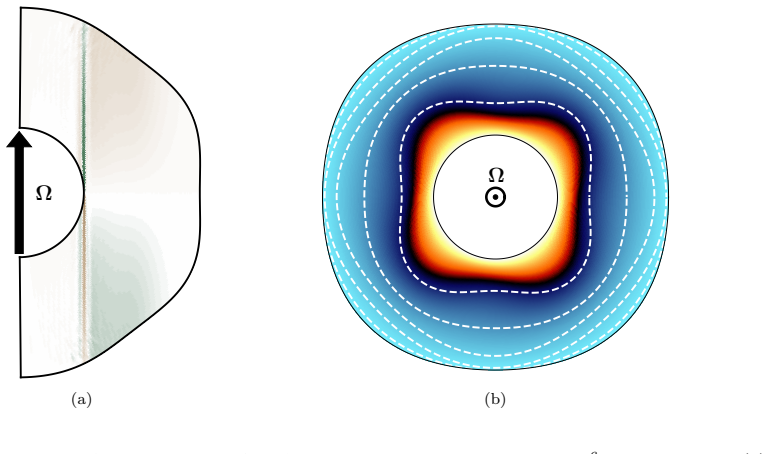
Deformed geostrophic contours (lines of constant axial height) that allow buoyancy to do sustained work on the time-averaged flow and produce topographic torques.
If this is right
- Reynolds and Nusselt numbers rise by up to 100 percent relative to a spherical boundary once contours are deformed.
- Topographic torques increase linearly with topographic height and quadratically with flow speed for both simple and spectrally broad shapes.
- The resulting torques, once extrapolated, fall within the range needed to drive measured decadal and subdecadal changes in length of day.
- The same topography couples the core to the mantle and can therefore influence both rotation rate and the geomagnetic field.
Where Pith is reading between the lines
- The contour-deformation route to convection may operate in other rapidly rotating planets or moons whose boundaries are not perfectly spherical.
- Seismically mapped deep-mantle heterogeneities could be used to forecast specific patterns of torque and flow adjustment inside the core.
- If the torque scaling survives more extreme parameters, then mantle convection models that include CMB topography would need to incorporate this additional core-mantle coupling term.
Load-bearing premise
The identified instability, contour-deformation mechanism, and torque scalings remain valid when the simulated parameters are pushed to the extreme Rayleigh, Ekman, and Prandtl numbers of Earth's core.
What would settle it
A simulation at Ekman numbers at least an order of magnitude smaller than those used here that produces time-averaged torques more than a factor of ten below the extrapolated values required for observed ΔLOD would falsify the claim.
Figures




read the original abstract
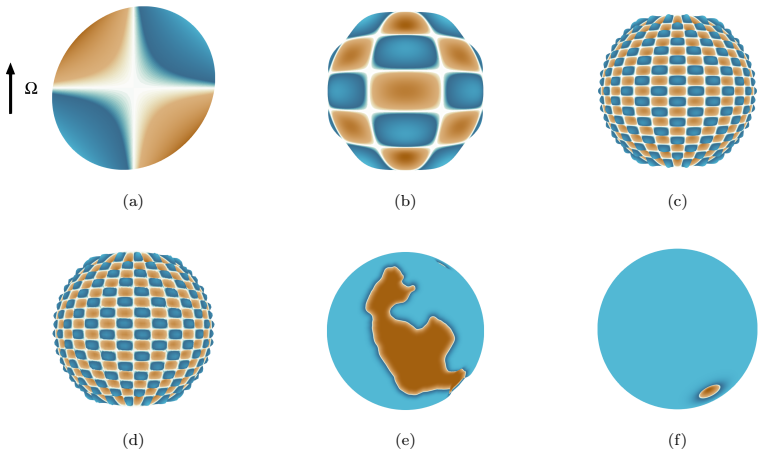
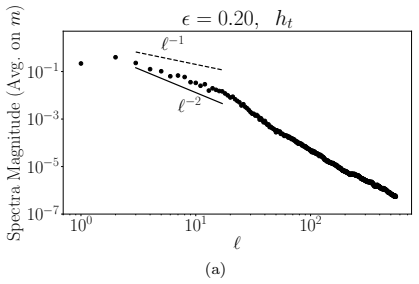
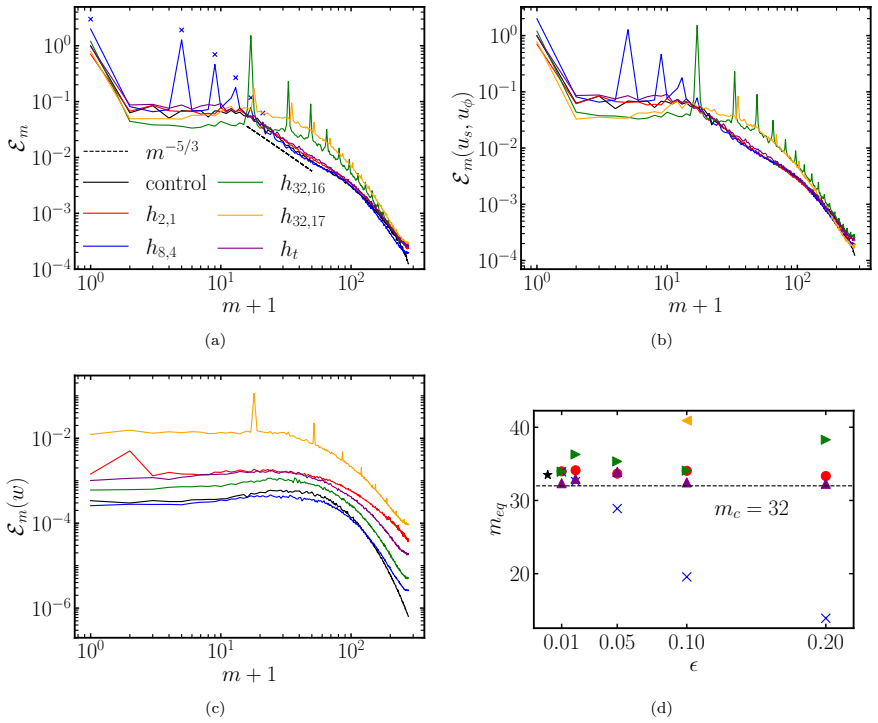
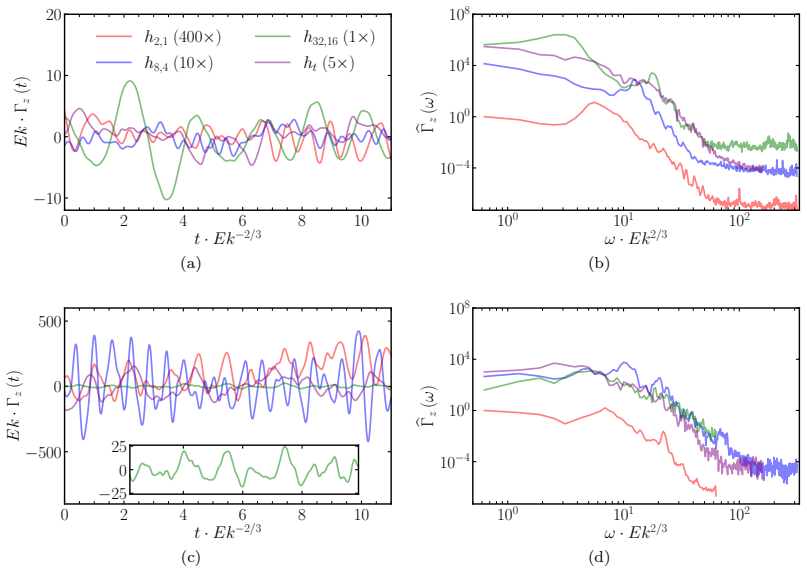
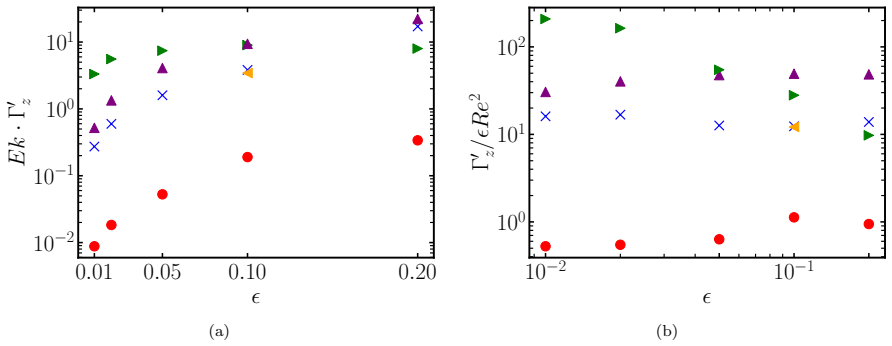
Topography at the core-mantle boundary (CMB) couples the outer core to the mantle and likely generates observable variations in the length of day ($\Delta$LOD) and the geomagnetic field, though these effects remain poorly understood. We use direct numerical simulations of rotating shell convection with finite-amplitude CMB topography to investigate dynamical effects on the outer core. A range of topographic shapes is used, including individual spherical harmonics and a model representing seismically inferred heterogeneities in the deep mantle. As predicted by prior linear theory in the rotating annulus model, a new instability arises for Rayleigh numbers below the onset of convection; we confirm its existence in a global geometry, though the predicted scalings are quantitatively modified. The shape of the geostrophic contours -- lines of constant axial height -- plays a central role: deformed contours allow buoyancy to do work on the time-averaged flow, driving increases in Reynolds and Nusselt numbers of up to $\sim$100\% relative to a spherical boundary. Previous work showed that topographic torques scale linearly with topographic amplitude and quadratically with flow speeds; we confirm this scaling and extend it with new theory that estimates the torques for global, spectrally broad topography. When extrapolated to core conditions, the predicted torques are consistent with the magnitude required to drive observed decadal and subdecadal $\Delta$LOD variations.
Editorial analysis
A structured set of objections, weighed in public.
Referee Report
Summary. The manuscript uses direct numerical simulations of rotating spherical-shell convection with finite-amplitude CMB topography (both single spherical harmonics and a seismically motivated model) to examine subcritical instabilities, modifications to convective vigor via deformed geostrophic contours, and topographic torques. It confirms the existence of a contour-deformation instability below the onset of convection, reports up to ~100% increases in Reynolds and Nusselt numbers, verifies the linear-in-amplitude and quadratic-in-velocity torque scaling, supplies new theory for spectrally broad topography, and extrapolates the resulting torques to core conditions to argue consistency with the magnitude required for observed decadal and subdecadal ΔLOD variations.
Significance. If the extrapolation holds, the work supplies a concrete, numerically supported mechanism by which CMB topography can drive observable LOD variations and potentially influence the geomagnetic field. The DNS confirmation of the instability in global geometry and the extension of torque theory to broad spectra are clear strengths; the paper also supplies reproducible parameter choices and direct comparisons to prior annulus results.
major comments (2)
- [core-extrapolation discussion] The central claim that extrapolated torques are consistent with observed ΔLOD magnitudes rests on the untested assumption that the identified contour-deformation instability and quadratic torque scaling remain dominant at core Ekman numbers (~10^{-15}), Rayleigh numbers, and Prandtl numbers. No asymptotic analysis, resolution studies at lower E, or demonstration that inertial/viscous corrections stay negligible is provided to support this extrapolation (see the final paragraph of the abstract and the discussion of core extrapolation).
- [torque-theory section] The new theory for torques generated by spectrally broad topography is introduced without a clear statement of its range of validity or quantitative error estimates when applied to the seismic model; this directly affects the reliability of the LOD-magnitude comparison.
minor comments (2)
- [abstract] The abstract states that 'predicted scalings are quantitatively modified' but does not specify the nature or magnitude of those modifications relative to the annulus model.
- [figures] Figure captions and axis labels should explicitly list the Ekman, Rayleigh, and Prandtl numbers used in each panel to facilitate direct comparison with the core regime.
Simulated Author's Rebuttal
We thank the referee for their careful reading, positive assessment of the work's significance, and constructive major comments. We address each point below and outline targeted revisions that will strengthen the manuscript without altering its core findings.
read point-by-point responses
-
Referee: [core-extrapolation discussion] The central claim that extrapolated torques are consistent with observed ΔLOD magnitudes rests on the untested assumption that the identified contour-deformation instability and quadratic torque scaling remain dominant at core Ekman numbers (~10^{-15}), Rayleigh numbers, and Prandtl numbers. No asymptotic analysis, resolution studies at lower E, or demonstration that inertial/viscous corrections stay negligible is provided to support this extrapolation (see the final paragraph of the abstract and the discussion of core extrapolation).
Authors: We agree that the extrapolation rests on the assumption that the contour-deformation mechanism and quadratic torque scaling identified in our DNS remain dominant at core parameters. Our simulations confirm these features across a range of accessible Ekman numbers and Rayleigh numbers, and the quadratic scaling follows directly from the torque theory we extend. However, we do not provide new asymptotic analysis or lower-E resolution studies, as these lie outside the scope of the present work. In the revised manuscript we will expand the core-extrapolation discussion to (i) restate the assumptions explicitly, (ii) reference existing asymptotic results on rotating convection that support the persistence of geostrophic balance and quadratic drag at low E, and (iii) qualify the ΔLOD comparison as order-of-magnitude consistency rather than a precise prediction. These additions will make the limitations transparent while preserving the value of the global-geometry confirmation and new theory. revision: partial
-
Referee: [torque-theory section] The new theory for torques generated by spectrally broad topography is introduced without a clear statement of its range of validity or quantitative error estimates when applied to the seismic model; this directly affects the reliability of the LOD-magnitude comparison.
Authors: We accept this criticism. The new theory for spectrally broad topography assumes linear superposition of single-harmonic contributions under the condition that topographic amplitudes remain small enough for the quadratic velocity scaling to hold and for mode interactions to be weak. In the revised manuscript we will insert a short subsection (or expanded paragraph) in the torque-theory section that (i) states the validity range in terms of topographic amplitude and flow regime, (ii) quantifies the approximation error by direct comparison of the broad-spectrum prediction against our single-harmonic DNS results, and (iii) reports the residual error when the theory is applied to the seismic model. These additions will directly improve the reliability assessment of the LOD-magnitude comparison. revision: yes
Circularity Check
No significant circularity; derivations and extrapolations are independent of inputs
full rationale
The paper conducts direct numerical simulations to confirm the existence of a contour-deformation instability (previously predicted in annulus geometry) and to verify/extend torque scalings (linear in topographic amplitude, quadratic in flow speed) with new theory for spectrally broad global topography. These steps produce independent outputs from the simulations rather than tautological reductions. The final claim compares extrapolated torque magnitudes to the order-of-magnitude requirement for observed ΔLOD variations; this is a consistency check, not a fit or self-definition. No load-bearing step reduces by construction to prior inputs, fitted parameters, or self-citation chains. The derivation chain remains self-contained against external benchmarks.
Axiom & Free-Parameter Ledger
free parameters (2)
- topographic amplitude
- Rayleigh number range
axioms (2)
- domain assumption Outer-core fluid obeys the Boussinesq approximation in a rotating spherical shell.
- domain assumption Deformed geostrophic contours allow net work by buoyancy on the time-averaged flow.
Lean theorems connected to this paper
-
IndisputableMonolith/Cost/FunctionalEquation.leanwashburn_uniqueness_aczel unclearWe use direct numerical simulations of rotating shell convection with finite-amplitude CMB topography... topographic torques scale linearly with topographic amplitude and quadratically with flow speeds
-
IndisputableMonolith/Foundation/AlexanderDuality.leanalexander_duality_circle_linking unclearThe shape of the geostrophic contours... plays a central role
Reference graph
Works this paper leans on
-
[1]
Anufriev, A. P., & Braginsky, S. I. (1977). Influence of irregularities of the boundary of the Earth’s core on the velocity of the liquid and on the magnetic field, II.Geomagnetism & Aeronomy, 17, 78–82 48
work page 1977
-
[2]
Aubert, J. (2023). State and evolution of the geodynamo from numerical models reaching the physical conditions of Earth’s core.Geophysical Journal International, 235(1), 468–487
work page 2023
-
[3]
Aurnou, J. M., Horn, S., & Julien, K. (2020). Connections between nonrotating, slowly rotating, and rapidly rotating turbulent convection transport scalings.Physical Review Research 2, 04315, 1–13
work page 2020
-
[4]
Barik, A., Triana, S. A., Calkins, M. A., Stanley, S., & Aurnou, J. M. (2023). Onset of convection in rotating spherical shells: Variations with radius ratio.Earth Space Sciences, 10(1), e2022EA002606
work page 2023
-
[5]
Bassom, A. P., & Soward, A. M. (1996). Localised rotating convection induced by topography.Physica D, 97, 29–44
work page 1996
-
[6]
Bell, P. I., & Soward, A. M. (1996). The influence of surface topography on rotating convection.Journal of Fluid Mechanics, 313, 147–180
work page 1996
-
[7]
Boerner, T. J., Deems, S., Furlani, T. R., Knuth, S. L., & Towns, J. (2023). Access: Advancing innova- tion: Nsf’s advanced cyberinfrastructure coordination ecosystem: Services & support. InPractice and Experience in Advanced Research Computing, (173–176). ACM, New York, NY, USA
work page 2023
-
[8]
Braginsky, S. I. (1969). Torsional magnetohydrodynamic vibrations in the Earth’s core and variations in day length.Geomagnetism & Aeronomy (USSR) (Engl. Transl.) (1970), 10, 1–8
work page 1969
-
[9]
Buffett, B. A. (1996). Gravitational oscillations in the length of the day.Geophysical Research Letters, 23(17), 2279–2282
work page 1996
-
[10]
Buffett, B. A., & Christensen, U. R. (2007). Magnetic and viscous coupling at the core–mantle boundary: inferences from observations of the Earth’s nutations.Geophysical Journal International, 171(1), 145– 152
work page 2007
-
[11]
Busse, F. H. (1970). Thermal instabilities in rapidly rotating systems.Journal of Fluid Mechanics, 44, 441–460
work page 1970
-
[12]
Calkins, M. A., Noir, J., Eldredge, J. D., & Aurnou, J. M. (2012). The effects of boundary topography on convection in Earth’s core.Geophysical Journal International, 189, 799–814
work page 2012
-
[13]
(1961).Hydrodynamic and Hydromagnetic Stability
Chandrasekhar, S. (1961).Hydrodynamic and Hydromagnetic Stability. Oxford University Press, U.K
work page 1961
-
[14]
Christensen, U., & Aubert, J. (2006). Scaling properties of convection-driven dynamos in rotating shells and applications to planetary magnetic fields.Geophysical Journal International, 166, 97–114 49
work page 2006
-
[15]
Christensen, U. R. (2002). Zonal flow driven by strongly supercritical convection in rotating spherical shells.Journal of Fluid Mechanics, 470, 115–133
work page 2002
-
[16]
Cottaar, S., & Lekic, V. (2016). Morphology of seismically slow lower-mantle structures.Geophysics Supplement Monthly Notifications of the Royal Astronomical Society, 207(2), 1122–1136
work page 2016
-
[17]
Davies, C. J., Gubbins, D., Willis, A. P., & Jimack, P. K. (2008). Time-averaged paleomagnetic field and secular variation: Predictions from dynamo solutions based on lower mantle seismic tomography. Physics of the Earth and Planetary Interiors, 169(1), 194–203
work page 2008
-
[18]
Dehant, V., Puica, M., Folgueira-L´ opez, M., Rekier, J., & Van Hoolst, T. (2025). Analytical computation of the total topographic torque at the core–mantle boundary and its impact on nutations.Geophysical Journal International, 241(1), 474–494
work page 2025
-
[19]
Dickey, J. O., Marcus, S. L., Hide, R., Eubanks, T. M., & Boggs, D. H. (1994). Angular momentum exchange among the solid earth, atmosphere, and oceans: A case study of the 1982–1983 El Ni˜ no event. Journal of Geophysical Research: Solid Earth, 99(B12), 23921–23937
work page 1994
-
[20]
Dormy, E., Soward, A. M., Jones, C. A., Jault, D., & Cardin, P. (2004). The onset of thermal convection in rotating spherical shells.Journal of Fluid Mechanics, 501, 43–70
work page 2004
-
[21]
C., Gillet, N., Aubert, J., Livermore, P
Finlay, C. C., Gillet, N., Aubert, J., Livermore, P. W., & Jault, D. (2023). Gyres, jets and waves in the Earth’s core.Nature Reviews Earth and Environment, 4(6), 377–392
work page 2023
-
[22]
C., Jackson, A., Gillet, N., & Olsen, N
Finlay, C. C., Jackson, A., Gillet, N., & Olsen, N. (2012). Core surface magnetic field evolution 2000–2010. Geophysical Journal International, 189(2), 761–781
work page 2012
-
[23]
Fischer, P., Kerkemeier, S., et al. (2019). Nek5000 version 19.0
work page 2019
-
[24]
Gastine, T., & Favier, B. (2025). Rotating convection with a melting boundary: An application to the icy moons.Icarus, 429, 116441
work page 2025
-
[25]
Gastine, T., Wicht, J., & Aubert, J. (2016). Scaling regimes in spherical shell rotating convection.Journal of Fluid Mechanics, 808, 690–732
work page 2016
-
[26]
Gillet, N., Dall’Asta, F., Amblard, P.-O., Claveau, R., & Aubert, J. (2024). Waves in earth’s core and geomagnetic field forecast.Physics of the Earth and Planetary Interiors, 357, 107284
work page 2024
-
[27]
Gillet, N., Gerick, F., Jault, D., Schwaiger, T., Aubert, J., & Istas, M. (2022). Satellite magnetic data reveal interannual waves in Earth’s core.Proceedings of the National Academy of Science, 119(13), e2115258119 50
work page 2022
-
[28]
Gilman, P. A. (1978). Nonlinear dynamics of Boussinesq convection in a deep rotating spherical shell III: effects of velocity boundary conditions.Geophysical and Astrophysical Fluid Dynamics, 11, 181–203
work page 1978
-
[29]
Greenspan, H. P. (1968).The Theory of Rotating Fluids. Cambridge University Press, London
work page 1968
-
[30]
Gross, R. S. (2015). 3.09 - earth rotation variations – long period. In G. Schubert (Ed.),Treatise on Geophysics (Second Edition), (215–261). Elsevier, Oxford, second edition edn
work page 2015
-
[31]
S., Fukumori, I., Menemenlis, D., & Gegout, P
Gross, R. S., Fukumori, I., Menemenlis, D., & Gegout, P. (2004). Atmospheric and oceanic excitation of length-of-day variations during 1980–2000.Journal of Geophysical Research: Solid Earth, 109(B1)
work page 2004
-
[32]
Guervilly, C., Cardin, P., & Schaeffer, N. (2019). Turbulent convective length scale in planetary cores. Nature, 570(7761), 368–371
work page 2019
-
[33]
Guervilly, C., & Dormy, E. (2025). The cross-over from viscous to inertial lengthscales in rapidly-rotating convection.Geophysical Research Letters, 52(7), e2024GL111593
work page 2025
-
[34]
Hansen, S. E., Garnero, E. J., Li, M., Shim, S.-H., & Rost, S. (2023). Globally distributed subducted materials along the earth’s core-mantle boundary: Implications for ultralow velocity zones.Science Advances, 9(14), eadd4838
work page 2023
-
[35]
Herrmann, J., & Busse, F. H. (1998). Stationary and time depedent convection in the rotating cylindrical annulus with modulated height.Physics of Fluids, 10(7), 1611–1620
work page 1998
-
[36]
Hide, R. (1969). Interaction between the Earth’s liquid core and solid mantle.Nature, 222, 1055–1056
work page 1969
-
[37]
Holme, R., & de Viron, O. (2005). Geomagnetic jerks and a high-resolution length-of-day profile for core studies.Geophysical Journal International, 160, 435–439
work page 2005
-
[38]
Holme, R., Olsen, N., & Bairstow, F. L. (2011). Mapping geomagnetic secular variation at the core–mantle boundary.Geophysical Journal International, 186(2), 521–528
work page 2011
-
[39]
Houser, C., Masters, G., Shearer, P., & Laske, G. (2008). Shear and compressional velocity models of the mantle from cluster analysis of long-period waveforms.Geophysical Journal International, 174(1), 195–212
work page 2008
-
[40]
Jault, D. (2015). Illuminating the electrical conductivity of the lowermost mantle from below.Geophysical Journal International, 202(1), 482–496
work page 2015
-
[41]
Jault, D. (2020). Tangential stress at the core–mantle interface.Geophysical Journal International, 221(2), 951–967 51
work page 2020
-
[42]
Jault, D., & Le Mou¨ el, J. L. (1989). The topographic torque associated with a tangentially geostrophic motion at the core surface and inferences on the flow inside the core.Geophysical and Astrophysical Fluid Dynamics, 48, 273–296
work page 1989
-
[43]
Jones, C. A., Soward, A. M., & Mussa, A. I. (2000). The onset of thermal convection in a rapidly rotating sphere.Journal of Fluid Mechanics, 405, 157–179
work page 2000
-
[44]
Kaula, W. M. (1966).Theory of Satellite Geodesy: Applications of Satellites to Geodesy. Blaisdell Publishing Company Kiani Shahvandi, M., & Soja, B. (2026). Climate-induced length of day variations since the late Pliocene. Journal of Geophysical Research: Solid Earth, 131(3), e2025JB032161
work page 1966
-
[45]
Koelemeijer, P. (2021). Toward consistent seismological models of the core–mantle boundary landscape. In H. Marquardt, M. Ballmer, S. Cottaar, & J. Konter (Eds.),Mantle Convection and Surface Expressions, vol. 263 ofGeophysical Monograph Series, (229–255). American Geophysical Union
work page 2021
-
[46]
Koper, K. D., Pyle, M. L., & Franks, J. M. (2003). Constraints on aspherical core structure from PKiKP-PcP differential travel times.Journal of Geophysical Research: Solid Earth, 108(B3)
work page 2003
-
[47]
Kraichnan, R. H. (1967). Inertial ranges in two-dimensional turbulence.Physics of Fluids, 10(7), 1417– 1423
work page 1967
-
[48]
Kuang, W. J., & Bloxham, J. (1993). The effect of boundary topography on motions in the Earth’s core. Geophysical and Astrophysical Fluid Dynamics, 72, 161–195
work page 1993
-
[49]
Kuang, W. J., & Chao, B. F. (2001). Topographic core-mantle coupling in geodynamo modeling.Geo- physical Research Letters, 28(9), 1871–1874
work page 2001
-
[50]
Kuang, W. J., Chao, B. F., & Chen, J. (2019). Reassessment of electromagnetic core-mantle coupling and its implications to the Earth’s decadal polar motion.Geodesy and Geodynamics, 10(5), 356–362
work page 2019
-
[51]
Kustowski, B., Ekstr¨ om, G., & Dziewo´ nski, A. M. (2008). Anisotropic shear-wave velocity structure of the earth’s mantle: A global model.Journal of Geophysical Research: Solid Earth, 113(B6)
work page 2008
-
[52]
Kvorka, J., & ˇCadek, O. (2022). A numerical model of convective heat transfer in Titan’s subsurface ocean.Icarus, 376(114853)
work page 2022
-
[53]
Lassak, T. M., McNamara, A. K., Garnero, E. J., & Zhong, S. (2010). Core-mantle boundary topography as a possible constraint on lower mantle chemistry and dynamics.Earth and Planetary Science Letters, 289, 232–241 52
work page 2010
-
[54]
Lassak, T. M., McNamara, A. K., & Zhong, S. (2007). Influence of thermochemical piles on topography at Earth’s core-mantle boundary.Earth and Planetary Science Letters, 261, 443–455
work page 2007
-
[55]
Lekic, V., Cottaar, S., Dziewonski, A., & Romanowicz, B. (2012). Cluster analysis of global lower mantle tomography: A new class of structure and implications for chemical heterogeneity.Earth and Planetary Science Letters, 357-358, 68–77
work page 2012
-
[56]
Lin, Y., Marti, P., & Jackson, A. (2025). Invariance of dynamo action in an early-Earth model.Nature, 644, 109–114
work page 2025
-
[57]
W., Hollerbach, R., & Finlay, C
Livermore, P. W., Hollerbach, R., & Finlay, C. C. (2017). An accelerating high-latitude jet in Earth’s core.Nature Geosciences, 10, 62–68
work page 2017
-
[58]
Madsen, F. D., & Holme, R. (2025). A recent interruption in the 6-year oscillation in length-of-day. Geophysical Journal International, 243(2), ggaf337
work page 2025
-
[59]
Maffei, S., Krouss, M. J., Julien, K., & Calkins, M. A. (2021). On the inverse cascade and flow speed scaling behaviour in rapidly rotating Rayleigh–B´ enard convection.Journal of Fluid Mechanics, 913, A18
work page 2021
-
[60]
Monville, R., C´ ebron, D., & Jault, D. (2025). Topographic drag at the core-mantle interface.Journal of Geophysical Research: Solid Earth, 130(4), e2024JB029770
work page 2025
-
[61]
Mound, J. E., & Buffett, B. A. (2003). Interannual oscillations in length of day: Implications for the structure of the mantle and core.Journal of Geophysical Research: Solid Earth, 108(B7)
work page 2003
-
[62]
Mound, J. E., & Davies, C. J. (2023). Longitudinal structure of the Earth’s magnetic field controlled by lower mantle heat flow.Nature Geosciences, 16, 380–385 M´ egnin, C., & Romanowicz, B. (2000). The three-dimensional shear velocity structure of the mantle from the inversion of body, surface and higher-mode waveforms.Geophysical Journal International, ...
work page 2023
-
[63]
Nicoski, J. A., O’Connor, A. R., & Calkins, M. A. (2024). Asymptotic scaling relations for rotating spherical convection with strong zonal flows.Journal of Fluid Mechanics, 981, A22
work page 2024
-
[64]
Oliver, T. G., Blackman, E. G., Tarduno, J. A., & Calkins, M. A. (2025). Turbulence in Earth’s core generates large topographic torques on the mantle.Communications Earth and Environment, 6, 484
work page 2025
-
[65]
G., Jacobi, A., Julien, K., & Calkins, M
Oliver, T. G., Jacobi, A., Julien, K., & Calkins, M. A. (2023). Small scale quasigeostrophic convective turbulence at large Rayleigh number.Physical Review Fluids, 8, 093502 53
work page 2023
-
[66]
Olson, P. O., Coe, R. S., Driscoll, P. E., Glatzmaier, G. A., & Roberts, P. H. (2010). Geodynamo reversal frequency and heterogeneous core-mantle boundary heat flow.Physics of the Earth and Planetary Interiors, 180, 66–79
work page 2010
-
[67]
Parker, E. N. (1955). Hydromagnetic dynamo models.The Astrophysical Journal, 122, 293–314
work page 1955
-
[68]
Patera, T. (1984). A spectral element method for fluid dynamics: laminar flow in a channel expansion. Journal of Computational Physics, 54, 468–488
work page 1984
-
[69]
Pope, S. B. (2000).Turbulent Flows. Cambridge University Press, Cambridge
work page 2000
-
[70]
Puica, M., Dehant, V., Folgueira-L´ opez, M., van Hoolst, T., & Rekier, J. (2023). Analytical computation of total topographic torque at the core–mantle boundary and its impact on tidally driven length-of-day variations.Geophysical Journal International, 234(1), 585–596
work page 2023
-
[71]
Ritsema, J., Deuss, A., van Heijst, H. J., & Woodhouse, J. H. (2011). S40RTS: a degree-40 shear-velocity model for the mantle from new Rayleigh wave dispersion, teleseismic traveltime and normal-mode splitting function measurements.Geophysical Journal International, 184(3), 1223–1236
work page 2011
-
[72]
Roberts, P. H. (1968). On the thermal instability of a rotating-fluid sphere containing heat sources. Philosophical Transactions of the Royal Society A, 263, 93–117
work page 1968
-
[73]
Roberts, P. H., & Aurnou, J. M. (2012). On the theory of core-mantle coupling.Geophysical and Astrophysical Fluid Dynamics, 106(2), 157–230
work page 2012
-
[74]
Rosat, S., & Gillet, N. (2023). Intradecadal variations in length of day: Coherence with models of the Earth’s core dynamics.Physics of the Earth and Planetary Interiors, 341, 107053
work page 2023
-
[75]
Rost, S., Garnero, E. J., & Williams, Q. (2006). Fine-scale ultralow-velocity zone structure from high- frequency seismic array data.Journal of Geophysical Research: Solid Earth, 111(B9)
work page 2006
-
[76]
Schaeffer, N., Jault, D., Nataf, H.-C., & Fournier, A. (2017). Turbulent geodynamo simulations: a leap towards earth’s core.Geophysical Journal International, 211(1), 1–29
work page 2017
-
[77]
Simmons, N. A., Forte, A. M., Boschi, L., & Grand, S. P. (2010). Gypsum: A joint tomographic model of mantle density and seismic wave speeds.Journal of Geophysical Research: Solid Earth, 115(B12)
work page 2010
-
[78]
T., Ghattas, O., & Dhabaleswar, K
Stanzione, D., West, J., Evans, R. T., Ghattas, O., & Dhabaleswar, K. P. (2020). Frontera: The evolution of leadership computing at the national science foundation.Practice and Experience in Advanced Research Computing (PEARC ’20) 54 ϵ0.01 0.02 0.05 0.10 0.2 h2,1 29.74 29.74 29.74 29.74 29.75 h8,4 29.74 29.74 29.74 29.74 29.75 h32,16 29.74 29.74 29.74 29....
work page 2020
-
[79]
Tanaka, S. (2010). Constraints on the core-mantle boundary topography from P4KP-PcP differential travel times.Journal of Geophysical Research, 115, B04310
work page 2010
-
[80]
Tarduno, J. A., Watkeys, M. K., Huffman, T. N., Cottrell, R. D., Blackman, E. G., Wendt, A., et al. (2015). Antiquity of the South Atlantic Anomaly and evidence for top-down control on the geodynamo. Nature Communications, 6(1), 7865
work page 2015
discussion (0)
Sign in with ORCID, Apple, or X to comment. Anyone can read and Pith papers without signing in.