Recognition: no theorem link
Optical detection of the electron spin resonances of G centers in silicon
Pith reviewed 2026-05-13 03:54 UTC · model grok-4.3
The pith
G centers in silicon allow optical detection of their electron spin resonances for coherent control.
A machine-rendered reading of the paper's core claim, the machinery that carries it, and where it could break.
Core claim
The electron spin resonances of G centers can be optically detected via ODMR, which arises from the spin-dependent photoluminescence of the metastable triplet state. The optimal conditions for measurement are identified, a level anticrossing is observed, coherent spin control is achieved, and the spin coherence properties are characterized.
What carries the argument
The ODMR signal from the G center's metastable electron-spin triplet state, which provides contrast for detecting spin resonances and enables coherent control under above-band-gap excitation.
If this is right
- Optimal pulsed sequences, temperature ranges, and optical powers are identified that maximize the ODMR contrast for G centers.
- A level anticrossing in the G center electron spin states is detected through magneto-optical measurements.
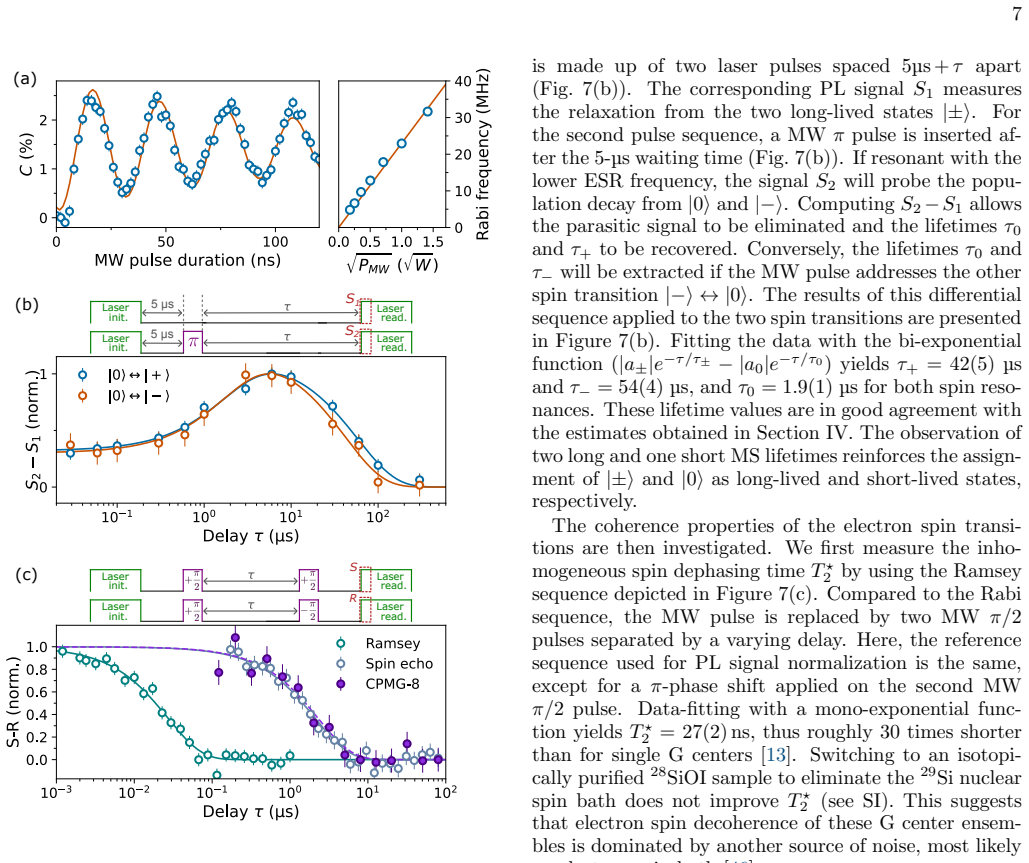
- Coherent spin control of the G centers is demonstrated using microwave pulses.
- Spin-coherence properties of the defects are characterized, supporting their use in quantum devices.
Where Pith is reading between the lines
- Integration with silicon-based quantum photonics could enable scalable quantum memories at telecom wavelengths.
- Similar spin control techniques might apply to other color centers in silicon for hybrid quantum systems.
- Extending to single G centers could allow for individual qubit addressing in quantum registers.
- Testing coherence under isotopic purification or at millikelvin temperatures could reveal limits set by nuclear spins or phonons.
Load-bearing premise
The observed ODMR response and level anticrossing are specifically due to the metastable triplet state of the G centers under above-band-gap excitation, without major interference from other defects.
What would settle it
Failing to observe any ODMR contrast or Rabi oscillations when applying the reported pulsed sequences and magnetic fields to G center ensembles would falsify the demonstration of coherent spin control.
Figures



read the original abstract
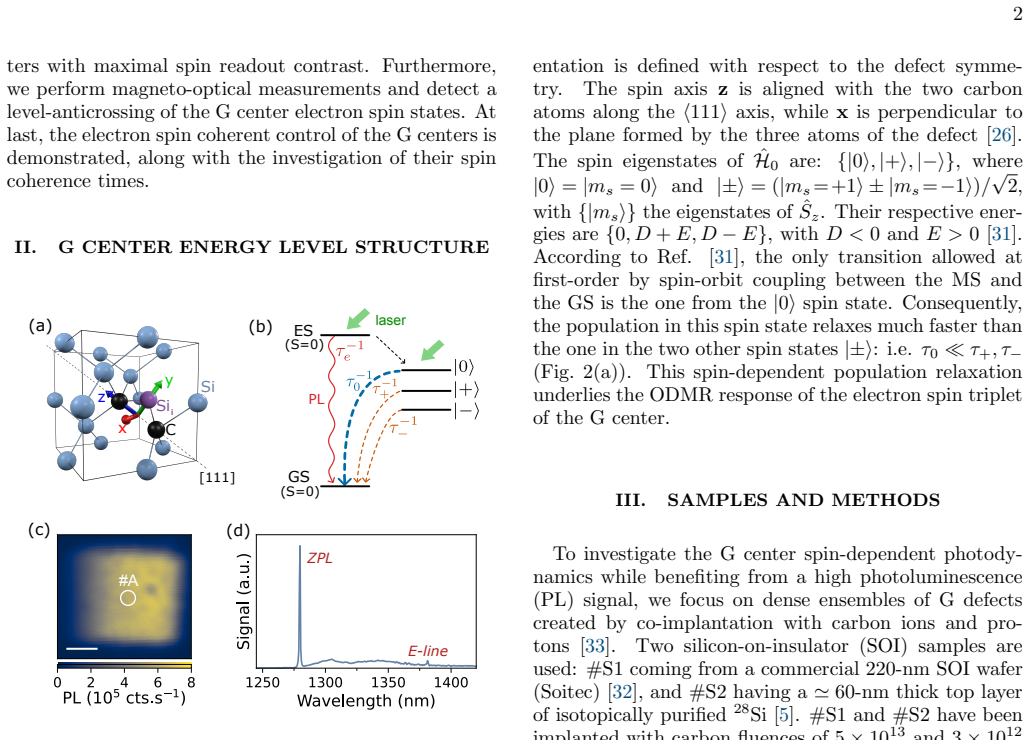
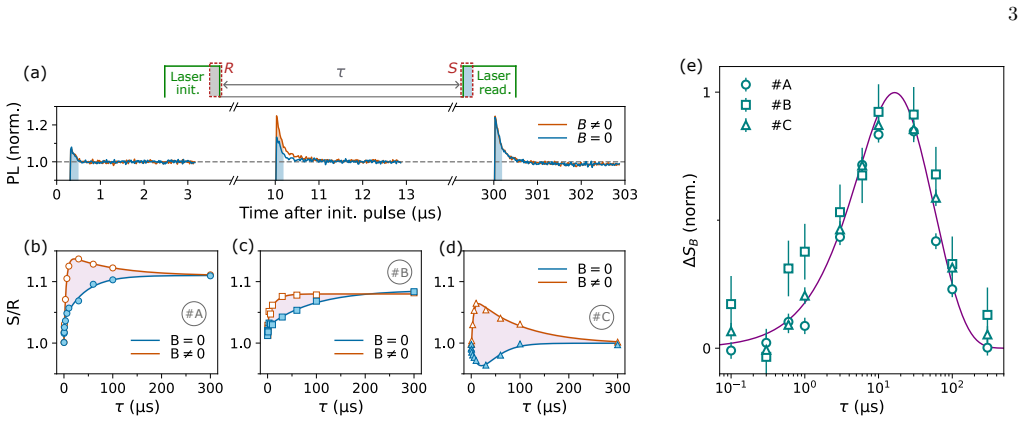
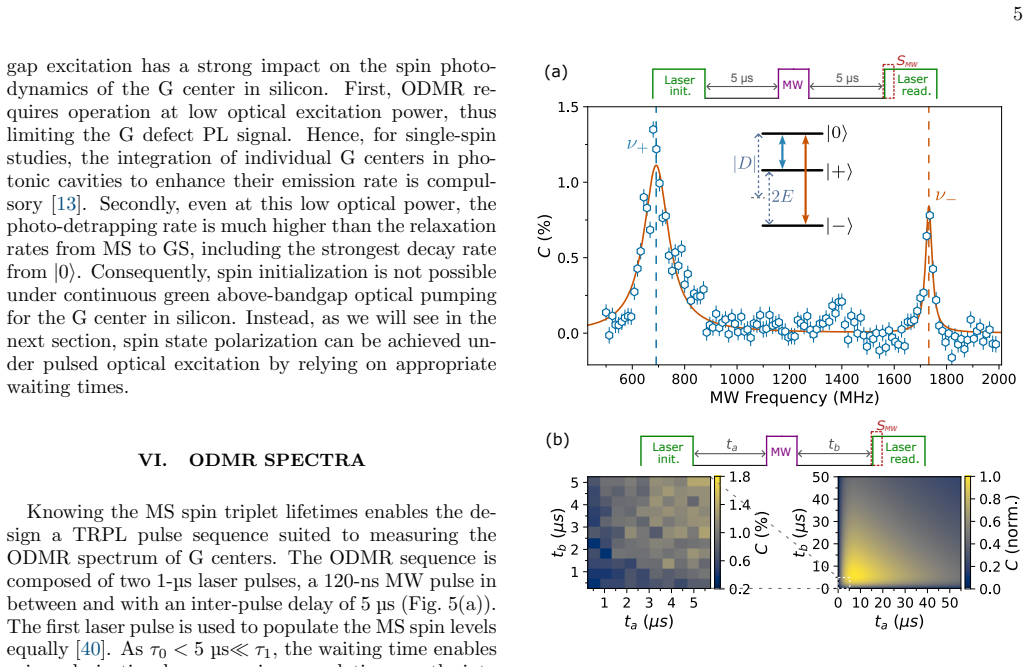
Color centers in silicon are emerging as promising platforms for quantum technologies. Among them, the G center has attracted considerable interest owing to its bright telecom O-band single-photon emission and its optically addressable metastable electron-spin triplet state. Here we investigate the spin properties of ensembles of G centers under above-band-gap excitation. We elucidate the spin photo-dynamics giving rise to the optical detected magnetic resonance (ODMR) response of G centers. The optimal pulsed sequence for measuring the ODMR spectrum of the G defects is identified, along with the temperature and optical-power regimes maximizing the spin readout contrast. Through magneto-optical measurements, we detect a level-anticrossing of the G center electron spin states. At last, we demonstrate coherent spin control of the defects, and characterize their spin-coherence properties. Unveiling the spin degree of freedom of the G center opens new avenues for the realization of quantum memories and quantum registers based on silicon color centers.
Editorial analysis
A structured set of objections, weighed in public.
Referee Report
Summary. The paper experimentally investigates the spin properties of G centers in silicon under above-band-gap excitation. It elucidates the underlying spin photo-dynamics responsible for the ODMR response, identifies optimal pulsed excitation sequences and operating regimes (temperature, optical power) that maximize readout contrast, reports a magneto-optical level anticrossing of the triplet spin states, demonstrates coherent spin control through Rabi oscillations and Hahn-echo sequences, and characterizes the spin coherence times.
Significance. If the central attribution of the ODMR and anticrossing signals to the G-center metastable triplet holds, the work provides a valuable characterization of an optically addressable spin in a telecom-wavelength emitter native to silicon. This strengthens the case for G centers as a platform for quantum memories or registers, complementing their known single-photon emission properties. The experimental demonstration of coherent control with reported controls for background exclusion is a concrete advance.
major comments (1)
- The central claim of coherent spin control and coherence characterization rests on the ODMR and anticrossing signals originating specifically from the G-center triplet. While the manuscript reports control measurements and spectral matching, §4 (magneto-optical data) and the associated discussion should include a quantitative bound on possible background contributions (e.g., from other known silicon defects) to confirm that they do not dominate the observed contrast or resonance positions.
minor comments (4)
- The abstract states that 'the optimal pulsed sequence' is identified, but the main text does not explicitly compare the contrast or signal-to-noise of the reported sequence against the most common alternatives (e.g., continuous-wave vs. pulsed readout); a brief table or sentence would strengthen this claim.
- Figure captions for the power- and temperature-dependent contrast maps should state the number of averaged shots or integration time per point to allow readers to assess statistical significance of the reported contrast values.
- The coherence-time extraction in the Hahn-echo section assumes a single-exponential decay; if stretched-exponential or other models were tested, this should be noted for completeness.
- A few references to earlier G-center ODMR or triplet-state studies appear to be missing from the introduction; adding them would better situate the new results.
Simulated Author's Rebuttal
We thank the referee for the positive assessment and the constructive comment on background contributions. We address the point below and have revised the manuscript to incorporate a quantitative bound as requested.
read point-by-point responses
-
Referee: The central claim of coherent spin control and coherence characterization rests on the ODMR and anticrossing signals originating specifically from the G-center triplet. While the manuscript reports control measurements and spectral matching, §4 (magneto-optical data) and the associated discussion should include a quantitative bound on possible background contributions (e.g., from other known silicon defects) to confirm that they do not dominate the observed contrast or resonance positions.
Authors: We agree that an explicit quantitative bound strengthens the attribution. Our existing controls (off-resonant excitation, power dependence, temperature dependence, and spectral matching to the G-center zero-phonon line) already indicate that the signals arise from G centers rather than other defects. In the revised manuscript we have added to §4 a quantitative upper bound derived from (i) the absence of additional resonances within our spectral window, (ii) the mismatch between observed resonance positions and literature values for other known silicon defects (e.g., P, C, or divacancy centers), and (iii) the measured contrast under conditions where background defects would be expected to contribute differently. This analysis shows that any non-G-center contribution to the observed ODMR contrast and anticrossing feature is at most ~7 %, insufficient to alter resonance positions or the interpretation of the coherent-control data. The revised text and a new supplementary figure present this bound explicitly. revision: yes
Circularity Check
No significant circularity in this experimental study
full rationale
This manuscript is a purely experimental investigation of G-center spin properties via ODMR, magneto-optical anticrossing, and coherent control measurements. No derivations, first-principles predictions, or fitted parameters are presented that could reduce to self-referential inputs. Central claims rest on direct spectral data, power/temperature dependence, and Rabi/Hahn-echo sequences, cross-checked against prior literature without load-bearing self-citation chains or ansatz smuggling. The work is self-contained against external benchmarks.
Axiom & Free-Parameter Ledger
Reference graph
Works this paper leans on
-
[1]
and focused ion-beam techniques [6] for the formation of single defects, and laser writing for ensembles [18–20]. On the other hand, understanding the optical proper- ties of individual G-centers [21, 22] and how to control ∗ anais.dreau@umontpellier.fr them through integration within nano-photonic devices have made remarkable progress. Purcell-enhanced s...
work page internal anchor Pith review Pith/arXiv arXiv 2026
-
[2]
and former ESR ensemble measurements from the 1980s [26]. SinceD x =−D/3 +E= 920(10) MHz and Dz = 2D/3 =−810(10) MHz, we note that the G center in silicon does not follow the usual ESR convention stat- ing that the principal spin axiszis oriented along the direction of the largest ZFS tensor component [42]. After identifying the ESR transitions, we invest...
-
[3]
(Fig. 6(c), see SI for details). Such a MS-LAC is particularly relevant to polarize and readout the states of nuclear spins coupled by hyperfine interaction to the electron spin of the defects [44, 45]. VIII. COHERENT CONTROL AND COHERENCE TIMES To demonstrate coherent control of the G center elec- tron spin we perform Rabi oscillation experiments. To do ...
work page 2030
- [4]
- [5]
-
[6]
D. B. Higginbottom, A. T. K. Kurkjian, C. Chartrand, M. Kazemi, N. A. Brunelle, E. R. MacQuarrie, J. R. Klein, N. R. Lee-Hone, J. Stacho, M. Ruether, C. Bow- ness, L. Bergeron, A. DeAbreu, S. R. Harrigan, J. Kana- ganayagam, D. W. Marsden, T. S. Richards, L. A. Stott, S. Roorda, K. J. Morse, M. L. W. Thewalt, and S. Sim- mons, Nature607, 266 (2022), number: 7918
work page 2022
- [7]
- [8]
-
[9]
M. Hollenbach, N. Klingner, N. S. Jagtap, L. Bischoff, C. Fowley, U. Kentsch, G. Hlawacek, A. Erbe, N. V. Abrosimov, M. Helm, Y. Berenc´ en, and G. V. Astakhov, Nature Communications13, 7683 (2022)
work page 2022
- [10]
- [11]
-
[12]
K. Sandholzer, I. Berkman, P. De´ ak, C. Errando- Herranz, P.-P. Filippatos, A. Gali, A. Gritsch, and A. Reiserer, Single-photon emitters and spin-photon in- terfaces in silicon (2026), arXiv:2603.02201 [quant-ph]
- [13]
-
[14]
L. Bergeron, C. Chartrand, A. T. K. Kurkjian, K. J. Morse, H. Riemann, N. V. Abrosimov, P. Becker, H.-J. Pohl, M. L. W. Thewalt, and S. Simmons, PRX Quantum 1, 020301 (2020)
work page 2020
-
[15]
A. Gritsch, A. Ulanowski, J. Pforr, and A. Reiserer, Na- ture Communications16, 64 (2025)
work page 2025
- [16]
-
[17]
H. Song, X. Zhang, L. Komza, N. Fiaschi, Y. Xiong, Y. Zhi, S. Dhuey, A. Schwartzberg, T. Schenkel, G. Hau- tier, Z.-H. Zhang, and A. Sipahigil, Nature Nanotechnol- ogy21, 53 (2026)
work page 2026
-
[18]
P. Inc, F. Afzal, M. Akhlaghi, S. J. Beale, O. Bedroya, K. Bell, L. Bergeron, K. Bonsma-Fisher, P. Bychkova, Z. M. E. Chaisson, C. Chartrand, C. Clear, A. Dar- cie, A. DeAbreu, C. DeLisle, L. A. Duncan, C. D. Smith, J. Dunn, A. Ebrahimi, N. Evetts, D. F. Pin- heiro, P. Fuentes, T. Georgiou, B. Guha, R. Haenel, 9 D. Higginbottom, D. M. Jackson, N. Jahed, A...
- [19]
- [20]
- [21]
-
[22]
G. Andrini, G. Zanelli, S. Ditalia Tchernij, E. Corte, E. Nieto Hern´ andez, A. Verna, M. Cocuzza, E. Bernardi, S. Virz` ı, P. Traina, I. P. Degiovanni, M. Genovese, P. Olivero, and J. Forneris, Communications Materials 5, 1 (2024)
work page 2024
- [23]
- [24]
- [25]
- [26]
-
[27]
A. M. Day, M. Sutula, J. R. Dietz, A. Raun, D. D. Sukachev, M. K. Bhaskar, and E. L. Hu, Nature Com- munications15, 4722 (2024)
work page 2024
- [28]
-
[29]
K. M. Lee, K. P. O’Donnell, J. Weber, B. C. Cavenett, and G. D. Watkins, Physical Review Letters48, 37 (1982)
work page 1982
-
[30]
K. P. O’Donnell, K. M. Lee, and G. D. Watkins, Physica B+C116, 258 (1983)
work page 1983
- [31]
-
[32]
W. M. Chen and B. Monemar, J. Appl. Phys.68, 5 (1990)
work page 1990
-
[33]
W. M. Chen and B. Monemar, Applied Physics A Solids and Surfaces53, 130 (1991)
work page 1991
-
[34]
P. Udvarhelyi, B. Somogyi, G. Thiering, and A. Gali, Physical Review Letters127, 196402 (2021)
work page 2021
-
[35]
C. Beaufils, W. Redjem, E. Rousseau, V. Jacques, A. Y. Kuznetsov, C. Raynaud, C. Voisin, A. Benali, T. Herzig, S. Pezzagna, J. Meijer, M. Abbarchi, and G. Cassabois, Physical Review B97, 035303 (2018)
work page 2018
-
[36]
D. D. Berhanuddin, M. A. Louren¸ co, R. M. Gwilliam, and K. P. Homewood, Advanced Functional Materials 22, 2709 (2012)
work page 2012
- [37]
- [38]
-
[39]
L. Robledo, H. Bernien, T. v. d. Sar, and R. Hanson, New Journal of Physics13, 025013 (2011)
work page 2011
-
[40]
L. W. Song, X. D. Zhan, B. W. Benson, and G. D. Watkins, Physical Review Letters60, 460 (1988)
work page 1988
-
[41]
M. M. Afanasjev, R. Laiho, L. S. Vlasenko, and M. P. Vlasenko, Solid State Communications102, 595 (1997)
work page 1997
-
[42]
L. Fleury, J.-M. Segura, G. Zumofen, B. Hecht, and U. P. Wild, Physical Review Letters84, 1148 (2000)
work page 2000
-
[43]
L. S. Vlasenko, Y. V. Martynov, T. Gregorkiewicz, and C. A. J. Ammerlaan, Physical Review B52, 1144 (1995)
work page 1995
-
[44]
A. Dr´ eau, M. Lesik, L. Rondin, P. Spinicelli, O. Ar- cizet, J.-F. Roch, and V. Jacques, Physical Review B 84, 195204 (2011)
work page 2011
-
[45]
J. A. Weil and J. R. Bolton,Electron Paramagnetic Res- onance: Elementary Theory and Practical Applications (John Wiley & Sons, Ltd, 2006)
work page 2006
-
[46]
R. J. Epstein, F. M. Mendoza, Y. K. Kato, and D. D. Awschalom, Nature Physics1, 94 (2005)
work page 2005
-
[47]
V. Jacques, P. Neumann, J. Beck, M. Markham, D. Twitchen, J. Meijer, F. Kaiser, G. Balasubramanian, F. Jelezko, and J. Wrachtrup, Physical Review Letters 102, 057403 (2009)
work page 2009
-
[48]
S.-Y. Lee, M. Widmann, T. Rendler, M. W. Doherty, T. M. Babinec, S. Yang, M. Eyer, P. Siyushev, B. J. M. Hausmann, M. Loncar, Z. Bodrog, A. Gali, N. B. Man- son, H. Fedder, and J. Wrachtrup, Nature Nanotechnol- ogy8, 487 (2013), number: 7
work page 2013
-
[49]
J. F. Barry, J. M. Schloss, E. Bauch, M. J. Turner, C. A. Hart, L. M. Pham, and R. L. Walsworth, Reviews of Modern Physics92, 015004 (2020)
work page 2020
-
[50]
Z.-H. Wang, G. de Lange, D. Rist` e, R. Hanson, and V. V. Dobrovitski, Physical Review B85, 155204 (2012)
work page 2012
-
[51]
S. Meiboom and D. Gill, Review of Scientific Instruments 29, 688 (1958)
work page 1958
- [52]
-
[53]
T. H. Taminiau, J. J. T. Wagenaar, T. van der Sar, F. Jelezko, V. V. Dobrovitski, and R. Hanson, Physical Review Letters109, 137602 (2012)
work page 2012
- [54]
discussion (0)
Sign in with ORCID, Apple, or X to comment. Anyone can read and Pith papers without signing in.