Recognition: no theorem link
Automated multiphase identification and refinement in powder diffraction using mismatch-tolerant machine learning
Pith reviewed 2026-05-13 03:22 UTC · model grok-4.3
The pith
RADAR-PD automates multiphase identification and refinement in X-ray and neutron powder diffraction with a mismatch-tolerant neural network.
A machine-rendered reading of the paper's core claim, the machinery that carries it, and where it could break.
Core claim
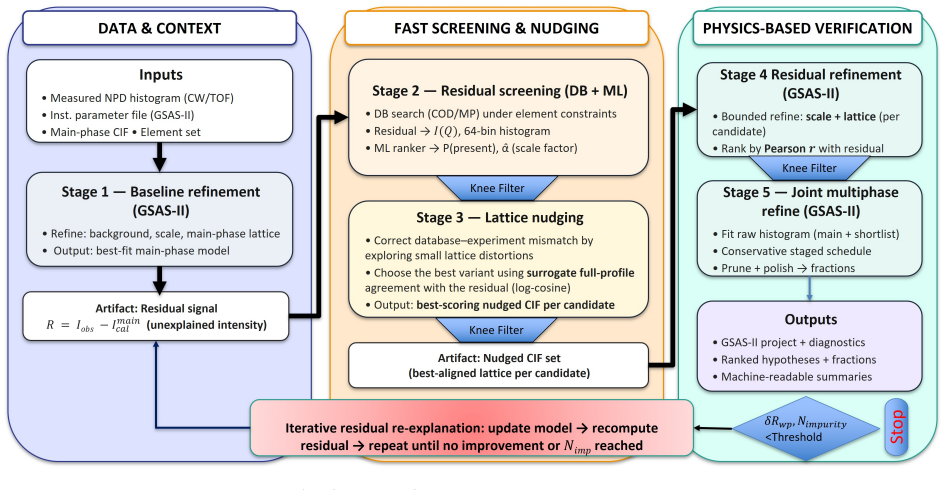
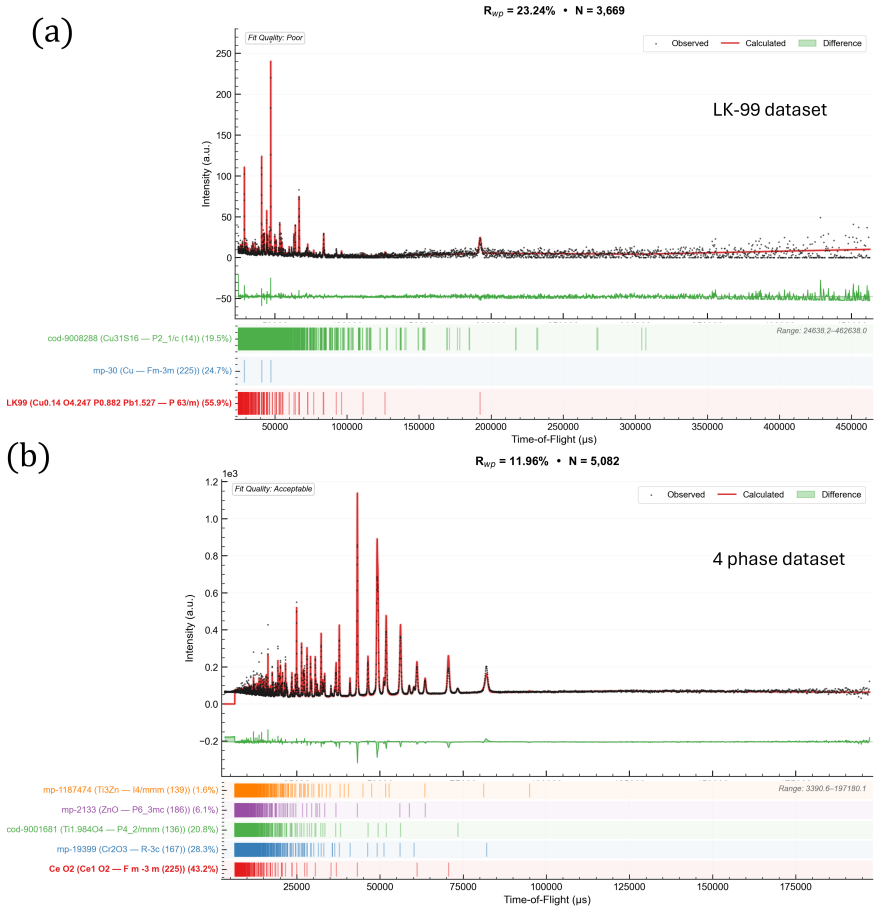
RADAR-PD couples a mismatch-tolerant neural network operating on coarse momentum-transfer fingerprints with automated lattice nudging and physics-constrained Rietveld verification. This enables dominant-phase hypotheses to be generated from elemental constraints and secondary phases to be isolated recursively. On an experimental RRUFF PXRD benchmark, RADAR-PD outperforms DARA in recovering the reference phase. RADAR-PD further provides robust multiphase analysis on complex time-of-flight and constant-wavelength neutron datasets.
What carries the argument
Mismatch-tolerant neural network on coarse momentum-transfer fingerprints, paired with automated lattice nudging and physics-constrained Rietveld verification.
Load-bearing premise
The neural network can reliably generate dominant-phase hypotheses from elemental constraints and coarse fingerprints such that the subsequent Rietveld verification corrects any mismatches without introducing uncorrectable systematic errors.
What would settle it
RADAR-PD failing to outperform DARA in reference phase recovery on the RRUFF PXRD benchmark or producing inaccurate multiphase quantifications on time-of-flight or constant-wavelength neutron datasets.
Figures


read the original abstract
Powder diffraction is a primary structural characterization tool in materials science, yet automated phase identification remains a major bottleneck for autonomous discovery. Existing workflows rely heavily on search--match heuristics and manual Rietveld refinement, and broadly usable end-to-end automation is especially limited for neutron powder diffraction, where comparable tools are largely absent. Here we introduce RADAR-PD, a modality-aware machine learning framework for phase identification and quantification across both X-ray and neutron powder diffraction. RADAR-PD couples a mismatch-tolerant neural network operating on coarse momentum-transfer fingerprints with automated lattice nudging and physics-constrained Rietveld verification, enabling dominant-phase hypotheses to be generated from elemental constraints and secondary phases to be isolated recursively. On an experimental RRUFF PXRD benchmark, RADAR-PD outperforms DARA in recovering the reference phase. RADAR-PD further provides robust multiphase analysis on complex time-of-flight and constant-wavelength neutron datasets, addressing an important unmet need in automated neutron diffraction analysis. These results establish RADAR-PD as an auditable, instrument-agnostic framework for autonomous structural discovery.
Editorial analysis
A structured set of objections, weighed in public.
Referee Report
Summary. The manuscript introduces RADAR-PD, a modality-aware machine learning framework for automated multiphase identification and quantification in powder X-ray and neutron diffraction. It couples a mismatch-tolerant neural network operating on coarse momentum-transfer fingerprints with automated lattice nudging and physics-constrained Rietveld verification. Dominant-phase hypotheses are generated from elemental constraints, with secondary phases isolated recursively. The central claims are that RADAR-PD outperforms DARA on an experimental RRUFF PXRD benchmark in recovering the reference phase and delivers robust multiphase analysis on complex time-of-flight and constant-wavelength neutron datasets, establishing an auditable, instrument-agnostic tool for autonomous structural discovery.
Significance. If the performance claims hold with supporting quantitative evidence, RADAR-PD would address a clear gap in automated tools for neutron powder diffraction while advancing end-to-end automation for X-ray data. The integration of ML hypothesis generation with downstream physics-based verification, the recursive isolation strategy, and the explicit handling of modality differences represent genuine strengths that could support broader adoption in high-throughput materials characterization workflows.
major comments (2)
- [Abstract] Abstract: The claim that RADAR-PD 'outperforms DARA in recovering the reference phase' on the RRUFF benchmark is load-bearing for the central contribution, yet no quantitative metrics (accuracy, precision, recall, or statistical significance), dataset size, or details on training/validation splits are provided. This omission prevents evaluation of the reported improvement.
- [Results] The robustness claim for neutron datasets (time-of-flight and constant-wavelength) rests on the assumption that any errors from the coarse-fingerprint neural network are reliably corrected by subsequent Rietveld verification. No specific error analysis, failure cases, or quantitative assessment of this correction step is given, which is central to the instrument-agnostic assertion.
minor comments (2)
- [Abstract] The abstract would be strengthened by explicitly stating the number of phases, samples, or patterns in the RRUFF benchmark and the precise comparison protocol against DARA.
- [Methods] Notation for the momentum-transfer fingerprints and the mismatch-tolerance mechanism could be clarified with a brief equation or pseudocode in the methods section to aid reproducibility.
Simulated Author's Rebuttal
We thank the referee for their constructive and detailed review. The two major comments identify areas where additional quantitative detail would strengthen the manuscript. We address each point below and have revised the manuscript to incorporate the requested information.
read point-by-point responses
-
Referee: [Abstract] Abstract: The claim that RADAR-PD 'outperforms DARA in recovering the reference phase' on the RRUFF benchmark is load-bearing for the central contribution, yet no quantitative metrics (accuracy, precision, recall, or statistical significance), dataset size, or details on training/validation splits are provided. This omission prevents evaluation of the reported improvement.
Authors: We agree that the abstract should be self-contained with respect to the central performance claim. Although the full quantitative comparison (accuracy, precision, recall, statistical significance, dataset size, and train/validation splits) appears in the Results and Methods sections, we have revised the abstract to include the key metrics supporting the outperformance statement. This change directly addresses the evaluability concern without altering the manuscript's technical content. revision: yes
-
Referee: [Results] The robustness claim for neutron datasets (time-of-flight and constant-wavelength) rests on the assumption that any errors from the coarse-fingerprint neural network are reliably corrected by subsequent Rietveld verification. No specific error analysis, failure cases, or quantitative assessment of this correction step is given, which is central to the instrument-agnostic assertion.
Authors: We acknowledge that an explicit error analysis of the verification step would better substantiate the instrument-agnostic claim. In the revised manuscript we have added a dedicated paragraph in the Results section that quantifies the correction efficacy (pre- versus post-verification mismatch rates on the neutron datasets), enumerates representative failure cases, and reports the success rate of the physics-constrained Rietveld step in recovering accurate phases. This addition provides the requested quantitative assessment while preserving the original recursive workflow description. revision: yes
Circularity Check
No significant circularity detected
full rationale
The paper describes RADAR-PD as an ML pipeline coupling a mismatch-tolerant neural network on coarse momentum-transfer fingerprints with lattice nudging and physics-constrained Rietveld verification. Claims of outperforming DARA on the RRUFF benchmark and handling neutron datasets rest on external empirical validation rather than any internal equations, self-definitional reductions, or fitted inputs renamed as predictions. No load-bearing self-citations, uniqueness theorems, or ansatzes are invoked that collapse the central performance assertions back to the inputs by construction. The framework is presented as instrument-agnostic and falsifiable via benchmarks, rendering the derivation chain self-contained.
Axiom & Free-Parameter Ledger
Reference graph
Works this paper leans on
-
[1]
DanielAllan, ThomasCaswell, StuartCampbell, andMaksimRakitin. Bluesky’sahead: Amulti- facility collaboration for an a la carte software project for data acquisition and management. Synchrotron Radiation News, 32(3):19–22, 2019. doi: 10.1080/08940886.2019.1608121. URL https://doi.org/10.1080/08940886.2019.1608121
-
[2]
Savici, Mathieu Doucet, Efrain E
Austin McDannald, Matthias Frontzek, Andrei T. Savici, Mathieu Doucet, Efrain E. Rodriguez, Kate Meuse, Jessica Opsahl-Ong, Daniel Samarov, Ichiro Takeuchi, William Ratcliff, and A. Gilad Kusne. On-the-fly autonomous control of neutron diffraction via physics-informed bayesian active learning.Applied Physics Reviews, 9(2):021408, 2022. doi: 10.1063/5.0082...
- [3]
- [4]
-
[5]
Standing up the nation’s supercomputing pipeline for streaming big data in real time
Oak Ridge Leadership Computing Facility (OLCF). Standing up the nation’s supercomputing pipeline for streaming big data in real time. Web page, 2024. URL https://www.olcf.ornl.gov/2024/10/14/ standing-up-the-nations-supercomputing-pipeline-for-streaming-big-data-in-real-time/ . Accessed 2026-03-23
work page 2024
-
[6]
H. M. Rietveld. A profile refinement method for nuclear and magnetic structures.Journal of Applied Crystallography, 2(2):65–71, 1969. doi: 10.1107/S0021889869006558. URLhttps: //doi.org/10.1107/S0021889869006558
-
[7]
L. B. McCusker, R. B. Von Dreele, D. E. Cox, D. Louër, and P. Scardi. Rietveld refinement guide- lines.Journal of Applied Crystallography, 32(1):36–50, 1999. doi: 10.1107/S0021889898009856. URLhttps://doi.org/10.1107/S0021889898009856
-
[8]
R. J. Hill and C. J. Howard. Quantitative phase analysis from neutron powder diffraction data using the rietveld method.Journal of Applied Crystallography, 20(6):467–474, 1987. doi: 10.1107/S0021889887086199. URLhttps://doi.org/10.1107/S0021889887086199
-
[9]
Brian H. Toby and Robert B. Von Dreele. GSAS-II: the genesis of a modern open-source all pur- pose crystallography software package.Journal of Applied Crystallography, 46(2):544–549, 2013. doi: 10.1107/S0021889813003531. URLhttps://doi.org/10.1107/S0021889813003531
-
[10]
Jackson H. O’Donnell, Robert B. Von Dreele, Maria K. Y. Chan, and Brian H. Toby. A scripting interface for GSAS-II.Journal of Applied Crystallography, 51(4):1244–1250, 2018. doi: 10.1107/S1600576718008075. URLhttps://doi.org/10.1107/S1600576718008075
-
[11]
Kabekkodu, Anja Dosen, and Thomas N
Soorya N. Kabekkodu, Anja Dosen, and Thomas N. Blanton. PDF-5+: a comprehensive powder diffraction file™for materials characterization.Powder Diffraction, 39(2):47–59, 2024. doi: 10.1017/S0885715624000150. URLhttps://doi.org/10.1017/S0885715624000150
-
[12]
Match! – phase analysis using powder diffraction
Crystal Impact. Match! – phase analysis using powder diffraction. Computer software, 2003. URLhttps://www.crystalimpact.com/match/
work page 2003
-
[13]
The highscore suite.Powder Diffraction, 29(S2):S13–S18, 2014
Thomas Degen, Mustapha Sadki, Egbert Bron, Uwe König, and Gwilherm Nénert. The highscore suite.Powder Diffraction, 29(S2):S13–S18, 2014. doi: 10.1017/S0885715614000840. URLhttps://doi.org/10.1017/S0885715614000840
-
[14]
The inorganic crystal structure database (ICSD)—present and future
Mariette Hellenbrandt. The inorganic crystal structure database (ICSD)—present and future. Crystallography Reviews, 10(1):17–22, 2004. doi: 10.1080/08893110410001664882. URLhttps: //doi.org/10.1080/08893110410001664882. 17
-
[15]
D. Zagorac, H. Müller, S. Ruehl, J. Zagorac, and S. Rehme. Recent developments in the inorganic crystal structure database: theoretical crystal structure data and related features. Journal of Applied Crystallography, 52(5):918–925, 2019. doi: 10.1107/S160057671900997X. URLhttps://doi.org/10.1107/S160057671900997X
-
[16]
Serebryanaya, Peter Moeck, Robert T
Saulius Gražulis, Adriana Daškevič, Andrius Merkys, Daniel Chateigner, Luca Lutterotti, Miguel Quirós, Nadezhda R. Serebryanaya, Peter Moeck, Robert T. Downs, and Armel Le Bail. Crystallography open database (COD): an open-access collection of crystal structures and platform for world-wide collaboration.Nucleic Acids Research, 40(D1):D420–D427, 2012. doi:...
-
[17]
Anubhav Jain, Shyue Ping Ong, Geoffroy Hautier, Wei Chen, William Davidson Richards, Stephen Dacek, Shreyas Cholia, Dan Gunter, David Skinner, Gerbrand Ceder, and Kristin A. Persson. Commentary: The materials project: A materials genome approach to accelerating materials innovation.APL Materials, 1(1):011002, 2013. doi: 10.1063/1.4812323. URL https://doi....
-
[18]
Luca Lutterotti, Henry Pillière, Christophe Fontugne, Philippe Boullay, and Daniel Chateigner. Full-profile search–match by the rietveld method.Journal of Applied Crystallography, 52 (3):587–598, 2019. doi: 10.1107/S160057671900342X. URL https://doi.org/10.1107/ S160057671900342X
-
[19]
Pedro Baptista de Castro, Kensei Terashima, Miren Garbine Esparza Echevarria, Hiroyuki Takeya, and Yoshihiko Takano. XERUS: An open-source tool for quick XRD phase identification and refinement automation.Advanced Theory and Simulations, 5(5), 2022. doi: 10.1002/adts. 202100588. URLhttps://doi.org/10.1002/adts.202100588
-
[20]
Yuxing Fei, Matthew J. McDermott, Christopher L. Rom, Shilong Wang, and Gerbrand Ceder. Dara: Automated multiple-hypothesis phase identification and refinement from powder x-ray diffraction.Chemistry of Materials, 38(3):1364–1376, 2026. doi: 10.1021/acs.chemmater.5c02820. URLhttps://doi.org/10.1021/acs.chemmater.5c02820
-
[21]
Butler, Dorota Matras, Stephen W
Hongyang Dong, Keith T. Butler, Dorota Matras, Stephen W. T. Price, Yaroslav Odarchenko, Rahul Khatry, Andrew Thompson, Vesna Middelkoop, Simon D. M. Jacques, Andrew M. Beale, and Antonis Vamvakeros. A deep convolutional neural network for real-time full profile analysis of big powder diffraction data.npj Computational Materials, 7(1):74, 2021. doi: 10.10...
-
[22]
Shouyang Zhang, Bin Cao, Tianhao Su, Yue Wu, Zhenjie Feng, Jie Xiong, and Tong-Yi Zhang. Crystallographic phase identifier of a convolutional self-attention neural network (CPICANN) on powder diffraction patterns.IUCrJ, 11(4):634–642, 2024. doi: 10.1107/S2052252524005323. URLhttps://doi.org/10.1107/S2052252524005323
-
[23]
Bin Cao, Zinan Zheng, Yang Liu, Longhan Zhang, Lawrence W-Y Wong, Lu-Tao Weng, Jia Li, Haoxiang Li, and Tong-Yi Zhang. XQueryer: an intelligent crystal structure identifier for powder x-ray diffraction.National Science Review, 12(12), 2025. doi: 10.1093/nsr/nwaf421. URLhttps://doi.org/10.1093/nsr/nwaf421. 18
-
[24]
Jin-Woong Lee, Woon Bae Park, Jin Hee Lee, Satendra Pal Singh, and Kee-Sun Sohn. A deep-learning technique for phase identification in multiphase inorganic compounds using synthetic XRD powder patterns.Nature Communications, 11(1):86, 2020. doi: 10.1038/ s41467-019-13749-3. URLhttps://doi.org/10.1038/s41467-019-13749-3
-
[25]
Jan Schuetzke, Alexander Benedix, Ralf Mikut, and Markus Reischl. Enhancing deep-learning training for phase identification in powder x-ray diffractograms.IUCrJ, 8(3):408–420, 2021. doi: 10.1107/S2052252521002402. URLhttps://doi.org/10.1107/S2052252521002402
-
[26]
S. Calder, K. An, R. Boehler, C. R. Dela Cruz, M. D. Frontzek, M. Guthrie, B. Haberl, A. Huq, S. A. J. Kimber, J. Liu, J. J. Molaison, J. Neuefeind, K. Page, A. M. dos Santos, K. M. Taddei, C. Tulk, and M. G. Tucker. A suite-level review of the neutron powder diffraction instruments at oak ridge national laboratory.Review of Scientific Instruments, 89(9):...
-
[27]
V. O. Garlea, B. C. Chakoumakos, S. A. Moore, G. B. Taylor, T. Chae, R. G. Maples, R. A. Riedel, G. W. Lynn, and D. L. Selby. The high-resolution powder diffractometer at the high flux isotope reactor.Applied Physics A, 99(3):531–535, 2010. doi: 10.1007/s00339-010-5603-6. URLhttps://doi.org/10.1007/s00339-010-5603-6
-
[28]
Ashfia Huq, Melanie Kirkham, Peter F. Peterson, Jason P. Hodges, Pamela S. Whitfield, Katharine Page, Thomas Hügle, Erik B. Iverson, Andre Parizzi, and George Rennich. POWGEN: rebuild of a third-generation powder diffractometer at the spallation neutron source.Journal of Applied Crystallography, 52(5):1189–1201, 2019. doi: 10.1107/S160057671901121X. URL h...
-
[29]
Joseph A. M. Paddison, Stuart Calder, Danielle R. Yahne, Malcolm J. Cochran, Si Athena Chen, Matthias D. Frontzek, and Yuanpeng Zhang. A planning tool for neutron powder diffraction experiments.Review of Scientific Instruments, 96(11):113901, 2025. doi: 10.1063/5.0283549. URLhttps://doi.org/10.1063/5.0283549
-
[30]
Keum, Zhiqiang Mao, and Matthew B
Qiang Zhang, Yingdong Guan, Yongqiang Cheng, Lujin Min, Jong K. Keum, Zhiqiang Mao, and Matthew B. Stone. Structure and lattice excitations of the copper substituted lead oxyapatite Pb9.06(7)Cu0.94(6)(PO3.92(4))6O0.96(3).Physical Review Materials, 8(1):014605, 2024. doi: 10.1103/PhysRevMaterials.8.014605. URL https://doi.org/10.1103/PhysRevMaterials.8. 014605
-
[31]
Shyue Ping Ong, William Davidson Richards, Anubhav Jain, Geoffroy Hautier, Michael Kocher, Shreyas Cholia, Dan Gunter, Vincent L. Chevrier, Kristin A. Persson, and Gerbrand Ceder. Python materials genomics (pymatgen): A robust, open-source python library for materials analysis.Computational Materials Science, 68:314–319, 2013. doi: 10.1016/j.commatsci.201...
discussion (0)
Sign in with ORCID, Apple, or X to comment. Anyone can read and Pith papers without signing in.