Recognition: 3 theorem links
· Lean TheoremUnveiling f(R) Gravity with Void-Galaxy Cross-Correlation Multipoles
Pith reviewed 2026-05-13 02:49 UTC · model grok-4.3
The pith
Redshift-space void-galaxy multipoles show size-dependent deviations from LCDM that grow sharply for smaller voids in f(R) gravity.
A machine-rendered reading of the paper's core claim, the machinery that carries it, and where it could break.
Core claim
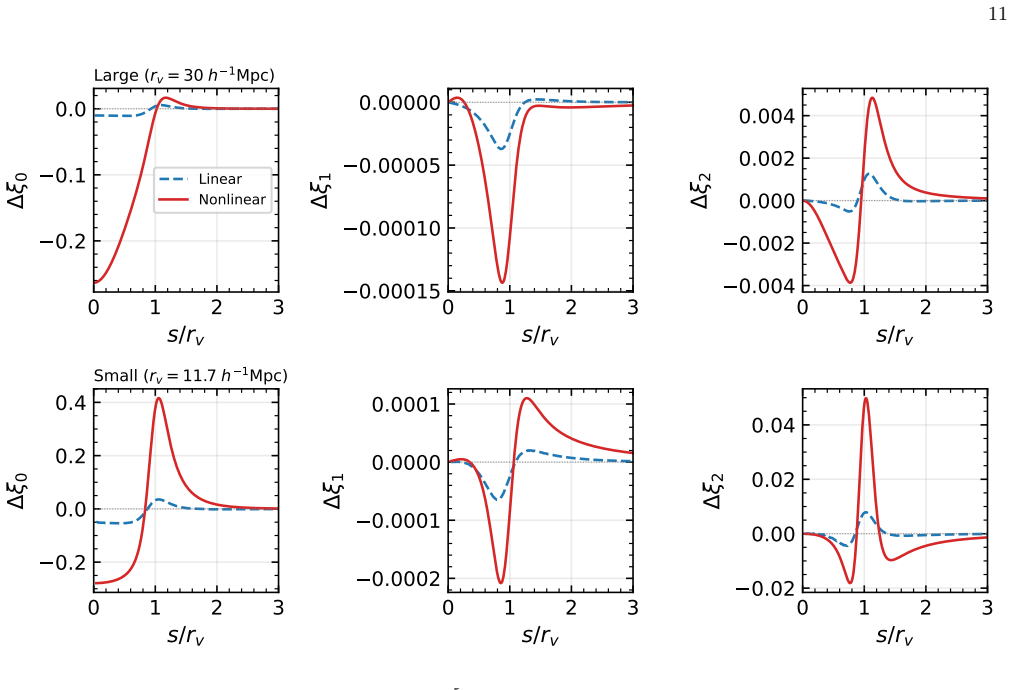
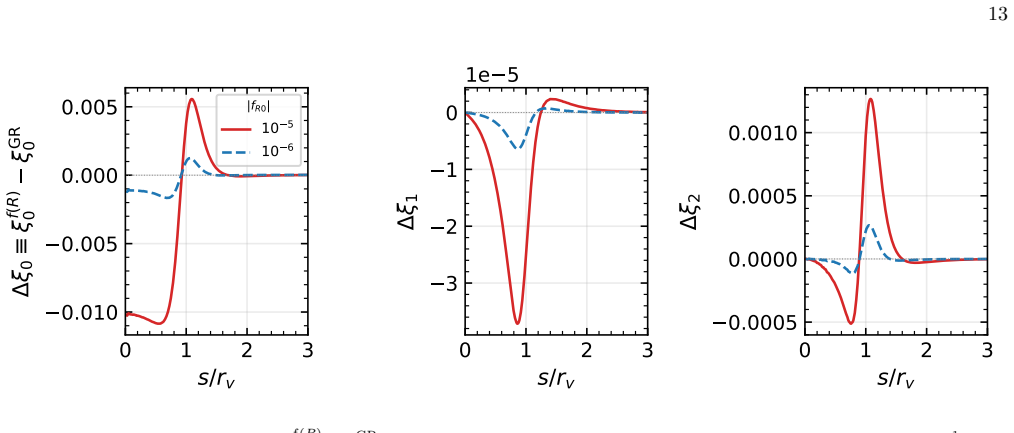
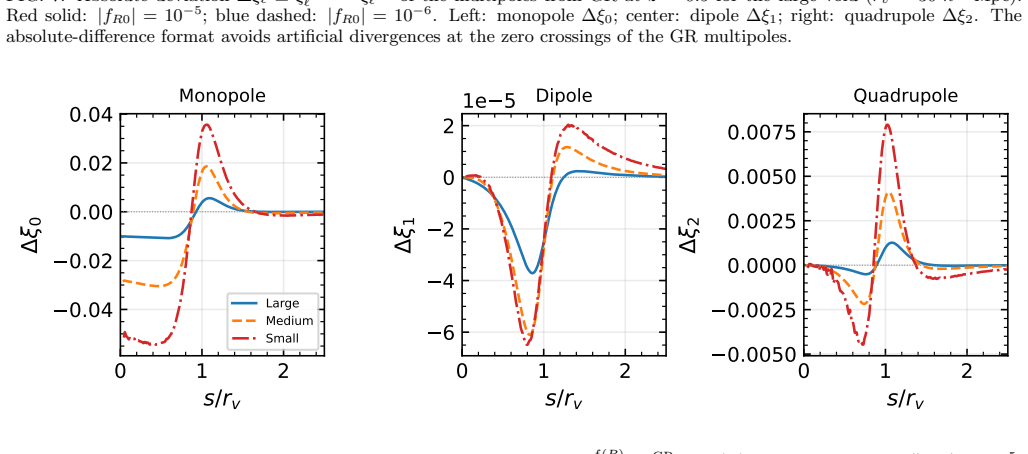
In the Hu-Sawicki f(R) model with n=1, the monopole of the redshift-space void-galaxy cross-correlation function deviates from its LCDM value by +2.8 percent for voids of radius 30 Mpc and by +29.7 percent for voids of radius 11.7 Mpc when fR0 equals 10 to the minus 5. This size-dependent enhancement traces the Compton-scale scalaron response under chameleon screening, with lambda_C approximately 8 Mpc. Nonlinear evolution around the void shells multiplies the modified-gravity contribution by an amplification factor A0 of approximately 4. The gravitational potential acquires a finite-range Yukawa component that imprints an additional radially dependent signature on the dipole moment.
What carries the argument
The semi-analytical calculation that folds the scale-dependent growth factor from the scalaron degree of freedom together with nonlinear spherical shell dynamics to predict the redshift-space multipoles of the void-galaxy cross-correlation function.
If this is right
- The modified-gravity signal is strongest in the smallest voids that remain unscreened, offering a direct probe of the scalaron Compton wavelength.
- Nonlinear amplification makes the effect large enough for detection in Stage-IV surveys such as DESI, Euclid and the Roman Space Telescope.
- The dipole moment carries an independent signature from the finite-range fifth force that is not present in standard gravity.
- The overall signal weakens at higher redshift as the Compton wavelength shrinks, setting a practical redshift window for observations.
Where Pith is reading between the lines
- Joint analysis of monopole, quadrupole and dipole moments could break degeneracies between f(R) parameters and other dark-energy or bias effects.
- The same void-shell framework might be applied to other modified-gravity models that admit a scale-dependent effective G in the quasi-static regime.
- If the predicted size-dependent transition is confirmed, it would tighten bounds on fR0 beyond what is currently possible with galaxy clustering or weak lensing alone.
Load-bearing premise
That the quasi-static limit for the effective gravitational constant can be specified for any metric f(R) theory and that nonlinear void evolution can be captured by spherical shell dynamics.
What would settle it
A measurement of the void-size dependence of the monopole deviation in a large spectroscopic sample that fails to show the predicted rise toward smaller voids for any value of fR0 would rule out the claimed signal.
Figures



read the original abstract
Cosmic voids provide a low-density environment where the scalar fifth force predicted by $\fR$ modified gravity (MG) is least screened. We present a semi-analytical calculation of the monopole, dipole, and quadrupole of the void-galaxy cross-correlation function $\xi^{s}(s,\mu)$ in redshift space for the Hu-Sawicki $\fR$ model ($n=1$), combining the scale-dependent growth factor from the scalaron degree of freedom with nonlinear spherical shell dynamics. The framework applies to any metric $\fR$ theory for which $\Geff(k,a)/G$ can be specified in the quasi-static limit. Our key results are: (1)~the monopole deviation from $\lcdm$ grows from $+2.8\%$ for large voids ($r_v = 30\;\Mpc$) to $+29.7\%$ for small voids ($r_v = 11.7\;\Mpc$) at $\fRz = 10^{-5}$ -- a distinctive size-dependent signature of the Compton-scale scalaron response associated with chameleon screening, with $\lambda_C \approx 8\;\Mpc$; (2)~nonlinear evolution amplifies the modified-gravity signal by $\mathcal{A}_0 \approx 4$, bringing it within reach of ongoing and upcoming wide-field spectroscopic surveys, such as DESI, Subaru PFS, Euclid, and the Roman Space Telescope; (3) the gravitational potential contains a finite-range Yukawa component, producing a radially dependent dipole signature that is complementary to the density and velocity multipoles; (4) the signal weakens with redshift as the scalaron Compton wavelength shrinks, but remains potentially detectable at Stage-IV spectroscopic void samples. We show that the void-scale transition in the modified-gravity response, the joint sensitivity to density, velocity, and fifth-force contributions, and the nonlinear amplification around void shells make redshift-space void-galaxy multipoles a powerful semi-analytical probe of f(R) gravity and related inhomogeneous dark energy scenarios.
Editorial analysis
A structured set of objections, weighed in public.
Referee Report
Summary. The paper develops a semi-analytical framework for computing the redshift-space void-galaxy cross-correlation multipoles (monopole, dipole, quadrupole) in the Hu-Sawicki f(R) model (n=1). It combines the quasi-static scale-dependent growth factor arising from the scalaron with nonlinear spherical shell dynamics for void evolution, and reports a size-dependent monopole deviation from LCDM that grows from +2.8% at rv=30 Mpc to +29.7% at rv=11.7 Mpc for fR0=10^{-5}, with nonlinear amplification A0≈4 and a Compton wavelength signature λC≈8 Mpc. The framework is presented as applicable to any metric f(R) theory once Geff(k,a)/G is specified in the quasi-static limit, with signals potentially detectable in Stage-IV surveys.
Significance. If the underlying approximations hold, the work identifies a distinctive, size-dependent signature of chameleon screening in void environments that is complementary to density and velocity multipoles and amplified into the observable range by nonlinear evolution. This could strengthen the case for using void-galaxy cross-correlations as a probe of modified gravity and inhomogeneous dark energy models, particularly with the joint sensitivity to fifth-force effects in the gravitational potential.
major comments (3)
- [Abstract / calculation framework] The headline quantitative results (29.7% monopole deviation at rv=11.7 Mpc, A0≈4 amplification) rest on the nonlinear spherical shell dynamics applied to small voids. The validity of assuming persistent spherical symmetry, negligible tidal/environmental corrections, and accurate 1D modeling of shell-crossing and redshift-space velocity fields at these scales is not demonstrated; if these break at the 10-20% level, the claimed size-dependent signature and amplification factor are undermined. (Abstract and associated calculation framework)
- [Abstract / quasi-static Geff specification] The quasi-static limit for Geff(k,a)/G is invoked throughout, yet no explicit range of validity is provided for the void scales and redshifts considered (especially small voids where the signal peaks). This assumption is load-bearing for the scalaron response and Compton-scale transition claims.
- [Results / validation] No comparison to N-body simulations or full numerical validation of the predicted multipole deviations is reported. Without this, the semi-analytical predictions for the 2.8% to 29.7% deviations and the A0≈4 factor remain untested against the very nonlinear regime they target.
minor comments (2)
- [Abstract] Notation for the amplification factor A0 and the precise definition of the void radius rv should be clarified with an explicit equation or reference to how they are extracted from the shell dynamics.
- [Abstract] The statement that the framework 'applies to any metric f(R) theory' would benefit from a short explicit list of the minimal assumptions required beyond specifying Geff(k,a)/G.
Simulated Author's Rebuttal
We thank the referee for their careful reading and constructive comments on our manuscript. We address each major comment point by point below, with revisions made where they strengthen the presentation of our semi-analytical framework without altering its core claims.
read point-by-point responses
-
Referee: [Abstract / calculation framework] The headline quantitative results (29.7% monopole deviation at rv=11.7 Mpc, A0≈4 amplification) rest on the nonlinear spherical shell dynamics applied to small voids. The validity of assuming persistent spherical symmetry, negligible tidal/environmental corrections, and accurate 1D modeling of shell-crossing and redshift-space velocity fields at these scales is not demonstrated; if these break at the 10-20% level, the claimed size-dependent signature and amplification factor are undermined. (Abstract and associated calculation framework)
Authors: We agree that the spherical symmetry assumption is an idealization whose accuracy must be assessed, particularly for small voids. Our framework deliberately employs the nonlinear spherical shell model to isolate the scalaron-driven fifth force and chameleon effects in underdense regions, where deviations from sphericity are statistically smaller than in overdense environments. The reported size-dependent monopole deviations and A0 amplification are presented as characteristic predictions of this controlled 1D dynamics. To address the concern, we will add a new subsection in Section 2 discussing the limitations, including order-of-magnitude estimates of tidal corrections drawn from existing void morphology studies, and explicitly state that the 29.7% figure should be interpreted as the leading-order MG signature subject to ~10-20% environmental scatter. This revision clarifies the approximation's scope without changing the quantitative results. revision: partial
-
Referee: [Abstract / quasi-static Geff specification] The quasi-static limit for Geff(k,a)/G is invoked throughout, yet no explicit range of validity is provided for the void scales and redshifts considered (especially small voids where the signal peaks). This assumption is load-bearing for the scalaron response and Compton-scale transition claims.
Authors: We acknowledge that an explicit statement of the quasi-static regime's applicability was omitted. In the Hu-Sawicki model, the quasi-static limit holds when the scalaron Compton wavelength is comparable to or larger than the void scale and when time derivatives remain subdominant to spatial gradients, which is satisfied for the relevant wavenumbers (k ≳ 0.05 h Mpc^{-1}) and redshifts (z ≲ 1) considered here. We will revise the calculation framework section to include a dedicated paragraph specifying these conditions, with supporting references to prior validations of the quasi-static Geff in void and cluster contexts. This addition directly bolsters the Compton wavelength signature claims for small voids. revision: yes
-
Referee: [Results / validation] No comparison to N-body simulations or full numerical validation of the predicted multipole deviations is reported. Without this, the semi-analytical predictions for the 2.8% to 29.7% deviations and the A0≈4 factor remain untested against the very nonlinear regime they target.
Authors: We recognize that direct N-body validation would provide the most robust test of the nonlinear amplification and multipole predictions. Our semi-analytical approach is intended as an efficient, transparent framework that extends established spherical dynamics to f(R) gravity, with internal consistency checks against linear theory and standard LCDM void evolution. A full simulation campaign lies beyond the present scope. We will expand the discussion section to acknowledge this limitation explicitly, outline expected sources of discrepancy (non-sphericity, velocity dispersion modeling), and indicate how the A0 factor and size-dependent signal can be tested in future simulation suites. This positions the work as a predictive tool while being transparent about its current validation status. revision: partial
- Full N-body simulation validation of the quantitative multipole deviations and amplification factor in the nonlinear regime targeted by the model.
Circularity Check
Derivation chain is self-contained with no circular reductions
full rationale
The paper computes void-galaxy multipoles by combining the quasi-static scale-dependent growth factor Geff(k,a)/G (standard for Hu-Sawicki f(R)) with nonlinear spherical shell dynamics. All numerical results (monopole deviations, A0 amplification, lambda_C scale) follow directly from these externally specified inputs and the stated assumptions on void sphericity and redshift-space mapping. No equation reduces a prediction to a quantity fitted inside the paper, no self-citation supplies a uniqueness theorem or ansatz, and no known result is merely renamed. The framework is therefore independent of its own outputs.
Axiom & Free-Parameter Ledger
free parameters (1)
- fR0 =
10^{-5}
axioms (2)
- domain assumption Quasi-static limit for specifying Geff(k,a)/G
- domain assumption Nonlinear evolution via spherical shell dynamics
Lean theorems connected to this paper
-
IndisputableMonolith/Cost/FunctionalEquationwashburn_uniqueness_aczel unclearthe monopole deviation from ΛCDM grows from +2.8% … to +29.7% … at |fR0|=10^{-5} … λC≈8 Mpc; nonlinear evolution amplifies … by A0≈4
-
IndisputableMonolith/Foundation/AlexanderDualityalexander_duality_circle_linking unclearnonlinear spherical shell dynamics … Geff(keff,a)/G … keff=π/q
-
IndisputableMonolith/Foundation/RealityFromDistinctionreality_from_one_distinction unclearHu-Sawicki f(R) model (n=1) … m_sc(a) … chameleon screening
Reference graph
Works this paper leans on
-
[1]
Scalaron mass and effective gravitational constant For a general metricf(R) theory written asR+f(R), we define fR ≡ d f dR , f RR ≡ d2f dR2 . The scalaron mass evaluated on the cosmological back- ground is m2 sc(a) = 1 3 1 +f R(a) fRR(a) −R a ,(5) whereR a denotes the background Ricci scalar at scale factora. In viable high-curvature models, |fR(a)| ≪1, 1...
-
[2]
Scale-Dependent Linear Growth Factor Under the same sub-horizon quasi-static conditions used in Eq. (15), the linear matter density contrast δ(k, a) =D(k, a)δ 0(k) obeys the standard modified- growth equation [5, 7, 48] D′′ + 2 + dlnH dlna D′ = 3 2 Ωm(a) Geff(k, a) G D ,(16) where primes denote derivatives with respect to lna. The equation assumes nonrela...
-
[3]
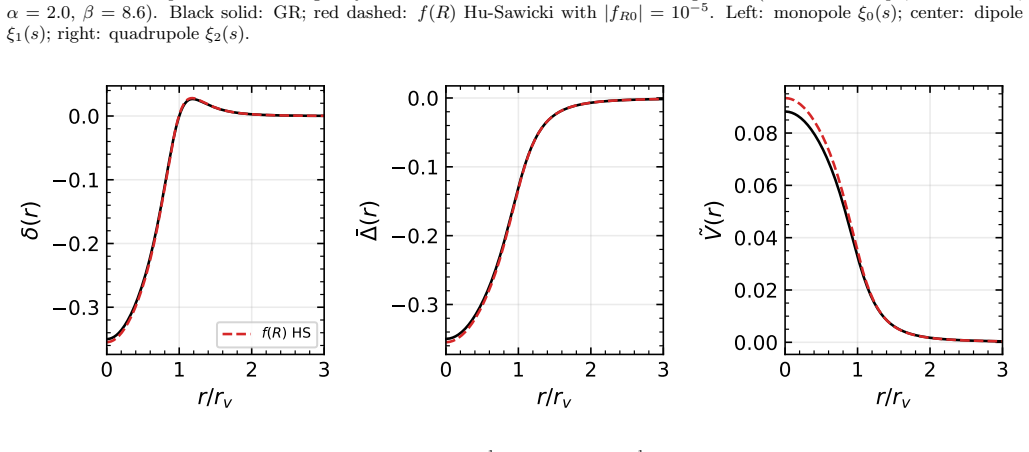
Universal profile We adopt the universal void density profile proposed by Hamauset al.[50], which provides a four-parameter analytic description of stacked void profiles measured in N-body simulations: δ(r) = ∆ c 1−(r/r s)α 1 + (r/rv)β .(19) 4 TABLE I. Void profile parameters from the universal fitting function of Hamauset al.[50], with numerical values f...
-
[4]
Modification to void profiles inf(R)gravity In Fourier space thef(R) void profile is obtained by rescaling with the growth ratio: δf(R)(k) =R(k, a)δ GR(k).(21) The real-spacef(R) profile is then obtained by the in- verse radial spherical Bessel transform. Equivalently, this is theℓ= 0 component of the spherical Fourier–Bessel transform (or spherical Hanke...
-
[5]
Velocity divergence In the linear regime the dimensionless velocity diver- genceθ(k, a)≡ −∇ ·v/(aHf) satisfies θ(k) =−f(k, a)δ(k).(23) We define the dimensionless radial velocity profile ˜V(r) = ¯∆θ(r) 3 ,(24) where ¯∆θ(r) = (3/r 3) R r 0 θ(r′)r ′2 dr′ is the mean inte- rior velocity divergence, evaluated with the same radial spherical Bessel transform fr...
-
[6]
Gravitational potential It is useful to rewrite the modified Poisson equation in terms of the dimensionless matter density contrast to clarify the notation. We define δρm(k, a) = ¯ρm(a)δ m(k, a), ¯ρm(a) = 3H2 0Ωm0 8πG a−3.(25) From now on, for the consistency of notation with RSD dipole analysis, we defineψ(k, a)≡Ψ(k, a) andδ(k, a)≡ δm(k, a) to denote the...
-
[7]
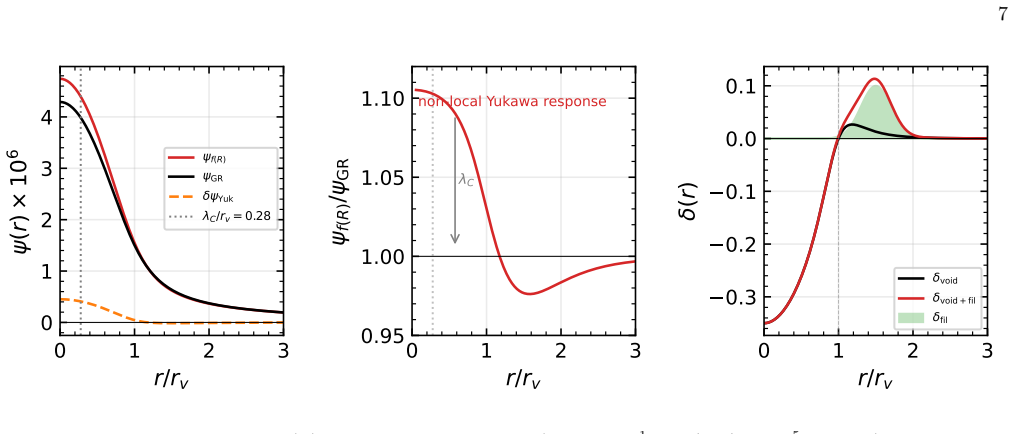
Yukawa decomposition Becauseµ f(R)(k, a) decomposes as 1 + (1/3)k 2/(k2 + a2m2 sc), thef(R) potential separates into a GR piece and the Yukawa correction of Eq. (30): ψf(R)(r) =ψ GR(r) +δψ Yuk(r).(31) The Yukawa pieceδψ Yuk is exponentially suppressed on scalesr≫λ C. For|f R0|= 10 −5 the Compton wave- length isλ C ≈8h −1Mpc atz= 0.5, so the correction is ...
-
[8]
General structure The starting point is the mapping from real-space to redshift-space coordinates for the void-galaxy cross- correlation. To distinguish the full redshift-space cor- relationξ s(s, µ) from the underlying radial profile, we writeξ vg(s)≡b δ(s) for the biased real-space void-galaxy correlation profile evaluated at the redshift-space sep- ara...
-
[9]
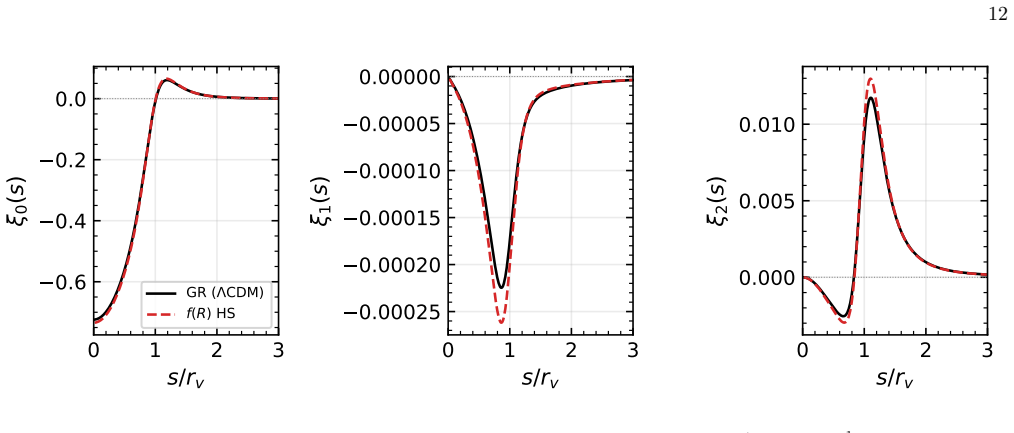
Monopole The monopole (ℓ= 0) follows from Eq. (25) of Ref. [20]. At lowest order in the velocity field the standard Kaiser- like formula gives ξ(0) 0 (s) =b δ(s) +b f ¯∆(s)−δ(s) + f2 3 ¯∆(s)−δ(s) , (34) wheref≡dlnD/dlnais the growth rate. The full ex- pression including the streaming (non-perturbative) cor- rections from the coherent velocity field ˜Vread...
-
[10]
Quadrupole The quadrupole (ℓ= 2) arises from the anisotropy be- tween radial and transverse motions (Eq. 26 of Ref. [20]). Its full expression is ξ2(s) = (1 +ξ vg) 2 105 −7 ˜V ′ s+ 29 ˜V ˜V ′ s + 6(˜V ′ s)2 + 6˜V ˜V ′′ s2 + ξ′ vg 105 ˜V s(−14 + 29 ˜V+ 24 ˜V ′ s) + 2 35 ˜V 2 s2 ξ′′ vg .(36) At leading order in ˜V(keeping onlyO( ˜V) terms), Eq. (36) reduces...
-
[11]
Dipole The dipole (ℓ= 1) uniquely contains a contribution from the gravitational potential, making it sensitive to the Poisson equation and hence toG eff/G. Following Eq. (27) of Ref. [20], the dipole splits into velocity and potential parts: ξ1(s) =ξ vel 1 (s) +ξ ψ 1 (s).(38) 7 0 1 2 3 r/rv 0 1 2 3 4(r) × 106 f(R) GR Yuk C/rv = 0.28 0 1 2 3 r/rv 0.95 1.0...
work page 2018
-
[12]
For the large void class the nonlinear am- plification of the quadrupole deviation isA 2 ≈4.3
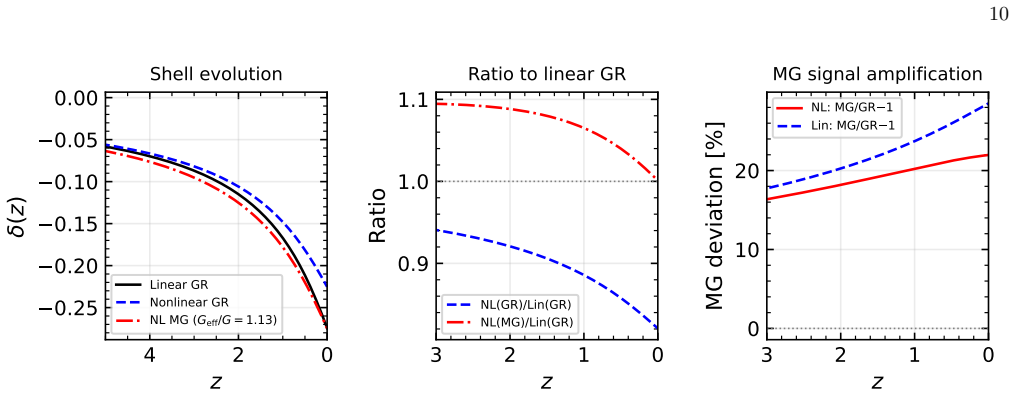
Quadrupole and nonlinear amplification The quadrupoleξ 2(s) depends quadratically on the growth rate (∝f 2) and on the velocity field ˜Vand its derivatives. For the large void class the nonlinear am- plification of the quadrupole deviation isA 2 ≈4.3. The monopole amplification isA 0 ≈3.7. For smaller voids, A0 rises to∼5.8–10 (see Appendix B, Table VI). ...
-
[13]
Inf(R) gravity the ratioψ f(R)(r)/ψGR(r) is r-dependent due to the finite-range Yukawa correction
Dipole and the Yukawa potential The dipoleξ 1(s) contains the gravitational potential termξ ψ 1 . Inf(R) gravity the ratioψ f(R)(r)/ψGR(r) is r-dependent due to the finite-range Yukawa correction. Unlike the Fourier-space response, whose unscreened limit isµ f(R) →4/3, this real-space ratio is a weighted convolution over the void density profile and is no...
-
[14]
GR We adopt S/N≥3 (the 3σcriterion) as the threshold for a confident detection of the MG signal
MG discrimination:f(R)vs. GR We adopt S/N≥3 (the 3σcriterion) as the threshold for a confident detection of the MG signal. Values below this threshold do not indicate the model is ruled out; rather, a non-detection at measured S/N =x <3 places an upper bound on the MG parameter after interpolating the|f R0|= 10 −5 and 10 −6 templates. A simple power- law ...
-
[15]
Direct multipole detection and compressed estimators It is useful to distinguish the detection of a multi- pole itself from the detection of thef(R)-vs-GR dif- ference in that multipole. Table IV shows the direct S/N of the GR multipoles for the large-void template. The monopole is overwhelmingly measured, and the quadrupole should be directly detectable ...
-
[16]
Optimistic prospects The conservative single-size, single-redshift estimates above represent alower boundon the achievable sensi- tivity. Several strategies can substantially improve the MG discrimination power: (i) Multi-size stacking.—Within the same synthetic- TABLE IV. Direct-detection S/N for the multipoles them- selves in the large-void GR template ...
-
[17]
Survey parameters Table VII lists the surveys considered. The approxi- mate void countsN v are baseline usable-count estimates for stacked spectroscopic RSD analyses, anchored to pub- lished BOSS catalogs, Euclid Flagship mock forecasts, DESI data releases, and a volume-scaled PFS estimate [16, 30, 71, 72, 80–83, 86, 87] For DESI Y5 and Sub- aru PFS, wher...
-
[18]
Covariance model The analyses of Refs. [16, 17, 30, 86] estimate the co- variance of the stacked void–galaxy correlation from jack- knife or mock-catalog realizations and use the resulting full covariance matrix in the likelihood. In the absence of such modified-gravity mock catalogs, we use asyn- theticor phenomenological covariance that mimics the non-d...
- [19]
-
[20]
S. Perlmutteret al.(Supernova Cosmology Project), Measurements of Ω and Λ from 42 high redshift su- pernovae, Astrophys. J.517, 565 (1999), arXiv:astro- ph/9812133 [astro-ph]
-
[21]
Weinberg, The cosmological constant problem, Rev
S. Weinberg, The cosmological constant problem, Rev. Mod. Phys.61, 1 (1989)
work page 1989
- [22]
-
[23]
Relativ.13 3 [arXiv:1002.4928]
A. De Felice and S. Tsujikawa,f(R) Theories, Living Rev. Rel.13, 3 (2010), arXiv:1002.4928 [gr-qc]
-
[24]
Modified Gravity and Cosmology
T. Clifton, P. G. Ferreira, A. Padilla, and C. Skordis, Modified Gravity and Cosmology: An Update, Phys. Rept.513, 1 (2012), arXiv:1106.2476 [astro-ph.CO]
work page internal anchor Pith review arXiv 2012
- [25]
-
[26]
Chameleon Fields: Awaiting Surpris es for Tests of Gravity in Space
J. Khoury and A. Weltman, Chameleon Fields: Awaiting Surprises for Tests of Gravity in Space, Phys. Rev. Lett. 93, 171104 (2004), arXiv:astro-ph/0309300 [astro-ph]
-
[27]
B. Jain and J. Khoury, Cosmological Tests of Gravity, Annals Phys.325, 1479 (2010), arXiv:1004.3294 [astro- ph.CO]
-
[28]
Pisaniet al., Cosmic voids: a novel probe to shed light on our Universe, Bull
A. Pisaniet al., Cosmic voids: a novel probe to shed light on our Universe, Bull. Am. Astron. Soc.51, 40 (2019), arXiv:1903.05161 [astro-ph.CO]
- [29]
- [30]
-
[31]
J. Clampitt, Y.-C. Cai, and B. Li, Voids in modified grav- ity: excursion set predictions, Mon. Not. Roy. Astron. Soc.431, 749 (2013), arXiv:1212.2216 [astro-ph.CO]
- [32]
- [33]
- [34]
- [35]
-
[37]
S. Nadathur, W. J. Percival, F. Beutler, and H. A. Winther, Testing Low-Redshift Cosmic Acceleration with Large-Scale Structure, Phys. Rev. Lett.124, 221301 (2020), arXiv:1904.01030 [astro-ph.CO]
- [38]
- [39]
- [40]
-
[41]
E. Paillas, M. Cautun, B. Li, Y.-C. Cai, N. Padilla, J. Armijo, and S. Bose, The Santiago–Durham–Edinburg void catalogue: Void lensing in f(R) gravity and the im- pact of void-finding method, Mon. Not. Roy. Astron. Soc. 484, 1149 (2019), arXiv:1810.02864 [astro-ph.CO]
-
[42]
Achitouv, New constraints onf(R) gravity from cosmic voids, Phys
I. Achitouv, New constraints onf(R) gravity from cosmic voids, Phys. Rev. D94, 103524 (2016), arXiv:1609.03565 [astro-ph.CO]
-
[43]
S. Contarini, F. Marulli, L. Moscardini, P. Vielzeuf, C. Giocoli, and M. Baldi, Cosmological constraints from the void size function of BOSS DR12, Mon. Not. Roy. Astron. Soc.518, 5799 (2022), arXiv:2112.10159 [astro- ph.CO]
-
[44]
C. Wilson and R. Bean, Constraints onf(R) gravity from void abundance with the Dark Energy Survey Year 1 data, Phys. Rev. D108, 123527 (2023), arXiv:2306.07519 [astro-ph.CO]
-
[45]
S. Contarini, A. Pisani, N. Hamaus, F. Marulli, L. Moscardini, and M. Baldi, Constraints onνΛCDM and f(R) gravity from the void size function of BOSS data, Astron. Astrophys.682, A20 (2024), arXiv:2310.17070 [astro-ph.CO]
- [46]
- [47]
-
[49]
A. Woodfinden, S. Nadathur, W. J. Percival, S. Radi- novic, and H. A. Winther, Measurements of cosmic ex- pansion and growth rate of structure from voids in the Sloan Digital Sky Survey, Mon. Not. Roy. Astron. Soc. 516, 4307 (2022), arXiv:2205.02779 [astro-ph.CO]
- [50]
-
[51]
M. Cataneo, D. Rapetti, F. Schmidt, A. B. Mantz, S. W. Allen, D. E. Applegate, P. L. Kelly, A. von der Linden, and R. G. Morris, New constraints onf(R) gravity from clusters of galaxies, Phys. Rev. D92, 044009 (2015), arXiv:1412.0133 [astro-ph.CO]
- [52]
-
[53]
C. Hernandez-Aguayo, C. M. Baugh, and B. Li, Galaxy clustering in the ELEPHANT simulations off(R) grav- ity, Mon. Not. Roy. Astron. Soc.479, 4824 (2018), arXiv:1807.02063 [astro-ph.CO]
-
[54]
C. Hernandez-Aguayo, C. Arnold, B. Li, and C. M. Baugh, Galaxy clustering in modified gravity cosmolo- gies, Mon. Not. Roy. Astron. Soc.518, 1282 (2022), arXiv:2111.02441 [astro-ph.CO]
-
[55]
A. Terukina, L. Lombriser, K. Yamamoto, D. Bacon, K. Koyama, and R. C. Nichol, Testing chameleon gravity with the Coma cluster, JCAP04, 013, arXiv:1312.5083 [astro-ph.CO]
-
[56]
H. Wilcox, D. Bacon, R. C. Nichol, P. J. Rooney, A. Terukina, K. Romer, K. Koyama, G.-B. Zhao, R. Hood, R. G. Mann,et al., The XMM Cluster Sur- vey: Testing chameleon gravity using the profiles of clus- ters, Mon. Not. Roy. Astron. Soc.452, 1171 (2015), arXiv:1507.01937 [astro-ph.CO]
- [57]
- [58]
- [59]
-
[60]
H. Desmond, P. G. Ferreira, G. Lavaux, and J. Jasche, Fifth force constraints from the separation of galaxy mass components, Phys. Rev. D103, 024028 (2021), arXiv:2009.14755 [astro-ph.CO]
- [61]
-
[62]
A. G. Adameet al.(DESI), DESI 2024 VI: Cosmological Constraints from the Measurements of Baryon Acous- tic Oscillations, arXiv e-prints (2024), arXiv:2404.03002 [astro-ph.CO]
work page internal anchor Pith review Pith/arXiv arXiv 2024
-
[63]
S. Hagstotz, M. Costanzi, M. Baldi, and J. Weller, Joint halo mass function for modified gravity and mas- sive neutrinos I: simulations and cosmological fore- 21 casts, Mon. Not. Roy. Astron. Soc.486, 3927 (2019), arXiv:1806.07400 [astro-ph.CO]
-
[64]
Planck 2018 results. VI. Cosmological parameters
N. Aghanimet al.(Planck), Planck 2018 results. VI. Cosmological parameters, Astron. Astrophys.641, A6 (2020), arXiv:1807.06209 [astro-ph.CO]
work page internal anchor Pith review Pith/arXiv arXiv 2018
-
[65]
E. D. Suchytaet al., Constraints on gravity from thermal- Sunyaev-Zel’dovich-effect-selected SPT galaxy clusters and weak lensing mass calibration from DES and HST, Phys. Rev. D111, 043519 (2025)
work page 2025
- [66]
- [67]
- [68]
-
[69]
Kaiser, Clustering in real space and in redshift space, Mon
N. Kaiser, Clustering in real space and in redshift space, Mon. Not. Roy. Astron. Soc.227, 1 (1987)
work page 1987
- [70]
- [71]
-
[72]
Bernardeau, The Nonlinear Gravitational Evolution of the Cosmic Web, Astrophys
F. Bernardeau, The Nonlinear Gravitational Evolution of the Cosmic Web, Astrophys. J.427, 51 (1994)
work page 1994
-
[74]
G. Pollina, N. Hamaus, K. Dolag, J. Weller, M. Baldi, and L. Moscardini, On the relative bias between galaxy tracers of cosmic voids, Mon. Not. Roy. Astron. Soc.469, 787 (2017)
work page 2017
-
[75]
A. Tamosiunas, H. A. Winther, K. Koyama, D. J. Bacon, R. C. Nichol, and B. Mawdsley, Testing modified grav- ity with cosmic voids, JCAP12, 050, arXiv:2112.11576 [astro-ph.CO]
- [76]
-
[77]
P. Brax, A.-C. Davis, B. Li, H. A. Winther, and G.-B. Zhao, Systematic simulations of modified grav- ity: chameleon models, JCAP10, 002, arXiv:1206.3568 [astro-ph.CO]
- [78]
- [79]
- [80]
-
[81]
M. Sahlen, Cluster-void degeneracy breaking: dark en- ergy, Planck, and the largest cluster and void, Phys. Rev. D99, 063525 (2019), arXiv:1807.02470 [astro-ph.CO]
-
[82]
M. Sahlen and I. Zubeldia, Cluster and void counts as a test off(R) gravity with Planck thermal Sunyaev-Zel’dovich, Phys. Rev. D106, 023525 (2022), arXiv:2112.02753 [astro-ph.CO]
-
[83]
E. Jennings, Y. Li, and W. Hu, The abundance of voids and the excursion set formalism, Mon. Not. Roy. Astron. Soc.434, 2167 (2013), arXiv:1304.6087 [astro-ph.CO]
discussion (0)
Sign in with ORCID, Apple, or X to comment. Anyone can read and Pith papers without signing in.