Recognition: 2 theorem links
· Lean TheoremDNN predictions for pp reference p_T spectra at unmeasured sqrt{s}
Pith reviewed 2026-05-13 02:33 UTC · model grok-4.3
The pith
Deep neural networks trained on ALICE data can predict proton-proton transverse-momentum spectra at unmeasured LHC energies.
A machine-rendered reading of the paper's core claim, the machinery that carries it, and where it could break.
Core claim
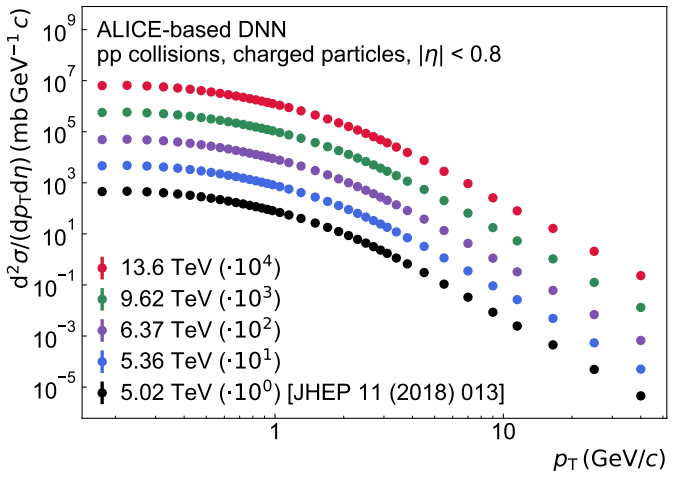
A deep neural network, trained on measured pp p_T spectra at known sqrt(s) from ALICE, can interpolate between existing energies and extrapolate to higher unmeasured ones, providing reference spectra for heavy-ion studies at LHC Run 3 energies and beyond.
What carries the argument
A deep neural network that learns the dependence of transverse-momentum spectra on center-of-mass energy from existing data.
If this is right
- The model supplies reference spectra for direct comparison in heavy-ion analyses at new energies.
- It allows study of energy evolution of particle production without requiring measurements at every energy point.
- Predictions can be used immediately for upcoming Run 3 data taking.
- Variations in the network can help estimate uncertainties in the extrapolated spectra.
Where Pith is reading between the lines
- The method could be extended to other particle observables or different collision types.
- Direct measurements at the predicted energies will provide a test of the model's accuracy.
- It may help in planning experiments by forecasting needed reference data.
Load-bearing premise
The energy dependence of the spectra follows a learnable pattern from the available measured points that generalizes to unmeasured higher energies.
What would settle it
A future measurement of pp transverse-momentum spectra at one of the unmeasured energies that deviates substantially from the DNN prediction would falsify the reliability of the extrapolation.
Figures


read the original abstract
Studies of the properties of the Quark-Gluon Plasma in high-energy heavy-ion collisions commonly facilitate proton-proton (pp) collisions at the same center-of-mass energy per nucleon pair as a reference measurement. In this paper, a deep neural network-based approach for interpolating and extrapolating pp reference transverse-momentum spectra to unmeasured energies is presented. The model is trained with ALICE data from LHC Runs 1 and 2 and provides predictions for center-of-mass energies relevant to LHC Run 3 and beyond.
Editorial analysis
A structured set of objections, weighed in public.
Referee Report
Summary. The paper presents a deep neural network (DNN) trained on ALICE pp p_T spectra from LHC Runs 1 and 2 to interpolate and extrapolate reference spectra to unmeasured center-of-mass energies √s relevant to Run 3 and beyond, for use in heavy-ion collision analyses.
Significance. If the extrapolation proves reliable, the method could supply practical reference spectra at new energies where direct measurements are unavailable, supporting QGP studies. The approach is self-contained, uses publicly referenced ALICE data, and avoids circular fitting to the same datasets, which are positive attributes. However, without reported validation or physics constraints, the practical significance remains limited.
major comments (2)
- [Abstract] Abstract: the central claim that the DNN 'provides predictions' for unmeasured √s is load-bearing but unsupported by any reported validation metrics, error estimates, extrapolation tests (e.g., held-out energy prediction), or comparison to pQCD/parametrizations, leaving the reliability of the extrapolation unverified.
- [Abstract] The weakest assumption—that a standard feed-forward DNN trained only on lower-energy spectra learns the true √s dependence without introducing unphysical tails or normalizations—is not addressed by any explicit test in the manuscript, which is required to substantiate the extrapolation claim.
minor comments (1)
- Notation for input features (e.g., how √s and p_T are encoded) could be clarified for reproducibility.
Simulated Author's Rebuttal
We thank the referee for the detailed and constructive report. The major comments correctly identify that the current manuscript does not contain explicit validation of the extrapolation performance. We will revise the paper to include the requested tests, metrics, and comparisons, thereby strengthening the central claims.
read point-by-point responses
-
Referee: [Abstract] Abstract: the central claim that the DNN 'provides predictions' for unmeasured √s is load-bearing but unsupported by any reported validation metrics, error estimates, extrapolation tests (e.g., held-out energy prediction), or comparison to pQCD/parametrizations, leaving the reliability of the extrapolation unverified.
Authors: We agree that the abstract claim requires supporting evidence. In the revised manuscript we will add a validation section that reports quantitative metrics (e.g., χ² per degree of freedom and relative residuals) on held-out √s points, provides uncertainty bands derived from the DNN ensemble or dropout, and includes direct comparisons of the DNN predictions against available pQCD calculations and standard parametrizations at both interpolated and extrapolated energies. These additions will allow readers to assess the reliability of the predictions. revision: yes
-
Referee: [Abstract] The weakest assumption—that a standard feed-forward DNN trained only on lower-energy spectra learns the true √s dependence without introducing unphysical tails or normalizations—is not addressed by any explicit test in the manuscript, which is required to substantiate the extrapolation claim.
Authors: We acknowledge that no explicit test of this assumption is currently presented. The revised version will include dedicated checks: (i) inspection of predicted spectra at extrapolated √s for negative yields or unphysical high-p_T tails, (ii) verification that integrated yields remain consistent with measured trends, and (iii) a comparison of the learned √s scaling against both data and theoretical expectations. Should any unphysical features appear, we will discuss them and consider adding physics-informed regularisation or limiting the extrapolation range. revision: yes
Circularity Check
No circularity: DNN trained on external ALICE data for energy extrapolation
full rationale
The paper presents a supervised DNN model trained on publicly referenced ALICE pp p_T spectra from LHC Runs 1 and 2 to interpolate and extrapolate to unmeasured √s values. This is a standard data-driven regression setup with no self-definitional loops, no fitted parameters renamed as predictions, and no load-bearing self-citations or imported uniqueness theorems. The derivation chain consists of training on external measurements and applying the model forward; predictions are not equivalent to inputs by construction. The approach is self-contained against external benchmarks, with any validation concerns falling under correctness rather than circularity.
Axiom & Free-Parameter Ledger
axioms (1)
- domain assumption Proton-proton transverse-momentum spectra at different center-of-mass energies can be learned and extrapolated by a deep neural network without large unmodeled physics effects
Lean theorems connected to this paper
-
IndisputableMonolith/Cost/FunctionalEquation.leanwashburn_uniqueness_aczel uncleara deep neural network-based approach for interpolating and extrapolating pp reference transverse-momentum spectra... trained with ALICE data from LHC Runs 1 and 2
-
IndisputableMonolith/Foundation/RealityFromDistinction.leanreality_from_one_distinction unclearDNN predictions... no assumptions about the physical processes underlying the spectra’s energy dependence
Reference graph
Works this paper leans on
-
[1]
T. Sj¨ ostrand, S. Ask, J. R. Christiansen, R. Corke, N. Desai, P. Ilten, S. Mrenna, S. Prestel, C. O. Rasmussen, and P. Z. Skands, “An introduction to PYTHIA 8.2” Comput. Phys. Commun.191(2015) 159–177,arXiv:1410.3012 [hep-ph]. [12]ALICECollaboration, J. Adamet al., “Pseudorapidity and transverse-momentum distributions of charged particles in proton–prot...
work page internal anchor Pith review Pith/arXiv arXiv 2015
-
[2]
J. Brewer, A. Huss, A. Mazeliauskas, and W. van der Schee, “Ratios of jet and hadron spectra at LHC energies: Measuring high-p T suppression without a pp reference,”Phys. Rev. D105no. 7, (2022) 074040,arXiv:2108.13434 [hep-ph]
-
[3]
E. Shokr, A. De Roeck, and M. A. Mahmoud, “Modeling of charged-particle multiplicity and transverse-momentum distributions in pp collisions using a DNN,”Sci. Rep.12no. 1, (2022) 8449,arXiv:2108.06102 [hep-ex]. [15]ALICECollaboration, A. Acharyaet al., “Multiplicity dependence of charged-particle production in pp, p-Pb, Xe-Xe and Pb-Pb collisions at the LH...
-
[4]
TensorFlow: Large-Scale Machine Learning on Heterogeneous Systems
M. Abadiet al., “TensorFlow: Large-Scale Machine Learning on Heterogeneous Systems.” 2015.https://www.tensorflow.org/
work page 2015
-
[5]
Incorporating Nesterov Momentum into Adam,
T. Dozat, “Incorporating Nesterov Momentum into Adam,” inProceedings of the 4th International Conference on Learning Representations. 2016
work page 2016
-
[6]
Tuning PYTHIA 8.1: the Monash 2013 Tune,
P. Skands, S. Carrazza, and J. Rojo, “Tuning PYTHIA 8.1: the Monash 2013 Tune,”Eur. Phys. J. C74no. 8, (2014) 3024,arXiv:1404.5630 [hep-ph]. [19]FCCCollaboration, A. Abadaet al., “HE-LHC: The High-Energy Large Hadron Collider: Future Circular Collider Conceptual Design Report Volume 4,”Eur. Phys. J. ST228no. 5, (2019) 1109–1382
-
[7]
R. Garnett,Bayesian Optimization. Cambridge University Press, 2023
work page 2023
-
[8]
T. O’Malley, E. Bursztein, J. Long, F. Chollet, H. Jin, L. Invernizzi,et al., “Kerastuner,”https://github.com/keras-team/keras-tuner, 2019. 10
work page 2019
-
[9]
S. Guth, A. Mojahed, and T. Sapsis, “Quality measures for the evaluation of machine learning architectures on the quantification of epistemic and aleatoric uncertainties in complex dynamical systems,”Computer Methods in Applied Mechanics and Engineering420(02, 2024) 116760
work page 2024
-
[10]
EPOS LHC: Test of collective hadronization with data measured at the CERN Large Hadron Collider,
T. Pierog, I. Karpenko, J. M. Katzy, E. Yatsenko, and K. Werner, “EPOS LHC: Test of collective hadronization with data measured at the CERN Large Hadron Collider,”Phys. Rev. C92no. 3, (2015) 034906,arXiv:1306.0121 [hep-ph]
-
[11]
Production of Hadrons with Large Transverse Momentum at 200 and 300 GeV.,
J. W. Cronin, H. J. Frisch, M. J. Shochet, J. P. Boymond, P. A. Piroue, and R. L. Sumner, “Production of Hadrons with Large Transverse Momentum at 200 and 300 GeV.,”Phys. Rev. Lett.31(1973) 1426–1429. [25]British-Scandinavian ISRCollaboration, B. Alperet al., “Production of high transverse momentum particles in p p collisions in the central region at the ...
work page 1973
-
[12]
Multiplicities,p T Distributions and the Expected Hadron→Quark - Gluon Phase Transition,
R. Hagedorn, “Multiplicities,p T Distributions and the Expected Hadron→Quark - Gluon Phase Transition,”Riv. Nuovo Cim.6N10(1983) 1–50
work page 1983
-
[13]
C.-Y. Wong, G. Wilk, L. J. L. Cirto, and C. Tsallis, “From QCD-based hard-scattering to nonextensive statistical mechanical descriptions of transverse momentum spectra in high-energyppandp¯pcollisions,”Phys. Rev. D91no. 11, (2015) 114027,arXiv:1505.02022 [hep-ph]. [28]ALICECollaboration, S. Acharyaet al., “Pseudorapidity densities of charged particles wit...
-
[14]
Improved Monte Carlo Glauber predictions at present and future nuclear colliders,
C. Loizides, J. Kamin, and D. d’Enterria, “Improved Monte Carlo Glauber predictions at present and future nuclear colliders,”Phys. Rev. C97no. 5, (2018) 054910,arXiv:1710.07098 [nucl-ex]. [Erratum:Phys. Rev. C99, 019901 (2019)]
-
[15]
Z. Citronet al., “Report from Working Group 5: Future physics opportunities for high-density QCD at the LHC with heavy-ion and proton beams,”CERN Yellow Rep. Monogr.7(2019) 1159–1410,arXiv:1812.06772 [hep-ph]. [31]ALICECollaboration, A. Acharyaet al., “ALICE physics projections for a short oxygen-beam run at the LHC.” 2021.https://cds.cern.ch/record/2765973
-
[16]
QCD Corrections to Parton-Parton Scattering Processes,
F. Aversa, P. Chiappetta, M. Greco, and J. P. Guillet, “QCD Corrections to Parton-Parton Scattering Processes,”Nucl. Phys. B327(1989) 105. 11
work page 1989
-
[17]
A compendium of cold-nuclear matter baseline predictions in light-ion collisions,
F. Jonas, C. Loizides, A. Mazeliauskas, P. Paakkinen, and N. Strangmann, “A compendium of cold-nuclear matter baseline predictions in light-ion collisions,” arXiv:2602.15928 [hep-ph]
-
[18]
INCNLO-direct photon and inclusive hadron production code - INCNLO version 1.4
INCNLO, “INCNLO-direct photon and inclusive hadron production code - INCNLO version 1.4”.https://lapth.cnrs.fr/PHOX_FAMILY/readme_inc.html
-
[19]
QCD Corrections to Parton-Parton Scattering Processes,
F. Aversa, P. Chiappetta, M. Greco, and J. P. Guillet, “QCD Corrections to Parton-Parton Scattering Processes,”Nucl. Phys. B327(1989) 105
work page 1989
-
[20]
Largep T inclusiveπ 0 cross-sections and next-to-leading-order QCD predictions,
P. Aurenche, M. Fontannaz, J. P. Guillet, B. A. Kniehl, and M. Werlen, “Largep T inclusiveπ 0 cross-sections and next-to-leading-order QCD predictions,”Eur. Phys. J. C13(2000) 347–355,arXiv:hep-ph/9910252. [37]ATLASCollaboration, G. Aadet al., “Measurement of charged-particle production in √sNN = 9.62 TeV proton-oxygen collisions as a probe of cosmic-ray ...
discussion (0)
Sign in with ORCID, Apple, or X to comment. Anyone can read and Pith papers without signing in.