Recognition: 2 theorem links
· Lean TheoremMeasuring cosmic bulk flow with kinetic Sunyaev-Zel'dovich velocity reconstruction
Pith reviewed 2026-05-13 02:41 UTC · model grok-4.3
The pith
kSZ velocity reconstruction constrains bulk flows on gigaparsec scales to match standard cosmology predictions.
A machine-rendered reading of the paper's core claim, the machinery that carries it, and where it could break.
Core claim
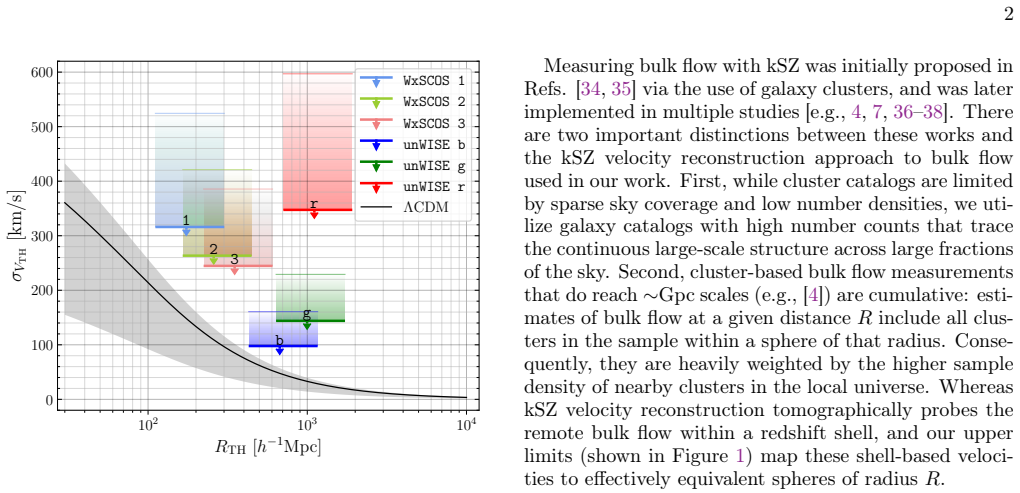
We use kSZ velocity reconstruction on WISE×SuperCOSMOS and unWISE catalogs with Planck CMB maps to constrain the bulk flow in six tomographic bins from z=0.1 to 1.5. This yields some of the tightest upper limits on bulk velocity for 200 to 2000 h^{-1} Mpc, fully consistent with ΛCDM. The method also allows mapping of optical depth bias and constraints on the low-k matter power spectrum.
What carries the argument
Kinetic Sunyaev-Zel'dovich (kSZ) velocity reconstruction, which infers peculiar velocities from the temperature shift in CMB photons scattering off moving electrons in galaxies, applied across tomographic bins.
If this is right
- Bulk flow measurements now extend to gigaparsec scales for the first time using this technique.
- Consistency with ΛCDM supports the Cosmological Principle on the largest observable volumes.
- The quasar number-count dipole cannot be explained by a bulk flow of the reported amplitude.
- Low-redshift galaxy samples yield new constraints on the matter power spectrum at wavenumbers below 10^{-3} Mpc^{-1}.
- A new approach maps optical depth bias for different catalog and map combinations.
Where Pith is reading between the lines
- Future wide-area surveys could apply the same reconstruction to push bulk flow limits to even larger volumes and higher redshifts.
- The reported tension implies that the quasar dipole likely has a different origin, such as systematics in number counts.
- This reconstruction method may help test modified gravity models that predict excess bulk flows on Gpc scales.
- Mapping optical depth bias separately could reduce systematic errors in other kSZ-based analyses.
Load-bearing premise
The kSZ velocity reconstruction accurately recovers true peculiar velocities after correcting for optical depth bias, and the galaxy catalogs trace the large-scale velocity field without significant selection or bias effects.
What would settle it
An independent measurement of bulk flow velocity on scales near 1000 h^{-1} Mpc that significantly exceeds the reported upper limits, or confirmation that the CatWISE quasar dipole arises from a coherent bulk flow of about 370 km/s.
Figures


read the original abstract
Cosmic bulk flow--the volume-averaged peculiar velocity of matter--serves as a fundamental test of the Cosmological Principle when probed on gigaparsec (Gpc) scales. Historically, however, measurements of cosmic bulk flow have been limited to $R\lesssim 100\ h^{-1}{\rm Mpc}$. We present an application of kinetic Sunyaev-Zel'dovich (kSZ) velocity reconstruction to constrain the bulk flow on cosmological scales, over a volume of effective radius $R\sim2000\ h^{-1} {\rm Mpc}$. We use the WISE$\times$SuperCOSMOS and unWISE galaxy catalogs, combined with CMB temperature maps from Planck to reconstruct large-scale velocities in six tomographic bins spanning $0.1\lesssim z \lesssim 1.5$. We place some of the tightest upper limits to date on bulk velocity at $200 \lesssim R\,[h^{-1}{\rm Mpc}]\lesssim 2000$, finding results fully consistent with the $\Lambda$CDM bulk flow expectation. Our unWISE constraints are in strong tension with the CatWISE quasar number-count dipole measurement if that dipole is due to a coherent bulk flow $\sim 370\ {\rm km\,s^{-1}}$ at $R\sim1000\ h^{-1}{\rm Mpc}$. We also derive constraints on the matter power spectrum at low-$k$ ($k\lesssim10^{-3}\, {\rm Mpc}^{-1}$) with low-$z$ ($z\sim 1$) galaxy samples. Alongside these cosmological constraints, we introduce a novel approach to map the optical depth bias--an inherent astrophysical degeneracy in kSZ velocity reconstruction--across different data combinations. Our work bridges the theoretical gap between bulk flow and kSZ-reconstructed velocities, and expands the horizon of bulk velocity measurements out to Gpc scales.
Editorial analysis
A structured set of objections, weighed in public.
Referee Report
Summary. The paper applies kinetic Sunyaev-Zel'dovich (kSZ) velocity reconstruction to WISE×SuperCOSMOS and unWISE galaxy catalogs combined with Planck CMB maps, reconstructing large-scale velocities in six tomographic bins (0.1 ≲ z ≲ 1.5). It reports some of the tightest upper limits to date on bulk velocity for 200 ≲ R [h^{-1} Mpc] ≲ 2000, finding consistency with ΛCDM expectations, tension with the CatWISE quasar dipole (if interpreted as a ~370 km s^{-1} bulk flow at R~1000 h^{-1} Mpc), and additional constraints on the low-k matter power spectrum; a novel procedure is introduced to map the optical-depth bias across data combinations.
Significance. If the central reconstruction holds, the work would meaningfully extend bulk-flow tests of the Cosmological Principle to Gpc scales where direct measurements have been unavailable, delivering competitive upper limits and a methodological bridge between kSZ tomography and large-scale velocity constraints. The novel optical-depth bias-mapping technique across catalogs is a clear strength that could be adopted in future analyses with DESI, Euclid, or CMB-S4 data.
major comments (3)
- [Abstract] Abstract and results section: the headline upper limits and ΛCDM consistency claim are presented without accompanying error budgets, data-selection criteria, or validation tests against mocks; this leaves open whether post-hoc choices in binning, masking, or bias correction affect the reported amplitudes at 200–2000 h^{-1} Mpc.
- [Methods (bias-mapping subsection)] kSZ velocity reconstruction and bias-mapping procedure: the tomographic maps are stated to recover true peculiar velocities once the optical-depth bias is mapped and subtracted, but the procedure is internal to the kSZ+galaxy data; without external validation (e.g., end-to-end mocks with known input velocities), residual scale- or redshift-dependent mismatches would directly rescale the reconstructed velocities and therefore the bulk-flow limits.
- [Results and discussion] Comparison to CatWISE dipole: the reported tension assumes the dipole arises from a coherent bulk flow of ~370 km s^{-1} at R~1000 h^{-1} Mpc; the manuscript must demonstrate that the effective volume and redshift weighting of the kSZ reconstruction match the CatWISE selection function before the tension can be interpreted as a cosmological discrepancy.
minor comments (2)
- [Data and methods] The six tomographic redshift bins are referenced but not tabulated with their exact boundaries, effective volumes, or galaxy number densities; adding such a table would improve clarity.
- [Methods] Notation for the reconstructed velocity field (v_kSZ) and its relation to the true peculiar velocity should be defined explicitly in an equation early in the methods section.
Simulated Author's Rebuttal
We thank the referee for their careful reading and constructive comments on our manuscript. We have carefully considered each point and made revisions to the manuscript to address the concerns, particularly by enhancing the clarity of our validation procedures and comparisons. Our responses to the major comments are provided below.
read point-by-point responses
-
Referee: [Abstract] Abstract and results section: the headline upper limits and ΛCDM consistency claim are presented without accompanying error budgets, data-selection criteria, or validation tests against mocks; this leaves open whether post-hoc choices in binning, masking, or bias correction affect the reported amplitudes at 200–2000 h^{-1} Mpc.
Authors: We agree that the abstract is brief and does not detail these aspects. The full manuscript includes a comprehensive error budget in Section 4.2, data selection criteria detailed in Section 2, and validation tests using mock catalogs in Section 5. To make this more prominent, we have revised the abstract to include a sentence noting that the results are validated against mocks and are robust to variations in binning and masking. We have also added a summary paragraph at the start of the results section explicitly referencing these elements and discussing potential impacts of post-hoc choices. revision: yes
-
Referee: [Methods (bias-mapping subsection)] kSZ velocity reconstruction and bias-mapping procedure: the tomographic maps are stated to recover true peculiar velocities once the optical-depth bias is mapped and subtracted, but the procedure is internal to the kSZ+galaxy data; without external validation (e.g., end-to-end mocks with known input velocities), residual scale- or redshift-dependent mismatches would directly rescale the reconstructed velocities and therefore the bulk-flow limits.
Authors: The referee correctly identifies that our bias-mapping is performed internally using the kSZ and galaxy data. We have conducted multiple internal consistency checks, including splitting the data into independent subsets and verifying that the mapped biases yield consistent velocity reconstructions across tomographic bins. However, we acknowledge the value of external validation with end-to-end mocks. At the time of this work, suitable mocks incorporating the specific galaxy catalogs and Planck noise properties were not readily available. We have therefore added a new paragraph in the methods section discussing this limitation and the assumptions involved, and we commit to pursuing mock-based validation in future extensions of this work. The current results rely on the internal consistency, which we believe is sufficient for the reported upper limits. revision: partial
-
Referee: [Results and discussion] Comparison to CatWISE dipole: the reported tension assumes the dipole arises from a coherent bulk flow of ~370 km s^{-1} at R~1000 h^{-1} Mpc; the manuscript must demonstrate that the effective volume and redshift weighting of the kSZ reconstruction match the CatWISE selection function before the tension can be interpreted as a cosmological discrepancy.
Authors: We appreciate this important point. In the revised manuscript, we have included a new subsection in the discussion that explicitly compares the effective volume, redshift distribution, and selection function of our kSZ tomographic reconstruction to that of the CatWISE quasar sample. We compute the weighted average redshift and the effective radius probed by each, showing that they overlap significantly in the range 0.5 < z < 1.5 and R ~ 1000 h^{-1} Mpc. While not identical, the weighting is sufficiently similar that the tension remains a meaningful cosmological constraint, with any mismatch affecting the amplitude at a sub-dominant level. We have updated the relevant text to reflect this analysis. revision: yes
Circularity Check
No significant circularity; bulk-flow limits derived from independent catalogs and maps without definitional reduction
full rationale
The paper reconstructs tomographic velocities from external galaxy catalogs (WISE×SuperCOSMOS, unWISE) and Planck CMB maps, applies a novel optical-depth bias mapping, and reports upper limits on bulk flow that are then compared to the independent ΛCDM expectation. No quoted step shows a fitted parameter or self-citation being renamed as a prediction, nor any self-definitional loop where the measured bulk flow is forced by construction to match the input assumptions. The consistency statement is a post-hoc comparison, not an input. The central result remains falsifiable against external benchmarks and does not reduce to the paper's own fitted values.
Axiom & Free-Parameter Ledger
axioms (2)
- domain assumption Galaxy catalogs trace the underlying velocity field without large-scale bias or selection effects
- domain assumption LambdaCDM supplies the correct expected bulk-flow amplitude for comparison
Lean theorems connected to this paper
-
IndisputableMonolith/Foundation/RealityFromDistinction.leanreality_from_one_distinction unclearquadratic estimator for kSZ velocity reconstruction (Eq. B1) and posterior for full-sky dipole Cvv_1 (Eq. 16) after marginalizing optical-depth bias bv
-
IndisputableMonolith/Foundation/AlexanderDuality.leanalexander_duality_circle_linking unclearmapping kSZ effective window WkSZ_1(k) to tophat WTH(k;RTH) via 50th-percentile CDF matching (Eq. 24) to obtain σVTH(RTH) limits
Reference graph
Works this paper leans on
-
[1]
Having constrainedC vv 1 , we infer the power spec- trum amplitude,A, by settingP mm(k) =A kin Eq. (14)
-
[2]
(8), whereR TH is the tophat distance scale that effectively matches the k-sensitivity ofW kSZ 1 (k)
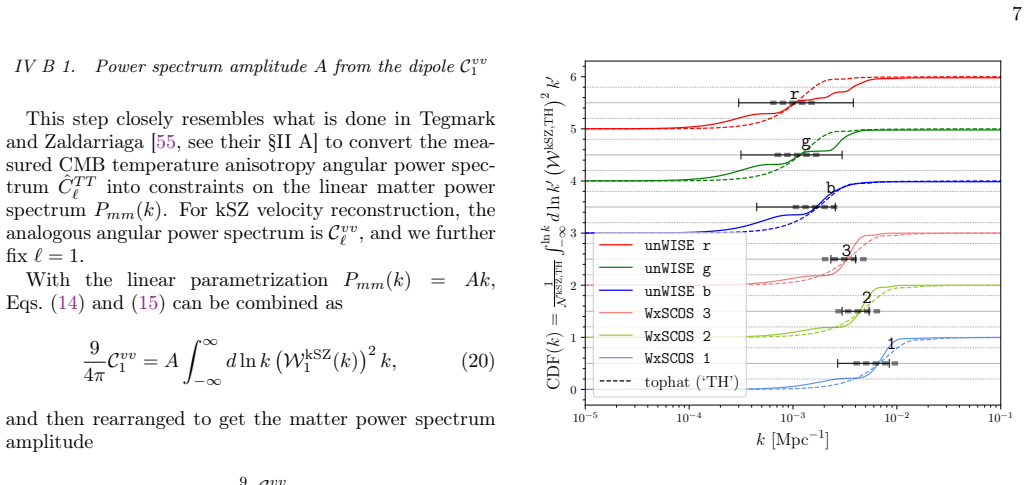
With the amplitudeAobtained above, we com- puteσ 2 VTH(RTH)using Eq. (8), whereR TH is the tophat distance scale that effectively matches the k-sensitivity ofW kSZ 1 (k). We discuss these two steps in more detail below. 7 IV B 1. Power spectrum amplitudeAfrom the dipoleC vv 1 This step closely resembles what is done in Tegmark and Zaldarriaga [55, see the...
-
[3]
measurements atRTH ∼100h −1Mpc. Since we con- strain the tophat bulk flow realization, our upper limits are weaker than what a more rigorous method of com- paring window functions (e.g., the Minimum Variance method mentioned earlier) would yield. Thus, we an- ticipate that the current upper limits are a conservative indicator of the tension at∼100h −1Mpc,...
work page 2000
-
[4]
Corrective weights As pointed out in Ref. [25], since the quadratic es- timator is built to detect statistically anisotropic corre- lations between the galaxy and CMB fields, it is highly sensitive to spatially varying survey systematics (e.g., ex- tinction, redshift calibration errors, survey depth varia- tions, bright stars). These anisotropic physical ...
work page 2000
-
[5]
Optical depth bias modeling Any modeling uncertainties in kSZ velocity reconstruc- tion results in a bias of the reconstructed velocities, known as the optical depth biasbv: ˆC vv ℓ =b 2 v C vv ℓ t ,(D1) where the superscript “t” denotes the unknown “true” velocity angular power spectrum. This discrepancy be- tween the measurement and truth can arise due ...
work page 2000
-
[6]
Obtain data-informedb v prior,P(b v) To obtain cosmological constraints from kSZ velocity reconstruction, we need to marginalize over the optical depth bias parameter,bv. We use the high signal-to-noise measurements ofb v from the recent ACT×DESI analy- sis [44] to inform the prior,P(bv), in Eqs. (16) and (32). Sinceb v depends on the specific galaxy samp...
-
[7]
From Gaussian scaleR G to tophat scaleRTH To do this, we need to solve forRTH that satisfies σ2 VTH(RTH) =σ 2 VG(RG),(E1) provided the study we want to compare to quotes a Gaus- sian window function scale,RG. Using Eq. (8), writing Pmm(k) =A k, 3 and definingκ=kR, the equivalence in Eq. (E1) implies 1 R2 TH Z ∞ −∞ dlnκ κ 2 W TH(κ) 2 = 1 R2 G Z ∞ −∞ dlnκ κ...
-
[8]
FromR 1/r2 scale to tophatRTH Some of the works we compare to (Refs. [9, 11]) com- pute their theoretical expectation ofσV using the ideal- ized window function W(r;R 1/r2) =R 2 1/r2 /r2.(E5) As Ref. [9] shows [see their Figure 3 and Eq. (34)], this window function matches fairly well with a Gaussian win- dow with the Gaussian averaging scaleRG →R 1/r2 /3...
-
[9]
[4] are already reported at a tophat scale equivalent toR TH
From the Planck Collaboration [4] tophat-based 95% UL to 68% The ‘P13-i–iii’ points in Figure 5 and Table II from Ref. [4] are already reported at a tophat scale equivalent toR TH. However, Ref. [4] reports 95% upper limits (UL) on bulk velocity realizationˆV. For consistency with the our 68% ULs and the other1σmeasurements that we compare with, we halve ...
work page 2009
-
[10]
Y. B. Zeldovich and S. R. A. Sunyaev, Peculiar velocities of galaxy clusters, and the mean density of matter in the universe, Pisma v Astronomicheskii Zhurnal6, 737 (1980)
work page 1980
-
[11]
P. J. E. Peebles,The large-scale structure of the universe (1980)
work page 1980
-
[12]
M. I. Scrimgeour, T. M. Davis, C. Blake, L. Staveley- Smith, C. Magoulas, C. M. Springob, F. Beutler, M. Col- less, A. Johnson, D. H. Jones, J. Koda, J. R. Lucey, Y.-Z. Ma, J. Mould, and G. B. Poole, The 6df galaxy survey: bulk flows on 50-70h-1mpc scales, Monthly Notices of the Royal Astronomical Society455, 386–401 (2015)
work page 2015
-
[13]
Planck Collaboration, Planck2013 results
a. Planck Collaboration, Planck2013 results. xvi. cosmo- logical parameters, Astronomy & Astrophysics571, A16 (2014)
work page 2014
- [14]
-
[15]
R. Watkins and H. A. Feldman, The origins of the bulk flow (2025), arXiv:2512.03168 [astro-ph.CO]
-
[16]
A. Kashlinsky, F. Atrio-Barandela, D. Kocevski, and H. Ebeling, A measurement of large-scale peculiar ve- locities of clusters of galaxies: Results and cosmological implications, The Astrophysical Journal686, L49–L52 (2008)
work page 2008
-
[17]
R. Watkins and H. A. Feldman, Large-scale bulk flows from the Cosmicflows-2 catalogue, Monthly Notices of the Royal Astronomical Society447, 132 (2015), arXiv:1407.6940 [astro-ph.CO]
- [18]
- [19]
-
[20]
R. Watkins, T. Allen, C. J. Bradford, A. Ramon, A. Walker, H. A. Feldman, R. Cionitti, Y. Al-Shorman, E. Kourkchi, and R. B. Tully, Analysing the large-scale bulk flow using cosmicflows4: increasing tension with the standard cosmological model, Monthly Notices of the Royal Astronomical Society524, 1885–1892 (2023)
work page 2023
- [21]
-
[22]
R. B. Tully and J. R. Fisher, A new method of determin- ing distances to galaxies., Astronomy and Astrophysics 54, 661 (1977)
work page 1977
-
[23]
A. Dressler, D. Lynden-Bell, D. Burstein, R. L. Davies, S. M. Faber, R. Terlevich, and G. Wegner, Spectroscopy and Photometry of Elliptical Galaxies. I. New Distance Estimator, Astrophys. J.313, 42 (1987)
work page 1987
-
[24]
M. M. Phillips, The Absolute Magnitudes of Type IA Supernovae, ApJ Letters413, L105 (1993)
work page 1993
-
[25]
H. S. Leavitt and E. C. Pickering, Periods of 25 Variable Stars in the Small Magellanic Cloud., Harvard College Observatory Circular173, 1 (1912)
work page 1912
-
[26]
M. G. Lee, W. L. Freedman, and B. F. Madore, The Tip of the Red Giant Branch as a Distance Indicator for Resolved Galaxies, Astrophys. J.417, 553 (1993)
work page 1993
-
[27]
R. A. Sunyaev and Y. B. Zeldovich, The velocity of clus- ters of galaxies relative to the microwave background - The possibility of its measurement., Monthly Notices of the Royal Astronomical Society190, 413 (1980)
work page 1980
-
[28]
J. Shao, P. Zhang, W. Lin, Y. Jing, and J. Pan, Kinetic sunyaev-zel’dovich tomography with spectroscopic red- shift surveys: Kinetic sz tomography, Monthly Notices of the Royal Astronomical Society413, 628–642 (2011)
work page 2011
- [29]
-
[30]
A. Terrana, M.-J. Harris, and M. C. Johnson, Analyzing the cosmic variance limit of remote dipole measurements of the cosmic microwave background using the large-scale kinetic sunyaev zel’dovich effect, Journal of Cosmology and Astroparticle Physics2017(02), 040–040
-
[31]
A.-S. Deutsch, E. Dimastrogiovanni, M. C. Johnson, M. Münchmeyer, and A. Terrana, Reconstruction of the remote dipole and quadrupole fields from the kinetic sunyaev zel’dovich and polarized sunyaev zel’dovich ef- fects,PhysicalReviewD98,10.1103/physrevd.98.123501 (2018)
- [32]
- [33]
-
[34]
Kinetic Sunyaev Zel'dovich velocity reconstruction from Planck and unWISE
R. Bloch and M. C. Johnson, Kinetic sunyaev zel’dovich velocity reconstruction from planck and unwise (2024), arXiv:2405.00809 [astro-ph.CO]
work page internal anchor Pith review Pith/arXiv arXiv 2024
-
[35]
P. Zhang, The dark flow induced small-scale kinetic sun- yaev–zel’dovich effect, Monthly Notices of the Royal As- tronomical Society: Letters407, L36–L40 (2010)
work page 2010
-
[36]
P. Zhang and A. Stebbins, Confirmation of the coper- nican principle at gpc radial scale and above from the kinetic sunyaev-zel’dovich effect power spectrum, Physi- cal Review Letters107, 10.1103/physrevlett.107.041301 (2011)
-
[37]
J. I. Cayuso and M. C. Johnson, Towards testing cmb anomalies using the kinetic and polarized sunyaev- zel’dovich effects, Physical Review D101, 10.1103/phys- revd.101.123508 (2020)
-
[38]
J. Krywonos, S. C. Hotinli, and M. C. Johnson, Constraints on cosmology beyondλcdm with ki- netic sunyaev zel’dovich velocity reconstruction (2024), arXiv:2408.05264 [astro-ph.CO]
-
[39]
E. F. Schlafly, A. M. Meisner, and G. M. Green, The un- wise catalog: Two billion infrared sources from five years of wise imaging, The Astrophysical Journal Supplement Series240, 30 (2019)
work page 2019
-
[40]
A. Krolewski, S. Ferraro, E. F. Schlafly, and M. White, unwise tomography of planck cmb lensing, Journal of Cosmology and Astroparticle Physics2020(05), 047–047. 23
-
[41]
Planck Collaboration, N. Aghanim, Y. Akrami, F. Ar- roja, M. Ashdown, and Aumont, Planck 2018 results. I. Overview and the cosmological legacy of Planck, Astron. Astrophys.641, A1 (2020), arXiv:1807.06205 [astro- ph.CO]
-
[42]
M. Bilicki, J. A. Peacock, T. H. Jarrett, M. E. Clu- ver, N. Maddox, M. J. I. Brown, E. N. Taylor, N. C. Hambly, A. Solarz, B. W. Holwerda, I. Baldry, J. Love- day, A. Moffett, A. M. Hopkins, S. P. Driver, M. Al- paslan, and J. Bland-Hawthorn, WISE×SuperCOS- MOS Photometric Redshift Catalog: 20 Million Galaxies over 3/pi Steradians, Astrophys. J. Suppl.22...
-
[43]
M. G. Haehnelt and M. Tegmark, Using the kinematic sunyaev-zeldovich effect to determine the peculiar veloc- ities of clusters of galaxies, Monthly Notices of the Royal Astronomical Society279, 545–556 (1996)
work page 1996
-
[44]
A. Kashlinsky and F. Atrio-Barandela, Measuring Cos- mological Bulk Flows via the Kinematic Sunyaev- Zeldovich Effect in the Upcoming Cosmic Microwave Background Maps, Astrophys. J. Lett.536, L67 (2000), arXiv:astro-ph/0005197 [astro-ph]
-
[45]
A. Kashlinsky, F. Atrio-Barandela, D. Kocevski, and H. Ebeling, A measurement of large-scale peculiar ve- locities of clusters of galaxies: Technical details, The As- trophysical Journal691, 1479–1493 (2009)
work page 2009
-
[46]
A. Kashlinsky, F. Atrio-Barandela, H. Ebeling, A. Edge, and D. Kocevski, A new measurement of the bulk flow of x-ray luminous clusters of galaxies, The Astrophysical Journal712, L81–L85 (2010)
work page 2010
-
[47]
S. J. Osborne, D. S. Y. Mak, S. E. Church, and E. Pier- paoli, Measuring the galaxy cluster bulk flow fromwmap- data, The Astrophysical Journal737, 98 (2011)
work page 2011
-
[48]
G. Lavaux and M. J. Hudson, The 2m++ galaxy red- shift catalogue: The 2m++ galaxy redshift catalogue, Monthly Notices of the Royal Astronomical Society416, 2840–2856 (2011)
work page 2011
-
[49]
N. Jarosik, C. L. Bennett, J. Dunkley, B. Gold, M. R. Greason, M. Halpern, R. S. Hill, G. Hinshaw, A. Kogut, E. Komatsu, D. Larson, M. Limon, S. S. Meyer, M. R. Nolta, N. Odegard, L. Page, K. M. Smith, D. N. Spergel, G. S. Tucker, J. L. Weiland, E. Wollack, and E. L. Wright, Seven-year wilkinson microwave anisotropy probe ( wmap ) observations: Sky maps, ...
work page 2011
-
[50]
N. Battaglia, The tau of galaxy clusters, Journal of Cos- mology and Astroparticle Physics2016(08), 058–058
-
[51]
S. Flender, D. Nagai, and M. McDonald, Constraints on the Optical Depth of Galaxy Groups and Clusters, Astrophys. J.837, 124 (2017), arXiv:1610.08029 [astro- ph.CO]
-
[52]
M. S. Madhavacheril, N. Battaglia, K. M. Smith, and J. L. Sievers, Cosmology with the kinematic sunyaev- zeldovich effect: Breaking the optical depth degener- acy with fast radio bursts, Physical Review D100, 10.1103/physrevd.100.103532 (2019)
- [53]
-
[54]
M. Li, J. Pan, L. Gao, Y. Jing, X. Yang, X. Chi, L. Feng, X. Kang, W. Lin, G. Shan, L. Wang, D. Zhao, and P. Zhang, Bulk flow of halos in lcdm simulation, The Astrophysical Journal761, 151 (2012)
work page 2012
-
[55]
R. Watkins, H. A. Feldman, and M. J. Hudson, Consis- tently large cosmic flows on scales of 100 mpc/h: a chal- lenge for the standard lcdm cosmology, Monthly Notices of the Royal Astronomical Society392, 743–756 (2009)
work page 2009
- [56]
-
[57]
N. Kaiser, Theoretical implications of deviations from Hubble flow, Monthly Notices of the Royal Astronomi- cal Society231, 149 (1988)
work page 1988
-
[58]
K. M. Górski, E. Hivon, A. J. Banday, B. D. Wan- delt, F. K. Hansen, M. Reinecke, and M. Bartelmann, HEALPix: A Framework for High-Resolution Discretiza- tionandFastAnalysisofDataDistributedontheSphere, Astrophys. J.622, 759 (2005), arXiv:astro-ph/0409513
work page internal anchor Pith review arXiv 2005
- [59]
- [60]
-
[61]
M.Tegmark, A.deOliveira-Costa,andA.J.S.Hamilton, High resolution foreground cleaned cmb map from wmap, Phys. Rev. D68, 123523 (2003)
work page 2003
-
[62]
E. Hivon, K. M. Gorski, C. B. Netterfield, B. P. Crill, S. Prunet, and F. Hansen, Master of the cosmic mi- crowave background anisotropy power spectrum: A fast method for statistical analysis of large and complex cos- mic microwave background data sets, The Astrophysical Journal567, 2–17 (2002)
work page 2002
-
[63]
A. Lewis and A. Challinor, CAMB: Code for anisotropies in the microwave background (2002), maintained by Antony Lewis
work page 2002
-
[64]
M. Tegmark and M. Zaldarriaga, Separating the early universe from the late universe: Cosmological parameter estimation beyond the black box, Physical Review D66, 10.1103/physrevd.66.103508 (2002)
- [65]
- [66]
-
[67]
C. Gibelyou and D. Huterer, Dipoles in the sky, Monthly Notices of the Royal Astronomical Society427, 1994 (2012), arXiv:1205.6476 [astro-ph.CO]
-
[68]
N. J. Secrest, S. von Hausegger, M. Rameez, R. Mo- hayaee, and S. Sarkar, A challenge to the standard cos- mological model, The Astrophysical Journal Letters937, L31 (2022)
work page 2022
-
[69]
J. D. Wagenveld, S. von Hausegger, H.-R. Klöckner, and D. J. Schwarz, The kinematic contribution to the cosmic number count dipole, Astronomy & Astrophysics697, A112 (2025)
work page 2025
-
[70]
G. F. R. Ellis and J. E. Baldwin, On the expected anisotropy of radio source counts, Monthly Notices of the Royal Astronomical Society206, 377 (1984). 24
work page 1984
-
[71]
N. J. Secrest, S. v. Hausegger, M. Rameez, R. Mohayaee, S. Sarkar, and J. Colin, A test of the cosmological princi- ple with quasars, The Astrophysical Journal Letters908, L51 (2021)
work page 2021
-
[72]
E. Macaulay, H. Feldman, P. G. Ferreira, M. J. Hud- son, and R. Watkins, A slight excess of large-scale power from moments of the peculiar velocity field, Monthly No- tices of the Royal Astronomical Society414, 621 (2011), arXiv:1010.2651 [astro-ph.CO]
- [73]
-
[74]
J. J. Bock, A. M. Aboobaker, and J. Adamo, The spherex satellite mission, The Astrophysical Journal999, 139 (2026)
work page 2026
-
[75]
Euclid Definition Study Report
R. Laureijs, J. Amiaux, S. Arduini, J. L. Auguères, J. Brinchmann, and R. Cole, Euclid definition study re- port (2011), arXiv:1110.3193 [astro-ph.CO]
work page internal anchor Pith review Pith/arXiv arXiv 2011
-
[76]
L. Amendola, S. Appleby, A. Avgoustidis, D. Bacon, T. Baker, M. Baldi, N. Bartolo, A. Blanchard, C. Bon- vin, S. Borgani, E. Branchini, C. Burrage, S. Camera, C. Carbone, L. Casarini, M. Cropper, C. de Rham, J. P. Dietrich, C. Di Porto, R. Durrer, A. Ealet, P. G. Ferreira, F. Finelli, J. García-Bellido, T. Giannantonio, L. Guzzo, A. Heavens, L. Heisenberg...
-
[77]
Ž. Ivezić, S. M. Kahn, J. A. Tyson, B. Abel, and E. Acosta, LSST: From Science Drivers to Reference De- sign and Anticipated Data Products, Astrophys. J.873, 111 (2019), arXiv:0805.2366 [astro-ph]
-
[78]
P. Ade, J. Aguirre, Z. Ahmed, S. Aiola, A. Ali, D. Alonso, andM.A.Alvarez,Thesimonsobservatory: sciencegoals and forecasts, Journal of Cosmology and Astroparticle Physics2019(02), 056–056
- [79]
-
[80]
C. R. Harris, K. J. Millman, S. J. van der Walt,et al., Ar- ray programming with NumPy, Nature585, 357 (2020)
work page 2020
discussion (0)
Sign in with ORCID, Apple, or X to comment. Anyone can read and Pith papers without signing in.