Recognition: 2 theorem links
· Lean TheoremScalable Measurement-Based Quantum Simulation Patterns for Benchmarking
Pith reviewed 2026-05-13 03:42 UTC · model grok-4.3
The pith
A library supplies scalable measurement patterns to execute Pauli-string unitaries for benchmarking quantum simulation on near-term hardware.
A machine-rendered reading of the paper's core claim, the machinery that carries it, and where it could break.
Core claim
The paper announces the release of the quantum measurement pattern library QPatLib in version 1.0, which contains patterns for measurement-based quantum simulation. The described workflow generates patterns that realize Pauli-string unitaries required by many quantum algorithms. Patterns are supplied under different conventions for commuting Pauli-string subsets, allowing the size and complexity of each pattern to scale. These serve as benchmarks for unitary evolution performed entirely by measurements, and the library is positioned to act as a testbed, a hardware-ready collection, a source of empirical design data, and an extensible archive for future patterns.
What carries the argument
Measurement patterns on quantum resource states that implement Pauli-string unitaries via a generation workflow supporting multiple conventions for commuting operator subsets to control scaling.
If this is right
- The library acts as a standardized testbed for developing and comparing pattern-optimization protocols in measurement-based quantum simulation.
- The patterns can be taken directly for implementation on current quantum hardware.
- The dataset supplies concrete examples that can be used to test and refine empirical rules for pattern design.
- The resource format supports ongoing addition of patterns for tasks outside quantum simulation.
Where Pith is reading between the lines
- If the patterns remain efficient at larger sizes, they could lower the overhead of moving existing algorithms from gate-based to measurement-based descriptions on noisy devices.
- The workflow structure suggests it could be adapted to generate patterns for operations beyond Pauli strings or on different resource states.
- Systematic use of the library across multiple hardware platforms might surface recurring constraints that inform the next generation of quantum device specifications.
- Embedding the patterns into existing quantum programming tools could allow automatic conversion of algorithm descriptions into measurement sequences.
Load-bearing premise
The generated patterns correctly and scalably perform the target Pauli-string unitaries when run under realistic hardware noise and software constraints.
What would settle it
Running one of the benchmark patterns on actual quantum hardware and finding that the measured output state deviates substantially from the state expected after the corresponding unitary evolution would indicate the patterns do not execute as claimed.
Figures



read the original abstract
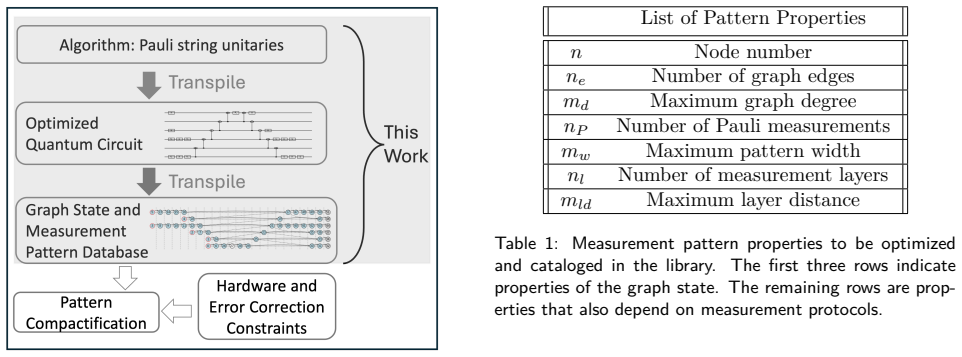
Measurement-based quantum computing uses measurement patterns on predefined quantum resource states to execute quantum logic. Quantum simulation offers an important use case on near-term devices. However, pattern optimization depends on the multivariable interplay between hardware and software constraints and is therefore use-dependent and highly non-trivial. Optimization of large-scale patterns under realistic assumptions remains a barrier. We announce the release of the quantum measurement pattern library QPatLib, a dataset that, in v1.0, presents patterns for use in measurement-based quantum simulation. We present the workflow for generating patterns that execute Pauli-string unitaries needed for many quantum algorithms. We provide benchmark patterns for measurement-based quantum unitary evolution. The measurement patterns are defined with different conventions for commuting Pauli-string subsets to allow scaling of pattern size and complexity. The purpose of the library is to (i) serve as a standardized testbed for pattern-optimization protocols for measurement-based quantum simulation routines, (ii) offer a suite of patterns for direct use on hardware, (iii) provide data to empirically justify pattern design principles, and (iv) provide a flexible resource for future storage and use of measurement-based patterns beyond quantum simulation.
Editorial analysis
A structured set of objections, weighed in public.
Referee Report
Summary. The manuscript announces the release of QPatLib v1.0, a dataset of measurement patterns for measurement-based quantum computing (MBQC) to execute Pauli-string unitaries. It describes a workflow for generating these patterns, including conventions for commuting subsets to enable scaling of pattern size and complexity, and positions the library as a standardized benchmark for pattern-optimization protocols, direct hardware use, empirical design justification, and future extensions beyond simulation.
Significance. If the patterns are shown to correctly implement the target unitaries (up to byproduct corrections), the library would supply a valuable, reproducible testbed for developing optimization methods under realistic hardware-software constraints, directly addressing the barrier noted for large-scale MBQC simulation patterns. The explicit scaling conventions and multi-purpose framing are strengths that support standardization and empirical studies.
major comments (1)
- [Abstract] The abstract states that the workflow generates patterns that 'execute Pauli-string unitaries needed for many quantum algorithms' and that the library provides 'benchmark patterns for measurement-based quantum unitary evolution,' but the manuscript supplies no explicit verification, small-case example, inductive argument, or error analysis confirming that the output patterns reproduce the desired evolution on the resource state. This is load-bearing for all four stated purposes of the library.
Simulated Author's Rebuttal
We thank the referee for their careful review and constructive feedback on our manuscript. The comment identifies a substantive gap that we address directly below.
read point-by-point responses
-
Referee: [Abstract] The abstract states that the workflow generates patterns that 'execute Pauli-string unitaries needed for many quantum algorithms' and that the library provides 'benchmark patterns for measurement-based quantum unitary evolution,' but the manuscript supplies no explicit verification, small-case example, inductive argument, or error analysis confirming that the output patterns reproduce the desired evolution on the resource state. This is load-bearing for all four stated purposes of the library.
Authors: We agree that the absence of explicit verification in the original submission is a genuine limitation that undermines the claims made for the library. In the revised manuscript we have added Section 3.2, which contains (i) a fully worked small-case example for the Pauli string X_1 Z_2 on a three-qubit linear cluster state, including the explicit measurement sequence, outcome-dependent byproduct operators, and direct verification that the implemented unitary matches the target up to the expected Pauli corrections; (ii) a concise inductive outline showing how the commuting-subset conventions preserve correctness when patterns are concatenated, based on the standard MBQC composition rules; and (iii) a short error analysis in Appendix A that quantifies the effect of finite measurement precision on the generated patterns. These additions are now referenced from the abstract and from the four stated purposes of the library. revision: yes
Circularity Check
No circularity: dataset release with external-value workflow description
full rationale
The paper is a library announcement and workflow description for generating MBQC measurement patterns that implement Pauli-string unitaries. No equations, fitted parameters, predictions, or first-principles derivations appear in the provided text. The central claim rests on the correctness of the (externally usable) generated patterns rather than any internal reduction of a result to its own inputs or self-citations. The workflow is presented as a constructive procedure whose validity is left for users or future verification; it does not invoke uniqueness theorems, rename known results, or smuggle ansatzes via self-citation. This is a standard non-circular dataset paper whose value is external.
Axiom & Free-Parameter Ledger
axioms (1)
- domain assumption Measurement patterns on predefined quantum resource states execute quantum logic for simulation tasks.
Lean theorems connected to this paper
-
IndisputableMonolith/Foundation/RealityFromDistinction.leanreality_from_one_distinction unclearWe announce the release of the quantum measurement pattern library QPatLib, a dataset that, in v1.0, presents patterns for use in measurement-based quantum simulation. We present the workflow for generating patterns that execute Pauli-string unitaries...
-
IndisputableMonolith/Foundation/AlexanderDuality.leanalexander_duality_circle_linking unclearGraph states are defined by a set of n nodes {N} and n_e edges {E}... eigenstates of X_i ... CZ operations
Reference graph
Works this paper leans on
-
[1]
Robert Raussendorf. “A One-Way Quan- tum Computer”. Physical Review Letters86, 5188 (2001)
work page 2001
-
[2]
Measurement-based quantum computation on cluster states
Robert Raussendorf, Daniel E. Browne, and Hans J. Briegel. “Measurement-based quantum computation on cluster states”. Physical Review A68, 022312 (2003)
work page 2003
-
[3]
Measurement-Based Quantum Computation
Tzu-Chieh Wei. “Measurement-Based Quantum Computation”. In Brian Foster, editor, Oxford Research Encyclopedia of Physics. Oxford Uni- versity PressNew York, NY (2021). 1 edition
work page 2021
-
[4]
Entangle- ment in Graph States and its Applications
M. Hein, W. Dür, J. Eisert, R. Raussendorf, M. Van den Nest, and H. J. Briegel. “Entangle- ment in Graph States and its Applications”. Pro- ceedings of the International School of Physics "Enrico Fermi"162, 115 (2006)
work page 2006
-
[5]
Strategies for quantum comput- ing molecular energies using the unitary coupled cluster ansatz
Jonathan Romero, Ryan Babbush, Jarrod R Mc- Clean, Cornelius Hempel, Peter J Love, and Alán Aspuru-Guzik. “Strategies for quantum comput- ing molecular energies using the unitary coupled cluster ansatz”. Quantum Science and Technol- ogy4, 014008 (2019)
work page 2019
-
[6]
Variational quantum algorithms
M. Cerezo, Andrew Arrasmith, Ryan Babbush, Simon C. Benjamin, Suguru Endo, Keisuke Fujii, Jarrod R. McClean, Kosuke Mitarai, Xiao Yuan, Lukasz Cincio, and Patrick J. Coles. “Variational quantum algorithms”. Nature Reviews Physics3, 625 (2021)
work page 2021
-
[7]
Noisy intermediate- scale quantum algorithms
Kishor Bharti, Alba Cervera-Lierta, Thi Ha Kyaw, Tobias Haug, Sumner Alperin-Lea, Abhi- nav Anand, Matthias Degroote, Hermanni Hei- monen, Jakob S. Kottmann, Tim Menke, Wai- Keong Mok, Sukin Sim, Leong-Chuan Kwek, and Alán Aspuru-Guzik. “Noisy intermediate- scale quantum algorithms”. Reviews of Modern Physics94, 015004 (2022)
work page 2022
-
[8]
Quantum measurements and the Abelian Stabilizer Problem
A. Yu. Kitaev. “Quantum measurements and the Abelian Stabilizer Problem” (1995). arXiv: quant-ph/9511026
work page internal anchor Pith review arXiv 1995
-
[9]
Quantum Algorithm Providing Exponential Speed Increase for Finding Eigenvalues and Eigenvectors
Daniel S. Abrams and Seth Lloyd. “Quantum Algorithm Providing Exponential Speed Increase for Finding Eigenvalues and Eigenvectors”. Phys- ical Review Letters83, 5162 (1999)
work page 1999
-
[10]
Quantum algorithms for fermionic simulations
G. Ortiz, J. E. Gubernatis, E. Knill, and R. Laflamme. “Quantum algorithms for fermionic simulations”. Physical Review A64, 022319 (2001)
work page 2001
-
[11]
Simulating physical phenom- ena by quantum networks
R. Somma, G. Ortiz, J. E. Gubernatis, E. Knill, and R. Laflamme. “Simulating physical phenom- ena by quantum networks”. Physical Review A 65, 042323 (2002)
work page 2002
-
[12]
Simulated Quantum Computation of Molecular Energies
Alán Aspuru-Guzik, Anthony D. Dutoi, Peter J. Love, and Martin Head-Gordon. “Simulated Quantum Computation of Molecular Energies”. Science309, 1704 (2005)
work page 2005
-
[13]
Quantum Algorithm for Spectral Measurement with a Lower Gate Count
David Poulin, Alexei Kitaev, Damian S. Steiger, Matthew B. Hastings, and Matthias Troyer. “Quantum Algorithm for Spectral Measurement with a Lower Gate Count”. Physical Review Let- ters121, 010501 (2018)
work page 2018
-
[14]
Mario Motta, Chong Sun, Adrian T. K. Tan, Matthew J. O’Rourke, Erika Ye, Austin J. Min- nich, Fernando G. S. L. Brandão, and Garnet Kin-Lic Chan. “Determining eigenstates and thermal states on a quantum computer using quantum imaginary time evolution”. Nature Physics16, 205 (2020)
work page 2020
-
[15]
Real-Time Krylov Theory for Quantum Computing Algorithms
Yizhi Shen, Katherine Klymko, James Sud, David B. Williams-Young, Wibe A. De Jong, and Norm M. Tubman. “Real-Time Krylov Theory for Quantum Computing Algorithms”. Quantum 7, 1066 (2023)
work page 2023
-
[16]
Quantum-Centric Algorithm for Sample-Based Krylov Diagonalization
Jeffery Yu, Javier Robledo Moreno, Joseph T. Io- sue, Luke Bertels, Daniel Claudino, Bryce Fuller, Peter Groszkowski, Travis S. Humble, Petar Jurcevic, William Kirby, Thomas A. Maier, Mario Motta, Bibek Pokharel, Alireza Seif, Amir Shehata, Kevin J. Sung, Minh C. Tran, Vinay Tripathi, Antonio Mezzacapo, and Ku- nal Sharma. “Quantum-Centric Algorithm for S...
-
[17]
Kishor Bharti and Tobias Haug. “Quantum- assisted simulator”. Physical Review A104, 042418 (2021)
work page 2021
-
[18]
Generalized quantum assisted simulator
Tobias Haug and Kishor Bharti. “Generalized quantum assisted simulator”. Quantum Science and Technology7, 045019 (2022)
work page 2022
-
[19]
Hybrid quantum-gap-estimation algorithm us- ing a filtered time series
Woo-Ram Lee, Ryan Scott, and V. W. Scarola. “Hybrid quantum-gap-estimation algorithm us- ing a filtered time series”. Physical Review A 109, 052403 (2024)
work page 2024
-
[20]
En- tanglementacceleratesquantumsimulation
Qi Zhao, You Zhou, and Andrew M. Childs. “En- tanglementacceleratesquantumsimulation”. Na- ture Physics21, 1338 (2025)
work page 2025
-
[21]
Noise-resilient and resource-efficient hybrid algorithm for robust quantum gap esti- mation
Woo-Ram Lee, Nathan M. Myers, and V. W. Scarola. “Noise-resilient and resource-efficient hybrid algorithm for robust quantum gap esti- mation”. Physical Review A111, 022421 (2025)
work page 2025
-
[22]
Measurement-based time evolution for quan- tum simulation of fermionic systems
Woo-Ram Lee, Zhangjie Qin, Robert Raussendorf, Eran Sela, and V. W. Scarola. “Measurement-based time evolution for quan- tum simulation of fermionic systems”. Physical Review Research4, L032013 (2022)
work page 2022
-
[23]
Measurement-Based Variational Quantum Eigensolver
R.R. Ferguson, L. Dellantonio, A. Al Balushi, K. Jansen, W. Dür, and C.A. Muschik. “Measurement-Based Variational Quantum Eigensolver”. Physical Review Letters126, 220501 (2021)
work page 2021
-
[24]
Applications and resource reductions in measurement-based variational quantum eigen- solvers
FrederikKofoedMarqversenandNikolajThomas Zinner. “Applications and resource reductions in measurement-based variational quantum eigen- solvers”. Quantum Science and Technology8, 045001 (2023). 14
work page 2023
-
[25]
Measurement-Based Infused Circuits for Vari- ational Quantum Eigensolvers
Albie Chan, Zheng Shi, Luca Dellantonio, Wolfgang Dür, and Christine A. Muschik. “Measurement-Based Infused Circuits for Vari- ational Quantum Eigensolvers”. Physical Review Letters132, 240601 (2024)
work page 2024
-
[26]
Mapping quantum circuits to shallow- depth measurement patterns based on graph states
Thierry N Kaldenbach and Matthias Heller. “Mapping quantum circuits to shallow- depth measurement patterns based on graph states”. Quantum Science and Technology10, 015010 (2025)
work page 2025
-
[27]
Thierry N. Kaldenbach, Isaac D. Smith, Hen- drik Poulsen Nautrup, Matthias Heller, and Hans J. Briegel. “Efficient Preparation of Resource States for Hamiltonian Simulation and Universal Quantum Computation” (2025). arXiv:2509.05404 [quant-ph]
-
[28]
Simulation of electronic struc- ture Hamiltonians using quantum computers
James D. Whitfield, Jacob Biamonte, and Alán Aspuru-Guzik. “Simulation of electronic struc- ture Hamiltonians using quantum computers”. Molecular Physics109, 735 (2011)
work page 2011
-
[29]
Matthias Troyer and Uwe-Jens Wiese. “Com- putational Complexity and Fundamental Lim- itations to Fermionic Quantum Monte Carlo Simulations”. Physical Review Letters94, 170201 (2005)
work page 2005
-
[30]
Quantum computational chemistry
Sam McArdle, Suguru Endo, Alán Aspuru- Guzik, Simon C. Benjamin, and Xiao Yuan. “Quantum computational chemistry”. Reviews of Modern Physics92, 015003 (2020)
work page 2020
-
[31]
Practical quantum advantage in quantum simulation
Andrew J. Daley, Immanuel Bloch, Chris- tian Kokail, Stuart Flannigan, Natalie Pearson, Matthias Troyer, and Peter Zoller. “Practical quantum advantage in quantum simulation”. Na- ture607, 667 (2022)
work page 2022
-
[32]
Efficient algorithm to recognize the local Clifford equivalence of graph states
Maarten Van Den Nest, Jeroen Dehaene, and Bart De Moor. “Efficient algorithm to recognize the local Clifford equivalence of graph states”. Physical Review A70, 034302 (2004)
work page 2004
-
[33]
Paralleliz- ingquantumcircuits
Anne Broadbent and Elham Kashefi. “Paralleliz- ingquantumcircuits”. TheoreticalComputerSci- ence410, 2489 (2009)
work page 2009
-
[34]
Rewrit- ingMeasurement-BasedQuantumComputations with Generalised Flow
Ross Duncan and Simon Perdrix. “Rewrit- ingMeasurement-BasedQuantumComputations with Generalised Flow”. In David Hutchison, Takeo Kanade, Josef Kittler, Jon M. Klein- berg, Friedemann Mattern, John C. Mitchell, Moni Naor, Oscar Nierstrasz, C. Pandu Ran- gan, Bernhard Steffen, Madhu Sudan, Demetri Terzopoulos, Doug Tygar, Moshe Y. Vardi, Gerhard Weikum, Sa...
work page 2010
-
[35]
Computational depth complexity of measurement-based quantum computation
Dan Browne, Elham Kashefi, and Simon Per- drix. “Computational depth complexity of measurement-based quantum computation”. In Wim van Dam, Vivien M. Kendon, and Simone Severini, editors, Theory of quantum computa- tion, communication, andcryptography. Page35. Berlin, Heidelberg (2011). Springer Berlin Hei- delberg
work page 2011
-
[36]
Trans- forming graph states using single-qubit opera- tions
Axel Dahlberg and Stephanie Wehner. “Trans- forming graph states using single-qubit opera- tions”. Philosophical Transactions of the Royal Society A: Mathematical, Physical and Engineer- ing Sciences376, 20170325 (2018)
work page 2018
-
[37]
Local Equivalence of Stabilizer States: A Graphical Characterisation
Nathan Claudet and Simon Perdrix. “Local Equivalence of Stabilizer States: A Graphical Characterisation”. LIPIcs, Volume 327, STACS 2025327, 27:1 (2025)
work page 2025
-
[38]
Minimising the number of edges in LC-equivalent graph states
Hemant Sharma, Kenneth Goodenough, Jo- hannes Borregaard, Filip Rozpędek, and Jonas Helsen. “Minimising the number of edges in LC-equivalent graph states”. Quantum10, 2001 (2026)
work page 2001
-
[39]
Trapped-ion quantum computing: Progress and challenges
ColinD.Bruzewicz, JohnChiaverini, RobertMc- Connell, and Jeremy M. Sage. “Trapped-ion quantum computing: Progress and challenges”. Applied Physics Reviews6, 021314 (2019)
work page 2019
-
[40]
Su- perconducting Qubits: Current State of Play
Morten Kjaergaard, Mollie E. Schwartz, Jochen Braumüller, Philip Krantz, Joel I.-J. Wang, Si- mon Gustavsson, and William D. Oliver. “Su- perconducting Qubits: Current State of Play”. Annual Review of Condensed Matter Physics11, 369 (2020)
work page 2020
-
[41]
Pro- posal for Pulsed On-Demand Sources of Photonic Cluster State Strings
Netanel H. Lindner and Terry Rudolph. “Pro- posal for Pulsed On-Demand Sources of Photonic Cluster State Strings”. Physical Review Letters 103, 113602 (2009)
work page 2009
-
[42]
Deterministic generation of a clus- ter state of entangled photons
I. Schwartz, D. Cogan, E. R. Schmidgall, Y. Don, L. Gantz, O. Kenneth, N. H. Lindner, and D. Gershoni. “Deterministic generation of a clus- ter state of entangled photons”. Science354, 434 (2016)
work page 2016
-
[43]
Sequential generation of linear cluster states from a single photon emitter
D. Istrati, Y. Pilnyak, J. C. Loredo, C. Antón, N. Somaschi, P. Hilaire, H. Ollivier, M. Esmann, L. Cohen, L. Vidro, C. Millet, A. Lemaître, I. Sagnes, A. Harouri, L. Lanco, P. Senellart, and H. S. Eisenberg. “Sequential generation of linear cluster states from a single photon emitter”. Na- ture Communications11, 5501 (2020)
work page 2020
-
[44]
A fault-tolerant one-way quantum computer
R. Raussendorf, J. Harrington, and K. Goyal. “A fault-tolerant one-way quantum computer”. An- nals of Physics321, 2242 (2006)
work page 2006
-
[45]
Fault- Tolerant Quantum Computation with High Threshold in Two Dimensions
Robert Raussendorf and Jim Harrington. “Fault- Tolerant Quantum Computation with High Threshold in Two Dimensions”. Physical Review Letters98, 190504 (2007)
work page 2007
-
[46]
Optimized Lie–Trotter–Suzuki decompositions for two and three non-commuting terms
Thomas Barthel and Yikang Zhang. “Optimized Lie–Trotter–Suzuki decompositions for two and three non-commuting terms”. Annals of Physics 418, 168165 (2020)
work page 2020
-
[47]
$O(N^3)$ Measurement Cost for Variational Quantum Eigensolver on Molecular Hamiltoni- ans
Pranav Gokhale, Olivia Angiuli, Yongshan Ding, Kaiwen Gui, Teague Tomesh, Martin Suchara, 15 Margaret Martonosi, and Frederic T. Chong. “$O(N^3)$ Measurement Cost for Variational Quantum Eigensolver on Molecular Hamiltoni- ans”. IEEE Transactions on Quantum Engineer- ing1, 1 (2020)
work page 2020
-
[48]
Opti- mally Generating su ( 2 N ) Using Pauli Strings
Isaac D. Smith, Maxime Cautrès, David T. Stephen, and Hendrik Poulsen Nautrup. “Opti- mally Generating su ( 2 N ) Using Pauli Strings”. Physical Review Letters134, 200601 (2025)
work page 2025
-
[49]
HamLib: A library of Hamiltonians for benchmarking quantum algorithms and hard- ware
Nicolas PD Sawaya, Daniel Marti-Dafcik, Yang Ho, Daniel P. Tabor, David E. Bernal Neira, Ali- cia B. Magann, Shavindra Premaratne, Pradeep Dubey, Anne Matsuura, Nathan Bishop, Wibe A. de Jong, Simon Benjamin, Ojas Parekh, Norm Tubman, Katherine Klymko, and Daan Camps. “HamLib: A library of Hamiltonians for benchmarking quantum algorithms and hard- ware”. ...
work page 2024
-
[50]
Ali Javadi-Abhari, Matthew Treinish, Kevin Kr- sulich, Christopher J. Wood, Jake Lishman, Julien Gacon, Simon Martiel, Paul D. Nation, Lev S. Bishop, Andrew W. Cross, Blake R. John- son, and Jay M. Gambetta. “Quantum com- puting with Qiskit” (2024). arXiv:2405.08810 [quant-ph]
work page internal anchor Pith review Pith/arXiv arXiv 2024
-
[51]
Shinichi Sunami and Masato Fukushima. “Graphix: optimizing and simulating measurement-based quantum computation on local-Clifford decorated graph” (2022). arXiv:2212.11975 [quant-ph]
-
[52]
STMC: Small-Tile Multiple-Copy Compilation for Reli- able Measurement-Based Quantum Computing
Rongchao Dong, Zewei Mo, Yingheng Li, Aditya Pawar, Jun Yang, and Xulong Tang. “STMC: Small-Tile Multiple-Copy Compilation for Reli- able Measurement-Based Quantum Computing”. In2025IEEE/ACMInternationalConferenceOn Computer Aided Design (ICCAD). Page 1. Mu- nich, Germany (2025). IEEE
work page 2025
-
[53]
Reinforcement Learning-Guided Graph State Generation in Photonic Quantum Comput- ers
Yingheng Li, Yue Dai, Aditya Pawar, Rongchao Dong, Jun Yang, Youtao Zhang, and Xulong Tang. “Reinforcement Learning-Guided Graph State Generation in Photonic Quantum Comput- ers”. In Proceedings of the 52nd Annual Inter- national Symposium on Computer Architecture. Page 1598. Tokyo Japan (2025). ACM
work page 2025
-
[54]
Effi- cient quantum circuits for quantum computa- tional chemistry
Yordan S. Yordanov, David R. M. Arvidsson- Shukur, and Crispin H. W. Barnes. “Effi- cient quantum circuits for quantum computa- tional chemistry”. Physical Review A102, 062612 (2020)
work page 2020
-
[55]
Vincent Danos, Elham Kashefi, and Prakash Panangaden. “The measurement calculus”. Jour- nal of the ACM54, 8 (2007)
work page 2007
-
[56]
Determin- ism in the one-way model
Vincent Danos and Elham Kashefi. “Determin- ism in the one-way model”. Physical Review A 74, 052310 (2006)
work page 2006
-
[57]
Generalized flow and deter- minism in measurement-based quantum compu- tation
Daniel E Browne, Elham Kashefi, Mehdi Mhalla, and Simon Perdrix. “Generalized flow and deter- minism in measurement-based quantum compu- tation”. New Journal of Physics9, 250 (2007)
work page 2007
-
[58]
There and back again: A circuit ex- traction tale
Miriam Backens, Hector Miller-Bakewell, Gio- vanni de Felice, Leo Lobski, and John van de Wetering. “There and back again: A circuit ex- traction tale”. Quantum5, 421 (2021)
work page 2021
-
[59]
Relating Measurement Patterns to Circuits via Pauli Flow
Will Simmons. “Relating Measurement Patterns to Circuits via Pauli Flow”. Electronic Pro- ceedings in Theoretical Computer Science343, 50 (2021)
work page 2021
-
[60]
Shadow Pauli Flow: Characteris- ing Determinism in MBQCs involving Pauli Mea- surements
Mehdi Mhalla, Simon Perdrix, and Luc Sanselme. “Shadow Pauli Flow: Characteris- ing Determinism in MBQCs involving Pauli Mea- surements” (2025). arXiv:2207.09368 [quant-ph]
-
[61]
An al- gebraic formulation of Pauli flow, leading to faster flow-finding algorithms
Piotr Mitosek and Miriam Backens. “An al- gebraic formulation of Pauli flow, leading to faster flow-finding algorithms”. Journal of Physics A: Mathematical and Theoretical59, 035301 (2026)
work page 2026
-
[62]
Finding Optimal Flows Efficiently
Mehdi Mhalla and Simon Perdrix. “Finding Optimal Flows Efficiently”. In Luca Aceto, Ivan Damgård, Leslie Ann Goldberg, Mag- nús M. Halldórsson, Anna Ingólfsdóttir, and Igor Walukiewicz, editors, Automata, Languages and Programming. Volume 5125, page 857. Springer Berlin Heidelberg, Berlin, Heidelberg (2008)
work page 2008
-
[63]
Optimisingtheinformationflowofone- way quantum computations
Einar Pius, Raphael Dias Da Silva, and Elham Kashefi. “Optimisingtheinformationflowofone- way quantum computations”. Quantum Informa- tion and Computation15, 853 (2015)
work page 2015
-
[64]
Über das Paulis- che Äquivalenzverbot
P. Jordan and E. Wigner. “Über das Paulis- che Äquivalenzverbot”. Zeitschrift für Physik47, 631 (1928)
work page 1928
-
[65]
On the product of semi-groups of operators
H. F. Trotter. “On the product of semi-groups of operators”. Proceedings of the American Mathe- matical Society10, 545 (1959)
work page 1959
-
[66]
Masuo Suzuki. “Generalized Trotter’s formula and systematic approximants of exponential op- erators and inner derivations with applications to many-body problems”. Communications in Mathematical Physics51, 183 (1976)
work page 1976
-
[67]
Theory of Trotter Error with Commutator Scaling
Andrew M. Childs, Yuan Su, Minh C. Tran, Nathan Wiebe, and Shuchen Zhu. “Theory of Trotter Error with Commutator Scaling”. Phys- ical Review X11, 011020 (2021)
work page 2021
-
[68]
Exploring Network Structure, Dynam- ics, and Function using NetworkX
Aric A. Hagberg, Daniel A. Schult, and Pieter J. Swart. “Exploring Network Structure, Dynam- ics, and Function using NetworkX”. In Python in Science Conference. Page 11. Pasadena, Cali- fornia (2008)
work page 2008
-
[69]
Orchestrating Measurement-Based Quantum Computation over Photonic Quantum Processors
Yingheng Li, Aditya Pawar, Mohadeseh Azari, Yanan Guo, Youtao Zhang, Jun Yang, Kaushik Parasuram Seshadreesan, and Xulong Tang. “Orchestrating Measurement-Based Quantum Computation over Photonic Quantum Processors”. In 2023 60th ACM/IEEE Design Automation Conference (DAC). Page 1. San Francisco, CA, USA (2023). IEEE. 16
work page 2023
discussion (0)
Sign in with ORCID, Apple, or X to comment. Anyone can read and Pith papers without signing in.