Recognition: 2 theorem links
· Lean TheoremMultiport Antenna Q-factor
Pith reviewed 2026-05-14 20:45 UTC · model grok-4.3
The pith
A generalized Q-factor estimates multiport antenna bandwidth from single-frequency port data.
A machine-rendered reading of the paper's core claim, the machinery that carries it, and where it could break.
Core claim
The paper claims that multiport antenna bandwidth can be estimated from a generalized Q-factor obtained by transforming the stored energy matrix to its port-equivalent representation. This Q-factor, evaluated together with the total active reflection coefficient, yields accurate bandwidth predictions at a single frequency and correctly reflects changes due to different feeding and matching networks.
What carries the argument
The port-equivalent stored energy matrix, formed by converting the full stored energy matrix using the port parameters, which defines the multiport Q-factor and ties it to the total active reflection coefficient.
If this is right
- Bandwidth evaluation reduces to a single-frequency calculation once port parameters are known.
- The estimate changes correctly with different feeding networks and matching circuits.
- The total active reflection coefficient becomes the practical quantity used in the formulas.
- Validation holds for both small dipole arrays and electrically large patch arrays.
Where Pith is reading between the lines
- Antenna designers could iterate array layouts more quickly by substituting this Q-factor for repeated broadband simulations.
- The same matrix conversion might apply to bandwidth estimates in other multiport electromagnetic systems beyond antennas.
- If the conversion step remains accurate, the method could support optimization routines that treat feeding networks as variables.
Load-bearing premise
Converting the stored energy matrix to a port-equivalent form preserves the bandwidth information accurately for arbitrary feeding and matching networks.
What would settle it
Simulate or measure the actual frequency-dependent bandwidth of a multiport antenna array and check whether it matches the value predicted by the generalized Q-factor at the design frequency.
Figures




read the original abstract
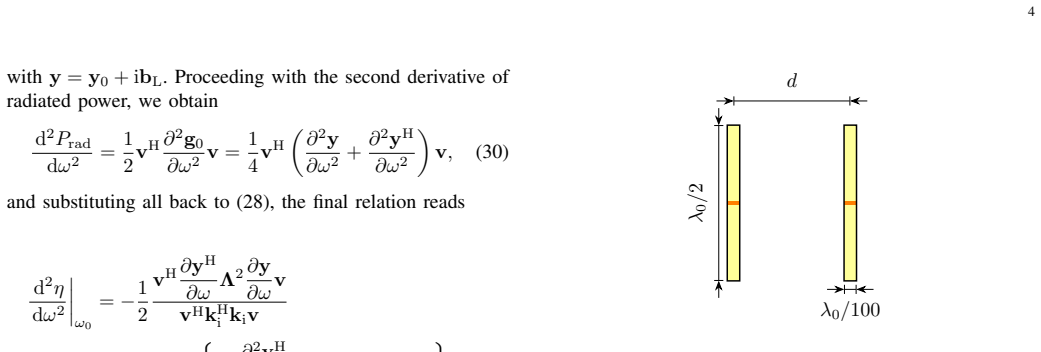
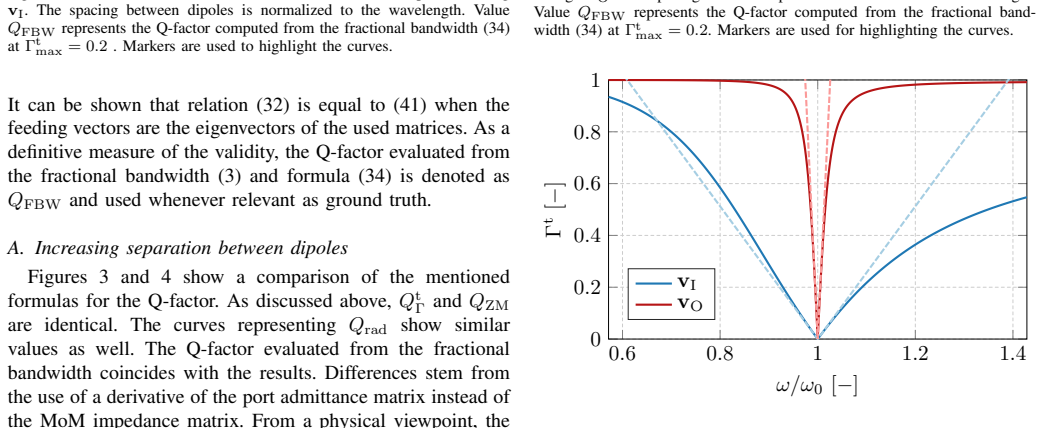
This article proposes an estimate of multiport antenna bandwidth based on a generalization of a single-port Q-factor. The explicit derivation is based on converting the stored energy matrix to its port equivalent and on the port parameters themselves. The work discusses the bandwidth dependencies on feeding and matching. Derived formulas are shown to utilize the total active reflection coefficient and allow for a single-frequency bandwidth evaluation. Examples comprising two different dipole arrays and electrically large patch antenna arrays validate the theory.
Editorial analysis
A structured set of objections, weighed in public.
Referee Report
Summary. The paper proposes a generalization of the single-port Q-factor to multiport antennas for estimating bandwidth from a single frequency. The derivation converts the stored-energy matrix to a port-parameter equivalent form and combines it with the total active reflection coefficient to account for feeding and matching network effects, enabling bandwidth prediction without full frequency-domain sweeps. Validation is claimed via two dipole-array examples and electrically large patch-array examples.
Significance. If the port-equivalent conversion is shown to preserve reactive energy contributions accurately, the method would offer a practical single-frequency tool for multiport antenna design and optimization, extending classical Q-factor bandwidth relations to arrays while incorporating matching dependencies. This could reduce computational cost in array synthesis compared to broadband simulations.
major comments (3)
- [§2] §2 (derivation of port Q-factor): the conversion of the stored-energy matrix to its port equivalent is presented without explicit intermediate equations or proof that all external reactive contributions from arbitrary matching networks are retained; the skeptic concern that frequency-dependent reactances outside the original matrix are omitted is not addressed by counter-example or bounding argument.
- [Validation section] Validation section (dipole and patch arrays): no quantitative error metrics (e.g., relative bandwidth error, RMS deviation from full-wave frequency sweep) or direct comparison tables against reference frequency-domain results are supplied, so the claim that the examples 'validate the theory' rests on qualitative agreement only.
- [§3] §3 (bandwidth formula using total active reflection coefficient): the assumption that the port-reduced Q plus active reflection coefficient yields accurate single-frequency bandwidth for arbitrary feeding networks is load-bearing, yet the provided examples use only simple corporate feeds without non-reciprocal or strongly frequency-dependent matching elements that would test the conversion's completeness.
minor comments (2)
- Notation for the total active reflection coefficient should include an explicit reference to its standard definition (e.g., from IEEE or prior multiport literature) to avoid ambiguity in the multiport generalization.
- Figure captions for the array examples could state the exact frequency at which the single-frequency Q estimate is evaluated and the reference bandwidth metric used for visual comparison.
Simulated Author's Rebuttal
We thank the referee for the detailed and constructive review. We have carefully considered each comment and provide point-by-point responses below. Where appropriate, we have revised the manuscript to address the concerns raised.
read point-by-point responses
-
Referee: [§2] §2 (derivation of port Q-factor): the conversion of the stored-energy matrix to its port equivalent is presented without explicit intermediate equations or proof that all external reactive contributions from arbitrary matching networks are retained; the skeptic concern that frequency-dependent reactances outside the original matrix are omitted is not addressed by counter-example or bounding argument.
Authors: We acknowledge that the derivation in Section 2 could benefit from additional explicit steps to clarify the conversion process. The port-equivalent stored energy is obtained by relating the total stored energy to the port voltages via the admittance or impedance parameters, which inherently include the effects of any external matching networks through their contribution to the port parameters. To address the concern, we will expand Section 2 with intermediate equations detailing the transformation and provide a brief explanation that the frequency dependence is captured in the port parameters, ensuring external reactances are not omitted. revision: yes
-
Referee: [Validation section] Validation section (dipole and patch arrays): no quantitative error metrics (e.g., relative bandwidth error, RMS deviation from full-wave frequency sweep) or direct comparison tables against reference frequency-domain results are supplied, so the claim that the examples 'validate the theory' rests on qualitative agreement only.
Authors: We agree that including quantitative metrics would provide stronger validation. In the revised manuscript, we will add comparison tables showing the single-frequency bandwidth estimates against those computed from full frequency sweeps for both the dipole and patch array examples. These will include relative errors and RMS deviations to quantify the agreement. revision: yes
-
Referee: [§3] §3 (bandwidth formula using total active reflection coefficient): the assumption that the port-reduced Q plus active reflection coefficient yields accurate single-frequency bandwidth for arbitrary feeding networks is load-bearing, yet the provided examples use only simple corporate feeds without non-reciprocal or strongly frequency-dependent matching elements that would test the conversion's completeness.
Authors: The bandwidth formula is derived in a general manner using the total active reflection coefficient (TARC), which is computed directly from the port parameters and thus accounts for the effects of arbitrary feeding and matching networks, including non-reciprocal or frequency-dependent elements. The examples with corporate feeds serve to illustrate the method in practical array configurations, but the underlying theory is not limited to these cases. We will add a clarifying statement in Section 3 emphasizing the generality and note that the port parameters can incorporate any network effects. revision: partial
Circularity Check
No significant circularity in derivation chain
full rationale
The paper's central derivation converts the stored-energy matrix to a port-equivalent form and combines it with total active reflection coefficient to obtain a single-frequency bandwidth estimate. This step is presented as a direct algebraic reduction from the multiport impedance or scattering parameters and the energy matrix; no equations are shown that define the output in terms of itself or that rename a fitted parameter as a prediction. Prior self-citations (if present) supply background on single-port Q-factor but are not invoked as a uniqueness theorem or ansatz that forces the multiport result. The derivation therefore remains self-contained against the stated inputs and does not reduce to its own outputs by construction.
Axiom & Free-Parameter Ledger
axioms (1)
- domain assumption Stored energy matrix can be converted to an equivalent port-parameter form without loss of bandwidth information
Lean theorems connected to this paper
-
IndisputableMonolith/Foundation/RealityFromDistinction.leanreality_from_one_distinction unclear?
unclearRelation between the paper passage and the cited Recognition theorem.
The explicit derivation is based on converting the stored energy matrix to its port equivalent and on the port parameters themselves... QΓt = ω0/2 ||Λ ∂y/∂ω v|| / ||ki v||
-
IndisputableMonolith/Cost/FunctionalEquation.leanwashburn_uniqueness_aczel unclear?
unclearRelation between the paper passage and the cited Recognition theorem.
radiation Q-factor Qrad = ω/2 (IH W I / IHR0I) + ...
What do these tags mean?
- matches
- The paper's claim is directly supported by a theorem in the formal canon.
- supports
- The theorem supports part of the paper's argument, but the paper may add assumptions or extra steps.
- extends
- The paper goes beyond the formal theorem; the theorem is a base layer rather than the whole result.
- uses
- The paper appears to rely on the theorem as machinery.
- contradicts
- The paper's claim conflicts with a theorem or certificate in the canon.
- unclear
- Pith found a possible connection, but the passage is too broad, indirect, or ambiguous to say the theorem truly supports the claim.
Reference graph
Works this paper leans on
-
[1]
C. A. Balanis,Antenna Theory: Analysis and Design, 2nd ed. Wiley, 1996
work page 1996
-
[2]
A. F. Molisch,Wireless Communications, 2nd ed. Wiley, 2011
work page 2011
-
[3]
J. V olakis, C. C. Chen, and K. Fujimoto,Small Antennas: Miniaturiza- tion Techniques and Applications, 1st ed., W. C. Chew, M. S. Tong, and B. Hu, Eds. McGraw-Hill Professional, 2010
work page 2010
-
[4]
Fundamentals of antenna bandwidth and quality factor,
A. D. Yaghjian, “Fundamentals of antenna bandwidth and quality factor,” IEEE Transactions on Antennas and Propagation, pp. 1–1, 2025
work page 2025
-
[5]
Q-bounded max- imum directivity of self-resonant antennas,
L. Passalacqua, C. Yepes, E. Martini, and S. Maci, “Q-bounded max- imum directivity of self-resonant antennas,”IEEE Transactions on Antennas and Propagation, vol. 71, no. 12, pp. 9549–9558, 2023. 9
work page 2023
-
[6]
Fundamental limits of characteristic mode slopes,
J. Lundgren and M. Gustafsson, “Fundamental limits of characteristic mode slopes,”IEEE Transactions on Antennas and Propagation, vol. 73, no. 12, pp. 10 294–10 303, 2025
work page 2025
-
[7]
R. P. Feynman, R. B. Leighton, and M. Sands,The Feynman Lectures on Physics, V olume I: Mainly Mechanics, Radiation, and Heat. New York, NY , USA: Basic Books, 2011
work page 2011
-
[8]
On the origins of the quality factor q,
K. L. Smith, “On the origins of the quality factor q,”Quarterly Journal of the Royal Astronomical Society, vol. 27, no. 4, p. 695, Dec. 1986
work page 1986
-
[9]
Fundamental limitations of small antennas,
H. A. Wheeler, “Fundamental limitations of small antennas,”Proceed- ings of the IRE, vol. 35, no. 12, pp. 1479–1484, 1947
work page 1947
-
[10]
Physical limitations of omni-directional antennas,
L. J. Chu, “Physical limitations of omni-directional antennas,”J. Appl. Phys., vol. 19, pp. 1163–1175, Dec. 1948
work page 1948
-
[11]
Effect of antenna size on gain, bandwidth, and efficiency,
R. F. Harrington, “Effect of antenna size on gain, bandwidth, and efficiency,”Journal of Research of the National Bureau of Standards, Section D: Radio Propagation, vol. 64D, no. 1, pp. 1–12, 1960. [Online]. Available: https://doi.org/10.6028/jres.064D.003
-
[12]
New radiationqlimits for spherical wire antennas,
H. L. Thal, “New radiationqlimits for spherical wire antennas,”IEEE Transactions on Antennas and Propagation, vol. 54, no. 10, pp. 2757– 2763, 2006
work page 2006
-
[13]
R. Collin and S. Rothschild, “Evaluation of antenna Q,”IEEE Transac- tions on Antennas and Propagation, vol. 12, no. 1, pp. 23–27, 1964
work page 1964
-
[14]
Quality factor of general ideal antennas,
R. Fante, “Quality factor of general ideal antennas,”IEEE Transactions on Antennas and Propagation, vol. 17, no. 2, pp. 151–155, 1969
work page 1969
-
[15]
A re-examination of the fundamental limits on the radi- ation q of electrically small antennas,
J. S. McLean, “A re-examination of the fundamental limits on the radi- ation q of electrically small antennas,”IEEE Transactions on Antennas and Propagation, vol. 44, no. 5, pp. 672–, 1996
work page 1996
-
[16]
A method for the evaluation of small antenna q,
W. Geyi, “A method for the evaluation of small antenna q,”IEEE Transactions on Antennas and Propagation, vol. 51, no. 8, pp. 2124– 2129, 2003
work page 2003
-
[17]
On the lower bound of the radiation q for electrically small antennas,
G. A. Thiele, P. L. Detweiler, and R. P. Penno, “On the lower bound of the radiation q for electrically small antennas,”IEEE Transactions on Antennas and Propagation, vol. 51, no. 6, pp. 1263–1269, 2003
work page 2003
-
[18]
The radiation properties of electrically small folded spher- ical helix antennas,
S. R. Best, “The radiation properties of electrically small folded spher- ical helix antennas,”IEEE Transactions on Antennas and Propagation, vol. 52, no. 4, pp. 953–960, 2004
work page 2004
-
[19]
Minimumqelectrically small antennas,
O. S. Kim, “Minimumqelectrically small antennas,”IEEE Transactions on Antennas and Propagation, vol. 60, no. 8, pp. 3551–3558, 2012
work page 2012
-
[20]
Density-based topology optimization in method of moments: Q-factor minimization,
J. Tucek, M. Capek, L. Jelinek, and O. Sigmund, “Density-based topology optimization in method of moments: Q-factor minimization,” IEEE Transactions on Antennas and Propagation, vol. 71, no. 12, pp. 9738–9751, 2023
work page 2023
-
[21]
Energy stored by radiating systems,
K. Schab, L. Jelinek, M. Capek, C. Ehrenborg, D. Tayli, G. A. E. Vandenbosch, and M. Gustafsson, “Energy stored by radiating systems,” IEEE Access, vol. 6, pp. 10 553–10 568, 2018
work page 2018
-
[22]
Control of radar scattering by reactive loading,
R. Harrington and J. Mautz, “Control of radar scattering by reactive loading,”IEEE Transactions on Antennas and Propagation, vol. 20, no. 4, pp. 446–454, 1972
work page 1972
-
[23]
R. F. Harrington,Field Computation by Moment Methods, ser. The IEEE PRESS Series in Electromagnetic Waves (Donald G. Dudley, Editor). Wiley-IEEE Press, 1993
work page 1993
-
[24]
Reactive energies, impedance, andQfactor of radiating structures,
G. A. E. Vandenbosch, “Reactive energies, impedance, andQfactor of radiating structures,”IEEE Transactions on Antennas and Propagation, vol. 58, no. 4, pp. 1112–1127, 2010
work page 2010
-
[25]
Impedance, bandwidth, and Q of antennas,
A. D. Yaghjian and S. R. Best, “Impedance, bandwidth, and Q of antennas,”IEEE Transactions on Antennas and Propagation, vol. 53, no. 4, pp. 1298–1324, 2005
work page 2005
-
[26]
Antenna current optimization using MATLAB and CVX,
M. Gustafsson, D. Tayli, C. Ehrenborg, M. Cismasu, and S. Nordebo, “Antenna current optimization using MATLAB and CVX,”F orum for Electromagnetic Research Methods and Application Technologies (FER- MAT), Apr. 2016
work page 2016
-
[27]
Minimization of antenna qual- ity factor,
M. Capek, M. Gustafsson, and K. Schab, “Minimization of antenna qual- ity factor,”IEEE Transactions on Antennas and Propagation, vol. 65, no. 8, pp. 4115–4123, 2017
work page 2017
-
[28]
Optimal composition of modal currents for minimal quality factor Q,
M. Capek and L. Jelinek, “Optimal composition of modal currents for minimal quality factor Q,”IEEE Transactions on Antennas and Propagation, vol. 64, no. 12, pp. 5230–5242, 2016
work page 2016
-
[29]
Lower bounds on substructure antennaQ-factor,
K. Schab, B. Yang, B. Hughes, and J. J. Adams, “Lower bounds on substructure antennaQ-factor,”IEEE Transactions on Antennas and Propagation, vol. 66, no. 7, pp. 3278–3285, 2018
work page 2018
-
[30]
Optimal bandwidth positions for a terminal embedded antenna: Physical bounds and antenna design,
B. L. G. Jonsson, F. Ferrero, S. Shi, and L. Wang, “Optimal bandwidth positions for a terminal embedded antenna: Physical bounds and antenna design,”IEEE Transactions on Antennas and Propagation, vol. 69, no. 4, pp. 1931–1941, 2021
work page 1931
-
[31]
Q-factor bounds for microstrip patch antennas,
B. A. P. Nel, A. K. Skrivervik, and M. Gustafsson, “Q-factor bounds for microstrip patch antennas,”IEEE Transactions on Antennas and Propagation, vol. 71, no. 4, pp. 3430–3440, 2023
work page 2023
-
[32]
A role of symmetries in evaluation of fundamental bounds,
M. Capek, L. Jelinek, and M. Masek, “A role of symmetries in evaluation of fundamental bounds,”IEEE Transactions on Antennas and Propagation, vol. 69, no. 11, pp. 7729–7742, 2021
work page 2021
-
[33]
Antenna shape synthesis without prior specification of the feedpoint locations,
J. L. T. Ethier and D. A. McNamara, “Antenna shape synthesis without prior specification of the feedpoint locations,”IEEE Transactions on Antennas and Propagation, vol. 62, no. 10, pp. 4919–4934, 2014
work page 2014
-
[34]
Antenna bandwidth optimization with single frequency simulation,
M. Cismasu and M. Gustafsson, “Antenna bandwidth optimization with single frequency simulation,”IEEE Transactions on Antennas and Propagation, vol. 62, no. 3, pp. 1304–1311, 2014
work page 2014
-
[35]
The foster reactance theorem for antennas and radiation q,
W. Geyi, P. Jarmuszewski, and Y . Qi, “The foster reactance theorem for antennas and radiation q,”IEEE Transactions on Antennas and Propagation, vol. 48, no. 3, pp. 401–408, 2000
work page 2000
-
[36]
The foster reactance theorem and quality factor for antennas,
S. Best, “The foster reactance theorem and quality factor for antennas,” IEEE Antennas and Wireless Propagation Letters, vol. 3, pp. 306–309, 2004
work page 2004
-
[37]
Bandwidth, q factor, and resonance models of antennas,
M. Gustafsson and S. Nordebo, “Bandwidth, q factor, and resonance models of antennas,”Progress In Electromagnetics Research, vol. 62, pp. 1–20, 2006
work page 2006
-
[38]
Limitations in relating quality factor to bandwidth in a double resonance small antenna,
H. R. Stuart, S. R. Best, and A. D. Yaghjian, “Limitations in relating quality factor to bandwidth in a double resonance small antenna,”IEEE Antennas and Wireless Propagation Letters, vol. 6, pp. 460–463, 2007
work page 2007
-
[39]
On the functional relation between quality factor and fractional bandwidth,
M. Capek, L. Jelinek, and P. Hazdra, “On the functional relation between quality factor and fractional bandwidth,”IEEE Transactions on Antennas and Propagation, vol. 63, no. 6, pp. 2787–2790, 2015
work page 2015
-
[40]
The conductance bandwidth of an electrically small antenna in antiresonant ranges,
O. B. V orobyev, “The conductance bandwidth of an electrically small antenna in antiresonant ranges,”Progress In Electromagnetics Research B, vol. 24, pp. 285–301, 2010
work page 2010
-
[41]
Antenna Q calculation using radiated modes and reflection coefficient,
H. L. Thal, “Antenna Q calculation using radiated modes and reflection coefficient,”IET Microwaves, Antennas & Propagation, vol. 9, pp. 328–335, 2015. [Online]. Available: https://digital-library.theiet.org/doi/ abs/10.1049/iet-map.2014.0219
-
[42]
The measurable Q fac- tor and observable energies of radiating structures,
M. Capek, L. Jelinek, P. Hazdra, and J. Eichler, “The measurable Q fac- tor and observable energies of radiating structures,”IEEE Transactions on Antennas and Propagation, vol. 62, no. 1, pp. 311–318, 2014
work page 2014
-
[43]
Q factors for antennas in dispersive media,
M. Gustafsson, D. Tayli, and M. Cismasu, “Q factors for antennas in dispersive media,” 2014. [Online]. Available: https://arxiv.org/abs/1408. 6834
work page 2014
-
[44]
Antenna Q and stored energy ex- pressed in the fields, currents, and input impedance,
M. Gustafsson and B. L. G. Jonsson, “Antenna Q and stored energy ex- pressed in the fields, currents, and input impedance,”IEEE Transactions on Antennas and Propagation, vol. 63, no. 1, pp. 240–249, 2015
work page 2015
-
[45]
Impact of matching network on bandwidth of compact antenna arrays,
B. K. Lau, J. B. Andersen, G. Kristensson, and A. F. Molisch, “Impact of matching network on bandwidth of compact antenna arrays,”IEEE Transactions on Antennas and Propagation, vol. 54, no. 11, pp. 3225– 3238, 2006
work page 2006
-
[46]
Bandwidth analysis of multiport radio frequency systems—part i,
D. Nie and B. M. Hochwald, “Bandwidth analysis of multiport radio frequency systems—part i,”IEEE Transactions on Antennas and Prop- agation, vol. 65, no. 3, pp. 1081–1092, 2017
work page 2017
-
[47]
M. Manteghi and Y . Rahmat-Samii, “Multiport characteristics of a wide-band cavity backed annular patch antenna for multipolarization operations,”IEEE Transactions on Antennas and Propagation, vol. 53, no. 1, pp. 466–474, 2005
work page 2005
-
[48]
The radiation and transducer efficiencies of a multiport antenna array,
F. Broyd ´e and E. Clavelier, “The radiation and transducer efficiencies of a multiport antenna array,”Excem Res. Papers in Electron. and Electromagn., no. 4, pp. 1–22, Jan. 2022
work page 2022
-
[49]
Bandwidth limitations on antenna systems with multiple isolated input ports,
H. D. Foltz and J. S. McLean, “Bandwidth limitations on antenna systems with multiple isolated input ports,”Microwave and Optical Technology Letters, vol. 19, no. 4, pp. 301–304, 1998
work page 1998
-
[50]
On cross coupling in multiple-beam antennas,
S. Stein, “On cross coupling in multiple-beam antennas,”IRE Transac- tions on Antennas and Propagation, vol. 10, no. 5, pp. 548–557, 1962
work page 1962
-
[51]
Impedance and quality factor of mutually coupled multiport antennas,
J. C.-E. Sten and M. Hirvonen, “Impedance and quality factor of mutually coupled multiport antennas,”Microwave and Optical Technology Letters, vol. 50, no. 8, pp. 2034–2039, 2008. [Online]. Available: https://onlinelibrary.wiley.com/doi/abs/10.1002/mop.23564
-
[52]
Bandwidth enhancement of antenna arrays utilizing mutual coupling between antenna elements,
M. Wang, W. Wu, and Z. Shen, “Bandwidth enhancement of antenna arrays utilizing mutual coupling between antenna elements,” International Journal of Antennas and Propagation, vol. 2010, no. 1, p. 690713, 2010. [Online]. Available: https://onlinelibrary.wiley.com/ doi/abs/10.1155/2010/690713
-
[53]
Systematic shape optimization of symmetric MIMO antennas using characteristic modes,
B. Yang and J. J. Adams, “Systematic shape optimization of symmetric MIMO antennas using characteristic modes,”IEEE Transactions on Antennas and Propagation, vol. 64, no. 7, pp. 2668–2678, 2016
work page 2016
-
[54]
Q-factor for multiport antennas and achievable bandwidth estimation,
R. Luomaniemi, P. Yl ¨a-Oijala, A. Lehtovuori, and V . Viikari, “Q-factor for multiport antennas and achievable bandwidth estimation,”IEEE Transactions on Antennas and Propagation, vol. 69, no. 10, pp. 6364– 6373, 2021. 10
work page 2021
-
[55]
Finding optimal total active reflection coefficient and realized gain for multiport lossy antennas,
M. Capek, L. Jelinek, and M. Masek, “Finding optimal total active reflection coefficient and realized gain for multiport lossy antennas,” IEEE Transactions on Antennas and Propagation, vol. 69, no. 5, pp. 2481–2493, 2021
work page 2021
-
[56]
D. M. Pozar,Microwave Engineering, 3rd ed. Wiley, 2005
work page 2005
-
[57]
IEEE standard definitions of terms for antennas,
“IEEE standard definitions of terms for antennas,”IEEE Transactions on Antennas and Propagation, vol. 17, no. 3, pp. 262–269, 1969
work page 1969
-
[58]
W. C. Chew, M. S. Tong, and B. Hu,Integral Equation Methods for Electromagnetic and Elastic Waves, 1st ed., ser. Synthesis Lectures on Computational Electromagnetics. Morgan and Claypool Publishers, 2007
work page 2007
-
[59]
J. L. V olakis and K. Sertel,Integral Equation Methods for Electromag- netics. SciTech Publishing, 2012
work page 2012
-
[60]
W. C. Gibson,The Method of Moments in Electromagnetics, 3rd ed. Chapman and Hall/CRC, 2021
work page 2021
-
[61]
Electromagnetic scattering by surfaces of arbitrary shape,
S. Rao, D. Wilton, and A. Glisson, “Electromagnetic scattering by surfaces of arbitrary shape,”IEEE Transactions on Antennas and Prop- agation, vol. 30, no. 3, pp. 409–418, 1982
work page 1982
-
[62]
RadiationQ-factors of thin-wire dipole arrangements,
P. Hazdra, M. Capek, and J. Eichler, “RadiationQ-factors of thin-wire dipole arrangements,”IEEE Antennas and Wireless Propagation Letters, vol. 10, pp. 556–560, 2011. [63]Ultra Low Loss, RF/MW Laminate and Prepreg, Isola, 12 2025. [On- line]. Available: https://www.isola-group.com/pcb-laminates-prepreg/ astra-mt77-laminate-and-prepreg/
work page 2011
-
[63]
G. H. Golub and C. F. Van Loan,Matrix Computations, 3rd ed., ser. Johns Hopkins studies in the mathematical sciences. Johns Hopkins University Press, 1996
work page 1996
discussion (0)
Sign in with ORCID, Apple, or X to comment. Anyone can read and Pith papers without signing in.