Recognition: 2 theorem links
· Lean TheoremEnsuring Logic in the Fog: Sound POMDP Synthesis with LTL Objectives
Pith reviewed 2026-05-14 20:29 UTC · model grok-4.3
The pith
A sound reward-shaping mechanism generates belief-dependent rewards from certified LTL satisfaction to guide POMDP synthesis under partial observability.
A machine-rendered reading of the paper's core claim, the machinery that carries it, and where it could break.
Core claim
We bridge this gap with a novel, sound reward-shaping mechanism that dynamically generates belief-dependent rewards grounded in certified LTL satisfaction. By integrating this mechanism into an enhanced Monte Carlo Planning framework, we empower agents to navigate the fog of partial observability with a search process focused on maximising verifiable success.
What carries the argument
The sound reward-shaping mechanism that dynamically generates belief-dependent rewards grounded in certified LTL satisfaction and feeds them into Monte Carlo planning.
Load-bearing premise
LTL satisfaction can be certified in a computationally tractable way for belief states so that the resulting rewards stay sound without encountering undecidability.
What would settle it
A POMDP benchmark in which the certification step assigns high reward to a belief that actually leads to LTL violation in full-information simulation would show the shaping is unsound.
Figures



read the original abstract
Synthesising autonomous agents that can navigate uncertain environments while adhering to complex temporal constraints remains a fundamental challenge. While Linear Temporal Logic (LTL) provides a rigorous language for specifying such tasks, the inherent undecidability of qualitatively verifying LTL satisfaction in partially observable Markov decision processes renders quantitative synthesis difficult, especially when designing reliable reward signals for approximate solvers. In this paper, we bridge this gap with a novel, sound reward-shaping mechanism that dynamically generates belief-dependent rewards grounded in certified LTL satisfaction. By integrating this mechanism into an enhanced Monte Carlo Planning framework, we empower agents to navigate the `fog' of partial observability with a search process focused on maximising verifiable success. Our experiments demonstrate that this approach not only thrives in scenarios where existing solvers fail but also maintains effectiveness and scalability across diverse benchmark domains.
Editorial analysis
A structured set of objections, weighed in public.
Referee Report
Summary. The paper claims to bridge the gap in POMDP synthesis under LTL objectives by introducing a novel sound reward-shaping mechanism that dynamically generates belief-dependent rewards grounded in certified LTL satisfaction; this is integrated into an enhanced Monte Carlo Planning framework, enabling agents to maximize verifiable success in partially observable settings, with experiments showing effectiveness where prior solvers fail and scalability across benchmarks.
Significance. If the soundness of the belief-state LTL certification procedure can be established without violating undecidability barriers, the result would be significant: it would provide a practical, verifiable reward signal for approximate planning that respects complex temporal constraints, advancing reliable autonomous agent synthesis in uncertain environments.
major comments (1)
- [Abstract] The central soundness claim (Abstract) rests on a certification procedure that produces belief-dependent rewards for LTL satisfaction inside Monte Carlo planning, yet the manuscript provides no explicit statement of the LTL fragment used, the belief representation (e.g., finite support or finite-memory policies), or the proof technique that ensures tractability and preserves soundness; given the known undecidability of qualitative LTL model checking on POMDPs, this omission is load-bearing for the quantitative synthesis guarantee.
minor comments (1)
- The abstract refers to 'diverse benchmark domains' and 'existing solvers' without naming them; the experiments section should include a clear table of domains, baselines, and quantitative metrics (success rate, runtime, etc.) to support the scalability claims.
Simulated Author's Rebuttal
We thank the referee for their constructive feedback on the soundness presentation. We address the major comment below and will revise the abstract to incorporate the requested details from the manuscript body.
read point-by-point responses
-
Referee: [Abstract] The central soundness claim (Abstract) rests on a certification procedure that produces belief-dependent rewards for LTL satisfaction inside Monte Carlo planning, yet the manuscript provides no explicit statement of the LTL fragment used, the belief representation (e.g., finite support or finite-memory policies), or the proof technique that ensures tractability and preserves soundness; given the known undecidability of qualitative LTL model checking on POMDPs, this omission is load-bearing for the quantitative synthesis guarantee.
Authors: We agree the abstract is insufficiently precise on these points, even though they are specified in Sections 2–4 of the manuscript. We restrict attention to the co-safe fragment of LTL (which admits an equivalent DFA and finite-memory policies). Beliefs are represented as finite-support distributions over the underlying state space. The certification procedure constructs the product POMDP with the DFA and computes sound lower bounds on the probability of reaching accepting states via Monte Carlo sampling; these bounds are used only for reward shaping inside the planner and never claim to solve the undecidable qualitative model-checking problem exactly. We will update the abstract to state the LTL fragment, the finite-support belief representation, and the product-construction-plus-bounded-sampling proof technique. revision: yes
Circularity Check
No circularity detected; novel mechanism claimed without self-referential reduction
full rationale
The paper acknowledges the general undecidability of LTL model checking on POMDPs and claims to bridge the gap via a novel sound reward-shaping mechanism that generates belief-dependent rewards from certified LTL satisfaction, then integrates it into Monte Carlo planning. No equations, parameter-fitting procedures, self-citations, or ansatzes are exhibited in the abstract or described text that would reduce the central claim to its own inputs by construction. The derivation is presented as self-contained, with the soundness grounded in the proposed certification procedure rather than a redefinition or statistical forcing from prior fitted results. This is the normal case of an independent technical contribution.
Axiom & Free-Parameter Ledger
axioms (1)
- domain assumption LTL satisfaction admits a sound certification procedure that can be evaluated on belief states of a POMDP
Lean theorems connected to this paper
-
IndisputableMonolith/Foundation/AbsoluteFloorClosure.leanreality_from_one_distinction unclear?
unclearRelation between the paper passage and the cited Recognition theorem.
the inherent undecidability of qualitatively verifying LTL satisfaction in partially observable Markov decision processes... sound reward-shaping mechanism that dynamically generates belief-dependent rewards grounded in certified LTL satisfaction
-
IndisputableMonolith/Cost/FunctionalEquation.leanwashburn_uniqueness_aczel unclear?
unclearRelation between the paper passage and the cited Recognition theorem.
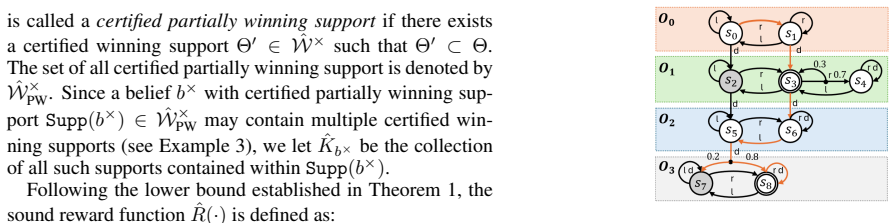
Theorem 1... max E[ max_Θ∈K_b× b×(Θ) ] ... sound reward function ˆR(b×) = 1 if Supp(b×)∈Ŵ×, max b×(Θ) if partially winning, 0 otherwise
What do these tags mean?
- matches
- The paper's claim is directly supported by a theorem in the formal canon.
- supports
- The theorem supports part of the paper's argument, but the paper may add assumptions or extra steps.
- extends
- The paper goes beyond the formal theorem; the theorem is a base layer rather than the whole result.
- uses
- The paper appears to rely on the theorem as machinery.
- contradicts
- The paper's claim conflicts with a theorem or certificate in the canon.
- unclear
- Pith found a possible connection, but the passage is too broad, indirect, or ambiguous to say the theorem truly supports the claim.
Reference graph
Works this paper leans on
-
[1]
Stochastic finite state con- trol of pomdps with ltl specifications.arXiv preprint arXiv:2001.07679,
[Ahmadiet al., 2020 ] Mohamadreza Ahmadi, Rangoli Sha- ran, and Joel W Burdick. Stochastic finite state con- trol of pomdps with ltl specifications.arXiv preprint arXiv:2001.07679,
-
[2]
[Baier and Katoen, 2008] Christel Baier and Joost-Pieter Katoen.Principles of model checking. MIT press,
work page 2008
-
[3]
On decision problems for probabilistic b¨uchi automata
[Baieret al., 2008 ] Christel Baier, Nathalie Bertrand, and Marcus Gr ¨oßer. On decision problems for probabilistic b¨uchi automata. InInternational Conference on Founda- tions of Software Science and Computational Structures, pages 287–301. Springer,
work page 2008
-
[4]
Point-based methods for model checking in partially observable markov decision pro- cesses
[Boutonet al., 2020 ] Maxime Bouton, Jana Tumova, and Mykel J Kochenderfer. Point-based methods for model checking in partially observable markov decision pro- cesses. InProceedings of the AAAI Conference on Arti- ficial Intelligence, volume 34, pages 10061–10068,
work page 2020
-
[5]
[Carret al., 2020 ] Steven Carr, Nils Jansen, and Ufuk Topcu. Verifiable rnn-based policies for pomdps under temporal logic constraints.arXiv preprint arXiv:2002.05615,
-
[6]
[Carret al., 2021 ] Steven Carr, Nils Jansen, and Ufuk Topcu. Task-aware verifiable rnn-based policies for partially ob- servable markov decision processes.Journal of Artificial Intelligence Research, 72:819–847,
work page 2021
-
[7]
[Chatterjeeet al., 2007 ] Krishnendu Chatterjee, Laurent Doyen, Thomas A Henzinger, and Jean-Franc ¸ois Raskin. Algorithms for omega-regular games with imperfect information.Logical Methods in Computer Science, 3,
work page 2007
-
[8]
[Chatterjeeet al., 2010 ] Krishnendu Chatterjee, Laurent Doyen, Hugo Gimbert, and Thomas A Henzinger. Randomness for free. InInternational Symposium on Mathematical Foundations of Computer Science, pages 246–257. Springer,
work page 2010
-
[9]
Qualitative analysis of pomdps with temporal logic specifications for robotics applications
[Chatterjeeet al., 2015 ] Krishnendu Chatterjee, Martin Chmelik, Raghav Gupta, and Ayush Kanodia. Qualitative analysis of pomdps with temporal logic specifications for robotics applications. In2015 IEEE International Conference on Robotics and Automation (ICRA), pages 325–330. IEEE,
work page 2015
-
[10]
[Chatterjeeet al., 2016 ] Krishnendu Chatterjee, Martin Chmelik, and Mathieu Tracol. What is decidable about partially observable markov decision processes with ω-regular objectives.Journal of Computer and System Sciences, 82(5):878–911,
work page 2016
-
[11]
Efficient selectivity and backup operators in monte-carlo tree search
[Coulom, 2006] R´emi Coulom. Efficient selectivity and backup operators in monte-carlo tree search. InInterna- tional conference on computers and games, pages 72–83. Springer,
work page 2006
-
[12]
Enforcing almost-sure reachability in pomdps
[Jungeset al., 2021 ] Sebastian Junges, Nils Jansen, and San- jit A Seshia. Enforcing almost-sure reachability in pomdps. InInternational Conference on Computer Aided Verification, pages 602–625. Springer,
work page 2021
-
[13]
Partially observable markov decision processes for artificial intelligence
[Kaelblinget al., 1995 ] Leslie Pack Kaelbling, Michael L Littman, and Anthony R Cassandra. Partially observable markov decision processes for artificial intelligence. In International Workshop on Reasoning with Uncertainty in Robotics, pages 146–163. Springer,
work page 1995
-
[14]
[Kalagarlaet al., 2022 ] Krishna C Kalagarla, Kartik Dhruva, Dongming Shen, Rahul Jain, Ashutosh Nayyar, and Pier- luigi Nuzzo. Optimal control of partially observable markov decision processes with finite linear temporal logic constraints. InUncertainty in Artificial Intelligence, pages 949–958. PMLR,
work page 2022
-
[15]
[Kalagarlaet al., 2024 ] Krishna C Kalagarla, Dhruva Kar- tik, Dongming Shen, Rahul Jain, Ashutosh Nayyar, and Pierluigi Nuzzo. Optimal control of logically con- strained partially observable and multiagent markov deci- sion processes.IEEE Transactions on Automatic Control, 70(1):263–277,
work page 2024
-
[16]
Rabinizer 4: From ltl to your favourite deterministic automaton
[Kˇret´ınsk`yet al., 2018 ] Jan K ˇret´ınsk`y, Tobias Meggendor- fer, Salomon Sickert, and Christopher Ziegler. Rabinizer 4: From ltl to your favourite deterministic automaton. In in Proceedings of International Conference on Computer Aided Verification, pages 567–577. Springer,
work page 2018
-
[17]
Learning policies for partially observable environments: Scaling up
[Littmanet al., 1995 ] Michael L Littman, Anthony R Cas- sandra, and Leslie Pack Kaelbling. Learning policies for partially observable environments: Scaling up. InMa- chine Learning Proceedings 1995, pages 362–370. Else- vier,
work page 1995
-
[18]
Leveraging tempo- ral structure in safety-critical task specifications for pomdp planning
[Liuet al., 2021 ] Jason Liu, Eric Rosen, Suchen Zheng, Ste- fanie Tellex, and George Konidaris. Leveraging tempo- ral structure in safety-critical task specifications for pomdp planning. InProc. RSS Workshop Robot. People,
work page 2021
-
[19]
[Madaniet al., 1999 ] Omid Madani, Steve Hanks, and Anne Condon. On the undecidability of probabilistic planning and infinite-horizon partially observable markov decision problems.Aaai/iaai, 10(315149.315395),
-
[20]
Point-based value iteration: An anytime algo- rithm for pomdps
[Pineauet al., 2003 ] Joelle Pineau, Geoff Gordon, Sebastian Thrun, et al. Point-based value iteration: An anytime algo- rithm for pomdps. InIjcai, volume 3, pages 1025–1032,
work page 2003
-
[21]
The temporal logic of programs
[Pnueli, 1977] Amir Pnueli. The temporal logic of programs. In18th annual symposium on foundations of computer sci- ence (sfcs 1977), pages 46–57. ieee,
work page 1977
-
[22]
[Sebastianet al., 2005 ] Thrun Sebastian, Burgard Wolfram, and Fox Dieter.Probabilistic Robotics. The MIT Press, Cambridge,
work page 2005
-
[23]
Finite state control of pomdps with ltl specifications
[Sharan and Burdick, 2014] Rangoli Sharan and Joel Bur- dick. Finite state control of pomdps with ltl specifications. In2014 American Control Conference, pages 501–508. IEEE,
work page 2014
-
[24]
Limit-deterministic B ¨uchi automata for linear temporal logic
[Sickertet al., 2016 ] Salomon Sickert, Javier Esparza, Ste- fan Jaax, and Jan K ˇret´ınsk`y. Limit-deterministic B ¨uchi automata for linear temporal logic. InInternational Con- ference on Computer Aided Verification, pages 312–332. Springer,
work page 2016
-
[25]
Monte-carlo planning in large pomdps.Advances in neu- ral information processing systems, 23,
[Silver and Veness, 2010] David Silver and Joel Veness. Monte-carlo planning in large pomdps.Advances in neu- ral information processing systems, 23,
work page 2010
-
[26]
Reasoning about infinite computations.Information and computation, 115(1):1–37,
[Vardi and Wolper, 1994] Moshe Y Vardi and Pierre Wolper. Reasoning about infinite computations.Information and computation, 115(1):1–37,
work page 1994
-
[27]
Appendix A Extended Related Work For fully observable MDPs, LTL satisfaction is identi- fied structurally via Accepting Maximal End Components (AMECs) within the product system. Under B ¨uchi accep- tance conditions, a state-based policy (e.g., a Round-Robin policy) can ensure almost-sure satisfaction. Consequently, policy synthesis for MDPs under LTL is ...
work page 2008
-
[28]
By Lemma 1 in [Chat- terjeeet al., 2010 ], for this randomised belief-support policy there exists a deterministic belief-support policy ˜π× :B × Supp →A × such thatPr ˜π× (E,AE)(□♢Acc ×) =
work page 2010
-
[29]
Hence, Al- gorithm 1 is sound and complete. E Implementation Details E.1 Algorithm 1 For the winning state setS ×× w of the product MDPM ××, we first identify all AMECs using the standard procedure, for example Algorithm 47 in [Baier and Katoen, 2008]. We then compute the backward reachability set of these AMECs fol- lowing Algorithm 45 in [Baier and Kato...
work page 2008
-
[30]
All experiments were run on a workstation equipped with an Intel Xeon Gold 6230R CPU (2.10 GHz), restricted to a single thread with up to 50 GB RAM, running Ubuntu 20.04.6 LTS. All source code is provided in the sup- plementary material. F.2 Toy Example Winning supports: {"[’s8_0’]"} Winning supports sets: {frozenset({’s8_0’})} Partically Winning Supports...
work page 1995
discussion (0)
Sign in with ORCID, Apple, or X to comment. Anyone can read and Pith papers without signing in.