Recognition: unknown
Global and Local Infall in the ASHES Sample (GLASHES). II. Asymmetric Line Profiles around Dense Cores in 70 μm Dark Massive Clumps
Pith reviewed 2026-05-14 20:53 UTC · model grok-4.3
The pith
Blue asymmetry in molecular line profiles indicates that gravitational infall is common in dense cores of massive 70 micron-dark clumps.
A machine-rendered reading of the paper's core claim, the machinery that carries it, and where it could break.
Core claim
Using observations of optically thick tracers, we detect blue asymmetric line profiles in a majority of cores after accounting for projection effects. These signatures appear from the prestellar phase and grow stronger with increasing core mass and surface density. This implies that gravitational collapse is common at core scales and proceeds hierarchically from clump to core scales.
What carries the argument
The velocity difference parameter (δ_v) and asymmetry parameter (A) measured from blue-shifted peaks in HCO+(3-2) and HNC(3-2) spectra, which quantify infalling motions once geometric projection effects are considered.
Load-bearing premise
Blue asymmetry in the chosen optically thick tracers reliably traces infall after geometric projection effects are accounted for, rather than being produced by rotation, outflows, or optical-depth variations.
What would settle it
Observing that the fraction of cores with blue asymmetry fails to increase with core mass, surface density, or evolutionary stage, or that red asymmetry dominates after identical geometric corrections.
Figures







read the original abstract
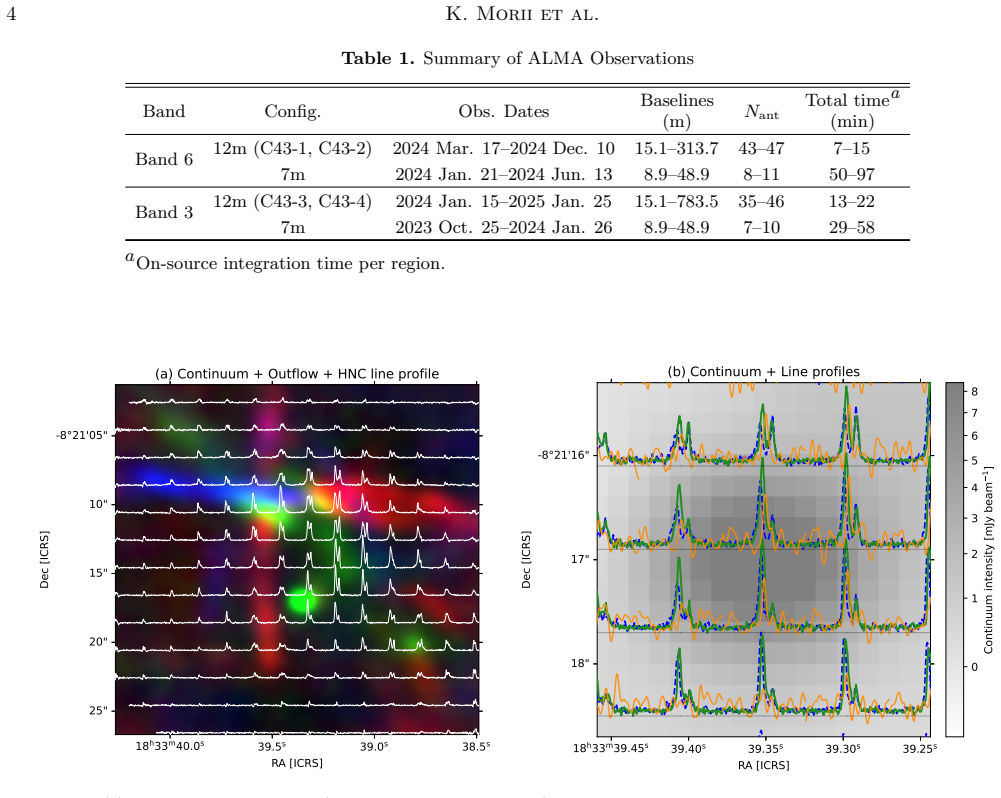
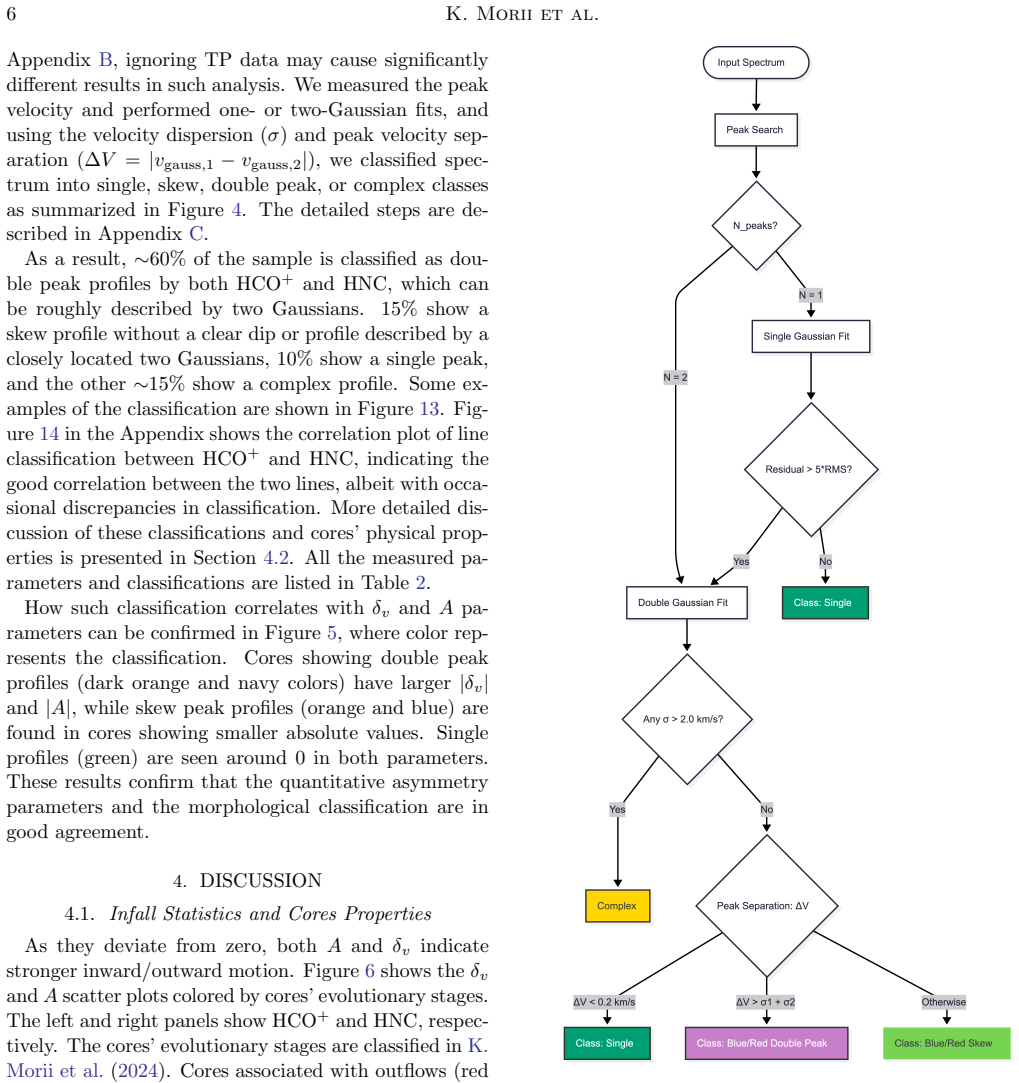
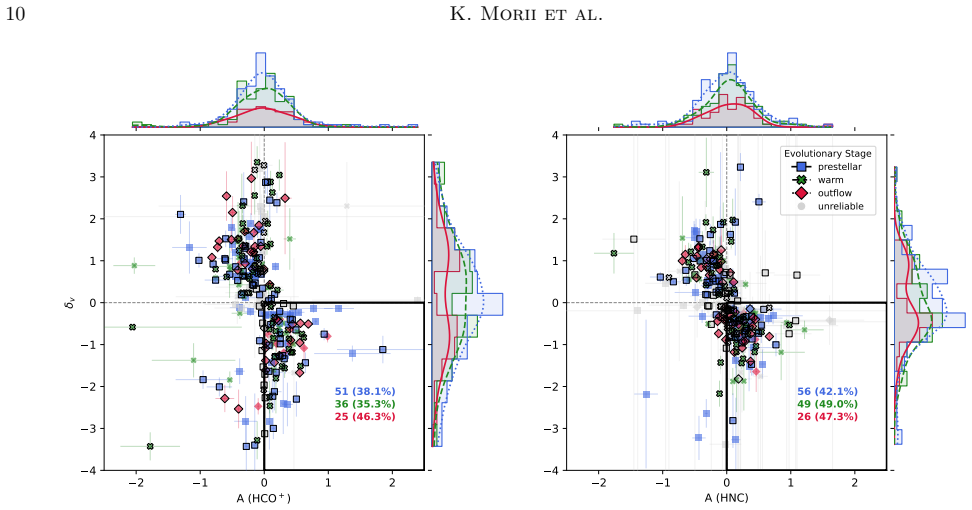
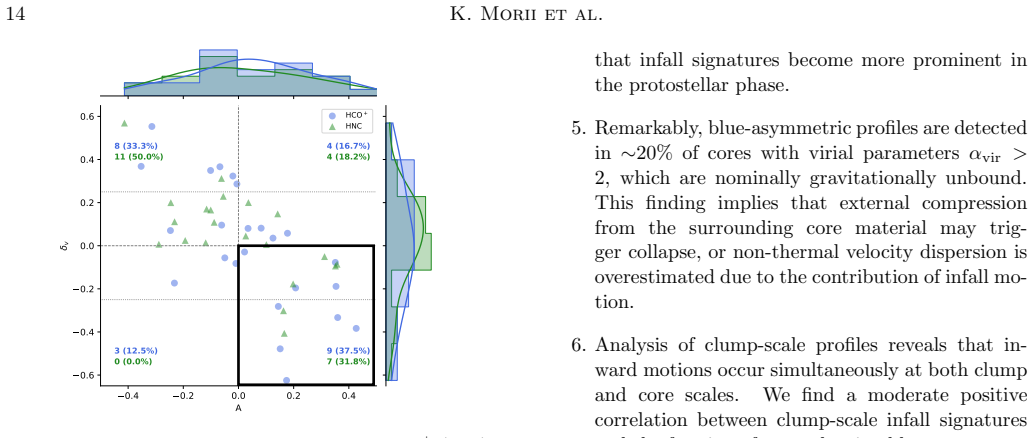
Gravitational collapse is fundamental to star formation, yet direct kinematic evidence of infall at the core scale in high-mass star-forming regions remains poorly constrained. We present the first large-scale statistical study of infall signatures in 304 dense cores within 24 massive 70 $\mu$m-dark clumps from the GLASHES (Global and Local Infall in the ASHES Sample) survey. Using ALMA Band 6 observations of the optically thick tracers HCO$^+$ and HNC (J=3-2), we systematically characterize blue asymmetry line profiles indicative of infalling motions. We employ two complementary metrics, the velocity difference parameter ($\delta_v$) and the asymmetry parameter ($A$), to quantify infall signatures, finding consistent results across both tracers. Blue asymmetry profiles are detected in $\sim$50-60% of cores ($\delta_v<$0 or A>0). Spectral classification reveals that $\sim$60% of cores exhibit double-peaked profiles, and 34% and 39% show blue asymmetry profiles in HCO$^+$ and HNC, respectively, with the percentage increasing with core mass and surface density. Accounting for geometric effects that can obscure infall signatures, our results suggest that gravitational collapse is prevalent in and around the cores. Importantly, infall signatures are detected from the prestellar stage and become more dominant as cores' evolution proceeds. Even cores with virial parameters $\alpha_{vir} > 2$ show infall signatures, suggesting that external compression may trigger collapse in addition to self-gravity or that linewidth may include inward motion in addition to turbulence. Furthermore, a moderate correlation between clump-scale and core-scale asymmetry supports a hierarchical collapse scenario, implying a dynamic and multi-scale process of high-mass star formation.
Editorial analysis
A structured set of objections, weighed in public.
Referee Report
Summary. This paper conducts the first large-scale statistical study of infall signatures in 304 dense cores embedded in 24 massive 70 μm-dark clumps from the GLASHES survey. Using ALMA Band 6 data of optically thick tracers HCO+ and HNC (J=3-2), the authors quantify blue-asymmetric line profiles with the velocity difference parameter δv and asymmetry parameter A, reporting blue asymmetry in ~34% and ~39% of cores respectively. They find these signatures increase with core mass and surface density, are present from the prestellar stage, and correlate moderately with clump-scale asymmetry, concluding that gravitational collapse is prevalent and supports hierarchical collapse in high-mass star formation even after accounting for geometric effects.
Significance. This study provides important new constraints on the prevalence of infall at the core scale in high-mass star-forming regions. The large sample size, use of two independent tracers and metrics yielding consistent results, and the finding of infall signatures across evolutionary stages represent a significant advance. If the blue asymmetries are confirmed to trace net infall after geometric corrections, the results would support dynamic models of high-mass star formation involving multi-scale collapse and possible external triggering.
major comments (2)
- [Abstract] Abstract: the assertion that geometric effects obscuring infall signatures have been accounted for is not supported by any quantitative details such as specific correction factors, inclination statistics, or radiative transfer simulations. This is load-bearing for the claim that collapse is prevalent, as the raw blue fraction of 50-60% could be significantly reduced by projection effects.
- [Abstract] Abstract: the interpretation that even cores with virial parameters α_vir > 2 exhibit infall signatures implies either external compression or that linewidths include inward motions is plausible but requires explicit discussion of how alternative kinematic explanations (rotation, outflows) were ruled out given the ALMA resolution and observed line widths.
minor comments (2)
- [Abstract] Abstract: the abstract lacks information on the noise thresholds used for profile classification, any optical-depth corrections applied to the tracers, and the precise criteria for selecting the 304 dense cores, all of which could influence the reported percentages.
- Clarify the exact definitions and any assumptions in the δv and A parameters, preferably with equations, to allow independent verification of the asymmetry classifications.
Simulated Author's Rebuttal
We thank the referee for their constructive and positive review, which highlights the significance of our large-sample statistical study of infall signatures. We address each major comment below with specific plans for revision. These changes will clarify our handling of geometric effects and alternative kinematics without altering the core conclusions.
read point-by-point responses
-
Referee: [Abstract] Abstract: the assertion that geometric effects obscuring infall signatures have been accounted for is not supported by any quantitative details such as specific correction factors, inclination statistics, or radiative transfer simulations. This is load-bearing for the claim that collapse is prevalent, as the raw blue fraction of 50-60% could be significantly reduced by projection effects.
Authors: We agree that the abstract would benefit from more explicit quantitative context on geometric effects. The full manuscript (Section 4.3) already includes a qualitative discussion noting that projection effects can mask infall signatures for certain inclinations, but we acknowledge the lack of specific numbers. In the revised version, we will update the abstract to reference new additions: a brief Monte Carlo estimate assuming random orientations (showing that blue asymmetry remains detectable in >40% of cases for inclinations <60°), and citations to radiative transfer studies (e.g., on HCO+ line profiles) that quantify how the observed fraction is a lower limit. This will support the prevalence claim while being transparent about uncertainties. revision: yes
-
Referee: [Abstract] Abstract: the interpretation that even cores with virial parameters α_vir > 2 exhibit infall signatures implies either external compression or that linewidths include inward motions is plausible but requires explicit discussion of how alternative kinematic explanations (rotation, outflows) were ruled out given the ALMA resolution and observed line widths.
Authors: We accept that the abstract interpretation requires more explicit justification to rule out alternatives. The manuscript discusses this in Section 5.2, noting the ALMA resolution (~0.5″) resolves core scales and the absence of broad wings in most spectra. For the revision, we will add a dedicated paragraph in Section 5.2 (and reference it in the abstract) explaining: (1) rotation is unlikely as it would produce position-velocity gradients or symmetric double peaks not seen in the majority of sources; (2) outflows are ruled out by the lack of high-velocity components (>5 km/s wings) in the HCO+ and HNC profiles; and (3) the virial parameter uses the full observed linewidth, which may incorporate infall motions. This will strengthen the external compression or linewidth-infall interpretation. revision: yes
Circularity Check
No circularity: direct spectral measurements without self-referential reductions
full rationale
The paper applies standard, pre-existing metrics (velocity difference δv and asymmetry parameter A) to classify observed ALMA line profiles in HCO+ and HNC. Reported fractions (~34-39% blue asymmetry, rising with core mass and density) are direct tallies from spectral classification of the 304 cores; no equations fit parameters to a subset and then re-label the output as a prediction of the same quantity. No self-citations are invoked to justify uniqueness theorems or load-bearing assumptions. Geometric effects are acknowledged qualitatively but without a quantitative model that would create a definitional loop. The derivation chain therefore consists of independent observational steps whose outputs are not equivalent to the inputs by construction.
Axiom & Free-Parameter Ledger
axioms (1)
- domain assumption Blue asymmetry in optically thick molecular lines indicates infalling gas motions
Reference graph
Works this paper leans on
-
[1]
A Search for Infall Motions Toward Nearby Young Stellar Objects
A Search for Infall Motions toward Nearby Young Stellar Objects. , keywords =. doi:10.1086/304812 , archivePrefix =. astro-ph/9707011 , primaryClass =
work page internal anchor Pith review Pith/arXiv arXiv doi:10.1086/304812
-
[2]
A Simple Model of Spectral-Line Profiles from Contracting Clouds. , keywords =. doi:10.1086/310146 , adsurl =
-
[4]
Evidence for Protostellar Collapse in B335. , keywords =. doi:10.1086/172271 , adsurl =
-
[5]
Self-reversed CO profiles in collapsing molecular clouds. , keywords =. doi:10.1086/154909 , adsurl =
-
[6]
Power-law distributions in empirical data
Power-Law Distributions in Empirical Data. SIAM Review , keywords =. doi:10.1137/070710111 , archivePrefix =. 0706.1062 , primaryClass =
work page internal anchor Pith review Pith/arXiv arXiv doi:10.1137/070710111
-
[7]
ALMA-IMF. X. The core population in the evolved W33-Main (G012.80) protocluster. , keywords =. doi:10.1051/0004-6361/202347595 , archivePrefix =. 2401.09203 , primaryClass =
-
[8]
An Observational Perspective of Low Mass Dense Cores II: Evolution towards the Initial Mass Function
An Observational Perspective of Low-Mass Dense Cores II: Evolution Toward the Initial Mass Function. Protostars and Planets V , year = 2007, editor =. doi:10.48550/arXiv.astro-ph/0603474 , archivePrefix =. astro-ph/0603474 , primaryClass =
work page internal anchor Pith review Pith/arXiv arXiv doi:10.48550/arxiv.astro-ph/0603474 2007
-
[9]
Digging into the Interior of Hot Cores with ALMA (DIHCA). II. Exploring the Inner Binary (Multiple) System Embedded in G335 MM1 ALMA1. , keywords =. doi:10.3847/1538-4357/ac5bd8 , archivePrefix =. 2203.04333 , primaryClass =
-
[10]
The Curated ATCA Census of High-Mass Clumps (CACHMC) Legacy Survey. , keywords =. doi:10.1017/pasa.2024.68 , adsurl =
-
[11]
The Core Mass Function across Galactic Environments. IV. The Galactic Center. , keywords =. doi:10.3847/1538-4357/adb725 , archivePrefix =. 2403.04032 , primaryClass =
-
[12]
Investigations of Massive Filaments and Star Formation (INFANT). I. Core Identification and Core Mass Function. , keywords =. doi:10.3847/1538-4357/ad3c41 , archivePrefix =. 2404.03858 , primaryClass =
-
[13]
The Core Mass Function in the Massive Protocluster G286.21+0.17 revealed by ALMA
The Core Mass Function in the Massive Protocluster G286.21+0.17 Revealed by ALMA. , keywords =. doi:10.3847/1538-4357/aaa3f1 , archivePrefix =. 1706.06584 , primaryClass =
work page internal anchor Pith review Pith/arXiv arXiv doi:10.3847/1538-4357/aaa3f1
-
[14]
Global and Local Infall in the ASHES Sample (GLASHES). I. Pilot Study in G337.541. , keywords =. doi:10.3847/1538-4357/ada27f , archivePrefix =. 2412.17901 , primaryClass =
-
[15]
CARMA-NRO Orion Survey: Unbiased Survey of Dense Cores and Core Mass Functions in Orion A. , keywords =. doi:10.3847/1538-4365/aca4d4 , archivePrefix =. 2211.10215 , primaryClass =
-
[16]
FRagmentation and Evolution of Dense Cores Judged by ALMA (FREJA). I. Overview: Inner 1000 au Structures of Prestellar/Protostellar Cores in Taurus. , keywords =. doi:10.3847/1538-4357/ab9ca7 , archivePrefix =. 2006.06361 , primaryClass =
-
[17]
The W43-MM1 mini-starburst ridge, a test for star formation efficiency models
The W43-MM1 mini-starburst ridge, a test for star formation efficiency models. , keywords =. doi:10.1051/0004-6361/201423603 , archivePrefix =. 1404.4843 , primaryClass =
work page internal anchor Pith review Pith/arXiv arXiv doi:10.1051/0004-6361/201423603
-
[18]
Frontiers in Astronomy and Space Sciences , keywords =
The role of magnetic field in molecular cloud formation and evolution. Frontiers in Astronomy and Space Sciences , keywords =. doi:10.3389/fspas.2019.00005 , archivePrefix =. 1902.00798 , primaryClass =
-
[19]
Frontiers in Astronomy and Space Sciences , keywords =
Submillimeter and Far-infrared Polarimetric Observations of Magnetic Fields in Star-Forming Regions. Frontiers in Astronomy and Space Sciences , keywords =. doi:10.3389/fspas.2019.00015 , archivePrefix =. 1904.04826 , primaryClass =
-
[20]
A Core Mass Function Indistinguishable from the Salpeter Stellar Initial Mass Function Using 1000 au Resolution ALMA Observations. , keywords =. doi:10.3847/1538-4357/ac1bb9 , archivePrefix =. 2107.14288 , primaryClass =
-
[21]
Michael L. Waskom , title =. 2021 , publisher =. doi:10.21105/joss.03021 , url =
-
[22]
A Robust Method to Measure Centroids of Spectral Lines
A Robust Method to Measure Centroids of Spectral Lines. Research Notes of the American Astronomical Society , keywords =. doi:10.3847/2515-5172/aae265 , archivePrefix =. 1809.10295 , primaryClass =
work page internal anchor Pith review Pith/arXiv arXiv doi:10.3847/2515-5172/aae265
-
[23]
Computing in Science and Engineering , keywords =
Matplotlib: A 2D Graphics Environment. Computing in Science and Engineering , keywords =. doi:10.1109/MCSE.2007.55 , adsurl =
-
[24]
The Astropy Project: Sustaining and Growing a Community-oriented Open-source Project and the Latest Major Release (v5.0) of the Core Package. , keywords =. doi:10.3847/1538-4357/ac7c74 , archivePrefix =. 2206.14220 , primaryClass =
work page internal anchor Pith review Pith/arXiv arXiv doi:10.3847/1538-4357/ac7c74
-
[25]
The Astropy Project: Building an inclusive, open-science project and status of the v2.0 core package
The Astropy Project: Building an Open-science Project and Status of the v2.0 Core Package. , keywords =. doi:10.3847/1538-3881/aabc4f , archivePrefix =. 1801.02634 , primaryClass =
work page internal anchor Pith review Pith/arXiv arXiv doi:10.3847/1538-3881/aabc4f
-
[26]
Astropy: A Community Python Package for Astronomy
Astropy: A community Python package for astronomy. , keywords =. doi:10.1051/0004-6361/201322068 , archivePrefix =. 1307.6212 , primaryClass =
work page internal anchor Pith review Pith/arXiv arXiv doi:10.1051/0004-6361/201322068
-
[27]
Chemical analysis of prestellar cores in Ophiuchus yields short timescales and rapid collapse. , keywords =. doi:10.1051/0004-6361/202141252 , archivePrefix =. 2105.02253 , primaryClass =
-
[28]
Nature Methods , author =. 2020 , pages =. doi:10.1038/s41592-019-0686-2 , number =
-
[29]
Array programming with. Nature , author =. 2020 , pages =. doi:10.1038/s41586-020-2649-2 , number =
-
[30]
The ALMA Survey of 70 m Dark High-mass Clumps in Early Stages (ASHES). XI. Statistical Study of Early Fragmentation. , keywords =. doi:10.3847/1538-4357/ad32d0 , archivePrefix =. 2403.07058 , primaryClass =
-
[31]
Filamentary Fragmentation and Accretion in High-Mass Star-Forming Molecular Clouds
Filamentary Fragmentation and Accretion in High-mass Star-forming Molecular Clouds. , keywords =. doi:10.3847/1538-4357/aaad11 , archivePrefix =. 1801.05955 , primaryClass =
work page internal anchor Pith review Pith/arXiv arXiv doi:10.3847/1538-4357/aaad11
-
[32]
Initial phases of massive star formation in high infrared extinction clouds. II. Infall and onset of star formation. , keywords =. doi:10.1051/0004-6361/201219574 , archivePrefix =. 1210.2063 , primaryClass =
work page internal anchor Pith review Pith/arXiv arXiv doi:10.1051/0004-6361/201219574 2063
-
[33]
Complex Structure in Class 0 Protostellar Envelopes. II. Kinematic Structure from Single-dish and Interferometric Molecular Line Mapping. , keywords =. doi:10.1088/0004-637X/740/1/45 , archivePrefix =. 1107.4361 , primaryClass =
work page internal anchor Pith review Pith/arXiv arXiv doi:10.1088/0004-637x/740/1/45
-
[34]
A young bipolar outflow from IRAS 15398-3359
A young bipolar outflow from IRAS 15398-3359. , keywords =. doi:10.1051/0004-6361/201527310 , archivePrefix =. 1601.06947 , primaryClass =
work page internal anchor Pith review Pith/arXiv arXiv doi:10.1051/0004-6361/201527310
-
[35]
Kinematics of Protostellar Objects in the $\rho$ Ophiuchus A Region
Kinematics of Protostellar Objects in the Ophiuchus A Region. , keywords =. doi:10.1086/505563 , archivePrefix =. astro-ph/0605163 , primaryClass =
work page internal anchor Pith review Pith/arXiv arXiv doi:10.1086/505563
-
[36]
Gas Infalling Motions in the Envelopes of Very Low Luminosity Objects. , keywords =. doi:10.3847/1538-4357/abe4d3 , archivePrefix =. 2102.10896 , primaryClass =
-
[37]
Infall and outflow towards high-mass starless clump candidates. , keywords =. doi:10.1093/mnras/stad1073 , archivePrefix =. 2305.04256 , primaryClass =
-
[38]
Turbulent fragmentation as the primary driver of core formation in Polaris Flare and Lupus I. , keywords =. doi:10.1051/0004-6361/202452427 , archivePrefix =. 2503.06613 , primaryClass =
-
[39]
Filamentary accretion flows in Cygnus X DR20
The Cygnus Allscale Survey of Chemistry and Dynamical Environments: CASCADE: V. Filamentary accretion flows in Cygnus X DR20. , keywords =. doi:10.1051/0004-6361/202449656 , archivePrefix =. 2512.09519 , primaryClass =
-
[40]
ATOMS-QUARKS Survey: Inflow and Infall in Massive Protocluster G318.049+00.086 Evidence of Competitive Accretion. , keywords =. doi:10.3847/1538-4357/ae40fd , archivePrefix =. 2602.01238 , primaryClass =
-
[41]
Clump-scale Gas Infall in High-mass Star Formation: A Multitransition View with James Clerk Maxwell Telescope HCN (4-3) Mapping. , keywords =. doi:10.3847/1538-4365/acfee2 , archivePrefix =. 2309.14686 , primaryClass =
-
[42]
A Survey for Infall Motions toward Starless Cores. II. CS (2-1) and N _ 2 H ^ + (1-0) Mapping Observations. , keywords =. doi:10.1086/322534 , archivePrefix =. astro-ph/0105515 , primaryClass =
work page internal anchor Pith review Pith/arXiv arXiv doi:10.1086/322534
-
[43]
Research in Astronomy and Astrophysics , keywords =
A Catalog of Molecular Clumps and Cores with Infall Signatures. Research in Astronomy and Astrophysics , keywords =. doi:10.1088/1674-4527/ac7d9d , archivePrefix =. 2206.13908 , primaryClass =
-
[45]
Pyspeckit: A Spectroscopic Analysis and Plotting Package. , keywords =. doi:10.3847/1538-3881/ac695a , archivePrefix =. 2205.04987 , primaryClass =
-
[46]
PySpecKit: Python Spectroscopic Toolkit
-
[47]
Molecular Line Profile Fitting with Analytic Radiative Transfer Models
Molecular Line Profile Fitting with Analytic Radiative Transfer Models. , keywords =. doi:10.1086/427141 , archivePrefix =. astro-ph/0410748 , primaryClass =
work page internal anchor Pith review Pith/arXiv arXiv doi:10.1086/427141
-
[48]
The Properties of Massive, Dense, Clumps: Mapping Surveys of HCN and CS
The Properties of Massive, Dense Clumps: Mapping Surveys of HCN and CS. , keywords =. doi:10.1088/0067-0049/188/2/313 , archivePrefix =. 1004.0398 , primaryClass =
work page internal anchor Pith review Pith/arXiv arXiv doi:10.1088/0067-0049/188/2/313
-
[49]
Physical Conditions in Regions of Star Formation
Physical Conditions in Regions of Star Formation. , keywords =. doi:10.1146/annurev.astro.37.1.311 , archivePrefix =. astro-ph/9905050 , primaryClass =
work page internal anchor Pith review Pith/arXiv arXiv doi:10.1146/annurev.astro.37.1.311
-
[51]
The dynamic centres of infrared-dark clouds and the formation of cores. , keywords =. doi:10.1093/mnras/stae030 , archivePrefix =. 2401.04238 , primaryClass =
-
[52]
ALMA-IMF XIII: N _2 H ^+ kinematic analysis on the intermediate protocluster G353.41. arXiv e-prints , keywords =. doi:10.48550/arXiv.2404.07363 , archivePrefix =. 2404.07363 , primaryClass =
-
[53]
Massive Quiescent Cores in Orion: Dynamical State Revealed by High-Resolution Ammonia Maps
Massive Quiescent Cores in Orion: Dynamical State Revealed by High-resolution Ammonia Maps. , keywords =. doi:10.1088/2041-8205/768/1/L5 , archivePrefix =. 1207.1178 , primaryClass =
work page internal anchor Pith review Pith/arXiv arXiv doi:10.1088/2041-8205/768/1/l5 2041
-
[54]
The true shapes of globular clusters. , keywords =. doi:10.1086/113452 , adsurl =
-
[55]
Monthly Notices of the Royal Astronomical Society , author =
Multiscale dynamics in star-forming regions: the interplay between gravity and turbulence , volume =. Monthly Notices of the Royal Astronomical Society , author =. 2020 , pages =. doi:10.1093/mnras/stz3344 , language =
-
[56]
Magnetic processes in a collapsing dense core. II. Fragmentation. Is there a fragmentation crisis?. , keywords =. doi:10.1051/0004-6361:20078310 , archivePrefix =. 0709.2887 , primaryClass =
work page internal anchor Pith review Pith/arXiv arXiv doi:10.1051/0004-6361:20078310
-
[57]
Collapse of Massive Magnetized Dense Cores Using Radiation Magnetohydrodynamics: Early Fragmentation Inhibition. , keywords =. doi:10.1088/2041-8205/742/1/L9 , archivePrefix =. 1110.2955 , primaryClass =
work page internal anchor Pith review Pith/arXiv arXiv doi:10.1088/2041-8205/742/1/l9 2041
-
[58]
Shaping a high-mass star-forming cluster through stellar feedback. The case of the NGC 7538 IRS 1-3 complex. , keywords =. doi:10.1051/0004-6361/201423917 , archivePrefix =. 1405.6742 , primaryClass =
work page internal anchor Pith review Pith/arXiv arXiv doi:10.1051/0004-6361/201423917
-
[59]
Does the Magnetic Field Suppress Fragmentation in Massive Dense Cores?. , keywords =. doi:10.3847/1538-4357/abee1e , archivePrefix =. 2010.12099 , primaryClass =
-
[60]
doi:10.3847/1538-4357/abadfe , eid =
, keywords =. doi:10.3847/1538-4357/abadfe , eid =
-
[61]
The Radio Ammonia Mid-Plane Survey (RAMPS) Pilot Survey
doi:10.3847/1538-4365/aacf94 , eid =. arXiv , author =:1808.02533 , journal =
work page internal anchor Pith review Pith/arXiv arXiv doi:10.3847/1538-4365/aacf94
-
[62]
doi:10.3847/1538-4357/ab1484 , eid =. arXiv , author =:1903.12397 , journal =
work page internal anchor Pith review Pith/arXiv arXiv doi:10.3847/1538-4357/ab1484 1903
-
[63]
arXiv , author =:2112.08182 , journal =
doi:10.1051/0004-6361/202141677 , eid =. arXiv , author =:2112.08182 , journal =
-
[64]
arXiv , author =:2112.08183 , journal =
doi:10.1051/0004-6361/202141681 , eid =. arXiv , author =:2112.08183 , journal =
-
[65]
arXiv , author =:2207.03537 , journal =
doi:10.1051/0004-6361/202243669 , eid =. arXiv , author =:2207.03537 , journal =
-
[66]
Thermal Jeans fragmentation within 1000 AU in OMC-1S
doi:10.3847/1538-4357/aaad03 , eid =. arXiv , author =:1706.04623 , journal =
work page internal anchor Pith review Pith/arXiv arXiv doi:10.3847/1538-4357/aaad03
-
[67]
doi:10.1093/mnras/stac1735 , eprint =
, keywords =. doi:10.1093/mnras/stac1735 , eprint =
-
[68]
doi:10.1051/0004-6361:20065420 , journal =
-
[69]
arXiv , author =:1808.07702 , journal =
doi:10.3847/1538-4357/aaf6b4 , eid =. arXiv , author =:1808.07702 , journal =
-
[70]
arXiv , author =:2004.09532 , journal =
doi:10.3847/2041-8213/ab8b65 , eid =. arXiv , author =:2004.09532 , journal =
-
[71]
doi:10.1093/mnras/staa2298 , eprint =
, keywords =. doi:10.1093/mnras/staa2298 , eprint =
-
[72]
arXiv , author =:2002.01594 , journal =
doi:10.3847/1538-4357/abb8d4 , eid =. arXiv , author =:2002.01594 , journal =
-
[73]
ALMA Observations of the IRDC Clump G34.43+00.24 MM3: DNC/HNC Ratio
doi:10.1088/0004-637X/803/2/70 , eid =. arXiv , author =:1503.01827 , journal =
work page internal anchor Pith review Pith/arXiv arXiv doi:10.1088/0004-637x/803/2/70
-
[74]
arXiv , author =:2111.13325 , journal =
doi:10.3847/1538-4357/ac3d2e , eid =. arXiv , author =:2111.13325 , journal =
-
[75]
doi:10.1111/j.1365-2966.2009.15598.x , archivePrefix =
, keywords =. doi:10.1111/j.1365-2966.2009.15621.x , eprint =
-
[76]
doi:10.3847/1538-4357/ac85b4 , eid =
, keywords =. doi:10.3847/1538-4357/ac85b4 , eid =
-
[77]
The ALMA Survey of 70 m Dark High-mass Clumps in Early Stages (ASHES). VII. Chemistry of Embedded Dense Cores. , keywords =. doi:10.3847/1538-4357/ac94d4 , archivePrefix =. 2209.12814 , primaryClass =
-
[78]
arXiv , author =:2207.12431 , journal =
doi:10.3847/1538-4357/ac83aa , eid =. arXiv , author =:2207.12431 , journal =
-
[79]
doi:10.3847/1538-4357/aa8996 , eid =. arXiv , author =:1709.01086 , journal =
work page internal anchor Pith review Pith/arXiv arXiv doi:10.3847/1538-4357/aa8996
-
[80]
doi:10.1093/mnras/stac2060 , eprint =
, keywords =. doi:10.1093/mnras/stac2060 , eprint =
-
[81]
TurbuStat: Turbulence Statistics in Python
doi:10.3847/1538-3881/ab1cc0 , eid =. arXiv , author =:1904.10484 , journal =
work page internal anchor Pith review Pith/arXiv arXiv doi:10.3847/1538-3881/ab1cc0 1904
-
[82]
arXiv , author =:2107.05750 , journal =
doi:10.3847/1538-4357/ac1425 , eid =. arXiv , author =:2107.05750 , journal =
-
[83]
arXiv , author =:2002.11736 , journal =
doi:10.3847/1538-4357/ab7378 , eid =. arXiv , author =:2002.11736 , journal =
discussion (0)
Sign in with ORCID, Apple, or X to comment. Anyone can read and Pith papers without signing in.