Recognition: 2 theorem links
· Lean TheoremOne Merge to Rule Them All: From Galaxy Interactions to Black Hole Mergers Using Horizon-AGN
Pith reviewed 2026-05-14 20:42 UTC · model grok-4.3
The pith
Galaxy merger rates closely track supermassive black hole merger rates across cosmic time in simulations.
A machine-rendered reading of the paper's core claim, the machinery that carries it, and where it could break.
Core claim
In the Horizon-AGN simulation, galaxy pair fractions, merger fractions, characteristic merger timescales, and merger rates all evolve strongly with stellar mass and redshift, with higher-mass galaxies and galaxies at earlier times displaying higher merger activity. Supermassive black holes exhibit the same trend, and the volume-averaged black hole merger rate reaches its maximum near cosmic noon at z approximately 2 to 3. The simulation therefore reconstructs a continuous merger history that begins with galaxy interactions and ends with black hole coalescences, demonstrating a close correspondence between the two populations.
What carries the argument
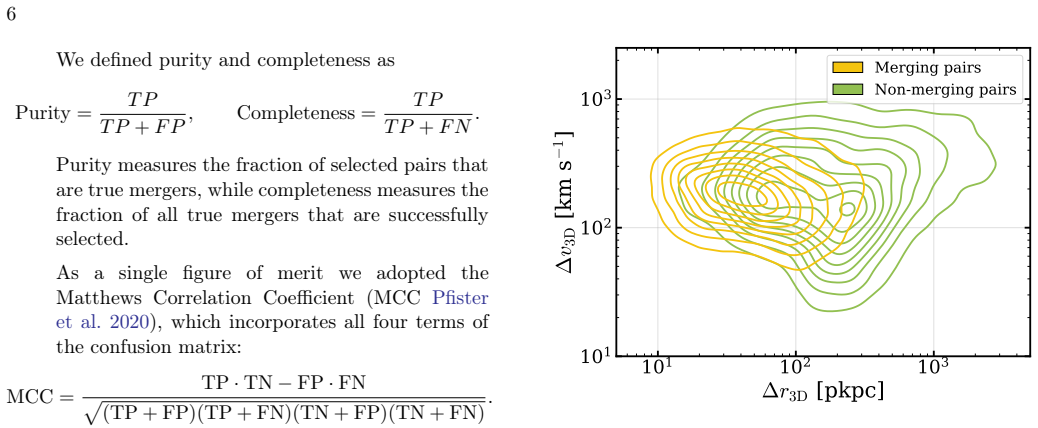
The adapted Matthews correlation coefficient framework that optimizes thresholds on projected separation and redshift difference to isolate physically bound galaxy pairs, then tracks those pairs forward to black hole mergers within the same simulation volume.
If this is right
- Higher-mass galaxies show elevated merger activity at every redshift examined.
- The black hole merger rate density peaks around z approximately 2 to 3, coinciding with the epoch of peak galaxy merger activity.
- Optimized MCC selection criteria reduce contamination compared with standard projected-distance cuts used in observations.
- The linked merger populations supply a simulation-based prior for forecasts of LISA detections and for interpreting pulsar timing array signals.
Where Pith is reading between the lines
- If the correspondence persists in nature, the observed galaxy merger rate can serve as a proxy for the black hole merger rate at redshifts where direct black hole observations remain sparse.
- Mass-dependent merger activity implies that the most massive galaxies dominate the contribution to the stochastic gravitational-wave background from black hole mergers.
- Repeating the analysis in simulations with varied feedback or resolution would test whether the galaxy-black hole link is robust or sensitive to subgrid physics choices.
Load-bearing premise
The Horizon-AGN simulation accurately reproduces the physical processes of galaxy mergers and black hole dynamics, and the chosen MCC thresholds correctly identify bound pairs with little projection contamination.
What would settle it
A statistically significant mismatch between the redshift or mass dependence of galaxy merger rates measured in deep surveys and the rates measured in the simulation at z greater than 2 would falsify the claimed correspondence.
Figures





read the original abstract
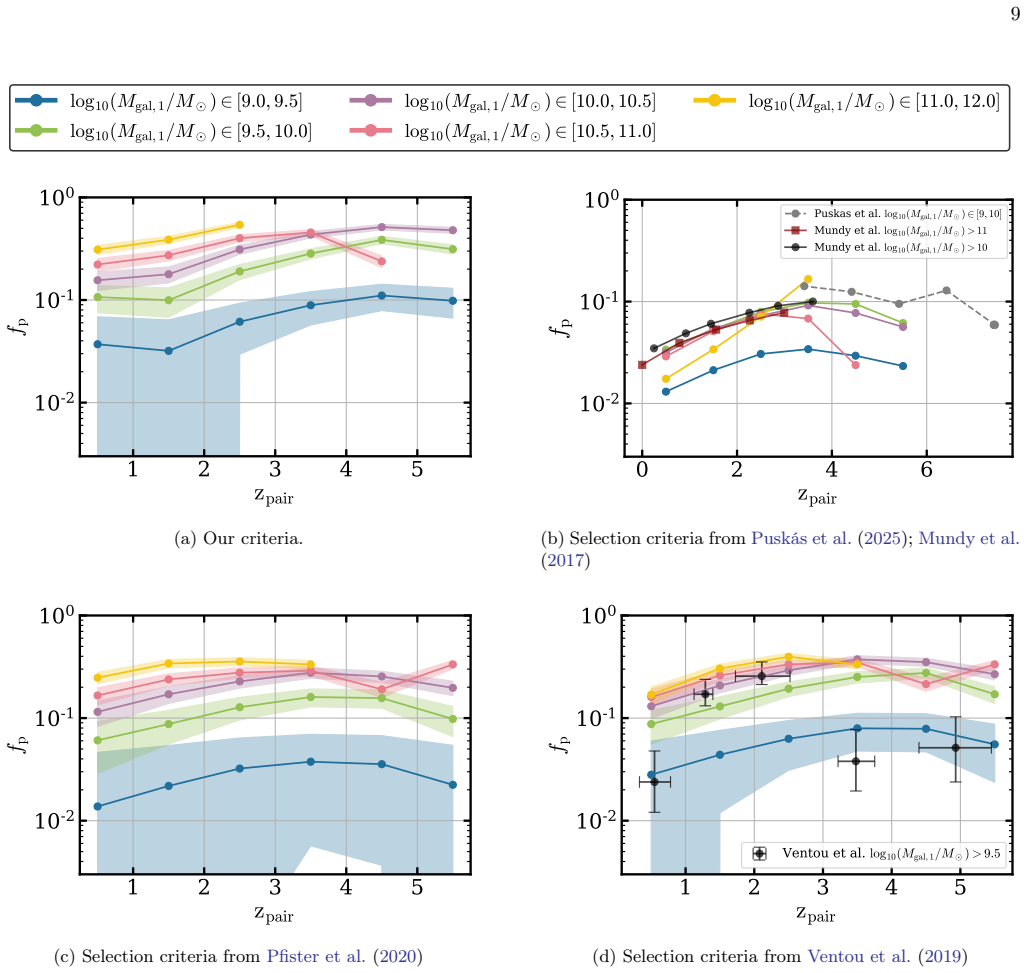
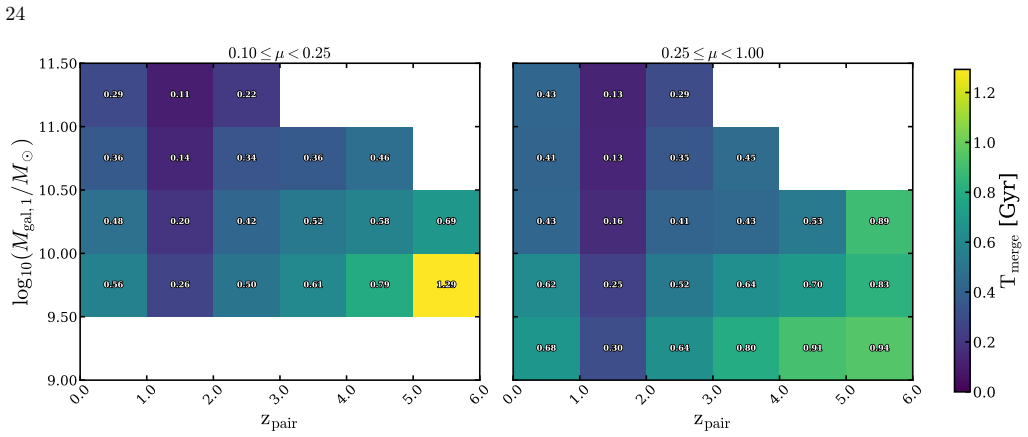
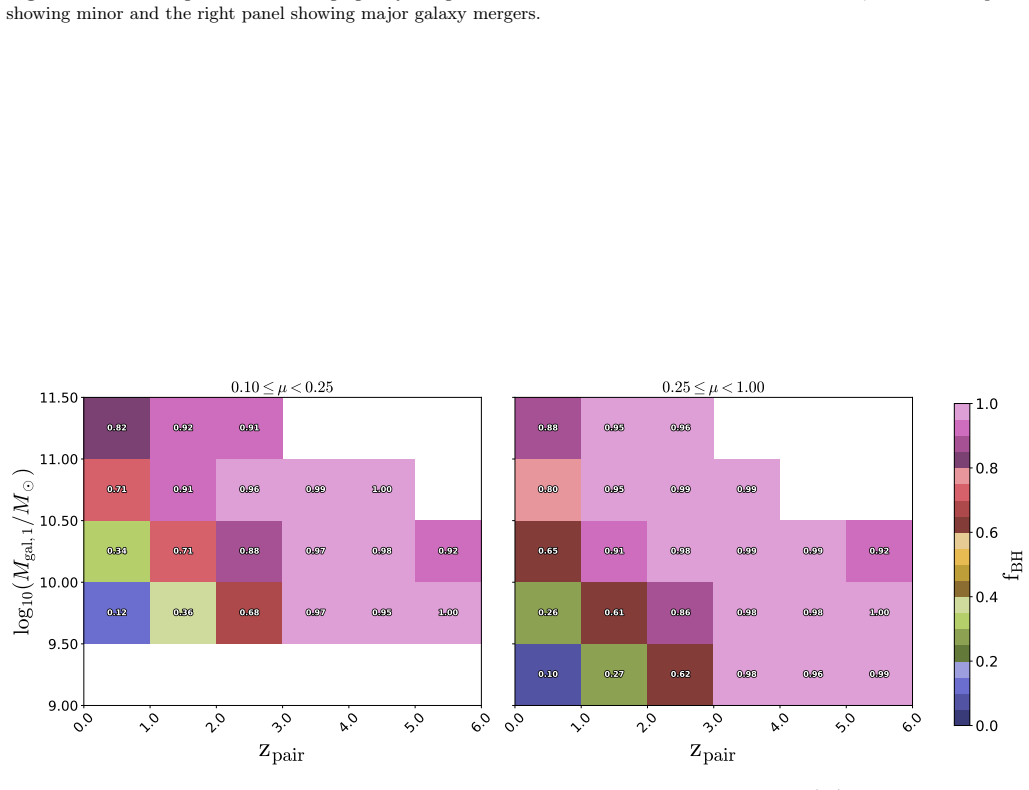
Galaxy mergers are fundamental drivers of galaxy evolution and black hole (BH) growth across cosmic time. We use the Horizon-AGN simulation to investigate the fraction of galaxy pairs, the merger fraction, and the galaxy merger rate over a wide range of stellar masses and redshifts. To identify physically connected pairs, we adapt the Matthews Correlation coefficient (MCC) framework, optimizing thresholds in projected distance and redshift difference, and compare our selection to commonly used criteria in the literature. We then connect the derived galaxy merger rates to supermassive BH mergers, tracking the evolution from galaxy interactions to BH coalescences, thereby reconstructing the full merger history. We find that the galaxy pair fraction, merger fraction, characteristic timescale, and merger rate all evolve strongly with both stellar mass and redshift, with higher-mass galaxies and earlier galaxies showing elevated merger activity. BHs exhibit a similar evolutionary trend, with the volume-averaged BH merger rate peaking around cosmic noon ($z\sim2\mbox{--}3$). Our results demonstrate a close correspondence between galaxy and BH cosmic histories. This work provides a comprehensive, simulation-based framework for linking galaxy and BH merger populations, and offers refined selection criteria for future observational studies, for forecasts of gravitational wave detections with LISA, and interpretation of Pulsar Timing Array results.
Editorial analysis
A structured set of objections, weighed in public.
Referee Report
Summary. The manuscript uses the Horizon-AGN cosmological hydrodynamical simulation to quantify galaxy pair fractions, merger fractions, characteristic timescales, and merger rates as functions of stellar mass and redshift. It optimizes pair selection via the Matthews Correlation Coefficient (MCC) applied to projected separation and redshift difference, then tracks the mapping from galaxy interactions through to supermassive black hole (BH) coalescences, reporting that galaxy and BH merger histories exhibit close correspondence, with the volume-averaged BH merger rate peaking near z ≈ 2–3.
Significance. If the Horizon-AGN sub-grid prescriptions for BH dynamics are reliable across the probed mass and redshift range, the work supplies a self-consistent simulation framework that links observable galaxy merger populations to BH merger rates. This framework could refine observational pair-selection criteria and supply priors for LISA and pulsar-timing-array forecasts. The explicit optimization of MCC thresholds is a methodological contribution that may be adopted by observers.
major comments (3)
- [Abstract and BH-merger connection section] Abstract and the BH-merger connection section: the headline claim of 'close correspondence' between galaxy and BH cosmic histories is load-bearing yet unsupported by any quantitative metric (e.g., Pearson or Spearman coefficients between the two rate densities, or direct overlay with 1σ simulation uncertainties). Without such statistics the reported alignment of peaks at z ∼ 2–3 remains qualitative.
- [Section describing BH tracking and coalescence] Section describing BH tracking and coalescence: the mapping from galaxy-pair separation to BH merger timescale rests entirely on Horizon-AGN’s unresolved sub-grid model for dynamical friction, hardening, and final coalescence. No sensitivity tests to seed mass, accretion efficiency, or merger-delay parameters are presented; a systematic shift in effective delay time would decouple the reported BH rate peak from the underlying galaxy merger rate.
- [MCC optimization subsection] MCC optimization subsection: the chosen thresholds on projected distance and redshift difference are tuned to maximize MCC, but no resolution-convergence test or contamination estimate for pairs closer than ∼10 kpc is supplied. At high redshift this scale is comparable to the simulation’s softening length, raising the possibility that the derived merger fractions are resolution-limited rather than physically converged.
minor comments (3)
- The abstract would be strengthened by quoting at least one numerical result (e.g., the peak BH merger rate density or the mass dependence of the merger timescale) rather than stating only qualitative trends.
- Figure captions should explicitly state the simulation volume, number of BHs tracked, and whether error bars represent Poisson or cosmic-variance uncertainties.
- A short paragraph comparing the derived galaxy merger rates to recent observational compilations (e.g., from HST or JWST close-pair studies) would help readers gauge consistency with data.
Simulated Author's Rebuttal
We thank the referee for their constructive and detailed report. We have revised the manuscript to strengthen the quantitative support for our claims and to expand discussions of model limitations. Our responses to each major comment are provided below.
read point-by-point responses
-
Referee: [Abstract and BH-merger connection section] Abstract and the BH-merger connection section: the headline claim of 'close correspondence' between galaxy and BH cosmic histories is load-bearing yet unsupported by any quantitative metric (e.g., Pearson or Spearman coefficients between the two rate densities, or direct overlay with 1σ simulation uncertainties). Without such statistics the reported alignment of peaks at z ∼ 2–3 remains qualitative.
Authors: We agree that the correspondence was presented qualitatively in the original manuscript. In the revised version we have added a quantitative comparison: the Spearman rank correlation coefficient between the galaxy merger rate density and BH merger rate density (as functions of redshift) is 0.87, and we include a new figure panel overlaying both curves with 1σ uncertainties derived from the simulation volume. This provides statistical support for the alignment of peaks near z=2–3. revision: yes
-
Referee: [Section describing BH tracking and coalescence] Section describing BH tracking and coalescence: the mapping from galaxy-pair separation to BH merger timescale rests entirely on Horizon-AGN’s unresolved sub-grid model for dynamical friction, hardening, and final coalescence. No sensitivity tests to seed mass, accretion efficiency, or merger-delay parameters are presented; a systematic shift in effective delay time would decouple the reported BH rate peak from the underlying galaxy merger rate.
Authors: We acknowledge that the BH merger timescales rely on Horizon-AGN’s sub-grid prescriptions. A full sensitivity analysis varying seed mass, accretion efficiency, and delay parameters would require new simulation runs that are outside the scope of this study. In the revision we have expanded the methods and discussion sections to describe these model dependencies, cite relevant literature on merger delay uncertainties, and explicitly note that the peak redshift could shift under different delay assumptions while remaining specific to the Horizon-AGN framework. revision: partial
-
Referee: [MCC optimization subsection] MCC optimization subsection: the chosen thresholds on projected distance and redshift difference are tuned to maximize MCC, but no resolution-convergence test or contamination estimate for pairs closer than ∼10 kpc is supplied. At high redshift this scale is comparable to the simulation’s softening length, raising the possibility that the derived merger fractions are resolution-limited rather than physically converged.
Authors: We thank the referee for highlighting potential resolution effects. In the revised manuscript we have added a resolution-convergence test comparing pair fractions from the fiducial run against a lower-resolution counterpart; the mass and redshift trends remain consistent. We also report a contamination estimate from the MCC framework of 5–12% across the redshift range. A caveat has been added noting that at the highest redshifts the ∼10 kpc scale approaches the softening length. revision: yes
- Full sensitivity tests varying BH seed mass, accretion efficiency, and merger-delay parameters cannot be performed without new simulations.
Circularity Check
No significant circularity; derivation follows directly from Horizon-AGN outputs
full rationale
The paper extracts galaxy pair fractions, merger rates, and BH coalescence rates as direct post-processed outputs from the Horizon-AGN simulation volume. Threshold optimization via MCC is performed against the simulation's own ground-truth merger catalog to define selection criteria, after which the same catalog supplies the reported cosmic histories; this is a standard simulation analysis pipeline rather than a fitted parameter being relabeled as a prediction. No equations reduce the target BH merger rate to a galaxy-pair fit by algebraic identity, and no load-bearing premise rests solely on a self-citation whose validity is presupposed. The correspondence between galaxy and BH histories is therefore an emergent simulation result, not a definitional tautology.
Axiom & Free-Parameter Ledger
free parameters (1)
- MCC thresholds for projected distance and redshift difference =
optimized values
axioms (1)
- domain assumption Horizon-AGN simulation accurately models galaxy and black hole merger processes
Lean theorems connected to this paper
-
IndisputableMonolith/Foundation/RealityFromDistinction.leanreality_from_one_distinction unclear?
unclearRelation between the paper passage and the cited Recognition theorem.
We use the Horizon-AGN simulation... MCC framework, optimizing thresholds in projected distance and redshift difference... BHs are merged when they are separated by ≤4Δx... post-processing timescales for sub-resolution dynamical friction, hardening... and emission of gravitational waves.
-
IndisputableMonolith/Cost/FunctionalEquation.leanwashburn_uniqueness_aczel unclear?
unclearRelation between the paper passage and the cited Recognition theorem.
The BH merger rate... Rmerge,BH = Rmerge fBH fBHM (Tmerge / (TBH + Tmerge))
What do these tags mean?
- matches
- The paper's claim is directly supported by a theorem in the formal canon.
- supports
- The theorem supports part of the paper's argument, but the paper may add assumptions or extra steps.
- extends
- The paper goes beyond the formal theorem; the theorem is a base layer rather than the whole result.
- uses
- The paper appears to rely on the theorem as machinery.
- contradicts
- The paper's claim conflicts with a theorem or certificate in the canon.
- unclear
- Pith found a possible connection, but the passage is too broad, indirect, or ambiguous to say the theorem truly supports the claim.
Reference graph
Works this paper leans on
-
[1]
Introducing the Illustris Project: simulating the coevolution of dark and visible matter in the Universe. , keywords =. doi:10.1093/mnras/stu1536 , archivePrefix =. 1405.2921 , primaryClass =
work page internal anchor Pith review Pith/arXiv arXiv doi:10.1093/mnras/stu1536
-
[2]
The origin and implications of dark matter anisotropic cosmic infall on -0.5ex _ * haloes. , keywords =. doi:10.1111/j.1365-2966.2004.07883.x , archivePrefix =. astro-ph/0402405 , primaryClass =
-
[3]
Building Merger Trees from Cosmological N-body Simulations
Building merger trees from cosmological N-body simulations. Towards improving galaxy formation models using subhaloes. , keywords =. doi:10.1051/0004-6361/200911787 , archivePrefix =. 0902.0679 , primaryClass =
work page internal anchor Pith review Pith/arXiv arXiv doi:10.1051/0004-6361/200911787
-
[4]
Laser Interferometer Space Antenna
Laser Interferometer Space Antenna. arXiv e-prints , keywords =. doi:10.48550/arXiv.1702.00786 , archivePrefix =. 1702.00786 , primaryClass =
work page internal anchor Pith review Pith/arXiv arXiv doi:10.48550/arxiv.1702.00786
-
[5]
Core condensation in heavy halos: a two-stage theory for galaxy formation and clustering. , keywords =. doi:10.1093/mnras/183.3.341 , adsurl =
-
[6]
The evolution of large-scale structure in a universe dominated by cold dark matter. , keywords =. doi:10.1086/163168 , adsurl =
-
[7]
, year = 1972, month = dec, volume =
Galactic Bridges and Tails. , year = 1972, month = dec, volume =. doi:10.1086/151823 , adsurl =
-
[8]
A Unified, Merger-driven Model of the Origin of Starbursts, Quasars, the Cosmic X-Ray Background, Supermassive Black Holes, and Galaxy Spheroids. , keywords =. doi:10.1086/499298 , archivePrefix =. astro-ph/0506398 , primaryClass =
work page internal anchor Pith review Pith/arXiv arXiv doi:10.1086/499298
-
[9]
The ATLAS ^ 3D project - XXV. Two-dimensional kinematic analysis of simulated galaxies and the cosmological origin of fast and slow rotators. , keywords =. doi:10.1093/mnras/stt1919 , archivePrefix =. 1311.0284 , primaryClass =
work page internal anchor Pith review Pith/arXiv arXiv doi:10.1093/mnras/stt1919
-
[10]
The merger rate of galaxies in the Illustris simulation: a comparison with observations and semi-empirical models. , keywords =. doi:10.1093/mnras/stv264 , archivePrefix =. 1502.01339 , primaryClass =
work page internal anchor Pith review Pith/arXiv arXiv doi:10.1093/mnras/stv264
-
[11]
The Major and Minor Galaxy Merger Rates at z < 1.5
The Major and Minor Galaxy Merger Rates at z < 1.5. , keywords =. doi:10.1088/0004-637X/742/2/103 , archivePrefix =. 1108.2508 , primaryClass =
work page internal anchor Pith review Pith/arXiv arXiv doi:10.1088/0004-637x/742/2/103
-
[12]
Energy input from quasars regulates the growth and activity of black holes and their host galaxies. , keywords =. doi:10.1038/nature03335 , archivePrefix =. astro-ph/0502199 , primaryClass =
work page internal anchor Pith review Pith/arXiv arXiv doi:10.1038/nature03335
-
[13]
Modelling feedback from stars and black holes in galaxy mergers. , keywords =. doi:10.1111/j.1365-2966.2005.09238.x , archivePrefix =. astro-ph/0411108 , primaryClass =
-
[14]
Dancing in the dark: galactic properties trace spin swings along the cosmic web
Dancing in the dark: galactic properties trace spin swings along the cosmic web. , keywords =. doi:10.1093/mnras/stu1227 , archivePrefix =. 1402.1165 , primaryClass =
work page internal anchor Pith review Pith/arXiv arXiv doi:10.1093/mnras/stu1227
-
[15]
The EAGLE project: Simulating the evolution and assembly of galaxies and their environments
The EAGLE project: simulating the evolution and assembly of galaxies and their environments. , keywords =. doi:10.1093/mnras/stu2058 , archivePrefix =. 1407.7040 , primaryClass =
work page internal anchor Pith review Pith/arXiv arXiv doi:10.1093/mnras/stu2058
-
[16]
A Cosmological Framework for the Co-Evolution of Quasars, Supermassive Black Holes, and Elliptical Galaxies. I. Galaxy Mergers and Quasar Activity. , keywords =. doi:10.1086/524362 , archivePrefix =. 0706.1243 , primaryClass =
work page internal anchor Pith review Pith/arXiv arXiv doi:10.1086/524362
-
[17]
and Haardt, F
Volonteri, M. and Haardt, F. and Gultekin, K. and Sesana, A. , title =. A&A Rev. , volume =
-
[18]
Gasdynamics and Starbursts in Major Mergers. , keywords =. doi:10.1086/177353 , archivePrefix =. astro-ph/9512099 , primaryClass =
work page internal anchor Pith review Pith/arXiv arXiv doi:10.1086/177353
-
[19]
Galaxy mergers with various mass ratios: properties of remnants
Galaxy mergers with various mass ratios: Properties of remnants. , keywords =. doi:10.1051/0004-6361:20042036 , archivePrefix =. astro-ph/0503189 , primaryClass =
work page internal anchor Pith review Pith/arXiv arXiv doi:10.1051/0004-6361:20042036
-
[20]
The importance of minor-merger-driven star formation and black-hole growth in disk galaxies
The importance of minor-merger-driven star formation and black hole growth in disc galaxies. , keywords =. doi:10.1093/mnras/stu338 , archivePrefix =. 1402.1166 , primaryClass =
work page internal anchor Pith review Pith/arXiv arXiv doi:10.1093/mnras/stu338
-
[21]
Massive Close Pairs Measure Rapid Galaxy Assembly in Mergers at High Redshift
Massive close pairs measure rapid galaxy assembly in mergers at high redshift. , keywords =. doi:10.1093/mnras/stx487 , archivePrefix =. 1610.01156 , primaryClass =
work page internal anchor Pith review Pith/arXiv arXiv doi:10.1093/mnras/stx487
-
[22]
Morphology and star formation in IllustrisTNG: the build-up of spheroids and discs
Morphology and star formation in IllustrisTNG: the build-up of spheroids and discs. , keywords =. doi:10.1093/mnras/stz1657 , archivePrefix =. 1904.12860 , primaryClass =
work page internal anchor Pith review Pith/arXiv arXiv doi:10.1093/mnras/stz1657 1904
-
[23]
A Direct Measurement of Major Galaxy Mergers at z < 3
A Direct Measurement of Major Galaxy Mergers at z< -0.5ex 3. , keywords =. doi:10.1086/377318 , archivePrefix =. astro-ph/0306106 , primaryClass =
work page internal anchor Pith review Pith/arXiv arXiv doi:10.1086/377318
-
[24]
The Evolution of Galaxy Mergers and Morphology at z<1.2 in the Extended Groth Strip
The Evolution of Galaxy Mergers and Morphology at z < 1.2 in the Extended Groth Strip. , keywords =. doi:10.1086/523659 , archivePrefix =. astro-ph/0602088 , primaryClass =
work page internal anchor Pith review Pith/arXiv arXiv doi:10.1086/523659
-
[25]
CANDELS Visual Classifications: Scheme, Data Release, and First Results
CANDELS Visual Classifications: Scheme, Data Release, and First Results. , keywords =. doi:10.1088/0067-0049/221/1/11 , archivePrefix =. 1401.2455 , primaryClass =
work page internal anchor Pith review Pith/arXiv arXiv doi:10.1088/0067-0049/221/1/11
-
[26]
New Techniques for Relating Dynamically Close Galaxy Pairs to Merger and Accretion Rates: Application to the Second Southern Sky Redshift Survey. , keywords =. doi:10.1086/308907 , archivePrefix =. astro-ph/0001364 , primaryClass =
work page internal anchor Pith review Pith/arXiv arXiv doi:10.1086/308907
-
[27]
The Redshift Evolution of Wet, Dry, and Mixed Galaxy Mergers from Close Galaxy Pairs in the DEEP2 Galaxy Redshift Survey. , keywords =. doi:10.1086/587928 , archivePrefix =. 0802.3004 , primaryClass =
work page internal anchor Pith review Pith/arXiv arXiv doi:10.1086/587928
-
[28]
The Greater Impact of Mergers on the Growth of Massive Galaxies: Implications for Mass Assembly and Evolution since z sime 1. , keywords =. doi:10.1088/0004-637X/697/2/1369 , archivePrefix =. 0902.1188 , primaryClass =
work page internal anchor Pith review Pith/arXiv arXiv doi:10.1088/0004-637x/697/2/1369
-
[29]
Major merging history in CANDELS. I. Evolution of the incidence of massive galaxy-galaxy pairs from z = 3 to z 0. , keywords =. doi:10.1093/mnras/stx3260 , archivePrefix =. 1712.06611 , primaryClass =
work page internal anchor Pith review Pith/arXiv arXiv doi:10.1093/mnras/stx3260
-
[30]
A calibration of the relation between the abundance of close galaxy pairs and the rate of galaxy mergers. , keywords =. doi:10.1111/j.1365-2966.2008.13873.x , archivePrefix =. 0804.1965 , primaryClass =
-
[31]
The effect of mass ratio on the morphology and time-scales of disc galaxy mergers. , keywords =. doi:10.1111/j.1365-2966.2010.16268.x , archivePrefix =. 0912.1590 , primaryClass =
-
[32]
Automated distant galaxy merger classifications from Space Telescope images using the Illustris simulation. , keywords =. doi:10.1093/mnras/stz1059 , archivePrefix =. 1809.02136 , primaryClass =
work page internal anchor Pith review Pith/arXiv arXiv doi:10.1093/mnras/stz1059
-
[33]
New criteria for the selection of galaxy close pairs from cosmological simulations: evolution of the major and minor merger fraction in MUSE deep fields. , keywords =. doi:10.1051/0004-6361/201935597 , archivePrefix =. 1909.03706 , primaryClass =
-
[34]
EMERGE: constraining merging probabilities and time-scales of close galaxy pairs. , keywords =. doi:10.1093/mnras/stab889 , archivePrefix =. 2011.05341 , primaryClass =
-
[35]
Horizon-AGN virtual observatory - 1. SED-fitting performance and forecasts for future imaging surveys. , keywords =. doi:10.1093/mnras/stz1054 , archivePrefix =. 1903.10934 , primaryClass =
work page internal anchor Pith review Pith/arXiv arXiv doi:10.1093/mnras/stz1054 1903
-
[36]
The impact of the connectivity of the cosmic web on the physical properties of galaxies at its nodes. , keywords =. doi:10.1093/mnras/stz3319 , archivePrefix =. 1910.08066 , primaryClass =
-
[37]
Massive black hole binaries in active galactic nuclei. , keywords =. doi:10.1038/287307a0 , adsurl =
-
[38]
Rapid Formation of Supermassive Black Hole Binaries in Galaxy Mergers with Gas
Rapid Formation of Supermassive Black Hole Binaries in Galaxy Mergers with Gas. Science , keywords =. doi:10.1126/science.1141858 , archivePrefix =. 0706.1562 , primaryClass =
work page internal anchor Pith review Pith/arXiv arXiv doi:10.1126/science.1141858
-
[39]
Massive black hole binaries: dynamical evolution and observational signatures
Massive Black Hole Binaries: Dynamical Evolution and Observational Signatures. Advances in Astronomy , keywords =. doi:10.1155/2012/940568 , archivePrefix =. 1111.0664 , primaryClass =
work page internal anchor Pith review Pith/arXiv arXiv doi:10.1155/2012/940568 2012
-
[40]
The NANOGrav 15-year Data Set: Evidence for a Gravitational-Wave Background
The NANOGrav 15 yr Data Set: Evidence for a Gravitational-wave Background. , keywords =. doi:10.3847/2041-8213/acdac6 , archivePrefix =. 2306.16213 , primaryClass =
work page internal anchor Pith review Pith/arXiv arXiv doi:10.3847/2041-8213/acdac6 2041
-
[41]
and et al
Barausse, E. and et al. , title =. General Relativity and Gravitation , volume =
-
[42]
Music from the heavens - gravitational waves from supermassive black hole mergers in the EAGLE simulations. , keywords =. doi:10.1093/mnras/stw2048 , archivePrefix =. 1601.06156 , primaryClass =
work page internal anchor Pith review Pith/arXiv arXiv doi:10.1093/mnras/stw2048
-
[43]
How feedback shapes galaxies: an analytic model. , keywords =. doi:10.1093/mnras/stz3156 , archivePrefix =. 1908.00552 , primaryClass =
-
[44]
Massive Black Hole Binary Mergers in Dynamical Galactic Environments
Massive black hole binary mergers in dynamical galactic environments. , keywords =. doi:10.1093/mnras/stw2452 , archivePrefix =. 1606.01900 , primaryClass =
work page internal anchor Pith review Pith/arXiv arXiv doi:10.1093/mnras/stw2452
-
[45]
Cosmological black hole spin evolution by mergers and accretion
Cosmological Black Hole Spin Evolution by Mergers and Accretion. , keywords =. doi:10.1086/590379 , archivePrefix =. 0802.0025 , primaryClass =
work page internal anchor Pith review Pith/arXiv arXiv doi:10.1086/590379
-
[46]
Post-Newtonian evolution of massive black hole triplets in galactic nuclei - IV. Implications for LISA. , keywords =. doi:10.1093/mnras/stz903 , archivePrefix =. 1812.01011 , primaryClass =
work page internal anchor Pith review Pith/arXiv arXiv doi:10.1093/mnras/stz903
-
[47]
Transformations of Galaxies. I. Mergers of Equal-Mass Stellar Disks. , keywords =. doi:10.1086/171522 , adsurl =
-
[48]
How do Disks Survive Mergers?. , keywords =. doi:10.1088/0004-637X/691/2/1168 , archivePrefix =. 0806.1739 , primaryClass =
work page internal anchor Pith review Pith/arXiv arXiv doi:10.1088/0004-637x/691/2/1168
-
[49]
Secular Evolution and the Formation of Pseudobulges in Disk Galaxies. , keywords =. doi:10.1146/annurev.astro.42.053102.134024 , archivePrefix =. astro-ph/0407343 , primaryClass =
-
[50]
A chronicle of galaxy mass assembly in the EAGLE simulation
A chronicle of galaxy mass assembly in the EAGLE simulation. , keywords =. doi:10.1093/mnras/stw2437 , archivePrefix =. 1609.07243 , primaryClass =
work page internal anchor Pith review Pith/arXiv arXiv doi:10.1093/mnras/stw2437
-
[51]
The role of mergers in driving morphological transformation over cosmic time
The role of mergers in driving morphological transformation over cosmic time. , keywords =. doi:10.1093/mnras/sty1936 , archivePrefix =. 1807.08761 , primaryClass =
work page internal anchor Pith review Pith/arXiv arXiv doi:10.1093/mnras/sty1936
-
[52]
Cosmological Hydrodynamics with Adaptive Mesh Refinement: a new high resolution code called RAMSES
Cosmological hydrodynamics with adaptive mesh refinement. A new high resolution code called RAMSES. , keywords =. doi:10.1051/0004-6361:20011817 , archivePrefix =. astro-ph/0111367 , primaryClass =
work page internal anchor Pith review Pith/arXiv arXiv doi:10.1051/0004-6361:20011817
-
[53]
Cooling Functions for Low-Density Astrophysical Plasmas. , keywords =. doi:10.1086/191823 , adsurl =
-
[54]
and Madau, P
Haardt, F. and Madau, P. , title =. ApJ , volume =
-
[55]
The History of the Baryon Budget: Cosmic Logistics in a Hierarchical Universe
The history of the baryon budget. Cosmic logistics in a hierarchical universe. , keywords =. doi:10.1051/0004-6361:20053116 , archivePrefix =. astro-ph/0505473 , primaryClass =
work page internal anchor Pith review Pith/arXiv arXiv doi:10.1051/0004-6361:20053116
-
[56]
On the onset of galactic winds in quiescent star forming galaxies
On the onset of galactic winds in quiescent star forming galaxies. , keywords =. doi:10.1051/0004-6361:20078326 , archivePrefix =. 0707.3376 , primaryClass =
work page internal anchor Pith review Pith/arXiv arXiv doi:10.1051/0004-6361:20078326
-
[57]
, year = 1955, month = jan, volume =
The Luminosity Function and Stellar Evolution. , year = 1955, month = jan, volume =. doi:10.1086/145971 , adsurl =
-
[58]
Cosmological simulations of the growth of supermassive black holes and feedback from active galactic nuclei: method and tests. , keywords =. doi:10.1111/j.1365-2966.2009.15043.x , archivePrefix =. 0904.2572 , primaryClass =
-
[59]
Self-regulated growth of supermassive black holes by a dual jet-heating active galactic nucleus feedback mechanism: methods, tests and implications for cosmological simulations. , keywords =. doi:10.1111/j.1365-2966.2011.20236.x , archivePrefix =. 1108.0110 , primaryClass =
-
[60]
AGN-driven quenching of star formation: morphological and dynamical implications for early-type galaxies. , keywords =. doi:10.1093/mnras/stt997 , archivePrefix =. 1301.3092 , primaryClass =
work page internal anchor Pith review Pith/arXiv arXiv doi:10.1093/mnras/stt997
-
[61]
Dynamical Friction in a Gaseous Medium
Dynamical Friction in a Gaseous Medium. , keywords =. doi:10.1086/306858 , archivePrefix =. astro-ph/9810324 , primaryClass =
work page internal anchor Pith review Pith/arXiv arXiv doi:10.1086/306858
-
[62]
Hydrodynamics of galaxy mergers with supermassive black holes: is there a last parsec problem ?
Hydrodynamics of galaxy mergers with supermassive black holes: is there a last parsec problem?. , keywords =. doi:10.1093/mnras/sts568 , archivePrefix =. 1110.6086 , primaryClass =
work page internal anchor Pith review Pith/arXiv arXiv doi:10.1093/mnras/sts568
-
[63]
Black hole evolution: I. Supernova-regulated black hole growth
Black hole evolution - I. Supernova-regulated black hole growth. , keywords =. doi:10.1093/mnras/stv1416 , archivePrefix =. 1504.00018 , primaryClass =
work page internal anchor Pith review Pith/arXiv arXiv doi:10.1093/mnras/stv1416
-
[64]
The cosmic evolution of massive black holes in the Horizon-AGN simulation
The cosmic evolution of massive black holes in the Horizon-AGN simulation. , keywords =. doi:10.1093/mnras/stw1123 , archivePrefix =. 1602.01941 , primaryClass =
work page internal anchor Pith review Pith/arXiv arXiv doi:10.1093/mnras/stw1123
-
[65]
Real galaxy mergers from galaxy pair catalogues. , keywords =. doi:10.1093/mnras/staa227 , archivePrefix =. 2001.02461 , primaryClass =
-
[66]
and Daddi, E
Calabrò, A. and Daddi, E. and Cassata, P. and others , title =. ApJ , volume =. 2019 , doi =
2019
-
[67]
and Mushotzky, R
Koss, M. and Mushotzky, R. and Treister, E. and others , title =. ApJ , volume =. 2012 , doi =
2012
-
[68]
The Millennium Galaxy Catalogue: The Connection between Close Pairs and Asymmetry; Implications for the Galaxy Merger Rate. , keywords =. doi:10.1086/520488 , archivePrefix =. 0705.2528 , primaryClass =
work page internal anchor Pith review Pith/arXiv arXiv doi:10.1086/520488
-
[69]
The Horizon-AGN simulation: evolution of galaxy properties over cosmic time
The Horizon-AGN simulation: evolution of galaxy properties over cosmic time. , keywords =. doi:10.1093/mnras/stx126 , archivePrefix =. 1605.09379 , primaryClass =
work page internal anchor Pith review Pith/arXiv arXiv doi:10.1093/mnras/stx126
-
[70]
Constraining the major merger history of z -0.5ex 3-9 galaxies using JADES: dominant in situ star formation. , keywords =. doi:10.1093/mnras/staf813 , archivePrefix =. 2502.01721 , primaryClass =
-
[71]
JWST/NIRSpec Observations of High-ionization Emission Lines in Galaxies at High Redshift. , keywords =. doi:10.3847/1538-4357/adfd57 , archivePrefix =. 2505.06359 , primaryClass =
-
[72]
A Direct Measurement of Galaxy Major and Minor Merger Rates and Stellar Mass Accretion Histories at Z < 3 Using Galaxy Pairs in the REFINE Survey. , keywords =. doi:10.3847/1538-4357/ac9b1a , archivePrefix =. 2207.03984 , primaryClass =
-
[73]
The second data release from the European Pulsar Timing Array. IV. Implications for massive black holes, dark matter, and the early Universe. , keywords =. doi:10.1051/0004-6361/202347433 , archivePrefix =. 2306.16227 , primaryClass =
-
[74]
Search for an isotropic gravitational-wave background with the Parkes Pulsar Timing Array
Search for an Isotropic Gravitational-wave Background with the Parkes Pulsar Timing Array. , keywords =. doi:10.3847/2041-8213/acdd02 , archivePrefix =. 2306.16215 , primaryClass =
work page internal anchor Pith review Pith/arXiv arXiv doi:10.3847/2041-8213/acdd02 2041
-
[75]
Searching for the Nano-Hertz Stochastic Gravitational Wave Background with the Chinese Pulsar Timing Array Data Release I. Research in Astronomy and Astrophysics , keywords =. doi:10.1088/1674-4527/acdfa5 , archivePrefix =. 2306.16216 , primaryClass =
work page internal anchor Pith review Pith/arXiv arXiv doi:10.1088/1674-4527/acdfa5
-
[76]
Black hole mergers from dwarf to massive galaxies with the NewHorizon and Horizon-AGN simulations. , keywords =. doi:10.1093/mnras/staa2384 , archivePrefix =. 2005.04902 , primaryClass =
-
[77]
RAMCOAL: Tracking on-the-fly massive black hole binary evolution and coalescence in galaxy simulations. , keywords =. doi:10.1051/0004-6361/202452562 , archivePrefix =. 2410.07856 , primaryClass =
-
[78]
Galaxy merger histories and the role of merging in driving star formation at z>1
Galaxy merger histories and the role of merging in driving star formation at z > 1. , keywords =. doi:10.1093/mnras/stv1500 , archivePrefix =. 1411.2595 , primaryClass =
work page internal anchor Pith review Pith/arXiv arXiv doi:10.1093/mnras/stv1500
-
[79]
A consistent measure of the merger histories of massive galaxies using close-pair statistics - I. Major mergers at z < 3.5. , keywords =. doi:10.1093/mnras/stx1238 , archivePrefix =. 1705.07986 , primaryClass =
work page internal anchor Pith review Pith/arXiv arXiv doi:10.1093/mnras/stx1238
-
[80]
Handy Relation between Binary Black Hole Merger Times and Host Galaxy Properties. , keywords =. doi:10.3847/2041-8213/ae1ccd , archivePrefix =. 2508.14253 , primaryClass =
discussion (0)
Sign in with ORCID, Apple, or X to comment. Anyone can read and Pith papers without signing in.