Recognition: 2 theorem links
· Lean TheoremLattice Gauging Interfaces and Noninvertible Defects in Higher Dimensions
Pith reviewed 2026-05-14 20:34 UTC · model grok-4.3
The pith
Explicit lattice constructions of gauging interfaces and condensation defects are given for higher-dimensional systems with higher-form symmetries, using movement operators to manage constrained Hilbert spaces.
A machine-rendered reading of the paper's core claim, the machinery that carries it, and where it could break.
Core claim
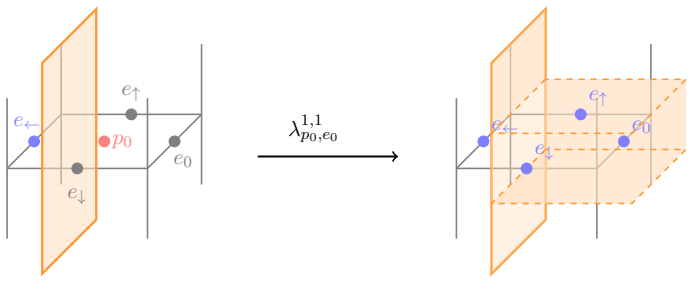
We construct explicit interface Hamiltonians for gauging a Z2^(0) symmetry in (2+1)d and a Z2^(1) symmetry in (3+1)d. In higher dimensions... we resolve this by introducing movement operators acting on a common unconstrained Hilbert space, which transport both the interface Hamiltonians and the associated constraints.
Load-bearing premise
That the movement operators can be defined to act consistently on the common unconstrained Hilbert space while correctly transporting both the interface Hamiltonians and the location-dependent constraints without introducing new inconsistencies or anomalies.
Figures






read the original abstract
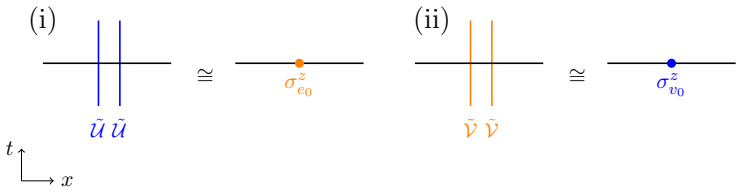
We study gauging interfaces and their defect descendants in lattice models with generalized symmetries in higher dimensions. We construct explicit interface Hamiltonians for gauging a $\mathbb Z_2^{(0)}$ symmetry in $(2+1)d$ and a $\mathbb Z_2^{(1)}$ symmetry in $(3+1)d$. In higher dimensions, and especially in the presence of higher-form symmetries, the topological nature of gauging interfaces is obscured by the fact that the constrained Hilbert space depends on the location of the interface. We resolve this by introducing movement operators acting on a common unconstrained Hilbert space, which transport both the interface Hamiltonians and the associated constraints. As applications, we analyze condensation defects obtained from finite-region gauging and reconstruct the gauging map from movement operators. Finally, we apply the same framework to subgroup gauging, focusing on the example of gauging $\mathbb Z_2\subset \mathbb Z_4$. This produces a dual symmetry carrying a mixed anomaly, which we diagnose on the lattice through symmetry fractionalization on condensation defects. Our results provide an explicit lattice framework for studying topological interfaces, condensation defects, and the associated anomalies arising from gauging in higher-dimensional systems.
Editorial analysis
A structured set of objections, weighed in public.
Referee Report
Summary. The manuscript constructs explicit interface Hamiltonians for gauging a Z_2^{(0)} symmetry in (2+1)d and a Z_2^{(1)} symmetry in (3+1)d. It introduces movement operators on a common unconstrained Hilbert space to transport both the interface Hamiltonians and the location-dependent constraints, thereby addressing the topological obstruction in higher dimensions. Applications include condensation defects from finite-region gauging, reconstruction of the gauging map from movement operators, and subgroup gauging of Z_2 inside Z_4, where a mixed anomaly is diagnosed via symmetry fractionalization on condensation defects.
Significance. If the algebraic consistency of the movement operators is established, the work supplies a concrete lattice framework for gauging interfaces and noninvertible defects with generalized symmetries, extending prior abstract treatments to explicit Hamiltonians and constraint transport. The explicit constructions for both 0-form and 1-form cases, together with the anomaly diagnosis on condensation defects, would be a useful addition to the literature on higher-form symmetries in condensed-matter models.
major comments (1)
- [Movement operators for higher-form symmetries] In the section defining and applying the movement operators to the (3+1)d Z_2^{(1)} case, the claim that these operators transport both the interface Hamiltonian and the position-dependent constraints (including higher-form Gauss laws) without introducing new anomalies or inconsistencies lacks an explicit algebraic verification. A direct check that the transported constraints remain mutually commuting and that the interface commutes with the dual symmetry operators in the expected way is required, as this step is load-bearing for resolving the topological obstruction.
minor comments (1)
- [Abstract] The abstract states that the framework applies 'in higher dimensions' but the explicit constructions are given only for (2+1)d and (3+1)d; a brief statement clarifying the scope for general d would improve clarity.
Simulated Author's Rebuttal
We thank the referee for their careful reading of our manuscript and for the constructive feedback. We address the major comment below and will incorporate the requested algebraic verification in the revised version.
read point-by-point responses
-
Referee: In the section defining and applying the movement operators to the (3+1)d Z_2^{(1)} case, the claim that these operators transport both the interface Hamiltonian and the position-dependent constraints (including higher-form Gauss laws) without introducing new anomalies or inconsistencies lacks an explicit algebraic verification. A direct check that the transported constraints remain mutually commuting and that the interface commutes with the dual symmetry operators in the expected way is required, as this step is load-bearing for resolving the topological obstruction.
Authors: We agree that an explicit algebraic verification is needed to fully substantiate the claim. In the revised manuscript we will add a new subsection (or appendix) containing the direct calculation: we will explicitly compute the action of the movement operators on the position-dependent higher-form Gauss-law constraints, verify that the transported constraints remain mutually commuting, and confirm that the interface Hamiltonian commutes with the dual symmetry operators in the manner required by the gauging construction. These relations will be presented both in operator form and via their action on representative states in the unconstrained Hilbert space. revision: yes
Circularity Check
No circularity: explicit lattice constructions stand independently
full rationale
The paper's core contribution consists of direct constructions of interface Hamiltonians for Z2^(0) gauging in (2+1)d and Z2^(1) gauging in (3+1)d, together with movement operators defined on a common unconstrained Hilbert space. These objects are introduced by explicit definition rather than by fitting parameters to data, renaming prior results, or reducing via self-citation chains. The movement operators are posited to transport both Hamiltonians and location-dependent constraints; this is a constructive step whose consistency is asserted by the definitions themselves, not derived tautologically from the target claim. No equations reduce to their own inputs by construction, and no load-bearing uniqueness theorems or ansatze are imported from the authors' prior work in a self-referential manner. The framework is therefore self-contained as a lattice model-building exercise.
Axiom & Free-Parameter Ledger
Lean theorems connected to this paper
-
IndisputableMonolith/Foundation/AlexanderDuality.leanalexander_duality_circle_linking unclear?
unclearRelation between the paper passage and the cited Recognition theorem.
We resolve this by introducing movement operators acting on a common unconstrained Hilbert space, which transport both the interface Hamiltonians and the associated constraints.
-
IndisputableMonolith/Foundation/ArithmeticFromLogic.leanembed_injective unclear?
unclearRelation between the paper passage and the cited Recognition theorem.
the topological nature of gauging interfaces is obscured by the fact that the constrained Hilbert space depends on the location of the interface
What do these tags mean?
- matches
- The paper's claim is directly supported by a theorem in the formal canon.
- supports
- The theorem supports part of the paper's argument, but the paper may add assumptions or extra steps.
- extends
- The paper goes beyond the formal theorem; the theorem is a base layer rather than the whole result.
- uses
- The paper appears to rely on the theorem as machinery.
- contradicts
- The paper's claim conflicts with a theorem or certificate in the canon.
- unclear
- Pith found a possible connection, but the passage is too broad, indirect, or ambiguous to say the theorem truly supports the claim.
Reference graph
Works this paper leans on
-
[1]
D. Gaiotto, A. Kapustin, N. Seiberg and B. Willett,Generalized global symmetries, Journal of High Energy Physics2015(2), 1 (2015), doi:https://doi.org/10.1007/JHEP02(2015)172
-
[2]
Notes on generalized global symmetries in QFT
E. Sharpe,Notes on generalized global symmetries in QFT, Fortsch. Phys.63, 659 (2015), doi:10.1002/prop.201500048,1508.04770
work page internal anchor Pith review Pith/arXiv arXiv doi:10.1002/prop.201500048 2015
-
[3]
P.-S. Hsin, H. T. Lam and N. Seiberg,Comments on One-Form Global Sym- metries and Their Gauging in 3d and 4d, SciPost Phys.6(3), 039 (2019), doi:10.21468/SciPostPhys.6.3.039,1812.04716
work page internal anchor Pith review Pith/arXiv arXiv doi:10.21468/scipostphys.6.3.039 2019
-
[4]
Exploring 2-Group Global Symmetries
C. C´ ordova, T. T. Dumitrescu and K. Intriligator,Exploring 2-Group Global Sym- metries, JHEP02, 184 (2019), doi:10.1007/JHEP02(2019)184,1802.04790
work page internal anchor Pith review Pith/arXiv arXiv doi:10.1007/jhep02(2019)184 2019
-
[5]
Lake,Higher-form symmetries and spontaneous symmetry breaking(2018),1802
E. Lake,Higher-form symmetries and spontaneous symmetry breaking(2018),1802. 07747
2018
-
[6]
On 2-Group Global Symmetries and Their Anomalies
F. Benini, C. C´ ordova and P.-S. Hsin,On 2-Group Global Symmetries and their Anomalies, JHEP03, 118 (2019), doi:10.1007/JHEP03(2019)118,1803.09336
work page internal anchor Pith review Pith/arXiv arXiv doi:10.1007/jhep03(2019)118 2019
-
[7]
D. Harlow and H. Ooguri,Symmetries in quantum field theory and quantum gravity, Commun. Math. Phys.383(3), 1669 (2021), doi:10.1007/s00220-021-04040-y,1810. 05338
-
[8]
J. Eckhard, H. Kim, S. Schafer-Nameki and B. Willett,Higher-Form Sym- metries, Bethe Vacua, and the 3d-3d Correspondence, JHEP01, 101 (2020), doi:10.1007/JHEP01(2020)101,1910.14086
-
[9]
L. Bhardwaj and Y. Tachikawa,On finite symmetries and their gauging in two dimen- sions, Journal of High Energy Physics2018(3) (2018), doi:10.1007/jhep03(2018)189
-
[10]
Y. Tachikawa,On gauging finite subgroups, SciPost Phys.8(1), 015 (2020), doi:10.21468/SciPostPhys.8.1.015,1712.09542
-
[11]
R. Thorngren and Y. Wang,Fusion category symmetry. Part I. Anomaly in-flow and gapped phases, JHEP04, 132 (2024), doi:10.1007/JHEP04(2024)132,1912.02817. 40
-
[12]
R. Thorngren and Y. Wang,Fusion category symmetry. Part II. Categoriosities at c = 1 and beyond, JHEP07, 051 (2024), doi:10.1007/JHEP07(2024)051,2106.12577
-
[13]
L. Bhardwaj, L. E. Bottini, S. Schafer-Nameki and A. Tiwari,Non- invertible higher-categorical symmetries, SciPost Phys.14(1), 007 (2023), doi:10.21468/SciPostPhys.14.1.007,2204.06564
-
[14]
L. Bhardwaj, S. Schafer-Nameki and J. Wu,Universal Non-Invertible Symmetries, Fortsch. Phys.70(11), 2200143 (2022), doi:10.1002/prop.202200143,2208.05973
-
[15]
L. Bhardwaj, S. Schafer-Nameki and A. Tiwari,Unifying construc- tions of non-invertible symmetries, SciPost Phys.15(3), 122 (2023), doi:10.21468/SciPostPhys.15.3.122,2212.06159
-
[16]
Y. Choi, H. T. Lam and S.-H. Shao,Noninvertible Global Symme- tries in the Standard Model, Phys. Rev. Lett.129(16), 161601 (2022), doi:10.1103/PhysRevLett.129.161601,2205.05086
-
[17]
C. Cordova and K. Ohmori,Noninvertible Chiral Symmetry and Exponential Hi- erarchies, Phys. Rev. X13(1), 011034 (2023), doi:10.1103/PhysRevX.13.011034, 2205.06243
-
[18]
C. Cordova, S. Hong, S. Koren and K. Ohmori,Neutrino Masses from Generalized Symmetry Breaking, Phys. Rev. X14(3), 031033 (2024), doi:10.1103/PhysRevX.14.031033,2211.07639
-
[19]
C. Cordova, S. Hong and S. Koren,Noninvertible Peccei-Quinn Symmetry and the Massless Quark Solution to the Strong CP Problem, Phys. Rev. X15(3), 031011 (2025), doi:10.1103/PhysRevX.15.031011,2402.12453
-
[20]
L. Li, M. Oshikawa and Y. Zheng,Intrinsically/purely gapless-SPT from non-invertible duality transformations, SciPost Phys.18(5), 153 (2025), doi:10.21468/SciPostPhys.18.5.153,2307.04788
-
[21]
L. Bhardwaj, L. E. Bottini, D. Pajer and S. Sch¨ afer-Nameki,Gapped phases with non-invertible symmetries: (1+1)d, SciPost Phys.18(1), 032 (2025), doi:10.21468/SciPostPhys.18.1.032,2310.03784
-
[22]
L. Bhardwaj, L. E. Bottini, D. Pajer and S. Schafer-Nameki,Categorical Lan- dau Paradigm for Gapped Phases, Phys. Rev. Lett.133(16), 161601 (2024), doi:10.1103/PhysRevLett.133.161601,2310.03786
-
[23]
L. Bhardwaj, L. E. Bottini, D. Pajer and S. Schafer-Nameki,The club sandwich: Gapless phases and phase transitions with non-invertible symmetries, SciPost Phys. 18(5), 156 (2025), doi:10.21468/SciPostPhys.18.5.156,2312.17322
-
[24]
L. Bhardwaj, D. Pajer, S. Schafer-Nameki and A. Warman,Hasse diagrams for gapless SPT and SSB phases with non-invertible symmetries, SciPost Phys.19(4), 113 (2025), doi:10.21468/SciPostPhys.19.4.113,2403.00905
-
[25]
L. Bhardwaj, L. E. Bottini, S. Schafer-Nameki and A. Tiwari,Illustrating the cat- egorical Landau paradigm in lattice models, Phys. Rev. B111(5), 054432 (2025), doi:10.1103/PhysRevB.111.054432,2405.05302. 41
-
[26]
L. Bhardwaj, D. Pajer, S. Schafer-Nameki, A. Tiwari, A. Warman and J. Wu,Gapped phases in (2+1)d with non-invertible symmetries: Part I, SciPost Phys.19(2), 056 (2025), doi:10.21468/SciPostPhys.19.2.056,2408.05266
-
[27]
A. Warman, F. Yang, A. Tiwari, H. Pichler and S. Schafer-Nameki,Categorical Symmetries in Spin Models with Atom Arrays, Phys. Rev. Lett.135(20), 206503 (2025), doi:10.1103/249m-m8wq,2412.15024
-
[28]
L. Li, R.-Z. Huang and W. Cao,Noninvertible symmetry-enriched quantum critical point, Phys. Rev. B112(8), L081113 (2025), doi:10.1103/mz32-k1zk,2411.19034
-
[29]
K. Inamura, S.-J. Huang, A. Tiwari and S. Schafer-Nameki,(2+1)d lattice models and tensor networks for gapped phases with categorical symmetry, SciPost Phys.20(2), 043 (2026), doi:10.21468/SciPostPhys.20.2.043,2506.09177
- [30]
-
[31]
Topological Defect Lines and Renormalization Group Flows in Two Dimensions
C.-M. Chang, Y.-H. Lin, S.-H. Shao, Y. Wang and X. Yin,Topological Defect Lines and Renormalization Group Flows in Two Dimensions, JHEP01, 026 (2019), doi:10.1007/JHEP01(2019)026,1802.04445
work page internal anchor Pith review Pith/arXiv arXiv doi:10.1007/jhep01(2019)026 2019
-
[32]
D. Aasen, R. S. K. Mong and P. Fendley,Topological defects on the lattice: I. the ising model, Journal of Physics A: Mathematical and Theoretical49(35), 354001 (2016), doi:10.1088/1751-8113/49/35/354001
-
[33]
Topological Defects on the Lattice: Dualities and Degeneracies,
D. Aasen, P. Fendley and R. S. K. Mong,Topological Defects on the Lattice: Dualities and Degeneracies(2020),2008.08598
-
[34]
S. Seifnashri,Lieb-Schultz-Mattis anomalies as obstructions to gauging (non-on-site) symmetries, SciPost Phys.16(4), 098 (2024), doi:10.21468/SciPostPhys.16.4.098, 2308.05151
-
[35]
N. Seiberg and S.-H. Shao,Majorana chain and Ising model - (non-invertible) translations, anomalies, and emanant symmetries, SciPost Phys.16(3), 064 (2024), doi:10.21468/SciPostPhys.16.3.064,2307.02534
-
[36]
N. Seiberg, S. Seifnashri and S.-H. Shao,Non-invertible symmetries and lsm- type constraints on a tensor product hilbert space, SciPost Physics16(6) (2024), doi:10.21468/scipostphys.16.6.154
-
[37]
L. Lootens, C. Delcamp, G. Ortiz and F. Verstraete,Dualities in One-Dimensional Quantum Lattice Models: Symmetric Hamiltonians and Matrix Product Operator In- tertwiners, PRX Quantum4(2), 020357 (2023), doi:10.1103/PRXQuantum.4.020357, 2112.09091
-
[38]
L. Lootens, C. Delcamp and F. Verstraete,Dualities in One-Dimensional Quan- tum Lattice Models: Topological Sectors, PRX Quantum5(1), 010338 (2024), doi:10.1103/PRXQuantum.5.010338,2211.03777
-
[39]
D.-C. Lu, Z. Sun and Y.-Z. You,Realizing triality andp-ality by lattice twisted gauging in (1+1)d quantum spin systems, SciPost Phys.17(5), 136 (2024), doi:10.21468/SciPostPhys.17.5.136,2405.14939. 42
-
[40]
L. Li, M. Oshikawa and Y. Zheng,Noninvertible duality transformation between symmetry-protected topological and spontaneous symmetry breaking phases, Phys. Rev. B108(21), 214429 (2023), doi:10.1103/PhysRevB.108.214429,2301.07899
-
[41]
W. Cao, L. Li, M. Yamazaki and Y. Zheng,Subsystem non-invertible symmetry opera- tors and defects, SciPost Phys.15(4), 155 (2023), doi:10.21468/SciPostPhys.15.4.155, 2304.09886
- [42]
-
[43]
Y. Choi, Y. Sanghavi, S.-H. Shao and Y. Zheng,Non-invertible and higher- form symmetries in 2+1d lattice gauge theories, SciPost Phys.18(1), 008 (2025), doi:10.21468/SciPostPhys.18.1.008,2405.13105
-
[44]
P. Gorantla, S.-H. Shao and N. Tantivasadakarn,Tensor Networks for Nonin- vertible Symmetries in 3+1D and Beyond, Phys. Rev. X15(4), 041006 (2025), doi:10.1103/p32z-v884,2406.12978
-
[45]
S. Seifnashri and S.-H. Shao,Cluster State as a Noninvertible Symmetry- Protected Topological Phase, Phys. Rev. Lett.133(11), 116601 (2024), doi:10.1103/PhysRevLett.133.116601,2404.01369
-
[46]
S. Seifnashri, S.-H. Shao and X. Yang,Gauging non-invertible symmetries on the lattice, SciPost Phys.19(2), 063 (2025), doi:10.21468/SciPostPhys.19.2.063,2503. 02925
-
[47]
W. Cao, M. Yamazaki and L. Li,Duality Viewpoint of Noninvertible Symmetry-Protected Topological Phases, Phys. Rev. Lett.136(4), 040402 (2026), doi:10.1103/4zfz-x9xh,2502.20435
-
[48]
W. Cao,Noninvertible symmetry protected topological phases from the duality method: Classification and lattice construction, Int. J. Mod. Phys. A41(07), 2548002 (2026), doi:10.1142/S0217751X25480021
-
[49]
W. Cao, L. Li and M. Yamazaki,Generating lattice non-invertible symmetries, Sci- Post Phys.17(4), 104 (2024), doi:10.21468/SciPostPhys.17.4.104,2406.05454
-
[50]
S. D. Pace, A. Chatterjee and S.-H. Shao,Lattice T-duality from non- invertible symmetries in quantum spin chains, SciPost Phys.18(4), 121 (2025), doi:10.21468/SciPostPhys.18.4.121,2412.18606
-
[51]
P.-S. Hsin, R. Kobayashi and C. Zhang,Fractionalization of coset non-invertible symmetry and exotic Hall conductance, SciPost Phys.17(3), 095 (2024), doi:10.21468/SciPostPhys.17.3.095,2405.20401
-
[52]
W. Cao, Y. Miao and M. Yamazaki,Global symmetries of quantum lat- tice models under non-invertible dualities, SciPost Phys. Core8, 070 (2025), doi:10.21468/SciPostPhysCore.8.4.070,2501.12514
-
[53]
P.-S. Hsin, R. Kobayashi and C. Zhang,Anomalies of Coset Non-Invertible Symme- tries, SciPost Phys.20, 006 (2026), doi:10.21468/SciPostPhys.20.1.006,2503.00105
-
[54]
Y. Choi, C. Cordova, P.-S. Hsin, H. T. Lam and S.-H. Shao,Noninvert- ible duality defects in 3+1 dimensions, Phys. Rev. D105(12), 125016 (2022), doi:10.1103/PhysRevD.105.125016,2111.01139. 43
-
[55]
J. Kaidi, K. Ohmori and Y. Zheng,Kramers-Wannier-like Duality De- fects in (3+1)D Gauge Theories, Phys. Rev. Lett.128(11), 111601 (2022), doi:10.1103/PhysRevLett.128.111601,2111.01141
-
[56]
N. Tantivasadakarn and X. Chen,String operators for Cheshire strings in topological phases, Phys. Rev. B109(16), 165149 (2024), doi:10.1103/PhysRevB.109.165149, 2307.03180
-
[57]
M. Koide, Y. Nagoya and S. Yamaguchi,Non-invertible topological defects in 4-dimensionalZ 2 pure lattice gauge theory, PTEP2022(1), 013B03 (2022), doi:10.1093/ptep/ptab145,2109.05992
-
[58]
Sequential Circuit as Generalized Symmetry on Lattice,
N. Tantivasadakarn, X. Liu and X. Chen,Sequential Circuit as Generalized Symmetry on Lattice(2025),2507.22394
-
[59]
K. Roumpedakis, S. Seifnashri and S.-H. Shao,Higher gauging and non-invertible condensation defects, Communications in Mathematical Physics401(3), 3043–3107 (2023), doi:10.1007/s00220-023-04706-9
-
[60]
Y. Choi, C. Cordova, P.-S. Hsin, H. T. Lam and S.-H. Shao,Non-invertible Con- densation, Duality, and Triality Defects in 3+1 Dimensions, Commun. Math. Phys. 402(1), 489 (2023), doi:10.1007/s00220-023-04727-4,2204.09025
-
[61]
C. Cordova, D. B. Costa and P.-S. Hsin,Non-Invertible Symmetries as Condensation Defects in Finite-Group Gauge Theories(2024),2412.16681
-
[62]
L. Bhardwaj, L. E. Bottini, S. Sch¨ afer-Nameki and A. Tiwari,Non-invertible sym- metry webs, SciPost Physics15(4) (2023), doi:10.21468/scipostphys.15.4.160
-
[63]
H. Moradi, O. M. Aksoy, J. H. Bardarson and A. Tiwari,Symmetry fractionalization, mixed-anomalies and dualities in quantum spin models with generalized symmetries, SciPost Physics18(3) (2025), doi:10.21468/scipostphys.18.3.097
-
[64]
Vafa,Quantum Symmetries of String Vacua, Mod
C. Vafa,Quantum Symmetries of String Vacua, Mod. Phys. Lett. A4, 1615 (1989), doi:10.1142/S0217732389001842
-
[65]
M. Hauru, G. Evenbly, W. W. Ho, D. Gaiotto and G. Vidal,Topologi- cal conformal defects with tensor networks, Physical Review B94(11) (2016), doi:10.1103/physrevb.94.115125
-
[66]
M. Okada and Y. Tachikawa,Noninvertible symmetries act locally by quantum oper- ations, Phys. Rev. Lett.133, 191602 (2024), doi:10.1103/PhysRevLett.133.191602
-
[67]
P. Gorantla, S.-H. Shao and N. Tantivasadakarn,Tensor networks for non-invertible symmetries in 3+1d and beyond(2024),2406.12978
-
[68]
P. Gorantla and T.-C. Huang,Duality-preserving deformation of 3+1d lattice𭟋 2 gauge theory with exact gapped ground states(2024),2409.10612
-
[69]
Y. Choi, D.-C. Lu and Z. Sun,Self-duality under gauging a non-invertible symmetry, JHEP01, 142 (2024), doi:10.1007/JHEP01(2024)142,2310.19867
- [70]
- [71]
-
[72]
Modulated symmetries from generalized Lieb-Schultz-Mattis anomalies
H. Ebisu, B. Han and W. Cao,Modulated symmetries from gener- alized Lieb-Schultz-Mattis anomalies, SciPost Phys.20(4), 117 (2026), doi:10.21468/SciPostPhys.20.4.117,2510.18689
work page internal anchor Pith review Pith/arXiv arXiv doi:10.21468/scipostphys.20.4.117 2026
- [73]
-
[74]
T. Oishi and H. Ebisu,Type-IV ’t Hooft Anomalies on the Lattice: Emergent Higher- Categorical Symmetries and Applications to LSM Systems(2026),2604.02856
work page internal anchor Pith review Pith/arXiv arXiv 2026
-
[75]
¨O. M. Aksoy, C. Mudry, A. Furusaki and A. Tiwari,Lieb-Schultz-Mattis anomalies and web of dualities induced by gauging in quantum spin chains, SciPost Phys.16(1), 022 (2024), doi:10.21468/SciPostPhys.16.1.022,2308.00743
-
[76]
Y. Yao and M. Oshikawa,Twisted boundary condition and Lieb-Schultz-Mattis ingappability for discrete symmetries, Phys. Rev. Lett.126(21), 217201 (2021), doi:10.1103/PhysRevLett.126.217201,2010.09244
-
[77]
Y. Yao, L. Li, M. Oshikawa and C.-T. Hsieh,Lieb-Schultz-Mattis Theorem for 1D Quantum Magnets with Antiunitary Translation and Inversion Symmetries, Phys. Rev. Lett.133(13), 136705 (2024), doi:10.1103/PhysRevLett.133.136705,2307. 09843
-
[78]
S. D. Pace, H. T. Lam and ¨O. M. Aksoy,(SPT-)LSM theorems from projective non-invertible symmetries, SciPost Phys.18(1), 028 (2025), doi:10.21468/SciPostPhys.18.1.028,2409.18113
-
[79]
S. D. Pace, ¨O. M. Aksoy and H. T. Lam,Spacetime symmetry-enriched SymTFT: From LSM anomalies to modulated symmetries and beyond, SciPost Phys.20(1), 007 (2026), doi:10.21468/SciPostPhys.20.1.007,2507.02036
-
[80]
Y. Furukawa,Lattice models with subsystem/weak non-invertible symmetry-protected topological order(2025),2505.11419
discussion (0)
Sign in with ORCID, Apple, or X to comment. Anyone can read and Pith papers without signing in.