Recognition: unknown
The flare and spiral structure of the Milky Way's disc as traced by young giant stars
Pith reviewed 2026-05-14 20:25 UTC · model grok-4.3
The pith
Young giant stars map the Milky Way's flaring disc and extend spiral arm segments by 2-4 kpc.
A machine-rendered reading of the paper's core claim, the machinery that carries it, and where it could break.
Core claim
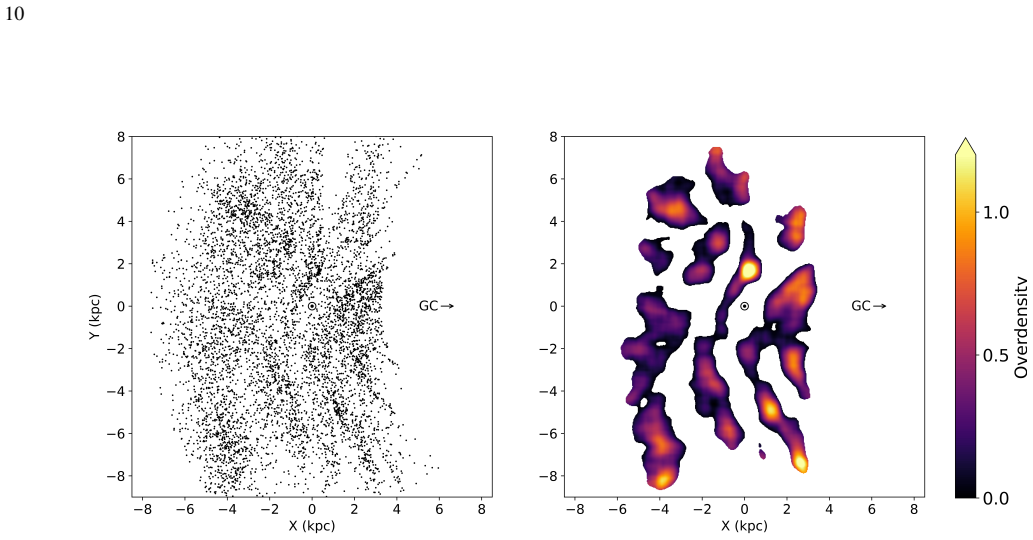
Young giant stars trace a thin disc with local scale height 77 pc that flares outward with radial scale length 3.5 kpc; in the plane they delineate coherent spiral arm segments that extend previous maps by 2-4 kpc, support a roughly 20-degree pitch for the Perseus Arm, reveal the Local/Orion arm as an extended 10 kpc structure with gentle curvature, and identify a new segment associated with the Scutum Arm detached from the Sagittarius-Carina Arm.
What carries the argument
Young giant stars as tracers, after correction for survey selection function and vertical displacements from the Galactic warp and corrugations.
If this is right
- The disc scale height grows exponentially outward, producing a thicker outer disc.
- Spiral arms remain coherent over distances several kiloparsecs longer than previously traced.
- The Perseus Arm follows a constant pitch angle of roughly 20 degrees across the mapped region.
- The Local/Orion arm forms a single extended, gently curving feature rather than a short straight segment.
- A distinct inner-Galaxy feature appears associated with the Scutum Arm and separated from the Sagittarius-Carina Arm.
Where Pith is reading between the lines
- Updated arm geometries can be used to test dynamical models of spiral structure maintenance.
- The measured flare length scale supplies a new constraint on outer-disc heating mechanisms.
- The extended Local arm length suggests it may connect to outer-arm features seen in other tracers.
- Similar mapping with future deeper surveys could test whether the flare continues beyond 8 kpc.
Load-bearing premise
The survey selection function and the vertical displacements from the Galactic warp and corrugations can be accurately modeled and subtracted.
What would settle it
New distance and position data for young giants that show no radial increase in disc thickness or that break the reported spiral arm segments into disconnected pieces.
Figures




read the original abstract
We explore the three-dimensional structure of a sample of $\sim$ 16000 young giant stars in the Galactic disc out to $\sim$8 kpc in heliocentric distance. This population traces a thin disc with a local vertical scale height of $h_{Z \odot} = 77 \pm 4$ pc, that progressively thickens toward the outer Galaxy with a prominent Galactic flare, rising exponentially with a radial scale length of $h_{fl} = 3.5 \pm 0.3 \, \rm{kpc}$. Our analysis incorporates both the survey selection function and the vertical displacements caused by the Galactic warp and corrugations, which, if neglected, would lead to significant biases in the derived disc scale height. In the Galactic plane, the young giants trace coherent spiral arm segments, extending previous maps based on upper main sequence (UMS) and OB stars by 2-4 kpc depending on the considered direction. The obtained map supports a pitch angle of roughly 20 degrees for the Perseus Arm, and shows that the Local/Orion arm stretches at least 10 kpc in length. Unlike earlier and more local maps based on UMS and OB stars, where the relatively small sampled portion of the Perseus Arm appeared as a short, nearly straight feature, our map reveals it as an extended structure with a gentle curvature, as expected for spiral arms on large scales. In the inner Galaxy, we also identify a new segment likely associated with the Scutum Arm, clearly detached from the Sagittarius-Carina Arm in the fourth Galactic quadrant.
Editorial analysis
A structured set of objections, weighed in public.
Referee Report
Summary. The manuscript analyzes a sample of ~16000 young giant stars in the Galactic disc out to ~8 kpc heliocentric distance. It reports a thin disc with local vertical scale height h_{Z⊙} = 77 ± 4 pc that flares outward with radial scale length h_fl = 3.5 ± 0.3 kpc. After applying survey selection function and corrections for vertical displacements due to the Galactic warp and corrugations, the stars are shown to trace coherent spiral arm segments that extend prior UMS/OB-star maps by 2-4 kpc, supporting a ~20° pitch angle for the Perseus Arm, a Local/Orion arm at least 10 kpc long with gentle curvature, and a new segment likely associated with the Scutum Arm.
Significance. If the corrections hold, the work provides a valuable extension of Milky Way spiral structure maps to larger radii using a distinct tracer population, yielding quantitative flare parameters and geometric constraints (e.g., Perseus pitch and Local arm length) that can be compared against dynamical models. The direct use of observed positions after stated corrections avoids obvious circularity.
major comments (2)
- [Abstract] Abstract: the central claims of coherent spiral arm segments extending 2-4 kpc and the specific geometries (20° Perseus pitch, 10 kpc Local arm) depend on accurate subtraction of warp/corrugation vertical displacements to recover in-plane (x,y) locations. No quantitative validation, residual error budget, or test of how subtraction residuals affect arm coherence at large radii is described, which is load-bearing for the extension and curvature results.
- [Abstract] Abstract and methods description: the fitted values h_{Z⊙} and h_fl are reported with uncertainties, yet no details are given on the fitting procedure, data cuts, or how selection function and warp models were jointly applied, preventing assessment of whether the reported uncertainties fully capture systematic effects.
minor comments (1)
- [Abstract] Abstract: the notation h_{Z ⊙} and h_fl is clear but could be defined explicitly on first use for readers unfamiliar with Galactic disc conventions.
Simulated Author's Rebuttal
We thank the referee for their thorough review and positive evaluation of the significance of our study. We have carefully considered the major comments and revised the manuscript to include quantitative validation of the warp corrections and expanded details on the fitting procedure for the disc parameters.
read point-by-point responses
-
Referee: [Abstract] Abstract: the central claims of coherent spiral arm segments extending 2-4 kpc and the specific geometries (20° Perseus pitch, 10 kpc Local arm) depend on accurate subtraction of warp/corrugation vertical displacements to recover in-plane (x,y) locations. No quantitative validation, residual error budget, or test of how subtraction residuals affect arm coherence at large radii is described, which is load-bearing for the extension and curvature results.
Authors: We agree that demonstrating the robustness of the warp and corrugation corrections is crucial for the reliability of the spiral arm extensions. In the revised version, we have included a new appendix with quantitative validation tests. These include an error budget for the residual vertical displacements after correction, derived from the uncertainties in the warp model parameters. Additionally, we performed Monte Carlo simulations by adding random residuals to the corrected positions and re-identifying the arm segments, showing that the coherence and curvature of the Perseus and Local arms are preserved at the reported scales. This supports the extension by 2-4 kpc and the 20° pitch angle. revision: yes
-
Referee: [Abstract] Abstract and methods description: the fitted values h_{Z⊙} and h_fl are reported with uncertainties, yet no details are given on the fitting procedure, data cuts, or how selection function and warp models were jointly applied, preventing assessment of whether the reported uncertainties fully capture systematic effects.
Authors: We acknowledge the lack of detail in the original submission regarding the fitting process. We have expanded the Methods section to describe the data selection criteria (e.g., age cuts, distance limits, and quality flags), the maximum-likelihood fitting procedure used to jointly model the vertical density profile while accounting for the survey selection function and the warp-induced displacements. The uncertainties now explicitly include both statistical and systematic components from the warp model variations. These additions allow readers to fully assess the robustness of h_{Z⊙} = 77 ± 4 pc and h_fl = 3.5 ± 0.3 kpc. revision: yes
Circularity Check
No significant circularity in derivation chain
full rationale
The paper reports direct positional mapping of ~16000 young giant stars after explicit corrections for survey selection, Galactic warp, and corrugations. The flare scale length (h_fl = 3.5 kpc) and spiral arm segments (Perseus pitch ~20°, Local arm ~10 kpc) are presented as measured outcomes from the corrected (x,y,z) coordinates, not as quantities defined by or fitted to the same arm geometry. No equations reduce reported structures to self-referential inputs, no predictions are statistically forced by prior fits, and no load-bearing self-citations or imported uniqueness theorems are invoked to justify the central claims. The derivation remains self-contained against external benchmarks.
Axiom & Free-Parameter Ledger
free parameters (2)
- flare radial scale length h_fl =
3.5 kpc
- local vertical scale height h_Z⊙ =
77 pc
axioms (2)
- domain assumption Young giant stars remain close to their birth radii and heights and therefore faithfully trace the present-day thin-disc structure.
- domain assumption The survey selection function together with warp and corrugation displacements can be modeled accurately enough to remove bias from the derived scale height.
Reference graph
Works this paper leans on
-
[1]
Amˆores, E. B., Robin, A. C., & Reyl´e, C. 2017, A&A, 602, A67, doi: 10.1051/0004-6361/201628461
-
[2]
2023, ApJS, 267, 8, doi: 10.3847/1538-4365/acd53e
Andrae, R., Rix, H.-W., & Chandra, V . 2023, ApJS, 267, 8, doi: 10.3847/1538-4365/acd53e
-
[3]
2025, arXiv e-prints, arXiv:2507.15473, doi: 10.48550/arXiv.2507.15473
Ard`evol, J., Semczuk, M., Antoja, T., et al. 2025, arXiv e-prints, arXiv:2507.15473, doi: 10.48550/arXiv.2507.15473
-
[4]
Asano, T., Kawata, D., Fujii, M. S., & Baba, J. 2024, MNRAS, 529, L7, doi: 10.1093/mnrasl/slad190
-
[5]
Bailer-Jones, C. A. L. 2015, PASP, 127, 994, doi: 10.1086/683116 20
-
[6]
Belokurov, V ., Erkal, D., Evans, N. W., Koposov, S. E., & Deason, A. J. 2018, MNRAS, 478, 611, doi: 10.1093/mnras/sty982
-
[7]
Bensby, T., Alves-Brito, A., Oey, M. S., Yong, D., & Mel´endez, J. 2011, ApJL, 735, L46, doi: 10.1088/2041-8205/735/2/L46
-
[8]
Binney, J., & Vasiliev, E. 2023, MNRAS, 520, 1832, doi: 10.1093/mnras/stad094
-
[10]
2016, ARA&A, 54, 529, doi: 10.1146/annurev-astro-081915-023441 Bogd´ an,´A., Forman, W
Bland-Hawthorn, J., & Gerhard, O. 2016b, ARA&A, 54, 529, doi: 10.1146/annurev-astro-081915-023441
-
[11]
Bland-Hawthorn, J., & Maloney, P. R. 2002, in Astronomical Society of the Pacific Conference Series, V ol. 254, Extragalactic Gas at Low Redshift, ed. J. S. Mulchaey & J. T. Stocke, 267, doi: 10.48550/arXiv.astro-ph/0110044
work page internal anchor Pith review Pith/arXiv arXiv doi:10.48550/arxiv.astro-ph/0110044 2002
-
[12]
Bobylev, V . V . 2022, Astronomy Letters, 48, 126, doi: 10.1134/S1063773722010017
-
[13]
Bovy, J., Rix, H.-W., Green, G. M., Schlafly, E. F., & Finkbeiner, D. P. 2016, The Astrophysical Journal, 818, 130, doi: 10.3847/0004-637x/818/2/130
-
[14]
2012, ApJ, 753, 148, doi: 10.1088/0004-637X/753/2/148
Bovy, J., Rix, H.-W., Liu, C., et al. 2012, ApJ, 753, 148, doi: 10.1088/0004-637X/753/2/148
-
[15]
Bressan, A., Marigo, P., Girardi, L., et al. 2012, MNRAS, 427, 127, doi: 10.1111/j.1365-2966.2012.21948.x
-
[16]
Castro-Ginard, A., Brown, A. G. A., Kostrzewa-Rutkowska, Z., et al. 2023, A&A, 677, A37, doi: 10.1051/0004-6361/202346547
-
[17]
2015, MNRAS, 452, 1068, doi: 10.1093/mnras/stv1281
Chen, Y ., Bressan, A., Girardi, L., et al. 2015, MNRAS, 452, 1068, doi: 10.1093/mnras/stv1281
-
[18]
Chen, Y ., Girardi, L., Bressan, A., et al. 2014, MNRAS, 444, 2525, doi: 10.1093/mnras/stu1605 Chrob´akov´a, ˇZ., Nagy, R., & L´opez-Corredoira, M. 2022, A&A, 664, A58, doi: 10.1051/0004-6361/202243296 De Angeli, F., Weiler, M., Montegriffo, P., et al. 2023, A&A, 674, A2, doi: 10.1051/0004-6361/202243680
-
[19]
Denyshchenko, S. I., Fedorov, P. N., Akhmetov, V . S., Velichko, A. B., & Dmytrenko, A. M. 2024, MNRAS, 527, 1472, doi: 10.1093/mnras/stad3350
-
[20]
Drimmel, R., Khanna, S., Poggio, E., & Skowron, D. M. 2025, A&A, 698, A230, doi: 10.1051/0004-6361/202451100
-
[21]
2018, Research Notes of the American Astronomical Society, 2, 210, doi: 10.3847/2515-5172/aaef8b
Drimmel, R., & Poggio, E. 2018, Research Notes of the American Astronomical Society, 2, 210, doi: 10.3847/2515-5172/aaef8b
-
[22]
D., & Babu, G
Feigelson, E. D., & Babu, G. J. 2012, Modern Statistical Methods for Astronomy
2012
-
[23]
Foreman-Mackey, D., Hogg, D. W., Lang, D., & Goodman, J. 2013, PASP, 125, 306, doi: 10.1086/670067
-
[24]
Freedman, D., & Diaconis, P. 1981, Zeitschrift f¨ur Wahrscheinlichkeitstheorie und Verwandte Gebiete, 57, 210, doi: 10.1007/BF01025868
-
[25]
2002, ARA&A, 40, 487, doi: 10.1146/annurev.astro.40.060401.093840
Freeman, K., & Bland-Hawthorn, J. 2002, ARA&A, 40, 487, doi: 10.1146/annurev.astro.40.060401.093840
-
[26]
Funakoshi, N., Matsunaga, N., Kawata, D., et al. 2024, MNRAS, 533, 4324, doi: 10.1093/mnras/stae2041 Gaia Collaboration, Drimmel, R., Romero-G´omez, M., et al. 2023a, A&A, 674, A37, doi: 10.1051/0004-6361/202243797 Gaia Collaboration, Vallenari, A., Brown, A. G. A., et al. 2023b, A&A, 674, A1, doi: 10.1051/0004-6361/202243940 Gaia Collaboration, Recio-Bla...
-
[27]
M., & Georgelin, Y
Georgelin, Y . M., & Georgelin, Y . P. 1976, A&A, 49, 57
1976
-
[28]
Galactic structure towards the South Pole and the Galactic thick disc
Gilmore, G., & Reid, N. 1983, MNRAS, 202, 1025, doi: 10.1093/mnras/202.4.1025
-
[29]
Girardi, L. 2016, ARA&A, 54, 95, doi: 10.1146/annurev-astro-081915-023354 GRA VITY Collaboration, Abuter, R., Aimar, N., et al. 2022, A&A, 657, L12, doi: 10.1051/0004-6361/202142465 G´orski, K. M., Hivon, E., Banday, A. J., et al. 2005, The Astrophysical Journal, 622, 759, doi: 10.1086/427976
-
[30]
Helmi, A., Babusiaux, C., Koppelman, H. H., et al. 2018, Nature, 563, 85, doi: 10.1038/s41586-018-0625-x
-
[31]
Hou, L. G., & Han, J. L. 2014, A&A, 569, A125, doi: 10.1051/0004-6361/201424039
-
[32]
Astronomy and Astrophysics , author =
Hunt, E. L., & Reffert, S. 2023, A&A, 673, A114, doi: 10.1051/0004-6361/202346285
-
[33]
Hunt, J. A. S., & Vasiliev, E. 2025, NewAR, 100, 101721, doi: 10.1016/j.newar.2024.101721
-
[34]
Kalberla, P. M. W., & Kerp, J. 2009, ARA&A, 47, 27, doi: 10.1146/annurev-astro-082708-101823
-
[35]
Moustakas, L. A. 2008, ApJ, 688, 254, doi: 10.1086/591958
-
[36]
2023, MNRAS, 520, 5002, doi: 10.1093/mnras/stad233
Khanna, S., Sharma, S., Bland-Hawthorn, J., & Hayden, M. 2023, MNRAS, 520, 5002, doi: 10.1093/mnras/stad233
-
[37]
2025, A&A, 701, A270, doi: 10.1051/0004-6361/202452798
Khanna, S., Yu, J., Drimmel, R., et al. 2025, A&A, 701, A270, doi: 10.1051/0004-6361/202452798
-
[38]
Kuhn, M. A., de Souza, R. S., Krone-Martins, A., et al. 2021a, ApJS, 254, 33, doi: 10.3847/1538-4365/abe465
-
[39]
Kuhn, M. A., Benjamin, R. A., Zucker, C., et al. 2021b, A&A, 651, L10, doi: 10.1051/0004-6361/202141198
-
[40]
Levine, E. S., Blitz, L., & Heiles, C. 2006a, ApJ, 643, 881, doi: 10.1086/503091
-
[41]
Levine, E. S., Blitz, L., & Heiles, C. 2006b, Science, 312, 1773, doi: 10.1126/science.1128455
-
[42]
Li, C., Zhao, G., Jia, Y ., et al. 2019, ApJ, 871, 208, doi: 10.3847/1538-4357/aafa17 L´opez-Corredoira, M., Cabrera-Lavers, A., Garz´on, F., &
-
[43]
Hammersley, P. L. 2002, A&A, 394, 883, doi: 10.1051/0004-6361:20021175
-
[44]
Luri, X., Brown, A. G. A., Sarro, L. M., et al. 2018, A&A, 616, A9, doi: 10.1051/0004-6361/201832964
-
[45]
Marocco, F., Eisenhardt, P. R. M., Fowler, J. W., et al. 2021, ApJS, 253, 8, doi: 10.3847/1538-4365/abd805 21
-
[46]
2022, MNRAS, 512, 1574, doi: 10.1093/mnras/stac642
Martinez-Medina, L., P´erez-Villegas, A., & Peimbert, A. 2022, MNRAS, 512, 1574, doi: 10.1093/mnras/stac642
-
[47]
2025, MNRAS, 542, L94, doi: 10.1093/mnrasl/slaf075
Martinez-Medina, L., Poggio, E., & Moreno-Hilario, E. 2025, MNRAS, 542, L94, doi: 10.1093/mnrasl/slaf075
-
[48]
1997, A&A, 327, 325
May, J., Alvarez, H., & Bronfman, L. 1997, A&A, 327, 325
1997
-
[49]
2024, MNRAS, 527, 583, doi: 10.1093/mnras/stad2952
Mazzi, A., Girardi, L., Trabucchi, M., et al. 2024, MNRAS, 527, 583, doi: 10.1093/mnras/stad2952
-
[50]
2014, A&A, 572, A92, doi: 10.1051/0004-6361/201423487
Minchev, I., Chiappini, C., & Martig, M. 2014, A&A, 572, A92, doi: 10.1051/0004-6361/201423487
-
[51]
Minchev, I., Famaey, B., Quillen, A. C., et al. 2012, A&A, 548, A127, doi: 10.1051/0004-6361/201219714
-
[52]
2015, ApJL, 804, L9, doi: 10.1088/2041-8205/804/1/L9
Minchev, I., Martig, M., Streich, D., et al. 2015, ApJL, 804, L9, doi: 10.1088/2041-8205/804/1/L9
-
[53]
2006, A&A, 451, 515, doi: 10.1051/0004-6361:20054081
Momany, Y ., Zaggia, S., Gilmore, G., et al. 2006, A&A, 451, 515, doi: 10.1051/0004-6361:20054081
-
[54]
2023, A&A, 674, A3, doi: 10.1051/0004-6361/202243880
Montegriffo, P., De Angeli, F., Andrae, R., et al. 2023, A&A, 674, A3, doi: 10.1051/0004-6361/202243880
-
[55]
2003, PASJ, 55, 191, doi: 10.1093/pasj/55.1.191 Nordstr¨om, B., Mayor, M., Andersen, J., et al
Nakanishi, H., & Sofue, Y . 2003, PASJ, 55, 191, doi: 10.1093/pasj/55.1.191 Nordstr¨om, B., Mayor, M., Andersen, J., et al. 2004, A&A, 418, 989, doi: 10.1051/0004-6361:20035959
-
[56]
A., Recio-Blanco, A., Poggio, E., et al
Palicio, P. A., Recio-Blanco, A., Poggio, E., et al. 2023, A&A, 670, L7, doi: 10.1051/0004-6361/202245026
-
[57]
A., Recio-Blanco, A., Tepper-Garc´ıa, T., et al
Palicio, P. A., Recio-Blanco, A., Tepper-Garc´ıa, T., et al. 2025, A&A, 695, A193, doi: 10.1051/0004-6361/202453611 Pantaleoni Gonz´alez, M., Ma´ız Apell´aniz, J., Barb´a, R. H., & Reed, B. C. 2021, MNRAS, 504, 2968, doi: 10.1093/mnras/stab688
-
[58]
2019, MNRAS, 485, 5666, doi: 10.1093/mnras/stz725
Pastorelli, G., Marigo, P., Girardi, L., et al. 2019, MNRAS, 485, 5666, doi: 10.1093/mnras/stz725
-
[59]
2021, A&A, 651, A104, doi: 10.1051/0004-6361/202140687
Poggio, E., Drimmel, R., Cantat-Gaudin, T., et al. 2021, A&A, 651, A104, doi: 10.1051/0004-6361/202140687
-
[60]
Poggio, E., Recio-Blanco, A., Palicio, P. A., et al. 2022, A&A, 666, L4, doi: 10.1051/0004-6361/202244361
-
[61]
2025, A&A, 699, A199, doi: 10.1051/0004-6361/202451668
Poggio, E., Khanna, S., Drimmel, R., et al. 2025, A&A, 699, A199, doi: 10.1051/0004-6361/202451668
-
[62]
Prusty, A. K., & Khanna, S. 2025, arXiv e-prints, arXiv:2506.11383, doi: 10.48550/arXiv.2506.11383
-
[63]
Quinn, J. R., Loebman, S. R., Daniel, K. J., et al. 2026, ApJ, 997, 363, doi: 10.3847/1538-4357/ae2be1
-
[64]
J., Hernquist, L., & Fullagar, D
Quinn, P. J., Hernquist, L., & Fullagar, D. P. 1993, ApJ, 403, 74, doi: 10.1086/172184
-
[65]
Quintana, A. L., Wright, N. J., & Mart´ınez Garc´ıa, J. 2025a, MNRAS, 538, 1367, doi: 10.1093/mnras/staf083
-
[66]
A new Gaia census of OB associations within 1 kpc
Quintana, A. L., Wright, N. J., Kormann, L. A., et al. 2025b, arXiv e-prints, arXiv:2512.05854. https://arxiv.org/abs/2512.05854
work page internal anchor Pith review Pith/arXiv arXiv
-
[67]
Reid, M. J., Menten, K. M., Brunthaler, A., et al. 2019, ApJ, 885, 131, doi: 10.3847/1538-4357/ab4a11
-
[68]
2013, A&A Rv, 21, 61, doi: 10.1007/s00159-013-0061-8
Rix, H.-W., & Bovy, J. 2013, A&A Rv, 21, 61, doi: 10.1007/s00159-013-0061-8
-
[69]
2003, A&A, 397, 133, doi: 10.1051/0004-6361:20021504
Russeil, D. 2003, A&A, 397, 133, doi: 10.1051/0004-6361:20021504
-
[70]
Scott, D. W. 1979, Biometrika, 66, 605, doi: 10.1093/biomet/66.3.605
-
[71]
Shen, J., & Zheng, X.-W. 2020, Research in Astronomy and Astrophysics, 20, 159, doi: 10.1088/1674-4527/20/10/159 S¨oding, L., Edenhofer, G., Enßlin, T. A., et al. 2025, A&A, 693, A139, doi: 10.1051/0004-6361/202451361
-
[72]
Taylor, J. H., & Cordes, J. M. 1993, ApJ, 411, 674, doi: 10.1086/172870
-
[73]
Toth, G., & Ostriker, J. P. 1992, ApJ, 389, 5, doi: 10.1086/171185
-
[74]
2024, MNRAS, 527, 4863, doi: 10.1093/mnras/stad3525
Uppal, N., Ganesh, S., & Schultheis, M. 2024, MNRAS, 527, 4863, doi: 10.1093/mnras/stad3525
-
[75]
Vallee, J. P. 1995, ApJ, 454, 119, doi: 10.1086/176470 Vall´ee, J. P. 2017a, The Astronomical Review, 13, 113, doi: 10.1080/21672857.2017.1379459 Vall´ee, J. P. 2017b, NewAR, 79, 49, doi: 10.1016/j.newar.2017.09.001 van der Kruit, P. C., & Freeman, K. C. 2011, ARA&A, 49, 301, doi: 10.1146/annurev-astro-083109-153241
-
[76]
Vasiliev, E., & Baumgardt, H. 2021, MNRAS, 505, 5978, doi: 10.1093/mnras/stab1475 Villalobos, ´A., & Helmi, A. 2008, MNRAS, 391, 1806, doi: 10.1111/j.1365-2966.2008.13979.x
-
[77]
Warfield, J. T., Zinn, J. C., Schonhut-Stasik, J., et al. 2024, AJ, 167, 208, doi: 10.3847/1538-3881/ad33bb
-
[78]
Widmark, A., & Naik, A. P. 2024, A&A, 686, A70, doi: 10.1051/0004-6361/202449199
-
[79]
Widmark, A., Tavangar, K., Kalish, J., Johnston, K. V ., & Hunt, J. A. S. 2025, arXiv e-prints, arXiv:2507.19579, doi: 10.48550/arXiv.2507.19579
-
[80]
Pulsars and the Warp of the Galaxy
Yusifov, I. 2004, in The Magnetized Interstellar Medium, ed. B. Uyaniker, W. Reich, & R. Wielebinski, 165–169, doi: 10.48550/arXiv.astro-ph/0405517
work page internal anchor Pith review Pith/arXiv arXiv doi:10.48550/arxiv.astro-ph/0405517 2004
-
[81]
2021, A&A, 650, A112, doi: 10.1051/0004-6361/202039726
Zari, E., Rix, H.-W., Frankel, N., et al. 2021, A&A, 650, A112, doi: 10.1051/0004-6361/202039726
discussion (0)
Sign in with ORCID, Apple, or X to comment. Anyone can read and Pith papers without signing in.