Recognition: no theorem link
Stability of localized solutions to lattice dynamical systems
Pith reviewed 2026-05-14 20:23 UTC · model grok-4.3
The pith
For well-separated localized patterns in lattices the Evans function factorizes into front and back contributions to count unstable eigenvalues explicitly.
A machine-rendered reading of the paper's core claim, the machinery that carries it, and where it could break.
Core claim
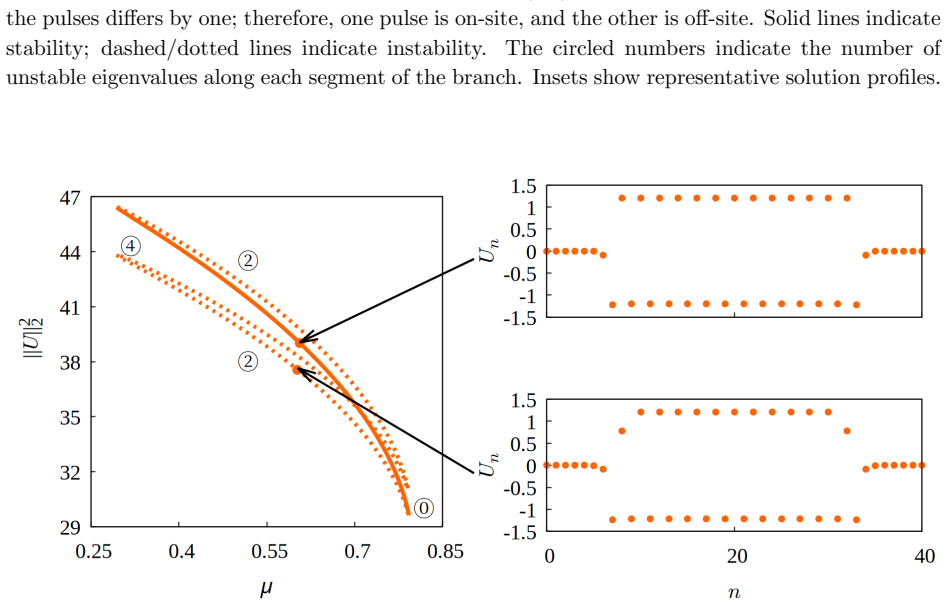
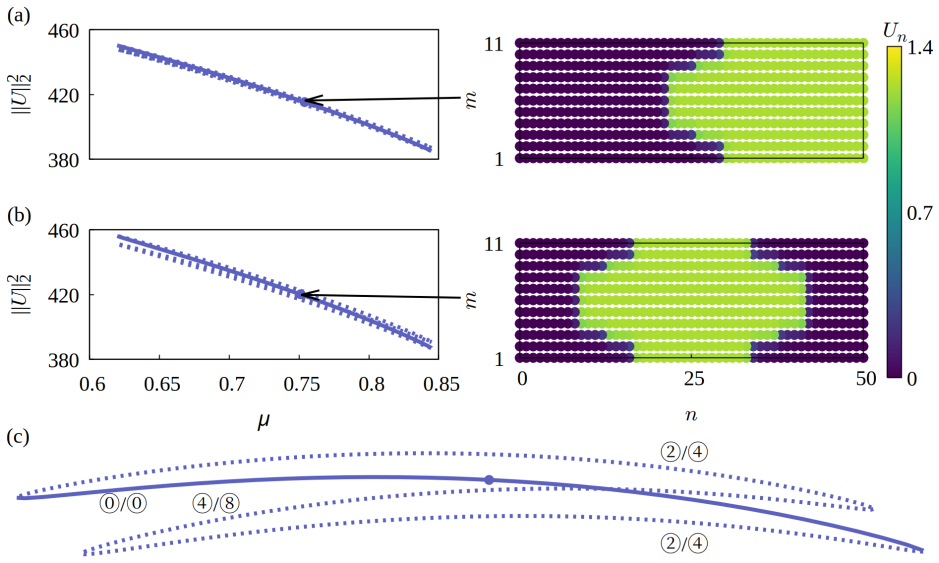
We prove that, for well-separated regions of localization, the Evans function asymptotically factorizes into contributions from the underlying fronts and backs, allowing explicit counting of unstable eigenvalues. This framework applies to solutions with single or multiple plateaus, including oscillatory and multi-pulse configurations in rectangular lattices.
What carries the argument
The discrete Evans function for lattice systems, which asymptotically factorizes for well-separated localizations into products of front and back contributions.
If this is right
- The total number of unstable eigenvalues of a localized solution equals the sum of those contributed by its component fronts and backs.
- Stability of multi-plateau and multi-pulse configurations follows directly from the separation distance and the individual front-back spectra.
- The same counting applies to oscillatory localized states and to solutions on rectangular lattices in any dimension.
- Bifurcation diagrams and eigenvalue crossings can be predicted without solving the full linearized operator at each parameter value.
Where Pith is reading between the lines
- The separation-based counting may extend to time-periodic localized solutions if an analogous Floquet-Evans function admits the same factorization.
- In biological or materials models the method could reduce stability checks for discrete patterns to independent checks on their traveling-wave building blocks.
- The framework suggests a route to stability results for localized structures in stochastic or forced lattice systems once the separation condition is satisfied.
- Numerical continuation packages could incorporate the factorization to accelerate detection of stability changes along branches of localized solutions.
Load-bearing premise
The localized regions must be well-separated so that the asymptotic factorization of the Evans function holds.
What would settle it
A direct numerical computation of the Evans function for two closely spaced localized regions that fails to match the product of the separate front and back Evans functions would falsify the factorization result.
Figures



read the original abstract
Localized patterns are spatially confined structures that arise in lattice dynamical systems and play an important role in physics, biology, and materials science. While their existence and bifurcation structure are well-understood, the stability of these solutions remains largely unexplored, particularly in discrete and high-dimensional settings. In this work, we develop a general theoretical framework to analyze the spectral stability of localized steady states in one-dimensional and multi-dimensional rectangular lattices. Our approach leverages the properties of front and back solutions, combined with a discrete Evans function formulation, to characterize the spectrum of localized solutions. We prove that, for well-separated regions of localization, the Evans function asymptotically factorizes into contributions from the underlying fronts and backs, allowing explicit counting of unstable eigenvalues. This framework applies to solutions with single or multiple plateaus, including oscillatory and multi-pulse configurations. We illustrate the results on a real-valued cubic-quintic Ginzburg-Landau lattice, a prototypical Nagumo-type system, and provide numerical demonstrations of bifurcation structures and eigenvalue spectra.
Editorial analysis
A structured set of objections, weighed in public.
Referee Report
Summary. The paper develops a theoretical framework for spectral stability of localized steady states in 1D and multi-dimensional rectangular lattices. It combines front/back solution properties with a discrete Evans function to prove that, for well-separated localization regions, the Evans function asymptotically factorizes into front and back contributions. This factorization permits explicit counting of unstable eigenvalues for single- or multi-plateau solutions, including oscillatory and multi-pulse cases. The results are illustrated analytically and numerically on a real-valued cubic-quintic Ginzburg-Landau lattice and a Nagumo-type system.
Significance. If the factorization result holds with adequate control on remainders, the work supplies a useful extension of Evans-function techniques to discrete lattices, enabling stability analysis of localized patterns that are otherwise difficult to treat directly. The explicit eigenvalue-counting formula for well-separated configurations, together with numerical demonstrations of bifurcations and spectra, would be a concrete advance for applications in nonlinear lattice dynamics.
major comments (1)
- The central factorization theorem (stated in the abstract and developed in the main theoretical section) asserts asymptotic factorization of the discrete Evans function but supplies no explicit remainder estimates, decay rates, or uniform bounds on the interaction operator between distant fronts and backs. In the lattice setting, especially for the cubic-quintic Ginzburg-Landau example with possible oscillatory tails, algebraic or slower-than-exponential decay could shift eigenvalues across the imaginary axis for any finite separation; without quantitative control the explicit unstable-eigenvalue count is not justified.
minor comments (1)
- The abstract mentions numerical demonstrations of eigenvalue spectra but does not specify quantitative agreement metrics (e.g., eigenvalue error bounds or convergence rates with separation distance).
Simulated Author's Rebuttal
We thank the referee for the detailed and constructive report. The concern regarding quantitative control on the factorization is well-taken and we will strengthen the manuscript by supplying the requested remainder estimates.
read point-by-point responses
-
Referee: The central factorization theorem (stated in the abstract and developed in the main theoretical section) asserts asymptotic factorization of the discrete Evans function but supplies no explicit remainder estimates, decay rates, or uniform bounds on the interaction operator between distant fronts and backs. In the lattice setting, especially for the cubic-quintic Ginzburg-Landau example with possible oscillatory tails, algebraic or slower-than-exponential decay could shift eigenvalues across the imaginary axis for any finite separation; without quantitative control the explicit unstable-eigenvalue count is not justified.
Authors: We agree that the current statement of the factorization theorem would benefit from explicit remainder estimates. In the revised version we will add a new subsection deriving decay rates for the interaction operator between distant fronts and backs, using the spectral gap assumptions already stated for the front and back solutions. For the cubic-quintic Ginzburg-Landau lattice we will delineate the parameter regimes in which the tails are exponentially localized (as opposed to oscillatory) and supply uniform bounds on the remainder that guarantee the eigenvalue-counting formula remains valid once the separation exceeds an explicitly computable threshold. These additions will be supported by the same numerical spectra already presented in the manuscript. revision: yes
Circularity Check
No circularity: asymptotic Evans factorization is a new theorem with independent content
full rationale
The derivation chain consists of a mathematical proof that the discrete Evans function factorizes asymptotically for well-separated localizations, using known spectral properties of fronts and backs plus a new asymptotic analysis. No equation reduces a count or stability conclusion to a fitted parameter, self-citation, or ansatz by construction. The separation assumption is stated explicitly as a hypothesis rather than smuggled in, and the counting result follows from the factorization theorem rather than being presupposed. This is a standard non-circular proof structure in dynamical systems.
Axiom & Free-Parameter Ledger
axioms (1)
- domain assumption Front and back solutions possess known spectral properties that can be combined asymptotically
Reference graph
Works this paper leans on
-
[1]
Balmforth, R
N. Balmforth, R. Craster, and P. Kevrekidis. Being stable and discrete. Physica D: Nonlinear Phenomena, 135(3-4):212–232, 2000
2000
-
[2]
Bergland, J
E. Bergland, J. J. Bramburger, and B. Sandstede. Localized synchronous patterns in weakly coupled bistable oscillator systems. Physica D: Nonlinear Phenomena , 472:134537, 2025
2025
-
[3]
Beyn and J.-M
W.-J. Beyn and J.-M. Kleinkauf. The numerical computation of homoclinic orbits for maps. SIAM journal on numerical analysis , 34(3):1207–1236, 1997
1997
-
[4]
J. J. Bramburger. Isolas of multi-pulse solutions to lattice dynamical systems. Proceedings of the Royal Society of Edinburgh Section A: Mathematics , 151(3):916–952, 2021. 29
2021
- [5]
-
[6]
J. J. Bramburger and B. Sandstede. Localized patterns in planar bistable weakly coupled lattice systems. Nonlinearity, 33(7):3500–3525, 2020
2020
-
[7]
J. J. Bramburger and B. Sandstede. Spatially localized structures in lattice dynamical systems. Journal of Nonlinear Science , 30:603–644, 2020
2020
- [8]
-
[9]
S.-N. Chow. Lattice dynamical systems. In Dynamical Systems: Lectures given at the CIME Summer School held in Cetraro, Italy, June 19-26, 2000 , pages 1–102. Springer, 2003
2000
-
[10]
S.-N. Chow, J. Mallet-Paret, and E. S. Van Vleck. Dynamics of lattice differential equations. International Journal of Bifurcation and Chaos , 6(09):1605–1621, 1996
1996
-
[11]
J. Dawes. The emergence of a coherent structure for coherent structures: localized states in nonlinear systems. Philosophical Transactions of the Royal Society A: Mathematical, Physical and Engineering Sciences, 368(1924):3519–3534, 2010
1924
-
[12]
Guo and C.-H
J.-S. Guo and C.-H. Wu. Wave propagation for a two-component lattice dynamical system arising in strong competition models. Journal of Differential Equations , 250(8):3504–3533, 2011
2011
-
[13]
Hupkes, D
H. Hupkes, D. Pelinovsky, and B. Sandstede. Propagation failure in the discrete Nagumo equation. Proceedings of the American Mathematical Society, 139(10):3537–3551, 2011
2011
-
[14]
Kapitula and P
T. Kapitula and P. Kevrekidis. Stability of waves in discrete systems. Nonlinearity, 14(3):533, 2001
2001
-
[15]
J. P. Keener. Propagation and its failure in coupled systems of discrete excitable cells. SIAM Journal on Applied Mathematics , 47(3):556–572, 1987
1987
-
[16]
Knobloch
E. Knobloch. Spatial localization in dissipative systems. Annual Review of Condensed Matter Physics, 6(1):325–359, 2015
2015
-
[17]
Makrides and B
E. Makrides and B. Sandstede. Existence and stability of spatially localized patterns. Journal of Differential Equations , 266(2-3):1073–1120, 2019
2019
-
[18]
Papangelo, A
A. Papangelo, A. Grolet, L. Salles, N. Hoffmann, and M. Ciavarella. Snaking bifurcations in a self-excited oscillator chain with cyclic symmetry. Communications in Nonlinear Science and Numerical Simulation, 44:108–119, 2017
2017
-
[19]
Peterhof, B
D. Peterhof, B. Sandstede, and A. Scheel. Exponential dichotomies for solitary-wave solu- tions of semilinear elliptic equations on infinite cylinders. Journal of Differential Equations , 140(2):266–308, 1997. 30
1997
-
[20]
Sandstede and A
B. Sandstede and A. Scheel. Absolute and convective instabilities of waves on unbounded and large bounded domains. Physica D: Nonlinear Phenomena , 145(3-4):233–277, 2000
2000
-
[21]
Taylor and J
C. Taylor and J. H. Dawes. Snaking and isolas of localised states in bistable discrete lattices. Physics Letters A , 375(1):14––22, Nov 2010. 31
2010
discussion (0)
Sign in with ORCID, Apple, or X to comment. Anyone can read and Pith papers without signing in.