Recognition: no theorem link
Power, Prescription, and Postpositivism: Considerations for collecting and representing neurodiversity demographic information in physics education research
Pith reviewed 2026-05-14 20:19 UTC · model grok-4.3
The pith
Prescriptive methods for collecting neurodiversity demographics in physics education research limit authentic identity expression and data reliability.
A machine-rendered reading of the paper's core claim, the machinery that carries it, and where it could break.
Core claim
Through a systematic literature review of neurodivergent student experiences in STEM and a subsequent thematic analysis, the paper identifies widespread discrepancies in how neurodiversity demographic data is collected and represented. It establishes that prescriptive approaches, such as mandating reports of official diagnoses, do not allow for authentic expression of intersecting identities and compromise the trustworthiness and reliability of data and interpretations. The work calls for the PER community to help create a framework that centers participant autonomy while maintaining clarity and consistency for future research.
What carries the argument
Thematic analysis of neurodivergent demographic data collection practices identified in the systematic review of STEM education literature
If this is right
- Participants could express their intersecting identities more authentically through self-identification.
- Trustworthiness and reliability of data and interpretations would improve.
- Consistent dissemination of demographic data would enhance accessibility and usability of research findings.
- The development of a new framework would support both autonomy and clarity in future studies.
Where Pith is reading between the lines
- Adopting self-identification practices might encourage similar shifts in demographic data collection across other areas of education research beyond physics.
- Researchers may need to develop new protocols to ensure consistent interpretation of self-reported neurodiversity data.
- Testing the proposed framework in pilot studies could reveal practical challenges and refinements needed for implementation.
Load-bearing premise
Shifting to self-identification methods will improve data trustworthiness and reliability without introducing new biases or inconsistencies.
What would settle it
A direct comparison experiment in which neurodivergent participants provide demographic information using both prescriptive diagnosis requirements and open self-identification, followed by assessment of data consistency and interpretive reliability.
Figures

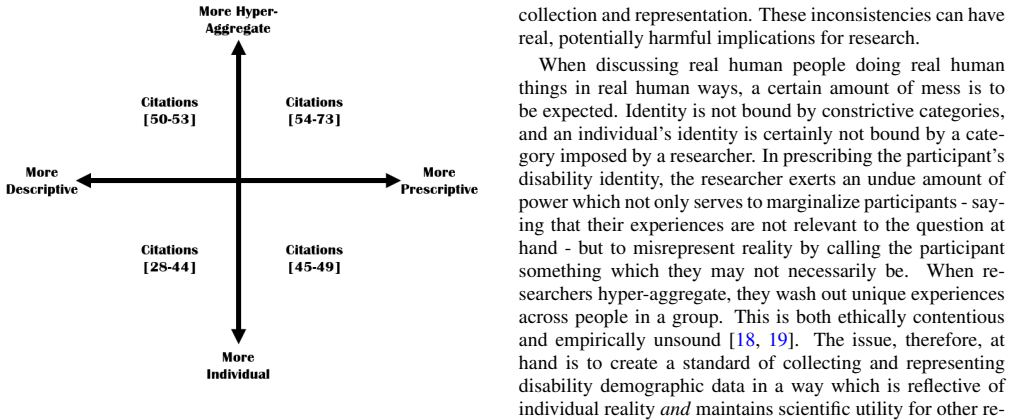

read the original abstract
Demographic data collection is essential in education research, as demographic data allows researchers to better describe the participant population they study and to contextualize findings. However, current research practices for neurodiversity demographics often rely on prescriptive methods (e.g., requiring participants to report official diagnoses) rather than allowing participants to self-identify. This approach can: a) not allow participants to express their intersecting identities in ways that are authentic; and b) limit trustworthiness and reliability of the data and interpretation. In addition, inconsistent dissemination and representation of demographic data across studies hinder the accessibility and usability of this work. Through a literature review of neurodivergent student experiences with learning and performing STEM, we identified widespread discrepancies in how demographic information is collected and reported. This paper explores how neurodivergent identities can be more accurately and inclusively represented in education research. We present findings of a thematic analysis on the ways neurodivergent demographic data collection is done in the literature using data from a systematic literature review on neurodivergent science, technology, engineering, and mathematics (STEM) learning and performance. We call on the PER community to contribute to the development of a framework that centers participant autonomy while supporting clarity, consistency, and future research use.
Editorial analysis
A structured set of objections, weighed in public.
Referee Report
Summary. The manuscript argues that prescriptive methods for collecting neurodiversity demographic data in physics education research (PER), such as requiring official diagnoses, prevent authentic expression of intersecting identities and undermine data trustworthiness and reliability. Drawing on a thematic analysis of inconsistencies identified in a systematic literature review of neurodivergent STEM learning and performance, the paper calls on the PER community to develop a new framework that prioritizes participant autonomy while supporting clarity, consistency, and future research usability.
Significance. If the recommendation for shifting to self-identification holds after validation, the work could improve inclusivity and data quality in PER demographic practices, making studies more representative of intersecting identities and enhancing cross-study comparability. The thematic analysis usefully documents current inconsistencies, but the absence of empirical tests for the proposed shift limits immediate applicability.
major comments (2)
- Abstract: the central claim that prescriptive diagnosis-based collection inherently limits trustworthiness and reliability (points a and b) rests on an untested causal assumption; the thematic analysis documents inconsistencies in reporting but supplies no comparative evidence (e.g., test-retest reliability, convergence with external validators, or stability of interpretations) showing self-identification reduces bias relative to diagnosis-anchored methods.
- Call for framework (final paragraph): the recommendation to develop a participant-autonomy-centered framework is load-bearing for the paper's contribution, yet no specific criteria, pilot items, or validation steps are outlined, leaving the proposal at the level of a call rather than a developed proposal.
minor comments (1)
- Abstract: the sentence 'This approach can: a) not allow...' contains awkward phrasing that could be revised for clarity and parallelism.
Simulated Author's Rebuttal
We thank the referee for their thoughtful and constructive comments on our manuscript. We address each major comment point by point below, clarifying our intent and outlining revisions where appropriate.
read point-by-point responses
-
Referee: Abstract: the central claim that prescriptive diagnosis-based collection inherently limits trustworthiness and reliability (points a and b) rests on an untested causal assumption; the thematic analysis documents inconsistencies in reporting but supplies no comparative evidence (e.g., test-retest reliability, convergence with external validators, or stability of interpretations) showing self-identification reduces bias relative to diagnosis-anchored methods.
Authors: We agree that the manuscript does not include new empirical comparative data testing self-identification against diagnosis-based methods. The abstract's use of 'can' reflects reasoned concerns drawn from the thematic analysis of widespread inconsistencies in the reviewed literature, which we argue undermine data reliability and authentic representation. We will revise the abstract to explicitly frame these as potential limitations inferred from observed practices, rather than directly demonstrated causal effects, and to note the need for future validation studies. revision: yes
-
Referee: Call for framework (final paragraph): the recommendation to develop a participant-autonomy-centered framework is load-bearing for the paper's contribution, yet no specific criteria, pilot items, or validation steps are outlined, leaving the proposal at the level of a call rather than a developed proposal.
Authors: The manuscript is deliberately positioned as a call to the PER community rather than a fully specified framework proposal, given that developing and validating such a framework requires broad participatory input beyond the scope of this literature review. We will add a new subsection in the discussion outlining initial guiding criteria (e.g., support for intersecting identities, clear but flexible response options, and mechanisms for cross-study consistency) to make the call more actionable while preserving its community-oriented nature. We will not include pilot items or validation steps, as these would require new empirical work. revision: partial
Circularity Check
No circularity: qualitative literature synthesis with no derivations or self-referential reductions
full rationale
The paper conducts a thematic analysis of existing STEM education literature on neurodiversity demographic collection practices. Its central recommendation for shifting toward participant self-identification is grounded in documented inconsistencies across reviewed studies and postpositivist framing, without any equations, fitted parameters, predictions, or self-citation chains that reduce the argument to its own inputs by construction. No load-bearing steps match the enumerated circularity patterns; the work is interpretive and calls for community framework development rather than claiming a closed deductive result.
Axiom & Free-Parameter Ledger
axioms (2)
- domain assumption Self-identification allows more authentic expression of intersecting identities than prescriptive diagnosis requirements.
- domain assumption Inconsistent dissemination of demographic data hinders accessibility and usability of research.
Reference graph
Works this paper leans on
-
[1]
howdo you identify as neurodivergent, if at all?
we, as researchers, exist as secondary interpreters of partic- ipants’ experiences. It is therefore, perhaps, more reflective of reality to ask "howdo you identify as neurodivergent, if at all?" and build pragmatic categories descriptively, from par- ticipants’ own words, rather than making assumptions. II. Methods A. Postionality This project, as a part ...
2024
-
[2]
Kanim, S., & Cid, X. C. (2020). Demographics of physics edu- cation research.Physical Review Physics Education Research, 16(2), 020106
2020
-
[3]
Frazer, L. (2017). Diversity in physics education research: A decade of inclusion and future challenges.arXiv preprint arXiv:1710.07863
work page internal anchor Pith review Pith/arXiv arXiv 2017
-
[4]
J., & Scanlon, E
Chini, J. J., & Scanlon, E. M. (2023). Teaching physics with disabled learners: A review of the literature.The International Handbook of Physics Education Research: Special Topics, 1-1
2023
-
[5]
President’s Council of Advisors on Science and Technology. (2024). Harnessing the power of social and behavioral science to improve American lives.Executive Office of the President. https://www.whitehouse.gov/pcast
2024
-
[6]
H., & Bilge, S
Collins, P. H., & Bilge, S. (2016).Intersectionality. Polity Press
2016
-
[7]
Museus, S.D. (2014). The Culturally Engaging Campus Envi- ronments (CECE) Model: A New Theory of Success Among Racially Diverse College Student Populations.In: Paulsen, M. (eds) Higher Education: Handbook of Theory and Research. Higher Education: Handbook of Theory and Research, vol
2014
-
[8]
https://doi.org/10.1007/978-94-017- 8005-6
Springer, Dordrecht. https://doi.org/10.1007/978-94-017- 8005-6
-
[9]
Call, C. C., Eckstrand, K. L., Kasparek, S. W., Boness, C. L., Blatt, L., Jamal-Orozco, N., Novacek, D. M., & Foti, D. (2022). An Ethics and Social-Justice Approach to Collecting and Using Demographic Data for Psychological Researchers.Perspectives on Psychological Science, 18(5), 979-995. https://doi.org/10.1177/17456916221137350 (Origi- nal work published 2023)
-
[10]
Ray, (2020)
R. Ray, (2020). The importance of collecting demographic data.The Brookings Institute
2020
-
[11]
Pinker, S. (2003). The language instinct: How the mind creates language.Penguin uK
2003
-
[12]
Liam Gregory McDermott; Introducing Neurodiversity to the Physics Education Community.Phys. Teach. 1 September 2024; 62 (6): 472-475. https://doi.org/10.1119/5.0135030
-
[13]
Dwyer, P. (2022). The neurodiversity approach (es): What are they and what do they mean for researchers?.Human develop- ment, 66(2), 73-92. https://doi.org/10.1159/000523723
-
[14]
Shakespeare, T. (2006). The social model of disability. In The disability studies reader (pp. 16-24). Routledge
2006
-
[15]
N. J. Fox, (2008). Post-positivism.The SAGE encyclopedia of qualitative research methods, 2(1), 659-664
2008
-
[16]
H., Ansari, S., & Shah, A
Panhwar, A. H., Ansari, S., & Shah, A. A. (2017). Post- positivism: An effective paradigm for social and educational research.International Research Journal of Arts and Humani- ties, 45(45), 253-259
2017
-
[17]
T., Meinzen-Derr, J., Tapia, A
Sharghi, S., Khalatbari, S., Laird, A., Lapidus, J., Enders, F. T., Meinzen-Derr, J., Tapia, A. L., & Ciolino, J. D. (2024). Race, ethnicity, and considerations for data collection and analysis in research studies.Journal of clinical and translational science, 8(1), e182. https://doi.org/10.1017/cts.2024.632
-
[18]
Museus, S.D. and Griffin, K.A. (2011), Mapping the margins in higher education: On the promise of intersectionality frame- works in research and discourse.New Directions for Institu- tional Research, 2011: 5-13. https://doi.org/10.1002/ir.395
-
[19]
Harper, S. R. (2010). An anti-deficit achievement framework for research on students of color in STEM.New directions for institutional research, 2010(148), 63-74
2010
-
[20]
Mertens, D. M. (2009).Transformative research and evalua- tion. New York: Guilford Press
2009
-
[21]
Baglieri, S., Valle, J. W., Connor, D. J., & Gal- lagher, D. J. (2010). Disability Studies in Education: The Need for a Plurality of Perspectives on Disabil- ity.Remedial and Special Education, 32(4), 267-278. https://doi.org/10.1177/0741932510362200 (Original work published 2011)
-
[22]
(2024, July 10-11)
Stella, S., Robertson, A., & Vélez, V . (2024, July 10-11). Considerations for Collecting Racial Demo- graphics Data in Physics Education Research.Paper presented at Physics Education Research Conference 2024, Boston, MA. Retrieved May 19, 2025, from https://www.compadre.org/Repository/document/ServeFile.cfm, ID=16929&DocID=5996
2024
-
[23]
Annamma, S. A., Connor, D., & Ferri, B. (2012). Dis/ability critical race studies (DisCrit): theorizing at the intersections of race and dis/ability.Race Ethnicity and Education, 16(1), 1-31. https://doi.org/10.1080/13613324.2012.730511
-
[24]
Greta R. Bauer, Ayden I. Scheim, Advancing quantitative inter- sectionality research methods: Intracategorical and intercate- gorical approaches to shared and differential constructs,Social Science & Medicine, Volume 226, 2019, Pages 260-262, ISSN 0277-9536, https://doi.org/10.1016/j.socscimed.2019.03.018
-
[25]
N., Tissi-Gassoway, N., Kim- ball, E
Vaccaro, A., Lee, M. N., Tissi-Gassoway, N., Kim- ball, E. W., & Newman, B. M. (2020). Gender and Ability Oppressions Shaping the Lives of College Stu- dents: An Intracategorical, Intersectional Analysis.Journal of Women and Gender in Higher Education, 13(2), 119-137. https://doi.org/10.1080/26379112.2020.1780134
-
[26]
Goldberg, C. (2016). Is Intersectionality a Disabled Frame- work? Presenting PWIVID: In/Visibility and Variability as In- tracategorical Interventions.Critical Disability Discourses, 7. https://doi.org/10.25071/1918-6215.39695
-
[27]
Intersectionality and the disability: Some conceptual and methodological chal- lenges
Sommo, A. and Chaskes, J. (2013), "Intersectionality and the disability: Some conceptual and methodological chal- lenges",Disability and Intersecting Statuses (Research in So- cial Science and Disability, Vol. 7), Emerald Group Publish- ing Limited, Leeds, pp. 47-59. https://doi.org/10.1108/S1479- 3547(2013)0000007005
-
[28]
Powell, R. M. (2020). Confronting eugenics means finally con- fronting its ableist roots.Wm. & Mary J. Race Gender & Soc. Just., 27, 607.https://ssrn.com/abstract=3706408
2020
-
[29]
M., Chini, J
McPadden, D., Sawtelle, V ., Scanlon, E. M., Chini, J. J., Cha- hal, H., Levy, R., & Reynolds, A. (2023). Planning for partici- pants’ varying needs and abilities in qualitative research.Phys- ical Review Physics Education Research, 19(2), 020143
2023
-
[30]
Cox, Thomas & Ogle, Brian & Campbell, Laurie. (2019). In- vestigating Challenges and Preferred Instructional Strategies in STEM.Journal of Postsecondary Education and Disability, 32(1) 49-61
2019
-
[31]
Salvatore, S., White, C. & Podowitz-Thomas, S. (2024). Not a cookie cutter situation: how neurodivergent students experi- ence group work in their STEM courses.IJ STEM Ed 11, 47 https://doi.org/10.1186/s40594-024-00508-0
-
[32]
McDermott, L. G., Mosley, N. A., & Cochran, G. L. (2024). Diverging nonlocal fields: Operational- izing critical disability physics identity with neuro- divergent physicists outside academia.Physical Re- view Physics Education Research, 20(1), 010111. https://doi.org/10.1103/PhysRevPhysEducRes.20.010111
-
[33]
Nieminen, J. H., & Pesonen, H. V . (2019). Taking universal de- sign back to its roots: Perspectives on accessibility and identity in undergraduate mathematics.Education Sciences,.10(1), 12. https://doi.org/10.3390/educsci10010012
-
[34]
(2022, August)
Cuellar, A., Webster, B., Solanki, S., Spence, C., & Tsug- awa, M. (2022, August). Examination of ableist educational systems and structures that limit access to engineering educa- tion through narratives.In 2022 ASEE Annual Conference & Exposition. https://peer.asee.org/41800
2022
- [35]
-
[36]
James, W., Bustamante, C., Lamons, K., Scanlon, E., & Chini, J. J. (2020). Disabling barriers experienced by stu- dents with disabilities in postsecondary introductory physics. Physical Review Physics Education Research, 16(2), 020111. https://doi.org/10.1103/PhysRevPhysEducRes.16.020111
-
[37]
This Isn’t Working for Me. Can We Do It a Different Way?
Morris, N. (2022). "This Isn’t Working for Me. Can We Do It a Different Way?" The Lived Experiences of Geoscience Students with Learning Disabilities. Dissertation: Western Michigan University
2022
-
[38]
Lapraik, S. (2013). Dyslexic students preparing for examina- tions in higher education: strategies and a sense of control. Doctoral dissertation, University of Southampton
2013
-
[39]
Mathe- matics is a battle, but I’ve learned to survive
Nieminen, J. H., Reinholz, D. L., & Valero, P. (2024). "Mathe- matics is a battle, but I’ve learned to survive": becoming a dis- abled student in university mathematics.Educational Studies in Mathematics, 116(1), 5-25. https://doi.org/10.1007/s10649- 024-10311-x
-
[40]
I just need a little more support
Mcpeake, E., Lamore, K., Boujut, E., El Khoury, J., Pellenq, C., Plumet, M. H., & Cappe, E. (2023). "I just need a little more support": A thematic analysis of autistic students’ experience of university in France.Research in Autism Spectrum Disor- ders, 105, 102172. https://doi.org/10.1016/j.rasd.2023.102172
-
[41]
It Seems Like I’m Doing Something More Important
Zaghi, A. E., Grey, A., Hain, A., & Syharat, C. M. (2023). "It Seems Like I’m Doing Something More Important"-An Interpretative Phenomenological Analysis of the Transformative Impact of Research Experiences for STEM Students with ADHD.Education Sciences, 13(8), 776. https://doi.org/10.3390/educsci13080776
-
[42]
Academia, as a whole, is structured entirely without any con- sideration for neurodivergency,
McDermott, L. G., & Mosley, N. A. (2023, September). "Academia, as a whole, is structured entirely without any con- sideration for neurodivergency," and other things neurodiver- gent students want you to know.In Proc. Phys. Educ. Res. Conf. https://doi.org/10.1119/perc.2023.pr.McDermott
-
[43]
Salty, K., Gobernatz, A., & Close, E. (2022, September). ADH... Disorder? Discoveries on ADHD and physics learn- ing from collaborative autoethnography.In Proc. Phys. Educ. Res. Conf. doi.org/10.1119/perc.2022.pr.Salty
-
[44]
Wang, K. D., McCool, J., & Wieman, C. (2024). Explor- ing the learning experiences of neurodivergent college stu- dents in STEM courses.Journal of Research in Special Edu- cational Needs, 24(3), 505-518. https://doi.org/10.1111/1471- 3802.12650
-
[46]
Perkin, G., & Croft, T. (2007). The dyslexic student and mathematics in higher education.Dyslexia, 13(3), 193-210. https://doi.org/10.1002/dys.334
-
[47]
Bolourian, Y ., Zeedyk, S. M., & Blacher, J. (2018). Autism and the university experience: Narratives from students with neu- rodevelopmental disorders.Journal of autism and developmen- tal disorders, 48, 3330-3343. https://doi.org/10.1007/s10803- 018-3599-5
-
[48]
Accardo, A. L., Kuder, S. J., & Woodruff, J. (2019). Ac- commodations and support services preferred by college stu- dents with autism spectrum disorder.Autism, 23(3), 574-583. https://doi.org/10.1177/1362361318760490
-
[49]
H., Carter, M., & Stephenson, J
Anderson, A. H., Carter, M., & Stephenson, J. (2018). Per- spectives of university students with autism spectrum disorder. Journal of autism and developmental disorders, 48, 651-665. https://doi.org/10.1007/s10803-017-3257-3
-
[50]
L., Bean, K., Cook, B., Gillies, A., Edgington, R., Kuder, S
Accardo, A. L., Bean, K., Cook, B., Gillies, A., Edgington, R., Kuder, S. J., & Bomgardner, E. M. (2019). College access, success and equity for students on the autism spectrum.Jour- nal of autism and developmental disorders, 49, 4877-4890. https://doi.org/10.1007/s10803-019-04205-8
-
[51]
Andreassen, R., Jensen, M. S., & Bråten, I. (2017). Investigating self-regulated study strategies among post- secondary students with and without dyslexia: A di- ary method study.Reading and Writing, 30, 1891-1916. https://doi.org/10.1007/s11145-017-9758-9
-
[52]
Friedensen, R., Lauterbach, A., Kimball, E., & Mwangi, C. G. (2021). Students with high-incidence disabilities in STEM: Barriers encountered in postsecondary learning environments. Journal of Postsecondary Education and Disability, 34(1), 77-
2021
-
[53]
https://eric.ed.gov/?id=EJ1308649
-
[54]
Taylor, C. L., & Zaghi, A. E. (2022). The interplay of ADHD characteristics and executive functioning with the GPA and di- vergent thinking of engineering students: A conceptual repli- cation and extension.Frontiers in Psychology, 13, 937153. https://doi.org/10.3389/fpsyg.2022.937153
-
[55]
Osborne, T. (2019). Not lazy, not faking: teach- ing and learning experiences of university students with disabilities.Disability & Society, 34(2), 228-252. https://doi.org/10.1080/09687599.2018.1515724
-
[56]
Gin, L. E., Pais, D. C., Parrish, K. D., Brownell, S. E., & Cooper, K. M. (2022). New online accommodations are not enough: The mismatch between student needs and supports given for students with disabilities during the COVID-19 pan- demic.Journal of microbiology & biology education, 23(1), e00280-21. https://doi.org/10.1128/jmbe.00280-21
-
[57]
D., Koff, R., Fields, H., Kuehne, L., Handlin, L., Getty, M., & Parker, D
Street, C. D., Koff, R., Fields, H., Kuehne, L., Handlin, L., Getty, M., & Parker, D. R. (2012). Expanding Access to STEM for At-Risk Learners: A New Application of Universal Design for Instruction.Journal of Postsecondary Education and Dis- ability, 25(4), 363-375. https://eric.ed.gov/?id=EJ1002146
2012
-
[58]
Morgan, M. V . C. (2016). The STEM and CTE Pipeline for Community College Students with Learning Disabilities.Dis- sertation: University of California, Santa Barbara
2016
-
[59]
L., Longhurst, D., Rolf, K
Bundock, K., Callan, G. L., Longhurst, D., Rolf, K. R., Ben- ney, C. M., & McClain, M. B. (2021). Mathematics Interven- tion for College Students With Learning Disabilities: A Pilot Study Targeting Rate of Change.Insights into Learning Dis- abilities, 18(1), 1-28. https://eric.ed.gov/?id=EJ1295246
2021
-
[60]
Dishauzi, K. M. (2016). Supporting students with disabilities entering the science, technology, engineering, and mathematics field disciplines.Dissertation
2016
-
[61]
Z., & Schuler, A
Madden, L., Carroll, S. Z., & Schuler, A. K. (2021). Elevat- ing the voices for all learners through shared stories of science learning.Journal of Science Education for Students with Dis- abilities, 24(1), 3. https://repository.rit.edu/jsesd/vol24/iss1/3/
2021
-
[62]
Pfeifer, M. A., Reiter, E. M., Hendrickson, M., & Stanton, J. D. (2020). Speaking up: A model of self-advocacy for STEM undergraduates with ADHD and/or specific learning disabilities.International Journal of STEM Education, 7, 1-21. https://doi.org/10.1186/s40594-020-00233-4
-
[63]
T., Vasquez, E., Banerjee, M., Parsons, C
Marino, M. T., Vasquez, E., Banerjee, M., Parsons, C. A., Saliba, Y . C., Gallegos, B., & Koch, A. (2020). Coaching as a means to enhance performance and persistence in under- graduate STEM majors with executive function deficits.Jour- nal of Higher Education Theory and Practice, 20(5), 94-109. https://doi.org/10.33423/jhetp.v20i5.3040
-
[64]
Pfeifer, M. A., Cordero, J. J., & Stanton, J. D. (2023). What I wish my instructor knew: How active learning influences the classroom experiences and self-advocacy of STEM majors with ADHD and specific learning disabilities.CBE-Life Sci- ences Education, 22(1), ar2. https://doi.org/10.1187/cbe.21- 12-0329
-
[65]
Brown, B. (2023). Describing the experiences of STEM ma- jors with attention deficit hyperactivity disorder and/or specific learning disabilities.Doctoral dissertation, California State Polytechnic University, Pomona
2023
-
[66]
A., McGladdery, G., & Dyer, K
Jordan, J. A., McGladdery, G., & Dyer, K. (2014). Dyslexia in higher education: Implications for maths anxiety, statistics anxiety and psychological well-being.Dyslexia, 20(3), 225-
2014
-
[67]
https://doi.org/10.1002/dys.1478
-
[68]
Jansen, D., Petry, K., Ceulemans, E., Noens, I., & Baeyens, D. (2017). Functioning and participation prob- lems of students with ASD in higher education: Which reasonable accommodations are effective?.European Journal of Special Needs Education, 32(1), 71-88. https://doi.org/10.1080/08856257.2016.1254962
-
[69]
Heiman, T., & Kariv, D. (2004). Coping experience among stu- dents in higher education.Educational Studies, 30(4), 441-455. https://doi.org/10.1080/0305569042000310354
-
[70]
L., Esmaili Zaghi, A., Kaufman, J
Taylor, C. L., Esmaili Zaghi, A., Kaufman, J. C., Reis, S. M., & Renzulli, J. S. (2020). Divergent thinking and academic perfor- mance of students with attention deficit hyperactivity disorder characteristics in engineering.Journal of Engineering Educa- tion, 109(2), 213-229. https://doi.org/10.1002/jee.20310
-
[71]
Cai, R. Y ., & Richdale, A. L. (2016). Educational experiences and needs of higher education students with autism spectrum disorder.Journal of autism and developmental disorders, 46, 31-41. https://doi.org/10.1007/s10803-015-2535-1
-
[72]
Pfeifer, M. A., Reiter, E. M., Cordero, J. J., & Stanton, J. D. (2021). Inside and out: Factors that support and hinder the self- advocacy of undergraduates with ADHD and/or specific learn- ing disabilities in STEM.CBE-Life Sciences Education, 20(2), ar17. https://doi.org/10.1187/cbe.20-06-0107
-
[73]
Gin, L. E., Guerrero, F. A., Brownell, S. E., & Cooper, K. M. (2021). COVID-19 and undergraduates with disabilities: Challenges resulting from the rapid transition to online course delivery for students with disabilities in undergraduate STEM at large-enrollment institutions.CBE-Life Sciences Education, 20(3), ar36. https://doi.org/10.1187/cbe.21-02-0028
-
[74]
Heiman, T., & Precel, K. (2003). Students with learn- ing disabilities in higher education: Academic strategies profile.Journal of learning disabilities, 36(3), 248-258. https://doi.org/10.1177/002221940303600304
-
[75]
A., Plant, S
Graves, L., Asunda, P. A., Plant, S. J., & Goad, C. (2011). Asynchronous Online Access as an Accommodation on Stu- dents with Learning Disabilities and/or Attention-Deficit Hy- peractivity Disorders in Postsecondary STEM Courses.Jour- nal of Postsecondary Education and Disability, 24(4), 317-330. https://eric.ed.gov/?id=EJ966132
2011
-
[76]
(Jul 2024) Students with autism spectrum condi- tion attending higher education: challenges for students and educators.Dissertation
Mulhall, M. (Jul 2024) Students with autism spectrum condi- tion attending higher education: challenges for students and educators.Dissertation
2024
-
[77]
Burek, B. L. (2022). Online Research and Comprehension Pro- cess and Experience for Postsecondary Students with Learning and Attention DisordersDoctoral dissertation, University of Toronto (Canada)
2022
discussion (0)
Sign in with ORCID, Apple, or X to comment. Anyone can read and Pith papers without signing in.