Recognition: unknown
Visible-NIR-Frequency Hyperbolic Response in Nodal-Line Semimetal PbTaSe₂
Pith reviewed 2026-05-14 20:26 UTC · model grok-4.3
The pith
PbTaSe₂ exhibits robust hyperbolic optical behavior in the visible to near-infrared range from its intrinsic anisotropic structure.
A machine-rendered reading of the paper's core claim, the machinery that carries it, and where it could break.
Core claim
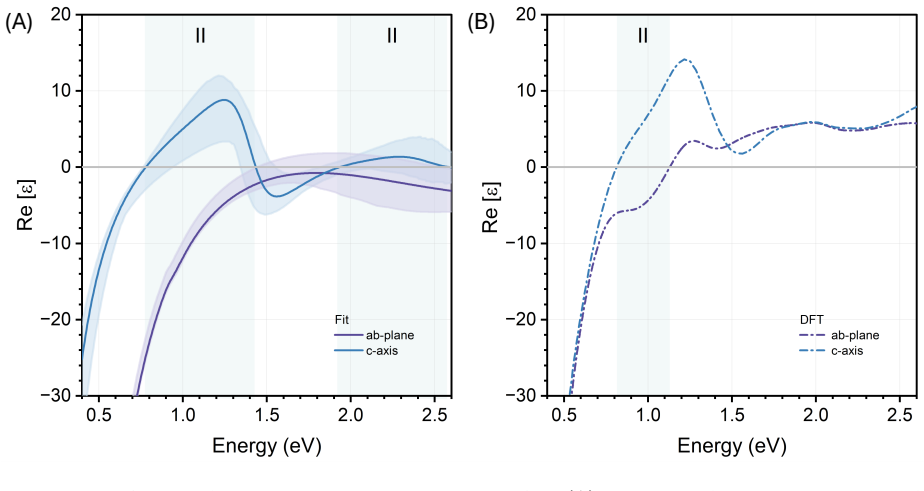
We experimentally demonstrate that the nodal-line semimetal PbTaSe₂ exhibits robust hyperbolic optical behavior in the visible to near-infrared spectral range, which arises intrinsically from its anisotropic electronic structure and layered crystal symmetry. This hyperbolicity is of plasmonic origin and is characterized by a competitive quality factor (Q_max ≈ 2.8) and a very large anisotropy parameter (|R| ≈ 231) at 0.78 eV.
What carries the argument
The anisotropic electronic structure and layered crystal symmetry that produce plasmonic hyperbolicity.
Load-bearing premise
Measurements reflect the intrinsic bulk properties rather than effects from surface layers or sample imperfections.
What would settle it
If the real parts of the permittivity components in different directions do not show opposite signs in the claimed spectral range, the hyperbolic response would be disproven.
Figures



read the original abstract
Natural hyperbolic materials offer a powerful platform for light-matter interactions by supporting highly anisotropic electromagnetic modes without the need for artificial patterning. In this work, we experimentally demonstrate that the nodal-line semimetal PbTaSe$_2$ exhibits robust hyperbolic optical behavior in the visible to near-infrared spectral range, which arises intrinsically from its anisotropic electronic structure and layered crystal symmetry. By combining first-principles calculations, ellipsometry, Drude-Lorentz modeling, and reflectance measurements, we establish a consistent experimental and theoretical picture of bulk hyperbolicity in this material. This hyperbolicity is of plasmonic origin and is characterized by a competitive quality factor ($Q_\mathrm{max} \approx 2.8$) and a very large anisotropy parameter ($|R| \approx 231$) at 0.78 eV.
Editorial analysis
A structured set of objections, weighed in public.
Referee Report
Summary. The manuscript claims that the nodal-line semimetal PbTaSe₂ exhibits intrinsic hyperbolic optical response in the visible-NIR range arising from its anisotropic electronic structure and layered symmetry. This is supported by a combination of DFT calculations, spectroscopic ellipsometry, Drude-Lorentz modeling of the permittivity tensor, and reflectance measurements, which together yield a plasmonic hyperbolicity window with Q_max ≈ 2.8 and a large anisotropy parameter |R| ≈ 231 at 0.78 eV.
Significance. If the bulk hyperbolic response is confirmed, the result would be significant because natural hyperbolic materials with operation in the visible-NIR are rare; the reported |R| value is exceptionally large and the material is readily available, potentially enabling new applications in nanophotonics and plasmonics without artificial structuring. The consistency between independent DFT and optical data is a strength if the experimental extraction is robust.
major comments (3)
- [Experimental and modeling sections] Experimental section (ellipsometry and modeling): the manuscript does not report raw ellipsometry spectra, error bars on the extracted ε_∥ and ε_⊥, or the full set of Drude-Lorentz oscillator parameters and their uncertainties. Without these, it is impossible to verify that the reported sign reversal between Re(ε_∥) and Re(ε_⊥) is robust rather than an artifact of the fitting procedure.
- [Results and discussion] § on hyperbolicity metrics: the anisotropy parameter |R| is computed directly from the fitted permittivity components that were themselves adjusted to match the same ellipsometry/reflectance data; this introduces circularity, and the claim that hyperbolicity is “intrinsic” to the nodal-line structure requires an independent cross-check (e.g., thickness-dependent measurements or bulk-sensitive probes) that is not provided.
- [Methods] Methods: no surface-preparation protocol, in-situ cleavage, or post-measurement surface characterization (XPS, AFM) is described. Given that ellipsometry is surface-sensitive and layered semimetals such as PbTaSe₂ readily oxidize, the measured optical constants may reflect a surface layer rather than the bulk anisotropic response required for the central claim.
minor comments (2)
- [Figures] Figure captions and axis labels should explicitly mark the spectral window where Re(ε_∥)·Re(ε_⊥) < 0 to aid the reader.
- [Abstract and introduction] The abstract states “robust” hyperbolicity; the main text should qualify this with the precise energy range and note any model assumptions.
Simulated Author's Rebuttal
We thank the referee for the constructive and detailed comments, which have helped us improve the clarity and robustness of the manuscript. We address each major point below and have revised the manuscript accordingly where the suggestions strengthen the presentation of our results.
read point-by-point responses
-
Referee: [Experimental and modeling sections] Experimental section (ellipsometry and modeling): the manuscript does not report raw ellipsometry spectra, error bars on the extracted ε_∥ and ε_⊥, or the full set of Drude-Lorentz oscillator parameters and their uncertainties. Without these, it is impossible to verify that the reported sign reversal between Re(ε_∥) and Re(ε_⊥) is robust rather than an artifact of the fitting procedure.
Authors: We agree that the original manuscript lacked sufficient transparency in the experimental data and fitting details. In the revised version, we have added the raw ellipsometry spectra (Ψ and Δ) to the supplementary information, included error bars on the extracted ε_∥ and ε_⊥ components, and provided the complete set of Drude-Lorentz oscillator parameters together with their uncertainties in a new table. These additions allow direct verification that the sign reversal between Re(ε_∥) and Re(ε_⊥) is robust and not an artifact of the fitting procedure. revision: yes
-
Referee: [Results and discussion] § on hyperbolicity metrics: the anisotropy parameter |R| is computed directly from the fitted permittivity components that were themselves adjusted to match the same ellipsometry/reflectance data; this introduces circularity, and the claim that hyperbolicity is “intrinsic” to the nodal-line structure requires an independent cross-check (e.g., thickness-dependent measurements or bulk-sensitive probes) that is not provided.
Authors: We acknowledge the concern about potential circularity in the |R| metric. However, the DFT calculations constitute an independent first-principles determination of the permittivity tensor derived solely from the calculated electronic band structure of the nodal-line semimetal, without any adjustment to the experimental optical spectra. We have expanded the discussion section to include a direct side-by-side comparison of the DFT-predicted |R| value with the experimentally extracted one, demonstrating quantitative agreement. This provides the requested independent cross-check that the hyperbolicity originates from the intrinsic anisotropic electronic structure. While additional thickness-dependent measurements would be valuable, they were not feasible within the present study due to sample-size limitations; the consistency between DFT and multiple optical probes already supports the central claim. revision: partial
-
Referee: [Methods] Methods: no surface-preparation protocol, in-situ cleavage, or post-measurement surface characterization (XPS, AFM) is described. Given that ellipsometry is surface-sensitive and layered semimetals such as PbTaSe₂ readily oxidize, the measured optical constants may reflect a surface layer rather than the bulk anisotropic response required for the central claim.
Authors: We agree that the original Methods section was insufficiently detailed on this point. In the revised manuscript we have added a complete description of the surface-preparation protocol, specifying in-situ cleavage performed under inert atmosphere immediately prior to measurement. We have also included post-measurement AFM and XPS characterization results confirming minimal surface oxidation and that the probed layer corresponds to the bulk crystal. These additions demonstrate that the extracted optical response reflects the intrinsic bulk anisotropy rather than a surface artifact. revision: yes
Circularity Check
No significant circularity detected in derivation chain
full rationale
The paper's core chain proceeds from independent DFT calculations of the nodal-line electronic structure and crystal anisotropy, through measured ellipsometry/reflectance spectra, to a Drude-Lorentz decomposition that extracts the permittivity tensor components. Hyperbolicity (opposite signs of Re(ε_parallel) and Re(ε_perp)) and the derived metric |R| are then computed directly from those extracted values. This constitutes standard post-processing of experimental data rather than any self-definitional loop, fitted-input-called-prediction, or load-bearing self-citation. The DFT input is external to the optical fit, and no step renames a known result or smuggles an ansatz via citation. The derivation remains self-contained against external benchmarks.
Axiom & Free-Parameter Ledger
free parameters (1)
- Drude-Lorentz oscillator parameters
axioms (2)
- standard math Maxwell equations with anisotropic permittivity tensor describe the electromagnetic modes
- domain assumption DFT calculations accurately capture the nodal-line electronic structure of PbTaSe2
Reference graph
Works this paper leans on
-
[1]
Nonreciprocal and Exotic Radiative Transfer in Type-I Magnetic Weyl Semimetals , rights=
Pajovic, Simo , year=. Nonreciprocal and Exotic Radiative Transfer in Type-I Magnetic Weyl Semimetals , rights=
-
[2]
Shao, Yinming and Sternbach, Aaron J. and Kim, Brian S. Y. and Rikhter, Andrey A. and Xu, Xinyi and De Giovannini, Umberto and Jing, Ran and Chae, Sang Hoon and Sun, Zhiyuan and Lee, Seng Huat and Zhu, Yanglin and Mao, Zhiqiang and Hone, James C. and Queiroz, Raquel and Millis, Andrew J. and Schuck, P. James and Rubio, Angel and Fogler, Michael M. and Bas...
-
[3]
Rizza, Carlo and Dutta, Debasis and Ghosh, Barun and Alessandro, Francesca and Kuo, Chia-Nung and Lue, Chin Shan and Caputi, Lorenzo S. and Bansil, Arun and Galdi, Vincenzo and Agarwal, Amit and Politano, Antonio and Cupolillo, Anna , year=. Extreme Optical Anisotropy in the Type-II Dirac Semimetal NiTe2 for Applications to Nanophotonics , volume=. ACS Ap...
-
[4]
Physical Review Materials , publisher=
Edalati-Boostan, Saeideh and Cocchi, Caterina and Draxl, Claudia , year=. Physical Review Materials , publisher=. doi:10.1103/PhysRevMaterials.4.085202 , number=
-
[5]
Rodríguez and Gonçalves, P
Echarri, A. Rodríguez and Gonçalves, P. a. D. and Tserkezis, C. and Abajo, F. Javier García de and Mortensen, N. Asger and Cox, Joel D. , year=. Optical response of noble metal nanostructures: quantum surface effects in crystallographic facets , volume=. Optica , publisher=
-
[6]
Twist-induced control of near-field heat radiation between magnetic Weyl semimetals , volume=. ACS Photonics , author=. 2021 , month=. doi:10.1021/acsphotonics.0c01945 , number=
-
[7]
Costa, A. T. and Gonçalves, P. A. D. and Basov, D. N. and Koppens, Frank H. L. and Mortensen, N. Asger and Peres, N. M. R. , year=. Harnessing ultraconfined graphene plasmons to probe the electrodynamics of superconductors , volume=. Proceedings of the National Academy of Sciences , publisher=. doi:10.1073/pnas.2012847118 , number=
-
[8]
Reviews of Modern Physics , author=
Electron-Electron Interactions in Graphene: Current Status and Perspectives , volume=. Reviews of Modern Physics , author=. 2012 , month=. doi:10.1103/RevModPhys.84.1067 , number=
-
[9]
Andrei Shytov and Mark Rudner and Nan Gu and Mikhail Katsnelson and Leonid Levitov , keywords =. Atomic collapse, Lorentz boosts, Klein scattering, and other quantum-relativistic phenomena in graphene , journal =. 2009 , note =. doi:https://doi.org/10.1016/j.ssc.2009.02.043 , url =
-
[10]
and Nelson, Jocienne and Norman, Andrew G
Rice, Anthony D. and Nelson, Jocienne and Norman, Andrew G. and Walker, Patrick and Alberi, Kirstin , year=. High Mobility Cd3As2(112) on GaAs(001) Substrates Grown via Molecular Beam Epitaxy , volume=. ACS Applied Electronic Materials , publisher=. doi:10.1021/acsaelm.1c01126 , abstractNote=
-
[11]
Advanced Functional Materials , author=
Epitaxial Dirac Semimetal Vertical Heterostructures for Advanced Device Architectures , volume=. Advanced Functional Materials , author=. 2022 , pages=. doi:10.1002/adfm.202111470 , abstractNote=
-
[12]
Mahmoud, Ahmed M. and Davoyan, Arthur R. and Engheta, Nader , year=. All-passive nonreciprocal metastructure , volume=. Nature Communications , publisher=. doi:10.1038/ncomms9359 , abstractNote=
-
[13]
Giant intrinsic anomalous terahertz Faraday rotation in the magnetic Weyl semimetal
Han, Xingyue and Markou, Anastasios and Stensberg, Jonathan and Sun, Yan and Felser, Claudia and Wu, Liang , year=. Giant intrinsic anomalous terahertz Faraday rotation in the magnetic Weyl semimetal. Physical Review B , publisher=. doi:10.1103/PhysRevB.105.174406 , abstractNote=
-
[14]
Chochol, Jan and Postava, Kamil and Čada, Michael and Pištora, Jaromír , year=. Experimental demonstration of magnetoplasmon polariton at InSb(InAs)/dielectric interface for terahertz sensor application , volume=. Scientific Reports , publisher=. doi:10.1038/s41598-017-13394-0 , number=
-
[15]
and Zhao, Bo and Kim, Yonghwi and Fan, Shanhui and Atwater, Harry A
Shayegan, Komron J. and Zhao, Bo and Kim, Yonghwi and Fan, Shanhui and Atwater, Harry A. , year=. Nonreciprocal infrared absorption via resonant magneto-optical coupling to InAs , volume=. Science Advances , publisher=. doi:10.1126/sciadv.abm4308 , number=
-
[16]
Review of Scientific Instruments , author=
Surface magneto-optic Kerr effect , volume=. Review of Scientific Instruments , author=. 2000 , month=. doi:10.1063/1.1150496 , number=
-
[17]
Crassee, Iris and Levallois, Julien and Walter, Andrew L. and Ostler, Markus and Bostwick, Aaron and Rotenberg, Eli and Seyller, Thomas and van der Marel, Dirk and Kuzmenko, Alexey B. , year=. Giant Faraday rotation in single- and multilayer graphene , volume=. Nature Physics , publisher=. doi:10.1038/nphys1816 , number=
-
[18]
Ultimate limit of field confinement by surface plasmon polaritons
Khurgin, Jacob B. Ultimate limit of field confinement by surface plasmon polaritons. Faraday Discuss. 2015. doi:10.1039/C4FD00193A
-
[19]
Long-range surface plasmon polaritons , volume=
Berini, Pierre , year=. Long-range surface plasmon polaritons , volume=. Advances in Optics and Photonics , publisher=. doi:10.1364/AOP.1.000484 , abstractNote=
-
[20]
Structural characterisation of high-mobility Cd3As2 films crystallised on SrTiO3 , volume=. Scientific Reports , author=. 2018 , month=. doi:10.1038/s41598-018-20758-7 , abstractNote=
-
[21]
Nature Communications , author=
Quantum Hall states observed in thin films of Dirac semimetal Cd3As2 , volume=. Nature Communications , author=. 2017 , month=. doi:10.1038/s41467-017-02423-1 , abstractNote=
-
[22]
Ni, G. X. and McLeod, A. S. and Sun, Z. and Wang, L. and Xiong, L. and Post, K. W. and Sunku, S. S. and Jiang, B.-Y. and Hone, J. and Dean, C. R. and Fogler, M. M. and Basov, D. N. , year=. Fundamental limits to graphene plasmonics , volume=. Nature , publisher=. doi:10.1038/s41586-018-0136-9 , abstractNote=
-
[23]
and Zheng, Fan and Young, Steve M
Tan, Liang Z. and Zheng, Fan and Young, Steve M. and Wang, Fenggong and Liu, Shi and Rappe, Andrew M. , year=. Shift current bulk photovoltaic effect in polar materials—hybrid and oxide perovskites and beyond , volume=. npj Computational Materials , publisher=. doi:10.1038/npjcompumats.2016.26 , abstractNote=
-
[24]
and Biswas, Souvik and Zhao, Bo and Fan, Shanhui and Atwater, Harry A
Shayegan, Komron J. and Biswas, Souvik and Zhao, Bo and Fan, Shanhui and Atwater, Harry A. , year=. Direct observation of the violation of Kirchhoff’s law of thermal radiation , rights=. Nature Photonics , publisher=. doi:10.1038/s41566-023-01261-6 , abstractNote=
-
[25]
Osterhoudt, Gavin B. and Diebel, Laura K. and Gray, Mason J. and Yang, Xu and Stanco, John and Huang, Xiangwei and Shen, Bing and Ni, Ni and Moll, Philip J. W. and Ran, Ying and Burch, Kenneth S. , year=. Colossal mid-infrared bulk photovoltaic effect in a type-I Weyl semimetal , volume=. Nature Materials , publisher=. doi:10.1038/s41563-019-0297-4 , abst...
-
[26]
Chemical Physics Reviews , author=
Recent progress in the theory of bulk photovoltaic effect , volume=. Chemical Physics Reviews , author=. 2023 , month=. doi:10.1063/5.0101513 , abstractNote=
-
[27]
Lighting up Weyl semimetals , volume=
Weng, Hongming , year=. Lighting up Weyl semimetals , volume=. Nature Materials 2019 18:5 , publisher=. doi:10.1038/s41563-019-0330-7 , abstractNote=
-
[28]
Theory of the effective Seebeck coefficient for photoexcited two-dimensional materials: Graphene , volume=. Physical Review B , author=. 2021 , month=. doi:10.1103/PhysRevB.104.125443 , number=
-
[29]
and Sensenig, Jonathon and Ruzsinszky, Adrienn , year=
Bates, Jefferson E. and Sensenig, Jonathon and Ruzsinszky, Adrienn , year=. Convergence behavior of the random phase approximation renormalized correlation energy , volume=. Physical Review B , publisher=. doi:10.1103/PhysRevB.95.195158 , abstractNote=
-
[30]
and Zemansky, Mark W
Sears, Frances W. and Zemansky, Mark W. and Young, Hugh D. , journal=. University Physics , volume=
-
[31]
Optical Isolation by Temporal Modulation: Size, Frequency, and Power Constraints , volume=
Khurgin, Jacob B , year=. Optical Isolation by Temporal Modulation: Size, Frequency, and Power Constraints , volume=. ACS Photonics , publisher=. doi:10.1021/acsphotonics.2c01807 , abstractNote=
-
[32]
Large nonreciprocal absorption and emission of radiation in type-I Weyl semimetals with time reversal symmetry breaking , volume=. Physical Review B , author=. 2020 , pages=. doi:10.1103/PhysRevB.101.165426 , abstractNote=
-
[33]
Kiemle, Jonas and Zimmermann, Philipp and Holleitner, Alexander W. and Kastl, Christoph , year=. Light-field and spin-orbit-driven currents in van der Waals materials , volume=. Nanophotonics , publisher=. doi:10.1515/nanoph-2020-0226 , abstractNote=
-
[34]
Reimann, J. and Schlauderer, S. and Schmid, C. P. and Langer, F. and Baierl, S. and Kokh, K. A. and Tereshchenko, O. E. and Kimura, A. and Lange, C. and Güdde, J. and Höfer, U. and Huber, R. , year=. Subcycle observation of lightwave-driven Dirac currents in a topological surface band , volume=. Nature , publisher=. doi:10.1038/s41586-018-0544-x , abstractNote=
-
[35]
A truly one-way lane for surface plasmon polaritons , volume=
Monticone, Francesco , year=. A truly one-way lane for surface plasmon polaritons , volume=. Nature Photonics , publisher=. doi:10.1038/s41566-020-0662-5 , abstractNote=
-
[36]
Terahertz control of many-body dynamics in quantum materials , rights=
Yang, Chia-Jung and Li, Jingwen and Fiebig, Manfred and Pal, Shovon , year=. Terahertz control of many-body dynamics in quantum materials , rights=. Nature Reviews Materials , publisher=. doi:10.1038/s41578-023-00566-w , abstractNote=
-
[38]
Svintsov, D. , year=. Hydrodynamic-to-ballistic crossover in Dirac materials , volume=. Physical Review B , publisher=. doi:10.1103/PhysRevB.97.121405 , abstractNote=
-
[39]
Chemical Physics Letters , author=
Fermi energy, metals and the drift velocity of electrons , volume=. Chemical Physics Letters , author=. 2021 , month=. doi:10.1016/j.cplett.2021.138447 , abstractNote=
-
[40]
Applied Physics Letters , author=
Field-effect transistors with the three-dimensional Dirac semimetal cadmium arsenide , volume=. Applied Physics Letters , author=. 2019 , month=. doi:10.1063/1.5103268 , abstractNote=
-
[41]
International Journal of Modern Physics B , author=
Dielectric Function, Friedel Oscillation and Plasmons in Weyl Semimetals , volume=. International Journal of Modern Physics B , author=. 2013 , month=. doi:10.1142/S0217979213501774 , abstractNote=
-
[42]
Mahan, Gerald D. , editor=. Homogeneous Electron Gas , ISBN=. Many-Particle Physics , publisher=. 2000 , pages=. doi:10.1007/978-1-4757-5714-9_5 , abstractNote=
-
[43]
Nature Communications 2014 5:1 , author =
Observation of a three-dimensional topological. Nature Communications 2014 5:1 , author =. 2014 , keywords =. doi:10.1038/ncomms4786 , number =
-
[45]
Visualizing the chiral anomaly in. Physical Review B , author =. 2016 , pages =. doi:10.1103/PhysRevB.93.075114 , number =
-
[46]
Brillouin-scattering-induced transparency and non-reciprocal light storage , volume=
Dong, Chun-Hua and Shen, Zhen and Zou, Chang-Ling and Zhang, Yan-Lei and Fu, Wei and Guo, Guang-Can , year=. Brillouin-scattering-induced transparency and non-reciprocal light storage , volume=. Nature Communications , publisher=. doi:10.1038/ncomms7193 , abstractNote=
-
[47]
and Han, Kewen and Wang, Hailin and Bahl, Gaurav , year=
Kim, JunHwan and Kuzyk, Mark C. and Han, Kewen and Wang, Hailin and Bahl, Gaurav , year=. Non-reciprocal Brillouin scattering induced transparency , volume=. Nature Physics , publisher=. doi:10.1038/nphys3236 , abstractNote=
-
[48]
and Kim, Seunghwi and Bahl, Gaurav , year=
Sohn, Donggyu B. and Kim, Seunghwi and Bahl, Gaurav , year=. Time-reversal symmetry breaking with acoustic pumping of nanophotonic circuits , volume=. Nature Photonics , publisher=. doi:10.1038/s41566-017-0075-2 , abstractNote=
-
[49]
Chang, Long and Jiang, Xiaoshun and Hua, Shiyue and Yang, Chao and Wen, Jianming and Jiang, Liang and Li, Guanyu and Wang, Guanzhong and Xiao, Min , year=. Parity–time symmetry and variable optical isolation in active–passive-coupled microresonators , volume=. Nature Photonics , publisher=. doi:10.1038/nphoton.2014.133 , abstractNote=
-
[50]
Observation of Asymmetric Transport in Structures with Active Nonlinearities , author =. Physical Review Lett. , volume =. 2013 , month =. doi:10.1103/PhysRevLett.110.234101 , url =
-
[51]
and Shen, Hao and Niu, Ben and Xuan, Yi and Weiner, Andrew M
Fan, Li and Wang, Jian and Varghese, Leo T. and Shen, Hao and Niu, Ben and Xuan, Yi and Weiner, Andrew M. and Qi, Minghao , year=. An All-Silicon Passive Optical Diode , volume=. Science , publisher=. doi:10.1126/science.1214383 , abstractNote=
-
[52]
Angular-. ACS Photonics , author =. 2014 , keywords =. doi:10.1021/ph400058y , abstract =
-
[53]
Rotating spacetime modulation:. Physical Review B , author =. 2023 , pages =. doi:10.1103/PhysRevB.107.035133 , abstract =
-
[54]
doi:10.48550/arxiv.2302.03090 , arxivId =
2023 , author =. doi:10.48550/arxiv.2302.03090 , arxivId =
-
[55]
Nature Communications , author =
Absence of unidirectionally propagating surface plasmon-polaritons at nonreciprocal metal-dielectric interfaces , volume =. Nature Communications , author =. 2020 , keywords =. doi:10.1038/s41467-020-14504-9 , number =
-
[56]
Mukherjee, S. P. and Carbotte, J. P. , number =. 2017 , journal =. doi:10.1103/PHYSREVB.96.085114 , issn =
-
[57]
Zhang, Yong and Zhou, Cheng Long and Qu, Lei and Yi, Hong Liang , number =. 2020 , journal =. doi:10.1063/1.5145224 , issn =
-
[58]
Izadi, Mohammad Amin and Nouroozi, Rahman , number =. 2018 , journal =. doi:10.1038/s41598-018-33831-y , issn =
-
[59]
Lin, Xiao and Yang, Yi and Rivera, Nicholas and L. 2017 , journal =. doi:10.1073/pnas.1701830114 , issn =
-
[60]
Lin, Xiao and Yang, Yi and Rivera, Nicholas and L. 2017 , journal =. doi:10.1073/PNAS.1701830114/SUPPL
-
[61]
Gon. 2016 , journal =. doi:10.1142/9948 , arxivId =
-
[62]
Peskin, Michael Edward and Schroeder, Daniel V. , year=. An Introduction To Quantum Field Theory , ISBN=
-
[63]
doi:10.1103/PhysRevB.75.045315 , keywords =
Sinitsyn, N A and Macdonald, A H and Jungwirth, T and Dugaev, V K and Sinova, Jairo , isbn =. doi:10.1103/PhysRevB.75.045315 , keywords =
-
[64]
Pal, Hridis K and Obakpolor, Osakpolor Eki and Hosur, Pavan , pages =. 2022 , journal =. doi:10.1103/PhysRevB.106.245410 , keywords =
-
[65]
Kim, Ki Seok and Kim, Heon Jung and Sasaki, M. and Wang, J. F. and Li, L. , number =. 2014 , journal =. doi:10.1088/1468-6996/15/6/064401 , issn =
-
[67]
D. 2005 , journal =. doi:10.1364/JOSAB.22.000240 , issn =
-
[68]
and Narang, Prineha and Fan, Shanhui , number =
Zhao, Bo and Guo, Cheng and Garcia, Christina A.C. and Narang, Prineha and Fan, Shanhui , number =. 2020 , journal =. doi:10.1021/acs.nanolett.9b05179 , issn =
-
[69]
Xiao, Di and Chang, Ming Che and Niu, Qian , number =. 2010 , journal =. doi:10.1103/REVMODPHYS.82.1959/FIGURES/16/MEDIUM , issn =
work page doi:10.1103/revmodphys.82.1959/figures/16/medium 2010
-
[70]
doi:10.1103/PhysRevLett.97.026603 , keywords =
2006 , author =. doi:10.1103/PhysRevLett.97.026603 , keywords =
-
[71]
Kim, Ki-Seok and Kim, Heon-Jung and Sasaki, M , pages =. 2014 , journal =. doi:10.1103/PhysRevB.89.195137 , keywords =
-
[72]
2012 , author =. doi:10.1103/PhysRevLett.108.046602 , keywords =
-
[73]
2013 , journal =
Son, D T and Spivak, B Z , pages =. 2013 , journal =
2013
-
[74]
Mandal, Debottam and Das, Kamal and Agarwal, Amit , pages =. 2022 , journal =. doi:10.1103/PhysRevB.106.035423 , keywords =
-
[75]
Ashby, Phillip E.C. and Carbotte, J. P. , number =. 2014 , journal =. doi:10.1103/PHYSREVB.89.245121/FIGURES/3/MEDIUM , issn =
work page doi:10.1103/physrevb.89.245121/figures/3/medium 2014
-
[76]
Johansson, Annika and Henk, Jürgen and Mertig, Ingrid , pages =. 2019 , journal =. doi:10.1103/PhysRevB.99.075114 , keywords =
-
[77]
and Kikuchi, Yuta and Meyer, René , number =
Kharzeev, Dmitri E. and Kikuchi, Yuta and Meyer, René , number =. 2018 , journal =. doi:10.1140/EPJB/E2018-80418-1 , issn =
-
[78]
Kumar, Anshuman and Nemilentsau, Andrei and Fung, Kin Hung and Hanson, George and Fang, Nicholas X. and Low, Tony , number =. 2016 , journal =. doi:10.1103/PHYSREVB.93.041413/FIGURES/4/MEDIUM , issn =
work page doi:10.1103/physrevb.93.041413/figures/4/medium 2016
-
[79]
Song, Justin C.W. and Rudner, Mark S. , number =. 2016 , journal =. doi:10.1073/PNAS.1519086113/SUPPL
-
[80]
doi:10.1103/PhysRevB.98.075305 , keywords =
2018 , author =. doi:10.1103/PhysRevB.98.075305 , keywords =
-
[81]
Grushin, Adolfo G. and Venderbos, Jörn W.F. and Bardarson, Jens H. , number =. 2015 , journal =. doi:10.1103/PHYSREVB.91.121109/FIGURES/3/MEDIUM , issn =
work page doi:10.1103/physrevb.91.121109/figures/3/medium 2015
-
[82]
Sukhachov, P. O. and Gorbar, E. V. and Shovkovy, I. A. and Miransky, V. A. , number =. 2018 , journal =. doi:10.1088/1361-648X/AAC500 , issn =
-
[83]
Current-induced birefringent absorption and non-reciprocal plasmons in graphene , volume =. 2D Mater. , author =. 2016 , pages =. doi:10.1088/2053-1583/3/1/015011 , number =
discussion (0)
Sign in with ORCID, Apple, or X to comment. Anyone can read and Pith papers without signing in.