Recognition: unknown
Collision Dynamics of False-Vacuum Oscillons
Pith reviewed 2026-05-14 20:10 UTC · model grok-4.3
The pith
Oscillon collisions in false-vacuum scalar theories can trigger phase transitions to the true vacuum by forming kink-antikink pairs.
A machine-rendered reading of the paper's core claim, the machinery that carries it, and where it could break.
Core claim
In the normal class of potentials, when two oscillons collide with sufficient total energy, the field configuration can surmount the sphaleron barrier and evolve into a kink-antikink pair, thereby initiating the transition from the false vacuum to the true vacuum.
What carries the argument
The sphaleron barrier in the normal potential, which colliding oscillons must overcome to produce true-vacuum kink-antikink pairs.
Load-bearing premise
The small-amplitude Fodor expansion yields oscillon shapes whose high-energy collision behavior remains qualitatively correct even when the energy suffices to cross the sphaleron barrier.
What would settle it
A simulation in which the total energy of colliding oscillons exceeds the sphaleron energy yet no kink-antikink pair forms, or the opposite outcome below that threshold.
Figures





read the original abstract
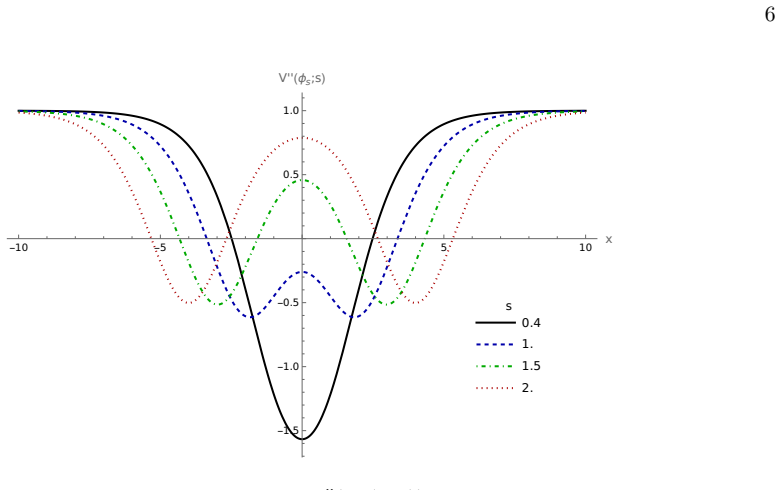
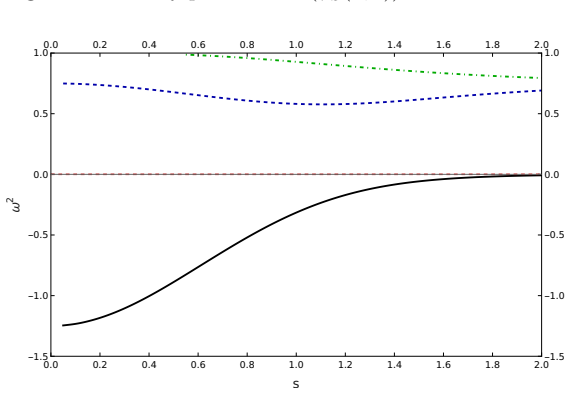
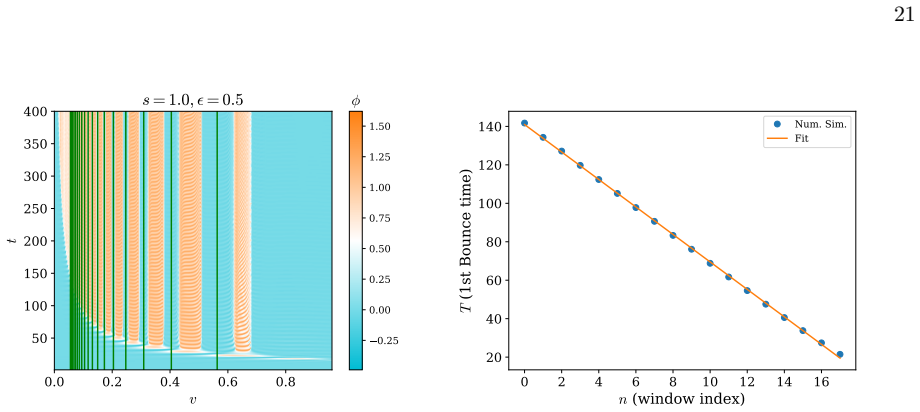
We study the collision dynamics of localized oscillons in two classes of $(1+1)$-dimensional scalar field theories with metastable false vacua, a normal class with a positive quartic self-interaction term and an inverted class with a negative quartic term. We construct small-amplitude oscillon solutions around the false vacuum using the Fodor {\emph{et al.}} expansion, and show that the force between oscillons decays exponentially at large separation, with a strength modulated by their relative phase. Numerical simulations of two-oscillon collisions exhibit reflection, crossing, and formation of excited oscillons. Resonance windows occur, similar to those found in kink-antikink collisions. In the normal theory, if the oscillons have sufficient energy, the field can pass over a sphaleron barrier and evolve into a kink-antikink pair, initiating a phase transition to the true vacuum. We also simulate the collision of oscillons evolved from a slightly perturbed sphaleron.
Editorial analysis
A structured set of objections, weighed in public.
Referee Report
Summary. The paper studies collision dynamics of small-amplitude oscillons in two (1+1)-dimensional scalar theories with metastable false vacua (normal positive-quartic and inverted negative-quartic classes). Oscillons are constructed via the Fodor et al. perturbative expansion around the false vacuum; the inter-oscillon force is shown to decay exponentially with separation and to depend on relative phase. Numerical evolutions reveal reflection, crossing, excited-oscillon formation, and resonance windows analogous to kink-antikink scattering. In the normal theory the authors state that, for sufficient energy, collisions can surmount the sphaleron barrier and produce a kink-antikink pair that initiates a phase transition to the true vacuum; they also simulate collisions of oscillons evolved from a perturbed sphaleron.
Significance. If the energy-threshold claim holds, the work would identify a concrete channel for false-vacuum decay mediated by oscillon collisions, extending the well-studied kink-antikink resonance phenomenology to metastable potentials. The phase-dependent force and resonance-window results are of intrinsic interest for nonlinear field dynamics. The manuscript supplies no machine-checked proofs or parameter-free derivations, but the numerical exploration of multiple outcomes is a concrete contribution provided the simulations are adequately controlled.
major comments (2)
- [Abstract] Abstract: the central claim that 'if the oscillons have sufficient energy, the field can pass over a sphaleron barrier and evolve into a kink-antikink pair' is load-bearing for the phase-transition result in the normal theory, yet the manuscript contains no explicit calculation showing that the energies of the Fodor et al. small-amplitude profiles exceed the sphaleron energy; because the expansion is perturbative in amplitude, the attainable energy is bounded by the regime of validity.
- [Numerical simulations] Numerical simulations section: no error bars, grid-convergence tests, or systematic parameter scans are reported for the collision evolutions; without these controls the robustness of the reported resonance windows and the kink-antikink formation channel cannot be assessed.
minor comments (2)
- [Introduction] The explicit forms of the two potentials (normal and inverted) should be stated in the introduction rather than deferred, to make the distinction between the two classes immediate.
- Figure captions for the collision snapshots should include the specific initial separation, relative phase, and total energy used in each run.
Simulated Author's Rebuttal
We thank the referee for the careful reading and constructive comments on our manuscript. We address the two major points below and will revise the manuscript to incorporate the requested clarifications and controls.
read point-by-point responses
-
Referee: [Abstract] Abstract: the central claim that 'if the oscillons have sufficient energy, the field can pass over a sphaleron barrier and evolve into a kink-antikink pair' is load-bearing for the phase-transition result in the normal theory, yet the manuscript contains no explicit calculation showing that the energies of the Fodor et al. small-amplitude profiles exceed the sphaleron energy; because the expansion is perturbative in amplitude, the attainable energy is bounded by the regime of validity.
Authors: We agree that an explicit energy comparison is needed to support the conditional claim. In the revised manuscript we will add a direct computation of the total energy for the small-amplitude Fodor profiles at the amplitudes used in our simulations, together with a comparison to the sphaleron barrier height. This will delineate the range of validity and indicate for which amplitudes the phase-transition channel becomes accessible. If the computed energies lie below the barrier we will qualify the statement accordingly while retaining the conditional phrasing. revision: yes
-
Referee: [Numerical simulations] Numerical simulations section: no error bars, grid-convergence tests, or systematic parameter scans are reported for the collision evolutions; without these controls the robustness of the reported resonance windows and the kink-antikink formation channel cannot be assessed.
Authors: We acknowledge the absence of reported numerical controls. In the revision we will include grid-convergence tests for representative two-oscillon collisions, provide error estimates on the locations of resonance windows, and add a limited parameter scan over initial separations and relative phases to demonstrate the robustness of the reflection, crossing, and phase-transition outcomes. revision: yes
Circularity Check
No significant circularity; results from cited expansion and external numerics
full rationale
The paper constructs small-amplitude oscillon profiles via the externally cited Fodor et al. expansion and obtains all collision outcomes (reflection, resonance windows, kink-antikink formation) from direct numerical integration of the field equations. No load-bearing step equates a derived quantity to a fitted parameter or self-citation by construction; the sphaleron-barrier claim is an observed simulation result rather than an internal redefinition. The derivation chain therefore remains self-contained against external benchmarks.
Axiom & Free-Parameter Ledger
axioms (2)
- domain assumption Existence and stability of small-amplitude oscillon solutions around the false vacuum via the Fodor et al. expansion
- domain assumption Classical evolution of the scalar field equation suffices to capture the reported dynamics
Reference graph
Works this paper leans on
-
[1]
M. Gleiser. Pseudostable bubbles.Phys. Rev. D, 49:2978, 1994
1994
-
[2]
E. J. Copeland, M. Gleiser, and H.-R. M¨ uller. Oscillons: Resonant configurations during bubble collapse.Phys. Rev. D, 52:1920, 1995
1920
-
[3]
M. A. Amin, R. Easther, and H. Finkel. Inflaton fragmentation and oscillon formation in three dimen- sions.J. Cosmol. Astropart. Phys., 12:001, 2010
2010
-
[4]
Flauger, L
R. Flauger, L. McAllister, E. Pajer, A. Westphal, and G. Xu. Oscillations in the cmb from axion monodromy inflation.J. Cosmol. Astropart. Phys., 6:009, 2010
2010
-
[5]
K. D. Lozanov and V. Takhistov. Enhanced gravitational waves from inflaton oscillons.Phys. Rev. Lett., 130:181002, 2023
2023
-
[6]
J. C. Aurrekoetxea, K. Clough, and F. Muia. Oscillon formation during inflationary preheating with general relativity.Phys. Rev. D, 108:023501, 2023
2023
-
[7]
Pˆ ırvu, M
D. Pˆ ırvu, M. C. Johnson, and S. Sibiryakov. Bubble velocities and oscillon precursors in first-order phase transitions.J. High Energy Phys., 11:64, 2024
2024
-
[8]
N. Graham. An electroweak oscillon.Phys. Rev. Lett., 98:101801, 2007
2007
-
[9]
N. Graham. Numerical simulation of an electroweak oscillon.Phys. Rev. D, 76:085017, 2007. 24
2007
-
[10]
M. V. Charukhchyan, E. S. Sedov, S. M. Arakelian, and A. P. Alodjants. Spatially localized structures and oscillons in atomic bose-einstein condensates confined in optical lattices.Phys. Rev. A, 89:063624, 2014
2014
-
[11]
Graham and N
N. Graham and N. Stamatopoulos. Unnatural oscillon lifetimes in an expanding background.Phys. Lett. B, 639:541, 2006
2006
-
[12]
Salmi and M
P. Salmi and M. Hindmarsh. Radiation and relaxation of oscillons.Phys. Rev. D, 85:085033, 2012
2012
-
[13]
Zhang, M
H.-Y. Zhang, M. A. Amin, E. J. Copeland, P. M. Saffin, and K. D. Lozanov. Classical decay rates of oscillons.J. Cosmol. Astropart. Phys., 07:055, 2020
2020
-
[14]
J. Olle, O. Pujolas, and F. Rompineve. Recipes for oscillon longevity.J. Cosmol. Astropart. Phys., 09:015, 2021
2021
-
[15]
Cyncynates and T
D. Cyncynates and T. Giurgica-Tiron. Structure of the oscillon: The dynamics of attractive self- interaction.Phys. Rev. D, 103:116011, 2021
2021
-
[16]
van Dissel, O
F. van Dissel, O. Pujol` as, and E. I. Sfakianakis. Oscillon spectroscopy.J. High Energy Phys., 07:194, 2023
2023
-
[17]
Fodor, P
G. Fodor, P. Forg´ acs, P. Grandcl´ ement, and I. R´ acz. Oscillons and quasibreathers in theϕ4 klein-gordon model.Phys. Rev. D, 74:124003, 2006
2006
-
[18]
Fodor, P
G. Fodor, P. Forg´ acs, Z. Horv´ ath, and A. Luk´ acs. Small amplitude quasibreathers and oscillons.Phys. Rev. D, 78:025003, 2008
2008
-
[19]
Blaschke, T
F. Blaschke, T. Roma´ nczukiewicz, K. S lawi´ nska, and A. Wereszczy´ nski. Oscillons from q-balls through renormalization.Phys. Rev. Lett., 134:081601, 2025
2025
-
[20]
Fodor, P
G. Fodor, P. Forg´ acs, Z. Horv´ ath, and M. Mezei. Computation of the radiation amplitude of oscillons. Phys. Rev. D, 79:065002, 2009
2009
-
[21]
Wang, Q.-X
Y.-J. Wang, Q.-X. Xie, and S.-Y. Zhou. Excited oscillons: Cascading levels and higher multipoles. Phys. Rev. D, 108:025006, 2023
2023
-
[22]
Evslin, T
J. Evslin, T. Roma´ nczukiewicz, K. S lawi´ nska, and A. Wereszczy´ nski. Normal modes of the small- amplitude oscillon.J. High Energy Phys., 01:039, 2025
2025
-
[23]
Evslin, T
J. Evslin, T. Roma´ nczukiewicz, K. S lawi´ nska, and A. Wereszczy´ nski. The universal floquet modes of (quasi)-breathers and oscillons.Phys. Lett. B, 872:140112, 2026
2026
-
[24]
D. K. Campbell, J. F. Schonfeld, and C. A. Wingate. Resonance structure in kink-antikink interactions inφ 4 theory.Physica D, 9:1, 1983
1983
-
[25]
Alonso-Izquierdo, D
A. Alonso-Izquierdo, D. Canillas Mart´ ınez, T. Roma´ nczukiewicz, K. S lawi´ nska, and A. Wereszczy´ nski. Excited oscillons and charge-swapping.J. High Energy Phys., 07:1, 2025
2025
-
[26]
R. F. Dashen, B. Hasslacher, and A. Neveu. Particle spectrum in model field theories from semiclassical functional integral techniques.Phys. Rev. D, 11:3424, 1975
1975
-
[27]
Evslin, T
J. Evslin, T. Roma´ nczukiewicz, and A. Wereszczy´ nski. Quantum oscillons may be long-lived.J. High Energy Phys., 08:182, 2023
2023
-
[28]
N. S. Manton and T. Roma´ nczukiewicz. Simplest oscillon and its sphaleron.Phys. Rev. D, 107:085012, 25 2023
2023
-
[29]
Navarro-Obreg´ on and J
S. Navarro-Obreg´ on and J. Queiruga. Impact of the internal modes on the sphaleron decay.Eur. Phys. J. C, 84:821, 2024
2024
-
[30]
J. G. F. Campos and A. Mohammadi. Interaction between kinks and antikinks with double long-range tails.Phys. Lett. B, 818:136361, 2021
2021
-
[31]
Bazeia, J
D. Bazeia, J. G. F. Campos, and A. Mohammadi. Kink-antikink collisions in theϕ 8 model: short-range to long-range journey.J. High Energy Phys., 05:116, 2023
2023
-
[32]
Dorey, T
P. Dorey, T. Roma´ nczukiewicz, Ya. Shnir, and A. Wereszczy´ nski. Oscillons in gapless theories.Phys. Rev. D, 109:085017, 2024
2024
-
[33]
J. G. F. Campos, A. Mohammadi, and T. Roma´ nczukiewicz. Resonance with quasinormal modes in long-range kinks’ collisions.Eur. Phys. J. C, 86:90, 2026
2026
-
[34]
Romanczukiewicz and Ya
T. Romanczukiewicz and Ya. Shnir. Oscillon resonances and creation of kinks in particle collisions. Phys. Rev. Lett., 105:081601, 2010
2010
-
[35]
Blaschke, T
F. Blaschke, T. Roma´ nczukiewicz, K. S lawi´ nska, and A. Wereszczy´ nski. Amplitude modulations and resonant decay of excited oscillons.Phys. Rev. E, 110:014203, 2024
2024
-
[36]
F. C. Simas and E. da Hora. Vacuum state perturbed by an oscillon: Composite configurations inϕ 4 model.Annals of Physics, 478:170008, 2025
2025
-
[37]
Klimas, J
P. Klimas, J. S. Streibel, A. Wereszczynski, and W. J. Zakrzewski. Oscillons in a perturbed signum- gordon model.J. High Energy Phys., 04:102, 2018
2018
-
[38]
F. M. Hahne, P. Klimas, J. S. Streibel, and W. J. Zakrzewski. Scattering of compact oscillons.J. High Energy Phys., 01:006, 2020
2020
-
[39]
F. C. Lima, F. C. Simas, K. Z. Nobrega, and A. R. Gomes. Scattering of metastable lumps in a model with a false vacuum.Phys. Lett. B, 822:136707, 2021
2021
-
[40]
S. C. Anco and D. Saadatmand. Long-time behaviour of sphalerons inϕ 4 models with a false vacuum. arXiv preprint 2510.04283, 2025
work page internal anchor Pith review Pith/arXiv arXiv 2025
-
[41]
A. T. Avelar, D. Bazeia, L. Losano, and R. Menezes. New lump-like structures in scalar-field models. Eur. Phys. J. C, 55:133, 2008
2008
-
[42]
Alonso Izquierdo, J
A. Alonso Izquierdo, J. Queiroga-Nunes, and L. M. Nieto. Scattering between wobbling kinks.Phys. Rev. D, 103:045003, 2021
2021
discussion (0)
Sign in with ORCID, Apple, or X to comment. Anyone can read and Pith papers without signing in.