Recognition: unknown
Ariel stellar characterisation IV. Fundamental parameters of 18 hot stars in the Ariel mission candidate sample
Pith reviewed 2026-05-14 20:12 UTC · model grok-4.3
The pith
A uniform determination of fundamental parameters for 18 hot stars extends mass-metallicity-planetary radius correlations to early-type hosts for the Ariel mission.
A machine-rendered reading of the paper's core claim, the machinery that carries it, and where it could break.
Core claim
We present a uniform determination of fundamental stellar parameters for 18 hot stars in the Tier 1 Ariel candidate list. An iterative spectro-trigonometric approach combines high-resolution spectral fits to metal and Balmer lines with photometry-based radii and masses from evolutionary tracks. The derived set includes effective temperatures, surface gravities, projected rotational velocities, microturbulent velocities, overall metallicities, iron abundances, stellar masses and radii. These parameters provide an internally consistent basis for studying links between stellar properties and planetary characteristics, and the correlations between stellar mass, metallicity and planetary radii do
What carries the argument
The iterative spectro-trigonometric approach that refines surface gravity from photometry-based radii and evolutionary-track masses after initial spectral analysis with the ZEEMAN code.
If this is right
- The parameters enable optimisation of the final Ariel target list before the 2029 launch.
- They supply a reliable foundation for interpreting formation and evolution of planetary systems around intermediate-mass stars.
- Stellar properties are shown to influence the architecture of multi-planet systems in early-type hosts.
- The same mass-metallicity-radius correlations previously seen in FGK hosts are confirmed to extend to hotter stars.
Where Pith is reading between the lines
- Future multi-planet systems discovered around these stars can be checked to see whether the reported architectural trends hold with additional data.
- Planet-formation simulations could be rerun with the new homogeneous parameters to test whether they reproduce the observed radius trends without ad-hoc adjustments for stellar temperature.
- Extending the same iterative method to the remaining hot Ariel candidates would allow a single consistent catalogue for the entire mission sample.
Load-bearing premise
The model atmospheres and evolutionary tracks produce accurate parameters for hot stars when combined with photometry-based radii in the iterative procedure.
What would settle it
Independent radius or temperature measurements from long-baseline interferometry or asteroseismology for several of these 18 stars that differ by more than the quoted uncertainties from the derived values.
Figures






read the original abstract
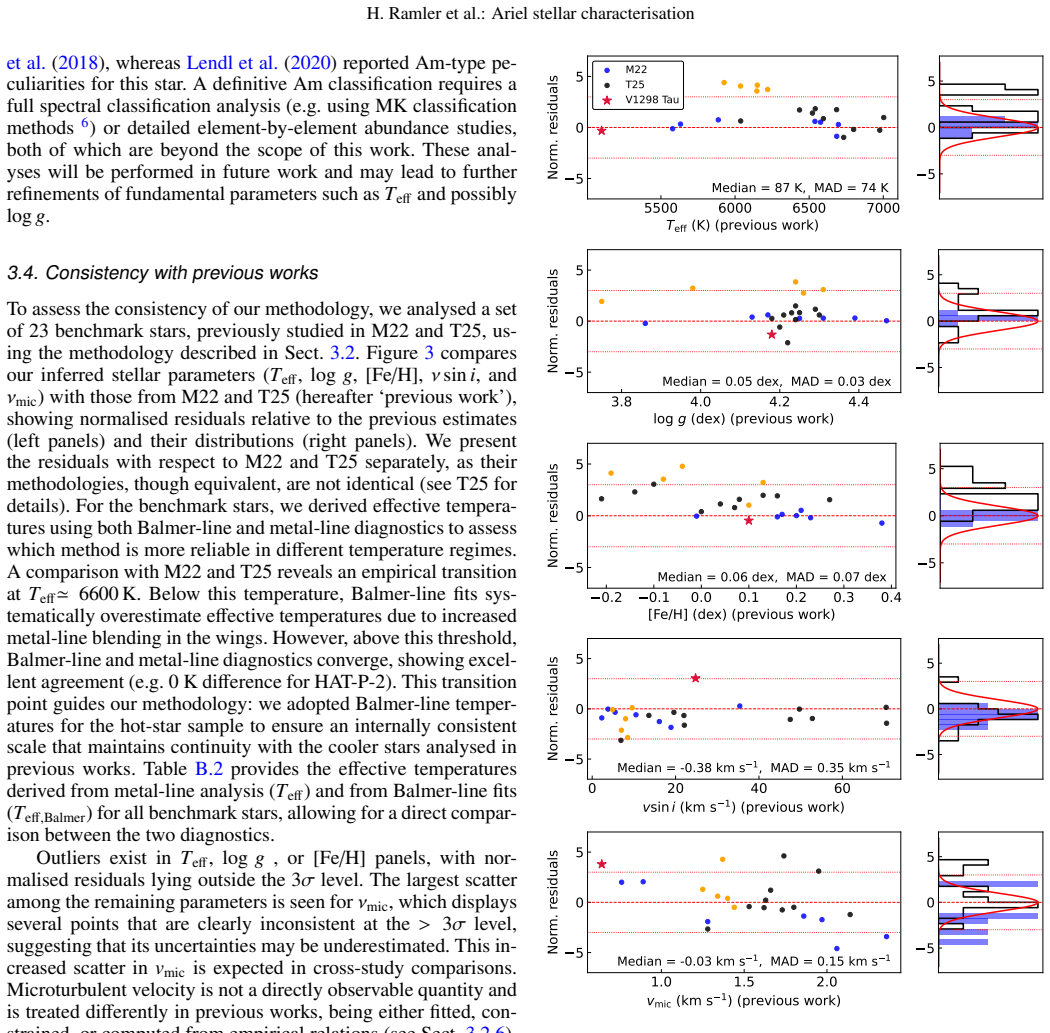
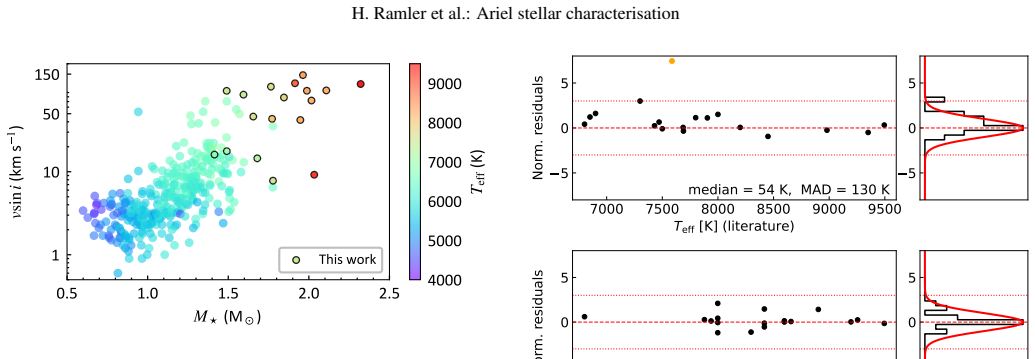
The characterisation of exoplanetary systems depends on the accurate determination of host star parameters. The Ariel mission will probe the atmospheres of a statistically significant sample of exoplanets, and so requires a precise characterisation of the stellar properties well before its launch in 2029. The homogeneous determination of stellar parameters for Ariel will enable both the optimisation of the final target list and set roots for a reliable interpretation of the formation and evolution of planetary systems. Such a homogeneous characterisation has thus far only been carried out for the cool (\teff\ $\lesssim 7000\,$K) host stars among the Ariel target candidates. We present a uniform determination of fundamental stellar parameters for 18 hot stars in the Tier 1 candidate list of the Ariel mission candidate sample. We adopted an iterative spectro-trigonometric approach optimised for high-temperature stars. High-resolution spectra were analysed using the \textsc{zeeman} code with $\chi^2$ minimisation, combining model fits to metal and Balmer lines. Surface gravity was refined using photometry-based radii and masses from stellar evolutionary tracks. We derived effective temperatures, surface gravities, projected rotational velocities, microturbulent velocities, overall metallicities, iron abundances, stellar masses, and radii for our sample of $18$ hot stars. Our results were validated against a set of benchmark stars previously presented in the literature. The derived parameters provide an internally consistent basis for studying the link between stellar properties and planetary characteristics in intermediate-mass stars. Building on our previous work on FGK host stars, we show that correlations between stellar mass, metallicity, and planetary radii also extend to early-type stars, and stellar properties influence the architecture of multi-planet systems.
Editorial analysis
A structured set of objections, weighed in public.
Referee Report
Summary. The manuscript presents a uniform determination of fundamental stellar parameters (effective temperatures, surface gravities, projected rotational velocities, microturbulent velocities, metallicities, iron abundances, masses, and radii) for 18 hot stars in the Ariel Tier 1 candidate sample. It employs an iterative spectro-trigonometric method using the ZEEMAN code for high-resolution spectral fits to metal and Balmer lines, refined with photometry-derived radii and evolutionary-track masses for log g. Parameters are validated against literature benchmark stars, and the work extends prior correlations between stellar mass, metallicity, and planetary radii to early-type hosts while noting influences on multi-planet system architecture.
Significance. If the parameters are shown to be accurate via detailed benchmarks, this provides the first homogeneous characterisation of hot Ariel host stars, complementing existing FGK results and supporting mission target optimisation and exoplanet atmosphere interpretation. The extension of mass-metallicity-radius correlations to intermediate-mass stars offers a testable link between stellar properties and planetary system architecture with direct relevance to formation models.
major comments (1)
- [Validation section] Validation section (referenced in abstract): the claim of validation against benchmark stars lacks quantitative metrics such as mean differences, standard deviations, or rms residuals in Teff, log g, and [Fe/H] for the hot-star regime; without these, the accuracy of the iterative ZEEMAN-plus-photometry method for stars above 7000 K cannot be fully assessed and remains a load-bearing point for the central claim of reliable parameters.
minor comments (2)
- [Abstract] Abstract: the phrase 'post-hoc adjustments were avoided' is not quantified; clarify in the methods section how the iteration was constrained to prevent circularity between spectral fits and evolutionary tracks.
- Notation: ensure consistent typesetting of Teff, log g, and v sin i across text, tables, and figures; define microturbulent velocity explicitly as a free parameter in the ZEEMAN fits.
Simulated Author's Rebuttal
We thank the referee for their positive assessment of our manuscript and for the constructive comment on the validation section. We address the point below and will incorporate the suggested improvements in the revised version.
read point-by-point responses
-
Referee: [Validation section] Validation section (referenced in abstract): the claim of validation against benchmark stars lacks quantitative metrics such as mean differences, standard deviations, or rms residuals in Teff, log g, and [Fe/H] for the hot-star regime; without these, the accuracy of the iterative ZEEMAN-plus-photometry method for stars above 7000 K cannot be fully assessed and remains a load-bearing point for the central claim of reliable parameters.
Authors: We agree that quantitative metrics are needed to fully substantiate the validation claims for the hot-star regime. In the revised manuscript we will add a dedicated table (or subsection) reporting the mean differences, standard deviations, and RMS residuals in Teff, log g, and [Fe/H] between our derived parameters and the literature benchmark values for all stars with Teff > 7000 K. This will allow a direct assessment of the accuracy of the iterative ZEEMAN-plus-photometry approach. revision: yes
Circularity Check
No significant circularity; derivation is self-contained
full rationale
The paper derives stellar parameters via direct spectral fitting with the ZEEMAN code using chi-squared minimization on metal and Balmer lines from high-resolution spectra, followed by refinement of surface gravity from independent photometry-based radii and masses drawn from stellar evolutionary tracks. This iterative spectro-trigonometric method produces Teff, log g, v sin i, microturbulence, metallicities, masses, and radii without any equations or steps that reduce outputs to fitted inputs by construction. Validation against external literature benchmark stars provides an independent check. The extension of mass-metallicity-planetary radius correlations to early-type stars applies the newly derived parameters to the 18-star sample and does not rely on self-citation chains or ansatzes that collapse the result to prior inputs. The approach is standard and externally falsifiable, yielding a self-contained chain.
Axiom & Free-Parameter Ledger
free parameters (1)
- microturbulent velocity
axioms (2)
- domain assumption Standard LTE model atmospheres accurately represent hot-star spectra when Balmer and metal lines are fitted simultaneously.
- domain assumption Stellar evolutionary tracks provide reliable masses and radii once effective temperature and surface gravity are known.
Reference graph
Works this paper leans on
-
[1]
WASP-189b: an ultra-hot Jupiter transiting the bright A star HR 5599 in a polar orbit
Addison, B. C., Knudstrup, E., Wong, I., et al. 2021, AJ, 162, 292 Adibekyan, V ., Dorn, C., Sousa, S. G., et al. 2021, Science, 374, 330 Adibekyan, V ., Santos, N. C., Figueira, P., et al. 2015, A&A, 581, L2 Anderson, D. R., Temple, L. Y ., Nielsen, L. D., et al. 2018, Monthly Notices of the Royal Astronomical Society [arXiv:1809.04897], submitted Anstee...
work page internal anchor Pith review Pith/arXiv arXiv 2021
-
[2]
A dominant subsolar–antisolar wind circula- tion pattern has been suggested
HAT-P-70 b 0.04739±0.00106≤6.78 +0 −6.77 1.66±0.20 2562±43 – Atmospheric species detected include Ca, Fe, Mg, Ni, Cr, Mn, Na and V . A dominant subsolar–antisolar wind circula- tion pattern has been suggested. (Zhou et al. 2019b; Gandhi et al. 2023; Langeveld et al
2023
-
[3]
(Zhou et al
HATS-70 b 0.0363±0.0007 12.9±1.8 1.38±0.08 2730±160 - HATS-70 b is more likely a brown dwarf than a planet. (Zhou et al. 2019a) HD 2685 b 0.0568±0.0006 1.17±0.12 1.44±0.05 2061 – The coolest host star in the sample. (Jones et al
2061
-
[4]
The planetary orbit is strongly misaligned (projected spin–orbit angleλ∼84 ◦)
KELT-17 b 0.04881±0.00065 1.31±0.29 1.525±0.065 2087 – KELT-17 is an Am-type star. The planetary orbit is strongly misaligned (projected spin–orbit angleλ∼84 ◦). (Garai et al. 2022; Zhou et al. 2016; Hansen
2087
-
[5]
The system exhibits a near-perfect spin–orbit alignment (3.4◦ ±2.1 ◦)
KELT-20 A b 0.0542±0.0021≤3.382 1.741±0.074 2252±78 KELT-20 B, possibly a brown dwarf, at a projected separation of 6595 AU. The system exhibits a near-perfect spin–orbit alignment (3.4◦ ±2.1 ◦). Supersonic day–night winds are inferred in the planetary atmosphere. (Lund et al. 2017; Finnerty et al. 2025; Eeles-Nolle & Armstrong
2017
-
[6]
KELT-21 A b has a well-aligned orbit; Kozai–Lidov oscilla- tions are therefore unlikely to have driven the migration
KELT-21 A b 0.05224±0.0016≤3.91 1.586±0.04 2025±30 KELT-21 B and KELT-21 C, mid-M dwarfs; separation B–C is 20 AU; distance from A is∼500 AU. KELT-21 A b has a well-aligned orbit; Kozai–Lidov oscilla- tions are therefore unlikely to have driven the migration. (Johnson et al. 2018; Hamers 2017; Saha
2025
-
[7]
The mass-loss rate is approximately 10 12.8±0.3 g s −1; the planet could lose its atmosphere within∼600 Myr
KELT-9 A b 0.03462±0.00078 2.88±0.84 1.891±0.061 3921±182 KELT-9 B, an M dwarf at a projected separation of 2671 AU. The mass-loss rate is approximately 10 12.8±0.3 g s −1; the planet could lose its atmosphere within∼600 Myr. (Stassun et al. 2019; Mugrauer 2019; Michel & Mugrauer 2024; Borsa et al. 2019; Wyttenbach et al. 2020; Gaudi et al. 2017; Harre et al
2019
-
[8]
The planet has an oblique orbit
KOI-13 A b 0.03641±0.001≤9.28 1.512±0.035 2550±80 KOI-13 B (A-type star, 1.69M ⊙, orbital period∼1000 yr) and KOI-13 C (low- mass K dwarf, 0.7M ⊙, orbiting B with P=65.8 d); projected separation from A is 569 AU. The planet has an oblique orbit. The system shows a strong spin–orbit misalignment and a varying transit duration, prob- ably caused by nodal pr...
2011
-
[9]
(Hooton et al
MASCARA-1 b 0.043±0.005 3.7±0.9 1.597±0.3 – – The planet has strongly misaligned orbit, 72.1 ◦ ±2.5 ◦. (Hooton et al. 2022; Talens et al
2022
-
[10]
The planet has very highly misaligned, retrograde orbit (λ= 250.34◦ ±0.14◦)
MASCARA-4 A b 0.0474±0.004 1.675±0.241 1.515±0.07 2455±41 MASCARA-4 B, a late K/M dwarf at a projected separation of 744 AU. The planet has very highly misaligned, retrograde orbit (λ= 250.34◦ ±0.14◦). Rubidium and samarium have been detected in its atmosphere. (Dorval et al. 2020; Michel & Mugrauer 2021; Zhang et al. 2022; Saha 2024; Jiang et al
2020
-
[11]
No atmosphere has yet been detected for the planet
TOI-1431 b 0.046±0.002 3.12±0.18 1.49±0.05 2370±70 ? TOI-1431 is an Am-type star. No atmosphere has yet been detected for the planet. (Addison et al. 2021; Stangret et al
2021
-
[12]
(Cabot et al
TOI-1518 b 0.0389±0.0011≤2.3 1.875±0.053 2892±38 – The orbit undergoes nodal precession; transits are predicted to cease by 2194±70 AD. (Cabot et al. 2021; Watanabe et al
2021
-
[13]
The planet’s atmosphere appears carbon-depleted and shows titanium de- pletion
W ASP-178 b 0.0558±0.001 1.66±0.12 1.81±0.09 2402±130 – W ASP-178 is a slowly rotating weak Am star. The planet’s atmosphere appears carbon-depleted and shows titanium de- pletion. (Fossati et al. 2025; Hellier et al. 2019a; Rodríguez Martínez et al. 2020; Lothringer et al
2025
-
[14]
Upper-atmosphere studies indicate Mg II and possibly Fe II, with evidence for escaping magnesium and temperatures around 1.5×10 4 K
W ASP-189 A b 0.05053±0.00098 1.99±0.16 1.619±0.021 3353±34 W ASP-189 B, an M dwarf at a projected separation of 942 AU. Upper-atmosphere studies indicate Mg II and possibly Fe II, with evidence for escaping magnesium and temperatures around 1.5×10 4 K. (Lendl et al. 2020; Sreejith et al. 2023; Eeles-Nolle & Armstrong
2020
-
[15]
W ASP-33 A is a non-radialδScuti pulsator (a γDoradus–δScuti hybrid candidate)
W ASP-33 A b 0.0239±0.00063 2.093±0.139 1.593±0.074 2781.70±41.10 W ASP-33 B (M dwarf, 238 AU) and W ASP-33 C (G dwarf, 5955 AU). W ASP-33 A is a non-radialδScuti pulsator (a γDoradus–δScuti hybrid candidate). The planet has a retrograde, nearly polar orbit (108.19±0.97) and exhibits poor day–night heat redistribution. (Chakrabarty & Sengupta 2019; Collie...
2019
-
[16]
Stellar and planetary parameters are adopted from the cited discovery and follow-up papers
Notes.ais the orbital distance;T eq is the zero-albedo equilibrium temperature. Stellar and planetary parameters are adopted from the cited discovery and follow-up papers. Article number, page 17 of 20 A&A proofs:manuscript no. aa58131-25corr Table B.2.Fundamental parameters of benchmark stars analysed in this paper. IDT eff[K]T eff,Balmer[K] logg[dex] Ma...
2022
discussion (0)
Sign in with ORCID, Apple, or X to comment. Anyone can read and Pith papers without signing in.