Recognition: unknown
UFO: A Domain-Unification-Free Operator Framework for Generalized Operator Learning
Pith reviewed 2026-05-14 20:51 UTC · model grok-4.3
The pith
UFO achieves discretization decoupling in neural operators by adaptive cross-domain interactions without unification.
A machine-rendered reading of the paper's core claim, the machinery that carries it, and where it could break.
Core claim
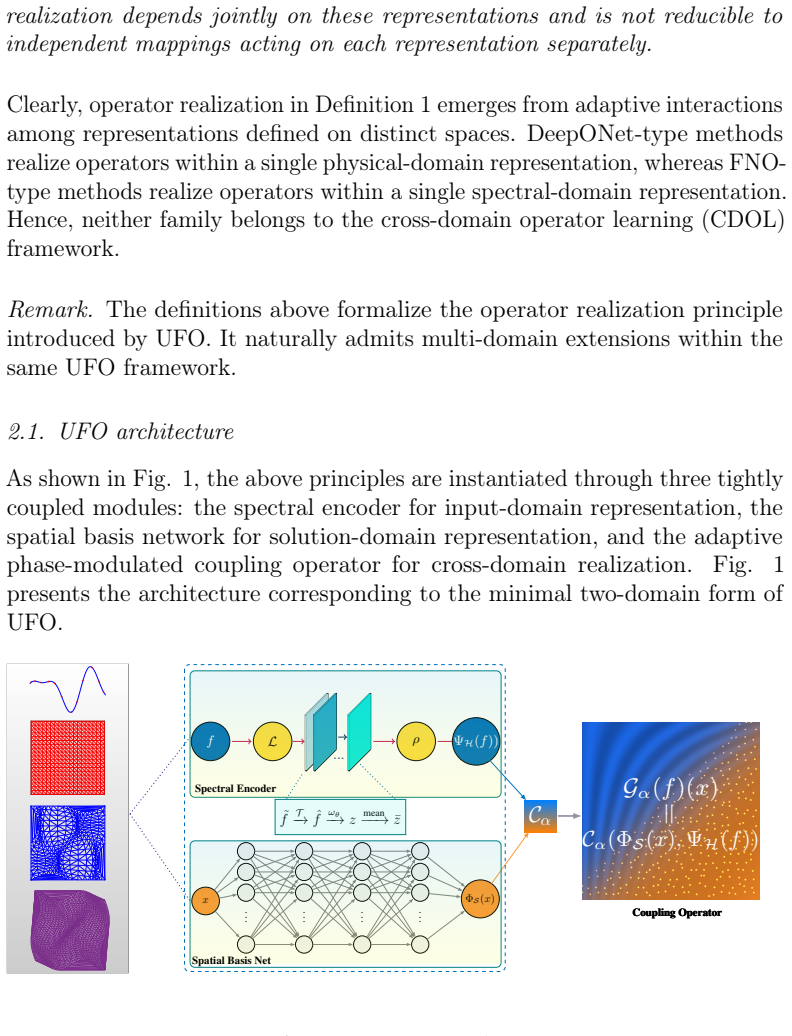
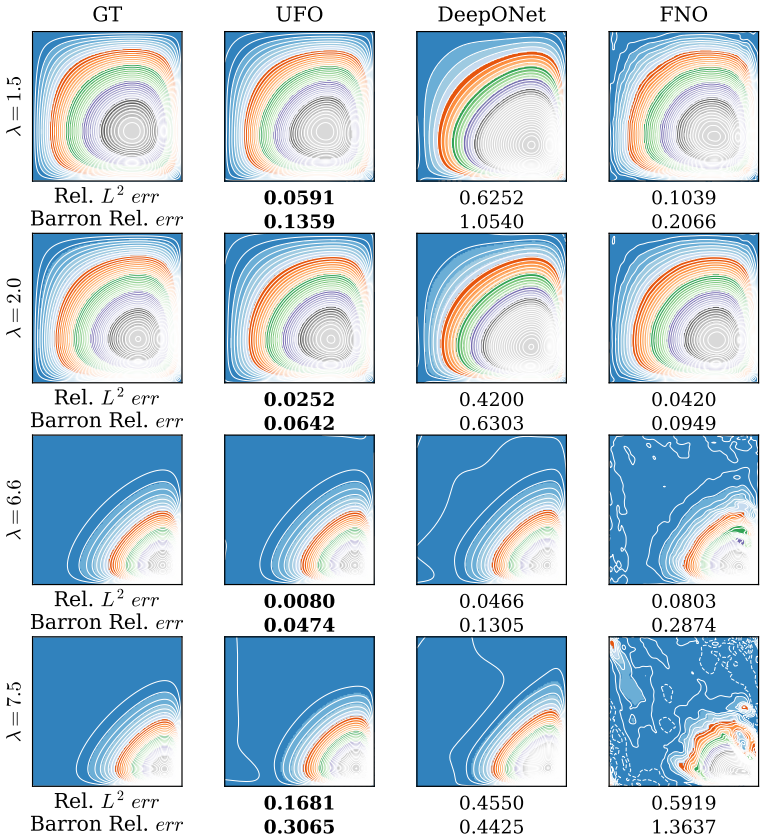
UFO realizes operators through adaptive, jointly conditioned interactions among representations defined on distinct domains, enabling discretization decoupling: the input function can be observed at resolutions or locations different from those used during training, while the solution can be queried at arbitrary output resolutions, delivering accurate, robust, and physically coherent predictions under distribution shifts on benchmarks covering discontinuous inputs, irregular sampling with spectral mismatch, nonlinear dynamics, and stochastic high-frequency fields.
What carries the argument
Adaptive jointly conditioned cross-domain interactions that realize the operator mapping without explicit domain unification.
If this is right
- Input functions can be supplied at resolutions or point sets different from training data.
- Output functions can be evaluated at any desired resolution after training.
- Predictions remain accurate and physically coherent on discontinuous, irregularly sampled, nonlinear, and high-frequency data under distribution shift.
- No separate unification step or auxiliary constraints are required to achieve the decoupling.
Where Pith is reading between the lines
- The same interaction mechanism could be applied to coupled multi-physics problems where each physics occupies its own representational domain.
- Sensor data arriving at irregular locations could be fed directly without resampling onto a common mesh.
- The framework might be extended to time-dependent or three-dimensional operators by adding a temporal or spatial domain to the set of interacting representations.
Load-bearing premise
Adaptive jointly-conditioned cross-domain interactions can be learned reliably from data and will produce discretization decoupling without explicit unification or additional constraints.
What would settle it
Training UFO on one resolution grid and testing on a markedly different grid for the same operator, then finding that prediction error exceeds that of a standard single-domain neural operator on at least one of the four benchmarks, would falsify the central claim.
Figures



read the original abstract
Neural operators have become an effective framework for learning mappings between function spaces, yet most existing architectures realize operators within a single representational domain, such as physical, spectral, or latent space. In this work, we introduce UFO (Domain-Unification-Free Operator), a cross-domain neural operator framework that realizes operators through adaptive, jointly conditioned interactions among representations defined on distinct domains. UFO enables discretization decoupling: the input function can be observed at resolutions or locations different from those used during training, while the solution can be queried at arbitrary output resolutions. Across four complementary benchmarks covering discontinuous inputs, irregular sampling with spectral mismatch, nonlinear dynamics, and stochastic high-frequency fields, UFO delivers accurate, robust, and physically coherent predictions under distribution shifts. These results establish cross-domain, phase-modulated realization as a powerful framework for discretization-decoupled neural operator learning.
Editorial analysis
A structured set of objections, weighed in public.
Referee Report
Summary. The manuscript introduces UFO, a cross-domain neural operator framework that realizes operators through adaptive, jointly conditioned interactions among representations defined on distinct domains, without requiring explicit domain unification. This construction is claimed to enable discretization decoupling, allowing inputs observed at resolutions or locations different from training and solutions queried at arbitrary output resolutions. The framework is evaluated on four benchmarks covering discontinuous inputs, irregular sampling with spectral mismatch, nonlinear dynamics, and stochastic high-frequency fields, with the central claim being accurate, robust, and physically coherent predictions under distribution shifts.
Significance. If the empirical results hold with the reported robustness, the work could meaningfully advance generalized operator learning by removing the unification step that often limits flexibility in existing architectures. The emphasis on cross-domain adaptive interactions offers a practical route to handling real-world distribution shifts in scientific computing applications where discretization varies.
minor comments (1)
- [Abstract] Abstract: the strong performance claims would be easier to assess if at least one quantitative metric (e.g., relative L2 error or comparison to a baseline) were included to ground the assertions of accuracy and robustness.
Simulated Author's Rebuttal
We thank the referee for the positive summary of our work and the recommendation for minor revision. The referee's description accurately reflects the core contribution of UFO in realizing cross-domain operators without explicit unification to achieve discretization decoupling.
Circularity Check
No significant circularity
full rationale
The paper presents UFO as a cross-domain neural operator framework that realizes operators via adaptive jointly-conditioned interactions among representations on distinct domains, enabling discretization decoupling. The provided abstract and high-level description introduce this as an architectural innovation supported by empirical results across four benchmarks (discontinuous inputs, irregular sampling, nonlinear dynamics, stochastic fields). No equations, fitted parameters, or self-citation chains are exhibited that reduce any claimed prediction or performance metric to a definition or input by construction. The central claims rest on external benchmark comparisons rather than internal self-referential reductions, making the derivation self-contained against the reported evidence.
Axiom & Free-Parameter Ledger
Reference graph
Works this paper leans on
-
[1]
Learning nonlinear operators via DeepONet based on the universal approximation theoremof operators
Lu Lu and Pengzhan Jin and Guofei Pang and Zhongqiang Zhang and George Em Karniadakis. Learning nonlinear operators via DeepONet based on the universal approximation theoremof operators. Nature Machine Intelligence. 2021
2021
-
[2]
Neural Operator: Learning Maps Between Function Spaces With Applications to PDEs
Nikola Kovachki and Zongyi Li and Burigede Liu and Kamyar Azizzadenesheli and Kaushik Bhattacharya and Andrew Stuart and Anima Anandkumar. Neural Operator: Learning Maps Between Function Spaces With Applications to PDEs. Journal of Machine Learning Research. 2023
2023
-
[3]
Hamprecht and Yoshua Bengio and Aaron Courville
Nasim Rahaman and Aristide Baratin and Devansh Arpit and Felix Draxler and Min Lin and Fred A. Hamprecht and Yoshua Bengio and Aaron Courville. On the Spectral Bias of Neural Networks. Proceedings of the 36 th International Conference on Machine Learning. 2019
2019
-
[4]
When and why PINNs fail to train: A neural tangent kernel perspective
Sifan Wang and Xinling Yu and Paris Perdikaris. When and why PINNs fail to train: A neural tangent kernel perspective. Journal of Computational Physics. 2022
2022
-
[5]
2021 , author =
Fourier Neural Operator for Parametric Partial Differential Equations , booktitle =. 2021 , author =
2021
-
[6]
Physics-informed neural operator for learning partial differential equations
Zongyi Li and Hongkai Zheng and Nikola Kovachki and David Jin and Haoxuan Chen and Burigede Liu and Kamyar Azizzadenesheli and Anima Anandkumar. Physics-informed neural operator for learning partial differential equations. ACM/IMS Journal of Data Science. 2024
2024
-
[7]
Surrogate modeling of heat transfer under flow fluctuation conditions using Fourier Basis-Deep Operator Network with uncertainty quantification
Qiyun Cheng and Md Hossain Sahadath and Huihua Yang and Shaowu Pan and Wei Ji. Surrogate modeling of heat transfer under flow fluctuation conditions using Fourier Basis-Deep Operator Network with uncertainty quantification. Progress in Nuclear Energy. 2025
2025
-
[8]
Fourier-MIONet: Fourier-enhanced multiple-input neural operators for multiphase modeling of geological carbon sequestration
Zhongyi Jiang and Min Zhu and Lu Lu. Fourier-MIONet: Fourier-enhanced multiple-input neural operators for multiphase modeling of geological carbon sequestration. Reliability Engineering and System Safety. 2024
2024
-
[9]
FEDONet : Fourier-Embedded DeepONet for Spectrally Accurate Operator Learning
Arth Sojitra and Mrigank Dhingra and Omer San. FEDONet: Fourier-Embedded DeepONet for Spectrally Accurate Operator Learning. arXiv preprint arXiv: 2509.12344v4. 2026
work page internal anchor Pith review Pith/arXiv arXiv 2026
-
[10]
Universal approximation bounds for superpositions of a sigmoidal function
Andrew R Barron. Universal approximation bounds for superpositions of a sigmoidal function. IEEE Transactions on Information Theory. 2002
2002
-
[11]
Spectral bias in physics-informed and operator learning: Analysis and mitigation guidelines
Siavash Khodakarami and Vivek Oommen and Nazanin Ahmadi Daryakenari and Maxim Beekenkamp and George Em Karniadakis. Spectral bias in physics-informed and operator learning: Analysis and mitigation guidelines. arXiv preprint arXiv:2602.19265v1. 2026
-
[12]
Neural operators for accelerating scientific simulations and design
Kamyar Azizzadenesheli and Nikola Kovachki and Zongyi Li and Miguel Liu-Schiaffini and Jean Kossaifi and Anima Anandkumar. Neural operators for accelerating scientific simulations and design. Nature Reviews Physics. 2024
2024
-
[13]
2023 , editor =
Hao, Zhongkai and Wang, Zhengyi and Su, Hang and Ying, Chengyang and Dong, Yinpeng and Liu, Songming and Cheng, Ze and Song, Jian and Zhu, Jun , booktitle =. 2023 , editor =
2023
-
[14]
2025 , author =
A resolution independent neural operator , journal =. 2025 , author =
2025
-
[15]
Journal of Machine Learning Research , year =
Zongyi Li and Daniel Zhengyu Huang and Burigede Liu and Anima Anandkumar , title =. Journal of Machine Learning Research , year =
-
[16]
Geometry-Informed Neural Operator for Large-Scale 3D PDEs , volume =
Li, Zongyi and Kovachki, Nikola and Choy, Chris and Li, Boyi and Kossaifi, Jean and Otta, Shourya and Nabian, Mohammad Amin and Stadler, Maximilian and Hundt, Christian and Azizzadenesheli, Kamyar and Anandkumar, Animashree , booktitle =. Geometry-Informed Neural Operator for Large-Scale 3D PDEs , volume =
-
[17]
Latent Neural Operator for Solving Forward and Inverse PDE Problems , volume =
Wang, Tian and Wang, Chuang , booktitle =. Latent Neural Operator for Solving Forward and Inverse PDE Problems , volume =
-
[18]
Proceedings of the IEEE/CVF Conference on Computer Vision and Pattern Recognition (CVPR) , year =
Liu, Xiaoyi and Tang, Hao , title =. Proceedings of the IEEE/CVF Conference on Computer Vision and Pattern Recognition (CVPR) , year =
-
[19]
2025 , author =
Spatio-temporal neural operator on complex geometries , journal =. 2025 , author =
2025
-
[20]
2023 , author =
Fourier-DeepONet: Fourier-enhanced deep operator networks for full waveform inversion with improved accuracy, generalizability, and robustness , journal =. 2023 , author =
2023
-
[21]
2026 , author =
Fusion-DeepONet: A data-efficient neural operator for geometry-dependent hypersonic and supersonic flows , journal =. 2026 , author =
2026
-
[22]
2026 , author =
Mitigating spectral bias in neural operators via high-frequency scaling for physical systems , journal =. 2026 , author =
2026
-
[23]
Proceedings of the IEEE/CVF Conference on Computer Vision and Pattern Recognition (CVPR) , month =
Wei, Min and Zhang, Xuesong , title =. Proceedings of the IEEE/CVF Conference on Computer Vision and Pattern Recognition (CVPR) , month =. 2023 , pages =
2023
-
[24]
2025 , author =
Diffeomorphism neural operator for various domains and parameters of partial differential equations , journal =. 2025 , author =
2025
-
[25]
2024 , author =
A scalable framework for learning the geometry-dependent solution operators of partial differential equations , journal =. 2024 , author =
2024
-
[26]
2024 , author =
Learning nonlinear operators in latent spaces for real-time predictions of complex dynamics in physical systems , journal =. 2024 , author =
2024
-
[27]
2024 , author =
Laplace neural operator for solving differential equations , journal =. 2024 , author =
2024
-
[28]
2022 , author =
U-FNO-An enhanced Fourier neural operator-based deep-learning model for multiphase flow , journal =. 2022 , author =
2022
-
[29]
Frontiers in Marine Science , VOLUME=
Choi, Byoung-Ju and Jin, Hong Sung and Lkhagvasuren, Bataa , TITLE=. Frontiers in Marine Science , VOLUME=
-
[30]
2024 , author =
Porous-DeepONet: Learning the Solution Operators of Parametric Reactive Transport Equations in Porous Media , journal =. 2024 , author =
2024
-
[31]
Jaideep Pathak and Shashank Subramanian and Peter Harrington and Sanjeev Raja and Ashesh Chattopadhyay and Morteza Mardani and Thorsten Kurth and David Hall and Zongyi Li and Kamyar Azizzadenesheli and Pedram Hassanzadeh and Karthik Kashinath and Animashree Anandkumar. FourCastNet: A Global Data-driven High-resolution Weather Model Using Adaptive Fourier ...
work page internal anchor Pith review Pith/arXiv arXiv 2026
discussion (0)
Sign in with ORCID, Apple, or X to comment. Anyone can read and Pith papers without signing in.