Recognition: unknown
Approximations with Non-Symmetric Green's Kernels and their Application to Fractional Differential Equations
Pith reviewed 2026-05-14 19:58 UTC · model grok-4.3
The pith
Non-symmetric Green's kernels produce optimal-order spline interpolants for fractional differential equations in reproducing kernel Banach spaces.
A machine-rendered reading of the paper's core claim, the machinery that carries it, and where it could break.
Core claim
Kernel interpolants built from the non-symmetric Green's kernel of a fractional differential operator attain optimal approximation orders in the associated reproducing kernel Banach space and can therefore be used to construct a convergent kernel Galerkin method for the corresponding fractional boundary-value problem.
What carries the argument
The non-symmetric Green's kernel of the fractional differential operator, which defines the spline interpolant and supplies the basis functions for the Galerkin discretization.
If this is right
- The kernel Galerkin method inherits optimal convergence from the interpolant without requiring symmetry of the kernel.
- Fractional-order spline spaces can be realized outside the Hilbert-space framework while preserving approximation theory.
- Numerical schemes for fractional differential equations become available for operators whose Green's functions are known only in non-symmetric form.
- The approach extends classical kernel interpolation theory to Banach-space settings without loss of rate.
Where Pith is reading between the lines
- Similar non-symmetric kernels could be constructed for other nonlocal operators such as fractional Laplacians on irregular domains.
- Implementation would require only the ability to evaluate the Green's kernel, opening the method to problems where the kernel is known analytically but not symmetric.
- Stability estimates in the Banach norm may translate into practical error indicators for adaptive refinement in fractional simulations.
Load-bearing premise
The fractional differential operator possesses a well-defined non-symmetric Green's kernel that can be used to construct the spline interpolant.
What would settle it
A concrete computation on a fractional equation whose exact solution is known, showing that the observed L2 or pointwise error of the kernel interpolant fails to decrease at the predicted optimal rate as the mesh is refined.
Figures

read the original abstract
Several kernel-based methods for the numerical solution of fractional differential equations have been developed in the recent past; however, these techniques exclusively relied on the use of radial basis function approximations. In the present work, we consider the non-symmetric Green's kernel perspective on fractional order spline interpolation and its application to a kernel Galerkin method for the numerical solution of certain fractional order differential equation. Unfortunately, the reliance on a non-symmetric kernel requires that our theoretical analysis of the kernel interpolants must take place outside the familiar setting of reproducing kernel Hilbert spaces. Nevertheless, we are able to prove that the proposed kernel interpolants obtain optimal order convergence rates in a reproducing kernel Banach space.
Editorial analysis
A structured set of objections, weighed in public.
Referee Report
Summary. The manuscript develops approximations based on non-symmetric Green's kernels arising from fractional differential operators. It constructs spline interpolants and applies them within a kernel Galerkin method for solving certain fractional-order differential equations. The central claim is a proof that the resulting kernel interpolants attain optimal-order convergence rates in a reproducing kernel Banach space, extending the analysis beyond the standard reproducing kernel Hilbert space framework.
Significance. If the Banach-space convergence analysis is complete, the work is significant because it provides a rigorous foundation for kernel methods on non-symmetric operators that commonly appear in fractional calculus, moving past the radial-basis-function restriction of prior techniques. The explicit treatment of the non-Hilbert setting could enable more general and accurate discretizations for fractional differential equations.
major comments (3)
- [Section 3] Section 3 (reproducing kernel Banach space construction): the proof that the non-symmetric Green's kernel induces a well-defined reproducing property must explicitly establish continuity of the point-evaluation functionals in the Banach norm; without this, the subsequent interpolation operator stability used for error bounds is not guaranteed.
- [Theorem 4.2] Theorem 4.2 (optimal-order convergence): the error estimate equating the native-space norm to a target Sobolev-type norm relies on boundedness of the inverse operator on the range; for non-symmetric kernels this boundedness must be verified directly from the fractional differential operator properties, as Hilbert-space orthogonality arguments no longer apply.
- [Section 5] Section 5 (kernel Galerkin application): the stability and convergence analysis of the Galerkin scheme for the fractional DE must derive explicit constants that remain independent of the non-symmetry; otherwise the claimed optimality for the full solver does not follow from the interpolation result alone.
minor comments (2)
- [Notation] The notation distinguishing the non-symmetric kernel from its symmetric counterpart should be introduced earlier and used consistently in all error statements.
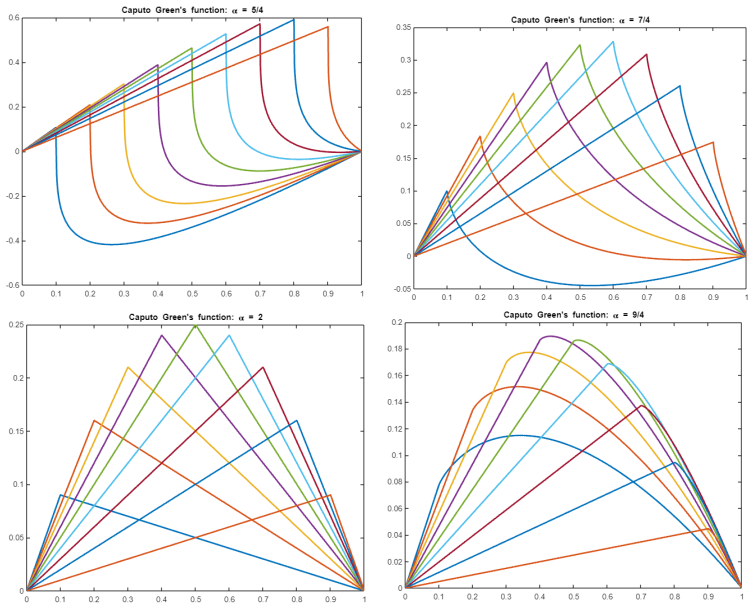
- [Figure 2] Figure 2 caption should state the precise fractional order and boundary conditions used in the numerical test to allow direct reproduction.
Simulated Author's Rebuttal
We thank the referee for the careful reading of our manuscript and the constructive comments. We address each major point below and have revised the manuscript to incorporate the suggested clarifications and additions to the proofs.
read point-by-point responses
-
Referee: [Section 3] Section 3 (reproducing kernel Banach space construction): the proof that the non-symmetric Green's kernel induces a well-defined reproducing property must explicitly establish continuity of the point-evaluation functionals in the Banach norm; without this, the subsequent interpolation operator stability used for error bounds is not guaranteed.
Authors: We agree that continuity of the point-evaluation functionals must be shown explicitly to guarantee the reproducing property and interpolation stability in the Banach-space setting. In the revised manuscript we have inserted a new lemma in Section 3 that proves this continuity directly from the definition of the non-symmetric Green's kernel and the boundedness of the underlying fractional differential operator. The argument uses the kernel's integral representation and standard embedding estimates, thereby justifying the stability of the interpolation operator used in all subsequent error bounds. revision: yes
-
Referee: [Theorem 4.2] Theorem 4.2 (optimal-order convergence): the error estimate equating the native-space norm to a target Sobolev-type norm relies on boundedness of the inverse operator on the range; for non-symmetric kernels this boundedness must be verified directly from the fractional differential operator properties, as Hilbert-space orthogonality arguments no longer apply.
Authors: The referee is correct that Hilbert-space orthogonality is unavailable. We have expanded the proof of Theorem 4.2 to contain a direct verification of the bounded invertibility of the fractional operator on the relevant range. The argument proceeds from the coercivity and continuity constants of the fractional differential operator (which are independent of symmetry) and yields the required norm equivalence between the native Banach space and the target Sobolev-type space, thereby establishing the optimal convergence rate. revision: yes
-
Referee: [Section 5] Section 5 (kernel Galerkin application): the stability and convergence analysis of the Galerkin scheme for the fractional DE must derive explicit constants that remain independent of the non-symmetry; otherwise the claimed optimality for the full solver does not follow from the interpolation result alone.
Authors: We acknowledge the necessity of explicit constants independent of non-symmetry. In the revised Section 5 we now derive the stability constants for the Galerkin scheme by combining the interpolation error bounds with the reproducing property of the kernel. The resulting constants are shown to depend only on the fractional order, the domain, and the kernel's coercivity constant, all of which are independent of the asymmetry; this closes the gap and confirms that the optimal rates carry over to the complete solver. revision: yes
Circularity Check
No circularity: convergence rates established by independent proof
full rationale
The paper asserts a proof of optimal-order convergence for non-symmetric kernel interpolants in a reproducing kernel Banach space. This is framed as a mathematical derivation outside the RKHS setting, with no equations or steps in the abstract or described chain reducing the claimed rates to fitted parameters, self-definitions, or prior self-citations by construction. The central result is presented as a theorem establishing the rates rather than a renaming or statistical prediction of inputs, making the derivation self-contained against external benchmarks.
Axiom & Free-Parameter Ledger
axioms (1)
- domain assumption The fractional differential operator admits a Green's kernel representation that can be used for spline interpolation.
Reference graph
Works this paper leans on
-
[1]
An introduction to the Hilbert-Schmidt SVD using iterated Brownian bridge kernels , author=. Numer. Algor. , volume=
-
[2]
Variational formulation for the stationary fractional advection dispersion equation , author=. Num. Meth. for PDE's , volume=
-
[3]
Esmaeilbeigi and O
M. Esmaeilbeigi and O. Chatrabgoun and M. Cheraghi , journal=. The role of
-
[4]
Total Positivity , author=
-
[5]
ANZIAM J
Numerical simulation for solute transport in fractal porous media , author=. ANZIAM J. , volume=
-
[6]
Numerical solution of the space fractional Fokker–Planck equation , author=. J. Comput. Appl. Math. , volume=
-
[7]
Numerical methods for the solution of partial differential equations of fractional order , author=. J. Comput. Phys. , volume=
-
[8]
Finite difference approximations for fractional advection–dispersion flow equations , author=. J. Comput. Appl. Math. , volume=
-
[9]
Roop , journal=
J.P. Roop , journal=. Computational aspects of
-
[10]
A second order accurate numerical approximation for the fractional diffusion equation , author=. J. Comput. Phys. , volume=
-
[11]
Fasshauer and M
G. Fasshauer and M. McCourt , year =. Kernel Based Approximation Methods using MATLAB , publisher =
-
[12]
Fasshauer and M
G. Fasshauer and M. McCourt , year =. Stable Evaluation of. SIAM J. Sci. Comput. , volume =
-
[13]
Fornberg and N
B. Fornberg and N. Flyer , year =. A Primer on Radial Basis Functions with Applications to the Geosciences , publisher =
-
[14]
Fornberg and E
B. Fornberg and E. Larsson and N. Flyer , year =. Stable computations with. SIAM J. Sci. Comput. , volume =
-
[15]
Fornberg and C
B. Fornberg and C. Piret , year =. A stable algorithm for flat radial basis functions on a sphere , journal =
-
[16]
Jin , year =
B. Jin , year =. Fractional Differential Equations , publisher =
-
[17]
Journal of Computational Physics , volume=
What is the fractional Laplacian? A comparative review with new results , author=. Journal of Computational Physics , volume=
-
[18]
Analysis and Applications , volume=
Reproducing kernels of Sobolev–Slobodeckij˘ spaces via Green’s kernel approach: Theory and applications , author=. Analysis and Applications , volume=
-
[19]
2026 , journal=
Radial Basis Function Finite Differencing for Fractional Differential Equations , author=. 2026 , journal=
2026
-
[20]
Journal of Computational Physics , volume=
A radial basis functions method for fractional diffusion equations , author=. Journal of Computational Physics , volume=
-
[21]
Podlubny , year =
I. Podlubny , year =. Fractional Differential Equations , publisher =
-
[22]
Rasmussen and C
C. Rasmussen and C. Williams , year =. Gaussian processes for machine learning , publisher =
-
[23]
Samko and A
S. Samko and A. Kilbas and O. Marichev , year =. Fractional Integrals and Derivaives , publisher =
-
[24]
Computers & Mathematics with Applications , volume=
Numerical approximations for fractional diffusion equations via splines , author=. Computers & Mathematics with Applications , volume=
-
[25]
Journal of Compuational Physics , volume=
A second-order accurate numerical method for the two-dimensional fractional diffusion equation , author=. Journal of Compuational Physics , volume=
-
[26]
SIAM Review , volume=
Fractional Splines and Wavelets , author=. SIAM Review , volume=
-
[27]
Fractional Spectral Collocation Method , author=. SIAM J. Sci. Comp. , volume=
-
[28]
2003 , author =
Local radial basis function-based differential quadrature method and its application to solve two-dimensional incompressible Navier–Stokes equations , journal =. 2003 , author =
2003
-
[29]
2006 , issn =
Scattered node compact finite difference-type formulas generated from radial basis functions , journal =. 2006 , issn =
2006
-
[30]
2003 , author =
On using radial basis functions in a ``finite difference mode" with applications to elasticity problems , journal =. 2003 , author =
2003
-
[31]
Fasshauer and F
G. Fasshauer and F. Hickernell and H. Wo\'. On Dimension-independent Rates of Convergence for Function Approximation with Gaussian Kernels , journal =
-
[32]
Wendland , year =
H. Wendland , year =. Scattered
-
[33]
Schaback , title =
R. Schaback , title =. Advances in Computational Mathematics , volume =
-
[34]
2004 , author =
Stable computation of multiquadric interpolants for all values of the shape parameter , journal =. 2004 , author =
2004
-
[35]
Xiu , year =
Y. Xiu , year =. Numerical Methods for Stochastic Computations: A Spectral Method Approach , publisher =
-
[36]
2012 , author =
Extension of sampling inequalities to Sobolev semi-norms of fractional order and derivative data , journal =. 2012 , author =
2012
-
[37]
2009 , eprint=
A sampling inequality for fractional order Sobolev semi-norms using arbitrary order data , author=. 2009 , eprint=
2009
-
[38]
2019 , author =
Jumping with variably scaled discontinuous kernels , journal =. 2019 , author =
2019
-
[39]
Sobolev-type approximations rates for divergence-free and curl-freee. Math. Comput. , volume =. 2008 , author =
2008
-
[40]
2018 , author =
Solving support vector machines in reproducing kernel Banach spaces with positive definite functions , journal =. 2018 , author =
2018
-
[41]
Wahba , year =
G. Wahba , year =. Spline Models for Observational Data , publisher =
-
[42]
2019 , author =
Generalized Mercer Kernels and Reproducing Kernel Banach Spaces , publisher =. 2019 , author =
2019
-
[43]
2009 , author =
Reproducing Kernel Banach Spaces for Machine Learning , journal =. 2009 , author =
2009
-
[44]
2022 , author =
On Reproducing Kernel Banach Spaces: Generic Definitions and Unified Framework of Constructions , journal =. 2022 , author =
2022
discussion (0)
Sign in with ORCID, Apple, or X to comment. Anyone can read and Pith papers without signing in.