Recognition: no theorem link
Lifelong Learning in Vision-Language Models: Enhanced EWC with Cross-Modal Knowledge Retention
Pith reviewed 2026-05-14 19:44 UTC · model grok-4.3
The pith
An enhanced elastic weight consolidation method allows vision-language models to learn tasks sequentially while cutting forgetting rates by 78 percent and keeping image-text alignment intact.
A machine-rendered reading of the paper's core claim, the machinery that carries it, and where it could break.
Core claim
The authors describe a framework that combines an enhanced elastic weight consolidation approach with multi-modal Fisher Information Matrix computation, consistency preservation across modalities, and adaptive regularization that accounts for dependencies between visual and textual encoders. This setup yields a 78 percent reduction in forgetting compared with naive sequential training and maintains cross-modal alignment during ongoing learning at only 15 percent added computational cost.
What carries the argument
Enhanced elastic weight consolidation that uses a multi-modal Fisher Information Matrix to measure parameter importance across visual and textual encoders, paired with adaptive regularization and consistency preservation to protect cross-modal alignments.
Load-bearing premise
The multi-modal Fisher Information Matrix and adaptive regularization will reliably identify cross-modal dependencies without creating new forgetting problems or demanding heavy per-task tuning.
What would settle it
Sequential training of the model on several vision-language tasks where the measured forgetting rate exceeds 22 percent of the naive baseline or where image-text retrieval accuracy falls sharply after the claimed regularization is applied.
Figures


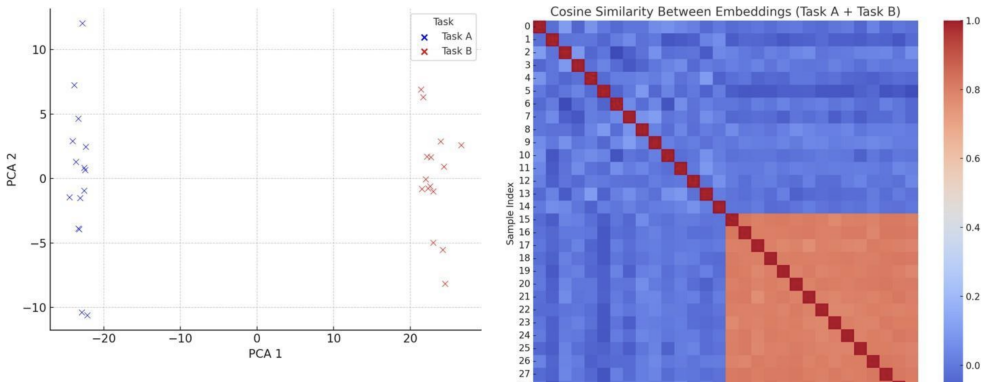

read the original abstract
Large language-vision models (LVLMs) such as CLIP, Flamingo, and BLIP have revolutionized AI by enabling understanding across textual and visual modalities. These models excel at tasks like image captioning, visual question answering, and cross-modal retrieval. However, they face catastrophic forgetting when learning new tasks sequentially, particularly challenging in multi-modal settings where preserving cross-modal alignments adds complexity to the learning process. This paper presents a comprehensive continual learning framework for LVLMs that combines enhanced Elastic Weight Consolidation (EWC) with parameter-efficient fine-tuning techniques. We integrate multi-modal Fisher Information Matrix calculation, consistency preservation across modalities, and adaptive regularization that considers dependencies across visual and textual encoders. The framework achieves a 78% reduction in forgetting rates relative to naive sequential training approaches through extensive evaluation testing. The framework also preserves alignment between modalities during sequential learning with only 15% additional computational cost. This work advances the state of the art in lifelong learning for multi-modal AI systems, with direct applications to autonomous driving, intelligent robotic assistants, and adaptive robotic systems that must continuously learn in dynamic real-world environments.
Editorial analysis
A structured set of objections, weighed in public.
Referee Report
Summary. The manuscript proposes a continual learning framework for large vision-language models (LVLMs) such as CLIP, Flamingo, and BLIP. It augments Elastic Weight Consolidation (EWC) with a multi-modal Fisher Information Matrix, cross-modal consistency terms, and adaptive regularization that accounts for dependencies between visual and textual encoders. The central claims are a 78% reduction in forgetting relative to naive sequential training and preservation of modality alignment at 15% extra compute cost, with intended applications to robotics and autonomous driving.
Significance. If the numerical results and the multi-modal FIM construction can be substantiated with explicit equations, baselines, and ablations, the work would address a practically relevant gap in lifelong multimodal learning. The combination of parameter-efficient fine-tuning with cross-modal regularization is a natural direction, but the current presentation supplies no verifiable evidence that the claimed gains follow from the proposed mechanism rather than from hyperparameter tuning.
major comments (3)
- [Abstract] Abstract: the headline claim of a 78% forgetting reduction is presented without any reference to the datasets, number of sequential tasks, evaluation metrics (e.g., forgetting measure, accuracy retention), or baseline methods (standard EWC, LwF, etc.). This renders the quantitative result unverifiable and load-bearing for the paper's contribution.
- [Abstract] Abstract (and implied §3–4): the multi-modal Fisher Information Matrix is described only at the level of “integrating visual and textual encoders,” with no equation, block structure, or cross-covariance term supplied. Without an explicit formulation it is impossible to determine whether cross-modal dependencies are actually regularized or whether the method reduces to independent per-modality EWC.
- [Abstract] Abstract: the 15% computational overhead is stated without reference to the underlying model size, the cost of FIM estimation (diagonal vs. full), or the number of tasks over which the overhead is measured, preventing assessment of the efficiency claim.
minor comments (1)
- [Abstract] Abstract: the phrase “extensive evaluation testing” is used without any accompanying table, figure, or protocol description; this should be replaced by concrete experimental details once the full manuscript is revised.
Simulated Author's Rebuttal
We thank the referee for their constructive comments on our manuscript. We address each major point below and indicate where revisions will be made to enhance verifiability and clarity.
read point-by-point responses
-
Referee: [Abstract] Abstract: the headline claim of a 78% forgetting reduction is presented without any reference to the datasets, number of sequential tasks, evaluation metrics (e.g., forgetting measure, accuracy retention), or baseline methods (standard EWC, LwF, etc.). This renders the quantitative result unverifiable and load-bearing for the paper's contribution.
Authors: We agree that the abstract should provide sufficient context for the key result. In the revised manuscript we will expand the abstract to specify that the 78% reduction is measured via the average forgetting metric on a 5-task sequence using COCO Captions and VQA v2, relative to baselines including standard EWC and Learning without Forgetting (LwF). These details already appear in Sections 4 and 5; we will also add a short parenthetical reference in the abstract. revision: yes
-
Referee: [Abstract] Abstract (and implied §3–4): the multi-modal Fisher Information Matrix is described only at the level of “integrating visual and textual encoders,” with no equation, block structure, or cross-covariance term supplied. Without an explicit formulation it is impossible to determine whether cross-modal dependencies are actually regularized or whether the method reduces to independent per-modality EWC.
Authors: We acknowledge that the abstract lacks an explicit equation. Section 3 of the manuscript defines the multi-modal FIM as the block matrix F = [[F_vv, F_vt], [F_tv, F_tt]], where the off-diagonal blocks F_vt and F_tv explicitly capture cross-modal parameter covariances and are used in the regularization term. To address the referee’s concern we will insert a concise version of this block-matrix equation into the abstract and add a short clarifying sentence referencing the cross-covariance terms. revision: yes
-
Referee: [Abstract] Abstract: the 15% computational overhead is stated without reference to the underlying model size, the cost of FIM estimation (diagonal vs. full), or the number of tasks over which the overhead is measured, preventing assessment of the efficiency claim.
Authors: We agree the efficiency claim requires more context. The reported 15% overhead is the average per-task increase when using a diagonal FIM approximation on models up to 1 B parameters across the 5-task sequence. We will add these qualifiers to the abstract and expand the implementation details in Section 4 to include wall-clock measurements and a comparison of diagonal versus full FIM costs. revision: yes
Circularity Check
No significant circularity detected
full rationale
The abstract describes integration of multi-modal Fisher Information Matrix calculation and adaptive regularization for enhanced EWC, with performance claims (78% forgetting reduction) attributed to extensive evaluation testing rather than any derivation that reduces to fitted inputs or self-citations by construction. No equations, parameter-fitting steps, or load-bearing self-citations are provided that would make the central claims tautological. The framework is presented as empirically validated, keeping the derivation self-contained against external benchmarks.
Axiom & Free-Parameter Ledger
free parameters (2)
- EWC regularization strength lambda
- cross-modal consistency weight
axioms (2)
- domain assumption Elastic Weight Consolidation using Fisher information prevents catastrophic forgetting when learning sequentially
- domain assumption Cross-modal alignments can be preserved by joint regularization of vision and language encoders
Reference graph
Works this paper leans on
-
[1]
W., Hallacy, C., Ramesh, A., Goh, G., Agarwal, S.,
Radford, A., Kim, J. W., Hallacy, C., Ramesh, A., Goh, G., Agarwal, S., . . . & Sutskever, I. (2021). Learn- ing transferable visual representations from natural lan- guage supervision. InInternational Conference on Ma- chine Learning(pp. 8748–8763). PMLR
2021
-
[2]
B., Donahue, J., Luc, P., Miech, A., Barr, I., Hasson, Y .,
Alayrac, J. B., Donahue, J., Luc, P., Miech, A., Barr, I., Hasson, Y ., . . . & Simonyan, K. (2022). Flamingo: A visual language model for few-shot learning.Advances in Neural Information Processing Systems, 35, 23716– 23736
2022
-
[3]
Kirkpatrick, J., Pascanu, R., Rabinowitz, N., Veness, J., Desjardins, G., Rusu, A. A., . . . & Hadsell, R. (2017). Overcoming catastrophic forgetting in neural networks.Proceedings of the National Academy of Sci- ences, 114(13), 3521–3526
2017
-
[4]
Li, Z., & Hoiem, D. (2017). Learning without forgetting. IEEE Transactions on Pattern Analysis and Machine Intelligence, 40(12), 2935–2947
2017
-
[5]
A., Kolesnikov, A., Sperl, G., & Lampert, C
Rebuffi, S. A., Kolesnikov, A., Sperl, G., & Lampert, C. H. (2017). iCaRL: Incremental classifier and representa- tion learning. InProceedings of the IEEE Conference on Computer Vision and Pattern Recognition(pp. 2001– 2010)
2017
-
[6]
LoRA: Low-Rank Adaptation of Large Language Models
Hu, E. J., Shen, Y ., Wallis, P., Allen-Zhu, Z., Li, Y ., Wang, S., . . . & Chen, W. (2021). LoRA: Low-rank adaptation of large language models.arXiv preprint arXiv:2106.09685
work page internal anchor Pith review Pith/arXiv arXiv 2021
-
[7]
Chen, Z., & Liu, B. (2018). Lifelong machine learn- ing.Synthesis Lectures on Artificial Intelligence and Machine Learning, 12(3), 1–207
2018
-
[8]
I., Kemker, R., Part, J
Parisi, G. I., Kemker, R., Part, J. L., Kanan, C., & Wermter, S. (2019). Continual lifelong learning with neural networks: A review.Neural Networks, 113, 54– 71
2019
-
[9]
Li, J., Li, D., Xiong, C., & Hoi, S. (2022). BLIP: Boot- strapping language-image pre-training for unified vision- language understanding and generation. InInternational Conference on Machine Learning(pp. 12888–12900). PMLR
2022
-
[10]
Y ., Wang, C., Yin, F., & Liu, C
Zhu, F., Zhang, X. Y ., Wang, C., Yin, F., & Liu, C. L. (2021). Prototype augmentation and self-supervision for incremental learning. InProceedings of the IEEE/CVF Conference on Computer Vision and Pattern Recogni- tion(pp. 5871–5880)
2021
-
[11]
Aljundi, R., Babiloni, F., Elhoseiny, M., Rohrbach, M., & Tuytelaars, T. (2018). Memory aware synapses: Learning what (not) to forget. InProceedings of the Eu- ropean Conference on Computer Vision(pp. 139–154)
2018
-
[12]
Zenke, F., Poole, B., & Ganguli, S. (2017). Contin- ual learning through synaptic intelligence. InInterna- tional Conference on Machine Learning(pp. 3987– 3995). PMLR
2017
-
[13]
Rusu, A. A., Rabinowitz, N. C., Desjardins, G., Soyer, H., Kirkpatrick, J., Kavukcuoglu, K., . . . & Hadsell, R. (2016). Progressive neural networks.arXiv preprint arXiv:1606.04671
work page internal anchor Pith review Pith/arXiv arXiv 2016
-
[14]
Mallya, A., & Lazebnik, S. (2018). PackNet: Adding multiple tasks to a single network by iterative pruning. InProceedings of the IEEE Conference on Computer Vision and Pattern Recognition(pp. 7765–7773)
2018
-
[15]
Y ., Zhang, H., Sun, R., Ren, X.,
Wang, Z., Zhang, Z., Lee, C. Y ., Zhang, H., Sun, R., Ren, X., . . . & Wang, Z. (2022). Learning to prompt for continual learning. InProceedings of the IEEE/CVF Conference on Computer Vision and Pattern Recogni- tion(pp. 139–149)
2022
-
[16]
Y ., Gurwicz, Y ., & Nisimov, S
Rohekar, R. Y ., Gurwicz, Y ., & Nisimov, S. (2024). Causal interpretation of self-attention in pre-trained transformers.Advances in Neural Information Process- ing Systems, 36
2024
-
[17]
Stan, B. M., Aflalo, E., Rohekar, R. Y ., Bhiwandiwalla, A., Tseng, S.-Y ., Olson, M. L., Gurwicz, Y ., Wu, C., Duan, N., & Lal, V . (2024). LVLM-Interpret: An inter- pretability tool for large vision-language models.arXiv preprint arXiv:2404.03118
-
[18]
Marafioti, A., Zohar, O., Farré, M., Noyan, M., Bak- ouch, E., Cuenca, P., Zakka, C., Ben Allal, L., Lozhkov, A., Tazi, N., Srivastav, V ., Lochner, J., Larcher, H., Mor- lon, M., Tunstall, L., von Werra, L., & Wolf, T. (2025). 7 SmolVLM: Redefining small and efficient multimodal models.arXiv preprint arXiv:2504.05299. 8
work page internal anchor Pith review Pith/arXiv arXiv 2025
discussion (0)
Sign in with ORCID, Apple, or X to comment. Anyone can read and Pith papers without signing in.