Recognition: unknown
Quantum Precoded Polar Codes
Pith reviewed 2026-05-14 19:22 UTC · model grok-4.3
The pith
Rate-1 precoded polar codes yield CSS quantum codes with logical error rates matching a much larger surface code.
A machine-rendered reading of the paper's core claim, the machinery that carries it, and where it could break.
Core claim
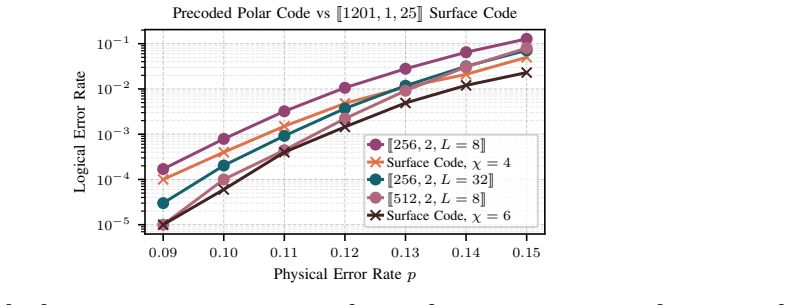
We present a new family of CSS codes obtained from rate-1 precoded polar codes. By optimizing the rate profile and precoder with a genetic algorithm, we obtain [[256,2]] and [[512,2]] codes that exhibit logical error rates comparable to the [[1201,1,25]] surface code over the depolarizing channel.
What carries the argument
Rate-1 precoded polar codes adapted into CSS quantum codes with genetic-algorithm optimization of the rate profile and precoder.
If this is right
- Quantum CSS codes can reach comparable reliability at block lengths much smaller than those required by surface codes.
- Classical precoding advantages apply to quantum codes after targeted parameter optimization.
- Low-dimensional codes become practical for quantum error correction without sacrificing error-rate performance.
- Genetic optimization allows systematic design of precoders tailored to quantum noise models.
Where Pith is reading between the lines
- Rerunning the genetic optimization for other quantum channels could produce codes adapted to different noise statistics.
- Pairing the precoded construction with improved quantum decoders may yield further reductions in logical error rates.
- Implementation on quantum hardware would require verifying that the precoder structure does not complicate syndrome extraction circuits.
Load-bearing premise
The performance benefits of classical rate-1 precoding for short-blocklength polar codes transfer directly to the quantum CSS setting once the rate profile and precoder are optimized.
What would settle it
Monte Carlo simulation showing that the logical error rate of the optimized [[256,2]] precoded polar code on the depolarizing channel exceeds the rate of the [[1201,1,25]] surface code by more than a modest margin would falsify the similarity result.
Figures

read the original abstract
We introduce a new family of CSS codes obtained from rate-1 precoded polar codes, which harnesses the precoding benefits obtained for classical short blocklength polar codes. We optimize the rate profile and precoder of these codes with a genetic algorithm, and present codes of dimension $ [\![256, 2 ]\!] $ and $ [\![512, 2]\!] $ that have logical error rates similar to the $ [\![1201, 1, 25 ]\!] $ surface code over the depolarizing channel.
Editorial analysis
A structured set of objections, weighed in public.
Axiom & Free-Parameter Ledger
free parameters (2)
- rate profile
- precoder matrix
axioms (1)
- domain assumption Classical rate-1 precoding benefits transfer to quantum CSS codes after optimization
Reference graph
Works this paper leans on
-
[1]
Gottesman,Stabilizer codes and quantum error correction
D. Gottesman,Stabilizer codes and quantum error correction. Califor- nia Institute of Technology, 1997
1997
-
[2]
Good Quantum Error-Correcting Codes Exist,
A. R. Calderbank and P. W. Shor, “Good Quantum Error-Correcting Codes Exist,”Physical Review A, vol. 54, no. 2, pp. 1098–1105, Aug. 1996
1996
-
[3]
Multiple-particle interference and quantum error correction,
A. Steane, “Multiple-particle interference and quantum error correction,” Proceedings of the Royal Society A: Mathematical, Physical and Engi- neering Sciences, vol. 452, no. 1954, pp. 2551–2577, Nov. 1996
1954
-
[4]
Efficient Polar Coding of Quantum Information,
J. M. Renes, F. Dupuis, and R. Renner, “Efficient Polar Coding of Quantum Information,”Physical Review Letters, vol. 109, no. 5, p. 050504, Aug. 2012
2012
-
[5]
Fault-tolerant preparation of quantum polar codes encoding one logical qubit,
A. Goswami, M. Mhalla, and V . Savin, “Fault-tolerant preparation of quantum polar codes encoding one logical qubit,”Physical Review A, vol. 108, no. 4, p. 042605, Oct. 2023
2023
-
[6]
Interpolation of Quantum Polar Codes and Quantum Reed-Muller Codes,
K. Hidaka, D. Abdelhadi, and R. Urbanke, “Interpolation of Quantum Polar Codes and Quantum Reed-Muller Codes,” inProc. IEEE Inf. Theory Workshop (ITW), Sep. 2025, pp. 1–7
2025
-
[7]
Improved Logical Error Rate via List Decoding of Quantum Polar Codes,
A. Gong and J. M. Renes, “Improved Logical Error Rate via List Decoding of Quantum Polar Codes,” inProc. IEEE Int. Symp. Inf. Theory (ISIT), Jul. 2024, pp. 2496–2501
2024
-
[8]
Efficient algorithms for maximum likelihood decoding in the surface code,
S. Bravyi, M. Suchara, and A. Vargo, “Efficient algorithms for maximum likelihood decoding in the surface code,”Physical Review A, vol. 90, no. 3, p. 032326, Sep. 2014
2014
-
[9]
Channel polarization: A method for constructing capacity- achieving codes for symmetric binary-input memoryless channels,
E. Arikan, “Channel polarization: A method for constructing capacity- achieving codes for symmetric binary-input memoryless channels,”IEEE Transactions on Information Theory, vol. 55, no. 7, pp. 3051–3073, 2009
2009
-
[10]
List decoding of polar codes,
I. Tal and A. Vardy, “List decoding of polar codes,”IEEE Transactions on Information Theory, vol. 61, no. 5, pp. 2213–2226, May 2015
2015
-
[11]
Convolutional decoding of polar codes,
A. Fazeli, A. Vardy, and H. Yao, “Convolutional decoding of polar codes,” inProc. IEEE Int. Symp. Inf. Theory (ISIT), Jul. 2019
2019
-
[12]
On pre-transformed polar codes,
B. Li, H. Zhang, and J. Gu, “On pre-transformed polar codes,” Dec. 2019
2019
-
[13]
On convolutional precoding in PAC codes,
M. Rowshan and E. Viterbo, “On convolutional precoding in PAC codes,” inProc. IEEE GLOBECOM Workshops (GC Workshops), 2021, pp. 1–6
2021
-
[14]
From sequential decoding to channel polarization and back again,
E. Arıkan, “From sequential decoding to channel polarization and back again,” Aug. 2019
2019
-
[15]
Polar codes with dynamic frozen symbols and their decoding by directed search,
P. Trifonov and V . Miloslavskaya, “Polar codes with dynamic frozen symbols and their decoding by directed search,” inProc. IEEE Inf. Theory Workshop (ITW), Seville, Spain, Sep. 2013
2013
-
[16]
A Path Metric Based Construc- tion of Polarization-Adjusted Convolutional Codes,
T. Kann, S. Kudekar, and M. R. Bloch, “A Path Metric Based Construc- tion of Polarization-Adjusted Convolutional Codes,” inProc. IEEE Int. Symp. Inf. Theory (ISIT), Jul. 2024, pp. 2406–2411
2024
-
[17]
A weighted sum based construction of PAC codes,
W. Liu, L. Chen, and X. Liu, “A weighted sum based construction of PAC codes,”IEEE Communications Letters, vol. 27, no. 1, pp. 28–31, 2023
2023
-
[18]
PAC Code Rate-Profile Design Using Search-Constrained Optimization Algorithms,
M. Moradi and D. G. M. Mitchell, “PAC Code Rate-Profile Design Using Search-Constrained Optimization Algorithms,” inProc. IEEE Int. Symp. Inf. Theory (ISIT), Jul. 2024, pp. 2204–2209
2024
-
[19]
Lossless source coding with polar codes,
H. S. Cronie and S. B. Korada, “Lossless source coding with polar codes,” inProc. IEEE Int. Symp. Inf. Theory (ISIT), Jun. 2010, pp. 904– 908
2010
-
[20]
Polarization-Adjusted Convo- lutional (PAC) Codes: Sequential Decoding vs List Decoding,
M. Rowshan, A. Burg, and E. Viterbo, “Polarization-Adjusted Convo- lutional (PAC) Codes: Sequential Decoding vs List Decoding,”IEEE Transactions on Vehicular Technology, vol. 70, no. 2, pp. 1434–1447, Feb. 2021
2021
-
[21]
Noiseless coding of correlated information sources,
D. Slepian and J. Wolf, “Noiseless coding of correlated information sources,”IEEE Transactions on Information Theory, vol. 19, no. 4, pp. 471–480, Jul. 1973
1973
-
[22]
Source Polarization-Adjusted Convolutional Codes,
T. Kann, S. Kudekar, and M. Bloch, “Source Polarization-Adjusted Convolutional Codes,” inProc. IEEE Int. Symp. Inf. Theory (ISIT), Jun. 2023, pp. 1896–1901
2023
-
[23]
Alignment of Polarized Sets,
J. M. Renes, D. Sutter, and S. H. Hassani, “Alignment of Polarized Sets,” IEEE Journal on Selected Areas in Communications, vol. 34, no. 2, pp. 224–238, Feb. 2016
2016
-
[24]
On Convolutional Precoding in PAC Codes,
M. Rowshan and E. Viterbo, “On Convolutional Precoding in PAC Codes,” inProc. IEEE GLOBECOM Workshops (GC Workshops), Madrid, Spain, Dec. 2021, pp. 1–6
2021
-
[25]
A Monte-Carlo Based Construction of Polarization-Adjusted Convolutional (PAC) Codes,
M. Moradi and A. Mozammel, “A Monte-Carlo Based Construction of Polarization-Adjusted Convolutional (PAC) Codes,” Jun. 2021
2021
-
[26]
On tail-biting polarization- adjusted convolutional (tb-pac) codes and small-sizes list decoding,
B. Feng, Y . Yang, J. Jiao, and Q. Zhang, “On tail-biting polarization- adjusted convolutional (tb-pac) codes and small-sizes list decoding,” IEEE Communications Letters, vol. 27, no. 2, pp. 433–437, 2023
2023
discussion (0)
Sign in with ORCID, Apple, or X to comment. Anyone can read and Pith papers without signing in.