Recognition: 2 theorem links
· Lean TheoremResolution Information: Limits of Ambiguity Resolution for Generative Communication
Pith reviewed 2026-05-14 19:18 UTC · model grok-4.3
The pith
Resolution information reduces to a prior-dependent binary divergence when posteriors are unconstrained, and repeated sampling then drives semantic ambiguity to zero exponentially fast.
A machine-rendered reading of the paper's core claim, the machinery that carries it, and where it could break.
Core claim
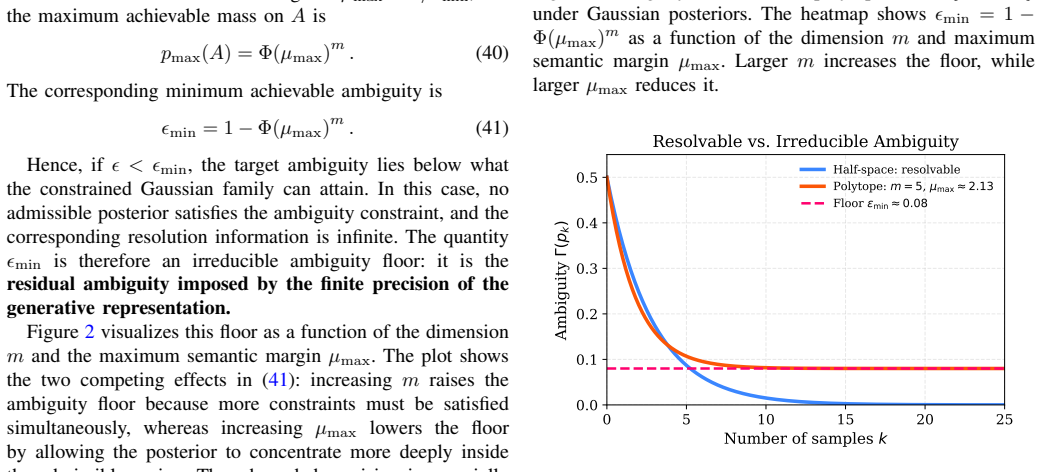
Resolution information is the minimum information update required to move the receiver's posterior into a low-ambiguity semantic region. In the unconstrained case it equals the binary divergence between the prior and the target region's probability and does not depend on region shape. Under repeated sampling the ambiguity probability decays exponentially at this rate. When the generative representation constrains the posterior family, half-space regions remain resolvable while polytope regions exhibit an irreducible ambiguity floor that persists no matter how much additional information is received.
What carries the argument
Resolution information, defined as the minimum information update needed to reach a low-ambiguity posterior region, serving as both a divergence measure and an ambiguity exponent under repeated sampling.
If this is right
- When posteriors are unconstrained, ambiguity decays exponentially at a rate exactly equal to the resolution information.
- Region shape has no effect on resolvability in the unconstrained case.
- Half-space regions remain fully resolvable even when the generative model constrains the posterior family.
- Polytope-type regions produce a positive ambiguity floor that cannot be removed by any amount of additional information.
- The fundamental limit in generative communication is on asymptotic resolvability rather than on achievable rate.
Where Pith is reading between the lines
- Designers could prioritize generative models whose induced posteriors approximate half-spaces to avoid permanent ambiguity floors.
- The exponential decay result supplies a concrete way to predict how many samples are needed to reach a target ambiguity level in unconstrained settings.
- Classical channel coding theorems may require extension to handle cases where the message itself imposes irreducible geometric constraints on the receiver's beliefs.
Load-bearing premise
The generative representation restricts the receiver's possible posteriors according to the geometry of the semantic regions.
What would settle it
Collect repeated samples from a generative model that induces polytope-type posterior regions and check whether the ambiguity probability continues to decay toward zero or stabilizes at a strictly positive floor.
Figures


read the original abstract
In generative communication, the transmitter sends a compact generative description, such as model parameters or a latent representation, rather than raw data. The receiver uses this description to form a posterior belief over the underlying state and to resolve semantic ambiguity: which interpretation, decision, or action is supported by the received representation? Inspired by Shannon's geometric view of communication as uncertainty resolution, we introduce resolution information as the minimum information update, measured in nats, required to move the receiver's posterior belief into a low-ambiguity semantic region. Our work yields three main results. First, when the receiver can form any posterior belief, corresponding to the ideal unconstrained case, resolution information reduces to a binary divergence that depends only on each region's prior probability. In this case, the shape of the regions is irrelevant. Under repeated sampling, ambiguity decays exponentially with an exponent equal to the resolution information, giving it an operational meaning as an ambiguity exponent. Second, when the generative representation constrains the posterior family, as in practice, geometry becomes operational and can create irreducible ambiguity floors: half-spaces remain resolvable, whereas polytope-type regions can exhibit residual ambiguity that no amount of additional information can remove. These results reveal a fundamental departure from classical channel coding. In Shannon theory, codes can be designed so that decoding regions separate messages and error probability vanishes below capacity. In generative communication, the model itself induces a constrained posterior geometry that may prevent asymptotic ambiguity resolution. The resulting limit is not on rate, but on resolvability itself.
Editorial analysis
A structured set of objections, weighed in public.
Referee Report
Summary. The manuscript introduces resolution information as the minimum information update (in nats) required to move a receiver's posterior belief over an underlying state into a low-ambiguity semantic region when the transmitter sends a compact generative description (e.g., model parameters or latents) rather than raw data. It claims three main results: (1) in the unconstrained case where any posterior is admissible, resolution information reduces to a binary divergence depending only on each region's prior probability (region shape irrelevant), with ambiguity decaying exponentially under repeated sampling at a rate given by this quantity; (2) under generative constraints on the allowable posterior family, geometry becomes operational, with half-spaces remaining resolvable but polytope-type regions exhibiting positive irreducible ambiguity floors that cannot be removed by additional information; (3) this constitutes a fundamental departure from classical channel coding, where decoding regions can be designed for vanishing error probability below capacity, because here the model itself may prevent asymptotic resolvability.
Significance. If the central claims are substantiated with derivations, the work would provide a novel operational measure extending Shannon's geometric view of communication to generative settings, with the ambiguity-exponent interpretation offering a concrete link to repeated sampling. It identifies potential resolvability limits induced by posterior geometry that are distinct from rate or capacity constraints, which could inform the design of latent-variable models and semantic communication protocols. No machine-checked proofs, reproducible code, or parameter-free derivations are present to credit at this stage.
major comments (3)
- [Abstract / Section III] Abstract and Section III (unconstrained case): the claim that resolution information 'reduces to a binary divergence that depends only on each region's prior probability' and that 'the shape of the regions is irrelevant' is stated without any derivation, explicit reduction, or supporting calculation; a step-by-step argument showing independence from geometry is required to establish the result.
- [Section IV] Section IV (constrained case): the assertion that polytope-type regions exhibit 'residual ambiguity that no amount of additional information can remove' while half-spaces remain resolvable rests on an implicit mapping from generative description to posterior support geometry; no explicit construction or invariance proof under arbitrary sequences of updates is supplied, leaving open whether repeated sampling could still drive the posterior into the target set.
- [Section V] Section V (departure from classical coding): the contrast with Shannon theory (where 'codes can be designed so that decoding regions separate messages and error probability vanishes') requires a precise statement of the generative constraint that prevents such design; without it the claimed limit on resolvability itself rather than rate remains unverified.
minor comments (2)
- [Section II] Notation for the binary divergence and the low-ambiguity region should be introduced with a formal definition before the main results are stated.
- [Abstract] The abstract would benefit from a single-sentence definition of 'generative description' to orient readers unfamiliar with the setting.
Simulated Author's Rebuttal
We thank the referee for the careful reading and constructive comments on our manuscript. We address each major comment below and have revised the manuscript to incorporate explicit derivations, constructions, and clarifications as requested.
read point-by-point responses
-
Referee: [Abstract / Section III] Abstract and Section III (unconstrained case): the claim that resolution information 'reduces to a binary divergence that depends only on each region's prior probability' and that 'the shape of the regions is irrelevant' is stated without any derivation, explicit reduction, or supporting calculation; a step-by-step argument showing independence from geometry is required to establish the result.
Authors: We agree that the reduction requires an explicit derivation. Resolution information is the infimum of the KL divergence D(q || p) over posteriors q such that q lies in the low-ambiguity set (i.e., q assigns sufficient mass to the target semantic region). In the unconstrained case, the minimizing q is the renormalization of the prior restricted to the region (or its complement), yielding D = -log(1 - p) + p log(p / (1-p)) or the equivalent binary divergence form depending only on the prior probability p of the region. Because the constraint depends solely on the measure of the region under the prior and not on its support geometry, the value is independent of shape. We have added this step-by-step argument, including the optimization and independence proof, as a new subsection in revised Section III. revision: yes
-
Referee: [Section IV] Section IV (constrained case): the assertion that polytope-type regions exhibit 'residual ambiguity that no amount of additional information can remove' while half-spaces remain resolvable rests on an implicit mapping from generative description to posterior support geometry; no explicit construction or invariance proof under arbitrary sequences of updates is supplied, leaving open whether repeated sampling could still drive the posterior into the target set.
Authors: We acknowledge the need for an explicit construction and invariance argument. In the revised manuscript we supply a concrete example: a linear-Gaussian generative model whose inducible posteriors are constrained to an affine subspace of the probability simplex. For a half-space target, repeated Bayesian updates with descriptions from the model can translate the mean arbitrarily far, eventually entering the target. For a polytope target whose interior lies outside this subspace, the posterior remains confined to the subspace for any finite or infinite sequence of updates, yielding a strictly positive ambiguity floor (measured by the minimal total-variation distance to the target set). We prove closure of the inducible family under the allowed updates, establishing invariance. revision: yes
-
Referee: [Section V] Section V (departure from classical coding): the contrast with Shannon theory (where 'codes can be designed so that decoding regions separate messages and error probability vanishes') requires a precise statement of the generative constraint that prevents such design; without it the claimed limit on resolvability itself rather than rate remains unverified.
Authors: The generative constraint is the restriction that allowable posteriors belong to the image P_G of the compact description map G (parameters or latents to distributions). Unlike classical coding, where the decoder may freely partition the observation space, here the effective decoding regions are the level sets induced by posteriors in P_G; these cannot be chosen arbitrarily. We have added a formal definition in revised Section V: asymptotic resolvability fails when the closure of P_G does not intersect the low-ambiguity set, even as the number of descriptions tends to infinity. This limit is on the reachable posterior geometry rather than on mutual information rate. revision: yes
Circularity Check
No circularity: derivation self-contained from definition and standard divergences
full rationale
The paper defines resolution information directly as the minimum information update (in nats) needed to move the posterior into a low-ambiguity semantic region. In the unconstrained case this is shown to equal a binary divergence depending only on prior probabilities; this follows by direct substitution into the definition rather than by fitting or self-reference. The geometric distinction between resolvable half-spaces and irreducible polytope floors is presented as a consequence of the generative representation constraining allowable posteriors, without any load-bearing self-citation or renaming of known results. No equations reduce a claimed prediction to an input parameter by construction, and the central departure from classical coding is argued from the model-induced posterior geometry itself. The analysis is therefore independent of the target claims.
Axiom & Free-Parameter Ledger
axioms (2)
- domain assumption Receiver forms a posterior belief over the underlying state from the generative description
- domain assumption Low-ambiguity semantic regions exist and can be targeted by information updates
invented entities (1)
-
resolution information
no independent evidence
Lean theorems connected to this paper
-
IndisputableMonolith/Cost/FunctionalEquation.leanwashburn_uniqueness_aczel unclear?
unclearRelation between the paper passage and the cited Recognition theorem.
resolution information as the minimum information update... I*_res(ε)=inf_{p:Γ(p)≤ε} D_KL(p∥p0)
-
IndisputableMonolith/Foundation/AlexanderDuality.leanalexander_duality_circle_linking unclear?
unclearRelation between the paper passage and the cited Recognition theorem.
half-spaces remain resolvable, whereas polytope-type regions can exhibit residual ambiguity
What do these tags mean?
- matches
- The paper's claim is directly supported by a theorem in the formal canon.
- supports
- The theorem supports part of the paper's argument, but the paper may add assumptions or extra steps.
- extends
- The paper goes beyond the formal theorem; the theorem is a base layer rather than the whole result.
- uses
- The paper appears to rely on the theorem as machinery.
- contradicts
- The paper's claim conflicts with a theorem or certificate in the canon.
- unclear
- Pith found a possible connection, but the passage is too broad, indirect, or ambiguous to say the theorem truly supports the claim.
Reference graph
Works this paper leans on
-
[1]
T. M. Cover and J. A. Thomas,Elements of Information Theory, 2nd ed. Wiley, 2006
work page 2006
-
[2]
Communication in the Presence of Noise,
C. E. Shannon, “Communication in the Presence of Noise,”Proceedings of the IRE, vol. 37, no. 1, pp. 10–21, Jan. 1949
work page 1949
-
[3]
A rate-distortion framework for characterizing semantic information,
J. Liu, W. Zhang, and H. V . Poor, “A rate-distortion framework for characterizing semantic information,”arXiv preprint arXiv:2105.04278, 2021
-
[4]
Semantic communications: Principles and challenges,
Z. Qin, X. Tao, J. Lu, W. Tong, and G. Y . Li, “Semantic communications: Principles and challenges,”arXiv preprint arXiv:2201.01389, 2022
-
[5]
Semantic communications: Principles and challenges,
D. Guo, Q. Wu, Y . Yuan, and H. V . Poor, “Semantic communications: Principles and challenges,”IEEE Wireless Communications, vol. 29, no. 2, pp. 110–117, Apr. 2022
work page 2022
-
[6]
E. Akyol, “Semantic rate distortion and posterior design: Compute constraints, multimodality, and strategic inference,”arXiv preprint arXiv:2602.03949, 2026
-
[7]
Channel-aware optimal transport: A theoretical framework for generative communication,
X. Qu, R. Li, J. Chen, L. Yu, and X. Wang, “Channel-aware optimal transport: A theoretical framework for generative communication,”arXiv preprint arXiv:2412.19025, 2024
-
[8]
Y . Jin et al., “Generative AI for multimedia communication: Recent advances, an information-theoretic framework, and future opportunities,” arXiv preprint arXiv:2508.17163, 2025
-
[9]
J. Li, M. He, C. Zhou, X. Huang, Z. Liu, L. Zhao, C.-X. Wang, and H. Wu, “Rate-distortion-perception controllable joint source-channel coding for high-fidelity generative semantic communications,”IEEE Transactions on Communications, 2024
work page 2024
-
[10]
L. X. Nguyen, A. D. Raha, P. S. Aung, D. Niyato, Z. Han, and C. S. Hong, “A contemporary survey on semantic communications: Theory of mind, generative AI, and deep joint source-channel coding,”IEEE Communications Surveys & Tutorials, 2025
work page 2025
-
[11]
Semantic-aware power allocation for generative semantic communications with foundation models,
C. Xu, M. B. Mashhadi, Y . Ma, and R. Tafazolli, “Semantic-aware power allocation for generative semantic communications with foundation models,”arXiv preprint arXiv:2407.03050, 2024
-
[12]
C. Xu, M. B. Mashhadi, Y . Ma, R. Tafazolli, and J. Wang, “Gen- erative semantic communications with foundation models: Perception- error analysis and semantic-aware power allocation,”IEEE Journal on Selected Areas in Communications, vol. 43, no. 7, pp. 2493–2505, Jul. 2025
work page 2025
-
[13]
I-divergence geometry of probability distributions and min- imization problems,
I. Csisz ´ar, “I-divergence geometry of probability distributions and min- imization problems,”The Annals of Probability, vol. 3, no. 1, pp. 146– 158, Feb. 1975
work page 1975
-
[14]
Information projections revisited,
I. Csisz ´ar and F. Mat ´uˇs, “Information projections revisited,”IEEE Transactions on Information Theory, vol. 49, no. 6, pp. 1474–1490, Jun. 2003
work page 2003
-
[15]
R ´enyi divergence and Kullback-Leibler divergence,
T. van Erven and P. Harremoes, “R ´enyi divergence and Kullback-Leibler divergence,”IEEE Transactions on Information Theory, vol. 60, no. 7, pp. 3797–3820, Jul. 2014
work page 2014
-
[16]
A. Dembo and O. Zeitouni,Large Deviations Techniques and Applica- tions, 2nd ed. Springer, 1998
work page 1998
-
[17]
Amari,Information Geometry and Its Applications
S.-I. Amari,Information Geometry and Its Applications. Springer, 2016
work page 2016
-
[18]
Approximation theory of output statistics,
T. S. Han and S. Verd ´u, “Approximation theory of output statistics,” IEEE Transactions on Information Theory, vol. 39, no. 3, pp. 752–772, May 1993
work page 1993
-
[19]
M. Hayashi, “Quantum resolvability,”Proceedings of the IEEE Interna- tional Symposium on Information Theory (ISIT), pp. 1–5, 2006
work page 2006
-
[20]
Resolvability and its applications to quantum information theory,
M. Hayashi, “Resolvability and its applications to quantum information theory,”IEICE Transactions on Fundamentals of Electronics, Commu- nications and Computer Sciences, vol. E94-A, no. 2, pp. 466–473, Feb. 2011
work page 2011
discussion (0)
Sign in with ORCID, Apple, or X to comment. Anyone can read and Pith papers without signing in.