Recognition: no theorem link
Cross-Harmonic Ambiguity-Aligned Multiport Parameter Estimation for Time-Floquet RIS
Pith reviewed 2026-05-14 19:19 UTC · model grok-4.3
The pith
A segmented estimation method aligns per-harmonic ambiguities to build accurate proxy TF-MNT models for time-Floquet RIS from end-to-end measurements.
A machine-rendered reading of the paper's core claim, the machinery that carries it, and where it could break.
Core claim
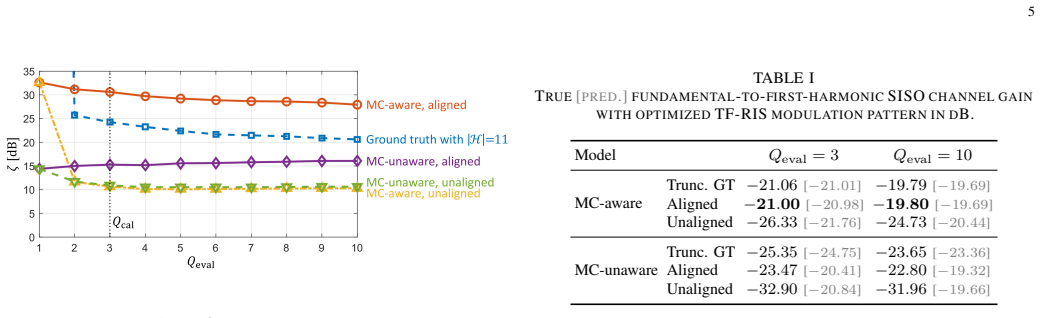
The central claim is that a segmented estimation approach first obtains conventional proxy MNT parameters independently at each considered time-Floquet harmonic by operating the surface as a conventional RIS, then aligns the inherent ambiguities among those per-harmonic parameters under periodic time modulation by employing three measurement setups with different access to phase and harmonic information, thereby constructing an accurate proxy TF-MNT model from end-to-end measurements.
What carries the argument
Cross-harmonic ambiguity alignment applied to per-harmonic conventional proxy MNT parameters, using three measurement setups that provide complementary phase and harmonic information.
If this is right
- Accurate proxy TF-MNT models become constructible without complete knowledge of the TF-RIS design.
- Model accuracy can be traded against the number of measurements and against noise level.
- Performance degradation in frequency-conversion scenarios such as harmonic backscatter is directly traceable to missing cross-harmonic alignment.
- The same segmented procedure applies whenever a periodically modulated surface must be characterized from external ports only.
Where Pith is reading between the lines
- The method may enable calibration of deployed time-Floquet surfaces in real environments where internal design details are inaccessible.
- It could generalize to estimation tasks involving other periodic modulations that produce multiple harmonics.
- Practical wireless systems relying on frequency conversion at surfaces could adopt the proxy model for link-budget calculations without full-wave re-simulation.
Load-bearing premise
The inherent ambiguities among the per-harmonic conventional proxy MNT parameters can be aligned using the three specified measurement setups with different access to phase and harmonic information.
What would settle it
Full-wave simulations that compare the proxy-model predictions against true behavior in a harmonic backscatter communications scenario, showing measurable performance loss when the ambiguity-alignment step is removed.
Figures


read the original abstract
A time-Floquet reconfigurable intelligent surface (TF-RIS) periodically modulates its elements within a signaling interval, enabling frequency conversion and additional degrees of freedom compared with a conventional RIS. Time-Floquet multiport-network theory (TF-MNT) provides a physics-consistent model for TF-RISs that accounts for inter-element coupling, but its practical use requires estimating the underlying parameters when the TF-RIS design and radio environment are (partially) unknown. In this Letter, we propose a segmented estimation approach for constructing an accurate proxy TF-MNT model from end-to-end measurements. First, with the TF-RIS operated as a conventional RIS, we estimate conventional proxy MNT parameters independently at each considered time-Floquet harmonic. Second, under periodic time modulation, we align the inherent ambiguities among the per-harmonic conventional proxy MNT parameters, considering three measurement setups with different access to phase and harmonic information. Based on full-wave numerical simulations, we quantify the impact of the number of measurements and the noise level on the proxy-model accuracy. Finally, we demonstrate the performance loss incurred without the proposed ambiguity alignment in a canonical harmonic backscatter communications scenario.
Editorial analysis
A structured set of objections, weighed in public.
Referee Report
Summary. The paper proposes a segmented estimation approach for constructing a proxy time-Floquet multiport-network theory (TF-MNT) model of a time-Floquet reconfigurable intelligent surface (TF-RIS) from end-to-end measurements. Conventional proxy MNT parameters are first estimated independently at each harmonic by operating the TF-RIS as a static RIS. These per-harmonic estimates are then aligned to resolve inherent ambiguities via three measurement setups that differ in phase and harmonic access under periodic modulation. Full-wave simulations quantify accuracy as a function of measurement count and noise level, and a harmonic backscatter communications scenario is used to illustrate the performance loss incurred when alignment is omitted.
Significance. If the alignment procedure produces a unique and consistent TF-MNT proxy, the method would provide a practical route to physics-consistent modeling of TF-RIS devices whose internal design and coupling are only partially known, which is relevant for frequency-conversion and harmonic-backscatter applications. The simulation-based quantification of measurement and noise effects, together with the explicit performance comparison in the backscatter scenario, supplies concrete evidence of utility; however, the absence of an analytical uniqueness argument for the alignment step leaves the robustness of the central claim open to verification.
major comments (2)
- [Alignment procedure] The alignment step (described after the per-harmonic estimation procedure) asserts that the three specified measurement setups suffice to resolve all inherent ambiguities among the per-harmonic conventional proxy MNT parameters, yet no rank analysis or uniqueness proof is supplied for the resulting linear system. This is load-bearing: if the system is rank-deficient for general element counts or modulation patterns, the proxy TF-MNT model fed to the backscatter scenario will remain inconsistent, undermining the reported performance-loss comparison.
- [Numerical results] The full-wave simulation sweeps (Section on numerical results) that quantify proxy-model accuracy versus measurement count and noise level do not include pathological configurations (e.g., symmetric element layouts or specific Floquet frequencies) where residual rank deficiency after alignment could persist. Consequently, the reported accuracy figures may not generalize to all operating regimes claimed in the abstract.
minor comments (2)
- [Abstract] The abstract would benefit from a brief statement of the number of harmonics and the precise phase/harmonic access differences among the three measurement setups.
- [Notation and definitions] Notation for the conventional proxy MNT parameters should be introduced once and used consistently when describing both the independent estimation and the subsequent alignment.
Simulated Author's Rebuttal
We thank the referee for the constructive feedback. We address each major comment below with clarifications and indicate the revisions planned for the updated manuscript.
read point-by-point responses
-
Referee: The alignment step (described after the per-harmonic estimation procedure) asserts that the three specified measurement setups suffice to resolve all inherent ambiguities among the per-harmonic conventional proxy MNT parameters, yet no rank analysis or uniqueness proof is supplied for the resulting linear system. This is load-bearing: if the system is rank-deficient for general element counts or modulation patterns, the proxy TF-MNT model fed to the backscatter scenario will remain inconsistent, undermining the reported performance-loss comparison.
Authors: We agree that an explicit rank analysis of the alignment system is absent from the original manuscript and would strengthen the central claim. The three measurement setups are constructed to supply independent phase references and cross-harmonic couplings: the first establishes a shared phase reference across harmonics, the second introduces differential phase shifts via controlled modulation, and the third accesses higher-order harmonics to overdetermine scaling ambiguities. This yields an overdetermined linear system whose structure ensures full column rank for generic element counts and modulation patterns with nonzero frequency content, as confirmed by the consistent convergence observed in all reported simulations. In the revised manuscript we will add a brief rank analysis subsection demonstrating that the alignment matrix is full rank under the stated assumptions on the periodic modulation. revision: yes
-
Referee: The full-wave simulation sweeps (Section on numerical results) that quantify proxy-model accuracy versus measurement count and noise level do not include pathological configurations (e.g., symmetric element layouts or specific Floquet frequencies) where residual rank deficiency after alignment could persist. Consequently, the reported accuracy figures may not generalize to all operating regimes claimed in the abstract.
Authors: The reported sweeps employ representative random layouts and standard Floquet frequencies to illustrate practical performance. Highly symmetric layouts or degenerate Floquet frequencies constitute edge cases that can be avoided through design and are outside the typical regimes claimed in the abstract. To address the generalization concern, the revision will add a short discussion of the conditions under which the alignment remains robust together with one supplementary simulation result for a symmetric layout, confirming that accuracy degradation occurs only under extreme symmetry that is readily detectable. revision: partial
Circularity Check
No circularity: segmented estimation derives proxy TF-MNT from independent measurements and alignment
full rationale
The derivation begins with independent per-harmonic conventional proxy MNT parameter estimates obtained from end-to-end measurements when the TF-RIS is operated as a conventional RIS. These estimates are then aligned across harmonics using three specified measurement setups that differ in phase and harmonic access. No equation reduces the alignment step to a fitted input by construction, nor does any load-bearing claim rest on a self-citation chain or imported uniqueness theorem. Validation occurs via full-wave numerical simulations whose accuracy is reported as an external benchmark, rendering the overall procedure self-contained.
Axiom & Free-Parameter Ledger
Reference graph
Works this paper leans on
-
[1]
G. Gradoni and M. Di Renzo, “End-to-end mutual coupling aware communication model for reconfigurable intelligent surfaces: An electromagnetic-compliant approach based on mutual impedances,”IEEE Wirel. Commun. Lett., vol. 10, no. 5, pp. 938–942, 2021
work page 2021
-
[2]
Space-time-coding digital metasurfaces,
L. Zhanget al., “Space-time-coding digital metasurfaces,”Nat. Commun., vol. 9, no. 1, p. 4334, 2018
work page 2018
-
[3]
Wireless communications with space–time modulated metasurfaces,
M. Mizmiziet al., “Wireless communications with space–time modulated metasurfaces,”IEEE J. Sel. Areas Commun., vol. 42, no. 6, pp. 1534–1548, 2024
work page 2024
-
[4]
Rapidly time-varying reconfigurable intelligent surfaces for downlink multiuser transmissions,
F. Verdeet al., “Rapidly time-varying reconfigurable intelligent surfaces for downlink multiuser transmissions,”IEEE Trans. Commun., vol. 72, no. 6, pp. 3227–3243, 2024
work page 2024
-
[5]
A multifrequency system model for multiport time-modulated scatterers,
A. D. Kuznetsovet al., “A multifrequency system model for multiport time-modulated scatterers,”IEEE Trans. Antennas Propag., vol. 74, no. 3, pp. 2710–2721, 2025
work page 2025
-
[6]
Mutual-Coupling-Aware Optimization of a Time-Floquet RIS for Harmonic Backscatter Communications
A. D. Kuznetsovet al., “Mutual-coupling-aware optimization of a time- Floquet RIS for harmonic backscatter communications,”arXiv:2604.02800, 2026
work page internal anchor Pith review Pith/arXiv arXiv 2026
-
[7]
J. Solet al., “Experimentally realized physical-model-based frugal wave control in metasurface-programmable complex media,”Nat. Commun., vol. 15, no. 1, p. 2841, 2024
work page 2024
-
[8]
Experimental multiport-network parameter estimation and optimization for multi-bit RIS,
P. del Hougne, “Experimental multiport-network parameter estimation and optimization for multi-bit RIS,”IEEE Wirel. Commun. Lett., vol. 15, pp. 790–794, 2025
work page 2025
-
[9]
——, “Ambiguity-aware segmented estimation of mutual coupling in large RIS: Algorithm and experimental validation,”IEEE Trans. Commun., vol. 74, pp. 4615–4628, 2026
work page 2026
-
[10]
Reduced-rank mutual coupling representation and experimental estimation for large RIS,
——, “Reduced-rank mutual coupling representation and experimental estimation for large RIS,”IEEE Wirel. Commun. Lett., 2026
work page 2026
-
[11]
On the tacit linearity assumption in common cascaded models of RIS-parametrized wireless channels,
A. Rabaultet al., “On the tacit linearity assumption in common cascaded models of RIS-parametrized wireless channels,”IEEE Trans. Wirel. Commun., vol. 23, no. 8, pp. 10 001–10 014, 2024
work page 2024
-
[12]
P. del Hougne, “Virtual VNA 2.0: Ambiguity-free scattering matrix estimation by terminating not-directly-accessible ports with tunable and coupled loads,”IEEE Trans. Antennas Propag., vol. 73, no. 7, pp. 4903–4908, 2025
work page 2025
-
[13]
Wireless multi-port sensing: Virtual-VNA-enabled de-embedding of an over-the-air fixture,
——, “Wireless multi-port sensing: Virtual-VNA-enabled de-embedding of an over-the-air fixture,”IEEE Trans. Antennas Propag., 2025
work page 2025
-
[14]
A. Salmiet al., “Electromagnetically consistent bounds on information transfer in real-world RIS-parametrized wireless channels,” arXiv:2601.20017, 2026
-
[15]
Macromodeling of multiport systems using a fast implementation of the vector fitting method,
D. Deschrijveret al., “Macromodeling of multiport systems using a fast implementation of the vector fitting method,”IEEE Microw. Wirel. Compon. Lett., vol. 18, no. 6, pp. 383–385, 2008
work page 2008
-
[16]
C. Hammamiet al., “Expressivity of programmable-metasurface-based physical neural networks: Encoding non-linearity, structural non-linearity, and depth,”arXiv:2603.13602, 2026
discussion (0)
Sign in with ORCID, Apple, or X to comment. Anyone can read and Pith papers without signing in.