Recognition: unknown
Unimodality of q-Fibonomial coefficients for small cases
Pith reviewed 2026-05-14 19:21 UTC · model grok-4.3
The pith
q-Fibonomial coefficients are unimodal for all n at most 3
A machine-rendered reading of the paper's core claim, the machinery that carries it, and where it could break.
Core claim
The q-Fibonomial coefficients are unimodal for n ≤ 3. For n = 2 a combinatorial proof of both unimodality and symmetry is obtained by constructing a nearly symmetric saturated chain decomposition on the set of weighted path-domino tilings. Algebraic proofs are supplied for n = 1, 2, and 3. For n = 3 a more general unimodality theorem is proved for certain products of q-analogs, and several related conjectures are proposed.
What carries the argument
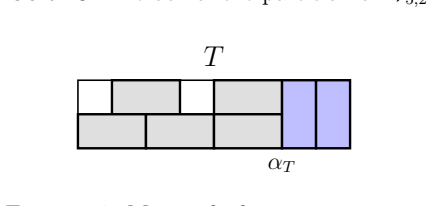
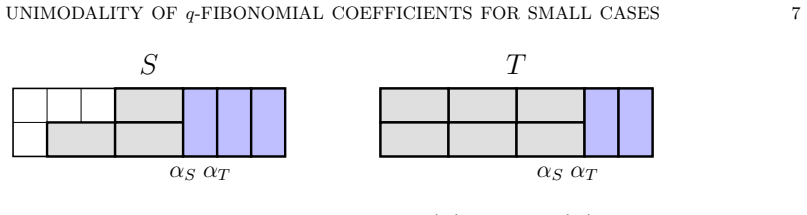
The weighted path-domino tiling model that interprets the q-Fibonomial coefficients, together with the nearly symmetric saturated chain decomposition defined on those tilings for the n=2 case.
If this is right
- The coefficient sequences of these polynomials have a single peak when n is at most 3.
- Symmetry and unimodality hold simultaneously for n=2 via the chain decomposition of the tilings.
- Certain products of q-analogs are unimodal in the n=3 setting.
- The algebraic identities used for the small cases remain valid without extra restrictions.
Where Pith is reading between the lines
- Similar chain decompositions with imposed symmetry could be sought for n greater than 3 to extend the combinatorial proof.
- The algebraic approach may apply to other families of q-analogs whose ordinary counterparts are known to be unimodal.
- The tiling model supplies a route to prove positivity or log-concavity properties for the same polynomials.
Load-bearing premise
The weighted path-domino tiling model correctly generates the q-Fibonomial coefficients as polynomials.
What would settle it
An explicit computation, for some integer m and n=3, of the coefficient sequence of the corresponding q-Fibonomial polynomial that fails to be unimodal.
Figures


read the original abstract
Bergeron--Ceballos--K\"ustner introduced the $q$-Fibonomial coefficients \( \qfibonom{m+n}{n}\), gave a combinatorial interpretation of the $q$-Fibonomial coefficients via a weighted path-domino tiling model, and conjectured that these polynomials are unimodal. We prove the conjecture for $n\leq3$. For the $n=2$ case, we give a combinatorial proof of both unimodality and symmetry by defining a nearly symmetric saturated chain decomposition on the set of tilings. For all three cases, we give an algebraic proof. Finally, for the $n=3$ case, we establish a more general unimodality result for certain products of $q$-analogs and propose several related conjectures.
Editorial analysis
A structured set of objections, weighed in public.
Referee Report
Summary. The manuscript proves the unimodality conjecture for the q-Fibonomial coefficients qfibonom{m+n}{n} when n≤3. For n=2 it supplies a combinatorial proof of both unimodality and symmetry via a nearly symmetric saturated chain decomposition on the weighted path-domino tilings of Bergeron–Ceballos–Küstner; for n≤3 it supplies direct algebraic proofs by expansion; and for n=3 it establishes a modest generalization to certain products of q-analogs together with several related conjectures.
Significance. If the arguments hold, the paper supplies the first rigorous confirmation of the conjecture in the smallest nontrivial cases, with an explicit combinatorial construction for n=2 that simultaneously yields symmetry. The algebraic verifications for fixed small n are finite and directly checkable, while the n=3 generalization and open conjectures provide concrete directions for further work on q-analogs of binomial coefficients.
minor comments (3)
- [Section 2] In the definition of the weighted tiling model (presumably §2), the precise weighting rule for horizontal dominoes versus vertical pairs should be restated explicitly so that the chain decomposition can be verified without consulting the cited reference.
- [Section 4] The algebraic proof for n=3 would be easier to follow if the expanded polynomial (or at least its coefficient sequence) were displayed in a small table before the unimodality argument is invoked.
- [Introduction] A short sentence recalling the original conjecture statement from Bergeron–Ceballos–Küstner would help readers who are not already familiar with the reference.
Simulated Author's Rebuttal
We thank the referee for their positive report and recommendation to accept the manuscript. The summary accurately reflects our combinatorial proof for n=2 via nearly symmetric saturated chain decompositions on weighted path-domino tilings and the algebraic verifications for n≤3, along with the modest generalization and conjectures for n=3.
Circularity Check
No significant circularity detected
full rationale
The paper proves unimodality of q-Fibonomial coefficients for n≤3 via explicit combinatorial nearly-symmetric saturated chain decompositions (n=2) on the external Bergeron–Ceballos–Küstner weighted tiling model and direct algebraic expansions (n≤3), plus a modest generalization for n=3. These are finite, case-by-case arguments relying on standard q-analog identities and an independent combinatorial interpretation; no derivation reduces by construction to fitted inputs, self-definitions, or load-bearing self-citations from the present authors.
Axiom & Free-Parameter Ledger
axioms (2)
- domain assumption The weighted path-domino tiling model gives the correct generating function for q-Fibonomial coefficients
- standard math Standard algebraic identities for q-analogs and q-Fibonacci numbers hold
Reference graph
Works this paper leans on
-
[1]
Symmetry, Integrability and Geometry: Methods and Applications , language =
Bergeron, Nantel and Ceballos, Cesar and Küstner, Josef , issn =. Symmetry, Integrability and Geometry: Methods and Applications , language =
-
[2]
, address =
Benjamin, Arthur and Quinn, Jennifer J. , address =
-
[3]
1989 , publisher =
Zeilberger, Doron , booktitle =. 1989 , publisher =
1989
-
[4]
1878 , publisher =
Sylvester, James Joseph , journal =. 1878 , publisher =
-
[5]
, journal =
O'Hara, Kathleen M. , journal =. 1990 , publisher =
1990
-
[6]
Sagan, Bruce and Savage, Carla , journal =
-
[7]
2014 , author =
ISRN Algebra , language =. 2014 , author =
2014
-
[8]
Zeckendorf, Édouard , journal =
-
[9]
, journal =
Bennett, Curtis and Carrillo, Juan and Machacek, John and Sagan, Bruce E. , journal =. 2020 , publisher =
2020
-
[10]
and Reiland, Elizabeth , journal =
Benjamin, Arthur T. and Reiland, Elizabeth , journal =. 2014 , publisher =
2014
-
[11]
and Sagan, Bruce E
Amdeberhan, Tewodros and Chen, Xi and Moll, Victor H. and Sagan, Bruce E. , journal =. 2014 , publisher =
2014
-
[12]
2018 , publisher =
Adiprasito, Karim and Huh, June and Katz, Eric , journal =. 2018 , publisher =
2018
-
[13]
2020 , publisher =
Brändén, Petter and Huh, June , journal =. 2020 , publisher =
2020
-
[14]
2018 , organization =
Anari, Nima and Gharan, Shayan Oveis and Vinzant, Cynthia , booktitle =. 2018 , organization =
2018
-
[15]
Chan, Swee Hong and Pak, Igor , journal =
-
[16]
, journal =
Stanley, Richard P. , journal =
-
[17]
1954 , publisher =
Bizley, Michael Terence Lewis , journal =. 1954 , publisher =
1954
-
[18]
and Plott, Sean S
Benjamin, Arthur T. and Plott, Sean S. , journal =. 2008 , publisher =
2008
-
[19]
1878 , publisher =
Lucas, Édouard , journal =. 1878 , publisher =
discussion (0)
Sign in with ORCID, Apple, or X to comment. Anyone can read and Pith papers without signing in.