Recognition: no theorem link
Linking COPD Prevalence with Income Distribution: A Spatial Heterogeneous Compositional Regression via Geographically Weighted Penalized Approach
Pith reviewed 2026-05-14 19:19 UTC · model grok-4.3
The pith
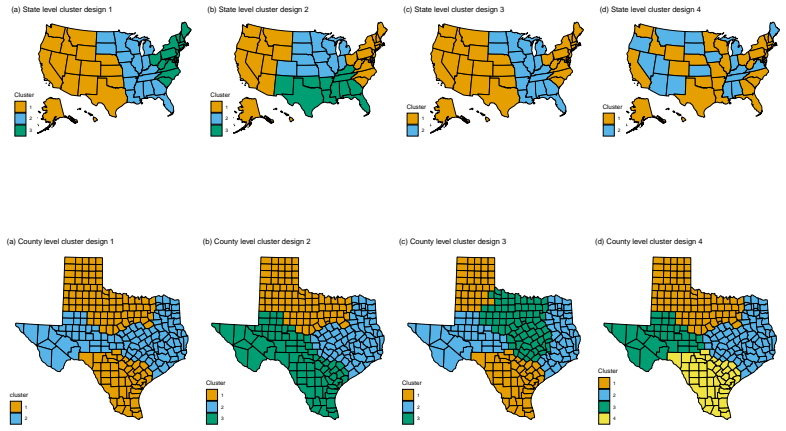
A geographically weighted regression with pairwise fusion penalties identifies clusters of regions sharing similar income-COPD relationships even when the regions are not adjacent.
A machine-rendered reading of the paper's core claim, the machinery that carries it, and where it could break.
Core claim
We propose a geographically weighted penalized compositional regression model that adopts a pairwise fusion penalty to detect both contiguous and noncontiguous regional clusters with shared regression effects, thereby relaxing assumptions of spatial smoothness and geographic contiguity, and we demonstrate the approach by linking U.S. income composition to COPD prevalence.
What carries the argument
Pairwise fusion penalty inside a geographically weighted penalized compositional regression, which fuses regression coefficients across regions to form clusters without requiring adjacency or smoothness.
If this is right
- Regions with similar socioeconomic structures can be grouped even if they are geographically separated.
- Conventional smooth spatial models miss abrupt heterogeneity that the fusion penalty captures.
- Nonconvex penalties such as MCP improve estimation accuracy and interpretability over convex alternatives.
- The framework scales to high-dimensional compositional predictors in spatial settings.
Where Pith is reading between the lines
- The same penalty structure could be extended to other compositional predictors such as education or occupation shares.
- Health-policy targeting could shift from purely geographic units to clusters defined by shared economic composition.
- Time-varying versions might track how these income-health clusters evolve.
Load-bearing premise
The pairwise fusion penalty, when paired with nonconvex regularization, correctly recovers the true underlying spatial clusters from real compositional income data without excessive merging or splitting.
What would settle it
A simulation study on synthetic spatial compositional data with known ground-truth clusters where the method fails to recover the exact partition structure.
Figures




read the original abstract
Income inequality is a major contributor to health disparities, yet its effects often vary by geography and are commonly represented as compositional distributions (e.g., proportions of households across income brackets). Existing spatial regression methods struggle in this setting: they typically assume smooth spatial variation, cannot accommodate abrupt spatial heterogeneity, and lack principled treatment of compositional covariates. We propose a geographically weighted penalized compositional regression model that addresses these challenges simultaneously. Our method adopts a pairwise fusion penalty that enables detection of both contiguous and noncontiguous regional clusters with shared regression effects, thereby relaxing strong assumptions of spatial smoothness and geographic contiguity. This allows regions with similar underlying socioeconomic structures to be identified even when they are not geographically adjacent. By incorporating nonconvex penalties, such as the minimax concave penalty (MCP), the approach achieves improved estimation accuracy, interpretability, and scalability in high-dimensional spatial settings. We illustrate the method through an analysis linking U.S. income composition to chronic obstructive pulmonary disease (COPD) prevalence, revealing spatially heterogeneous associations that are obscured by conventional models. The proposed framework provides a flexible and robust tool for spatial data analysis involving compositional predictors and region-specific heterogeneity.
Editorial analysis
A structured set of objections, weighed in public.
Referee Report
Summary. The manuscript proposes a geographically weighted penalized compositional regression model that incorporates a pairwise fusion penalty together with nonconvex regularization (e.g., MCP) to relate income-bracket proportions to COPD prevalence across U.S. regions. The method is claimed to identify both contiguous and non-contiguous clusters of regions that share identical regression coefficients, thereby relaxing the usual spatial-smoothness and geographic-contiguity assumptions.
Significance. If the pairwise fusion penalty plus MCP regularization can be shown to recover the true partition with low false-merging rates under compositional constraints and geographically weighted local likelihood, the framework would constitute a useful extension of spatial regression tools for compositional predictors. The COPD application illustrates a concrete domain where abrupt spatial heterogeneity in socioeconomic effects is plausible.
major comments (2)
- [Abstract / §3] Abstract and §3 (model formulation): the central claim that the pairwise fusion penalty recovers both contiguous and non-contiguous clusters rests on an unverified oracle property under the sum-to-one compositional constraint and the geographically weighted local likelihood. No simulation study or consistency theorem is referenced that quantifies false-positive fusion rates when true clusters mix adjacent and non-adjacent regions.
- [§4] §4 (estimation and algorithm): it is unclear how the nonconvex MCP penalty interacts with the compositional constraint (e.g., via log-ratio or Dirichlet-type transformation) to guarantee exact cluster recovery; the abstract provides no numerical evidence (e.g., adjusted Rand index or false-merging rate) from either simulated or real data to support the claim of “improved estimation accuracy.”
minor comments (1)
- [Abstract] Abstract: the phrase “improved estimation accuracy, interpretability, and scalability” is stated without accompanying quantitative metrics (e.g., MSE reduction or runtime scaling) from the COPD analysis.
Simulated Author's Rebuttal
We thank the referee for the constructive and detailed comments. We address each major comment below, indicating where revisions will be made to strengthen the manuscript.
read point-by-point responses
-
Referee: [Abstract / §3] Abstract and §3 (model formulation): the central claim that the pairwise fusion penalty recovers both contiguous and non-contiguous clusters rests on an unverified oracle property under the sum-to-one compositional constraint and the geographically weighted local likelihood. No simulation study or consistency theorem is referenced that quantifies false-positive fusion rates when true clusters mix adjacent and non-adjacent regions.
Authors: We acknowledge that the current version does not contain a dedicated simulation study or formal consistency theorem quantifying false-positive fusion rates for mixed contiguous/non-contiguous clusters under the compositional constraint. In the revision we will add a simulation study that generates data with both adjacent and non-adjacent true clusters, applies the geographically weighted penalized compositional regression, and reports adjusted Rand index, false-merging rates, and estimation error. We will also include a brief outline of the oracle property in the supplementary material, extending existing results for pairwise fusion penalties to the log-ratio transformed, geographically weighted setting. revision: yes
-
Referee: [§4] §4 (estimation and algorithm): it is unclear how the nonconvex MCP penalty interacts with the compositional constraint (e.g., via log-ratio or Dirichlet-type transformation) to guarantee exact cluster recovery; the abstract provides no numerical evidence (e.g., adjusted Rand index or false-merging rate) from either simulated or real data to support the claim of “improved estimation accuracy.”
Authors: The model applies an isometric log-ratio transformation to the compositional predictors, mapping them to an unconstrained Euclidean space before the pairwise fusion and MCP penalties are imposed on the regression coefficients; this transformation preserves the sum-to-one constraint while allowing standard fusion-penalty theory to apply. We will expand §4 to explicitly describe this interaction and the resulting exact-recovery conditions. In addition, we will insert numerical results from both the planned simulations and the COPD application, reporting adjusted Rand indices for cluster recovery and mean-squared-error comparisons against non-penalized and spatially smooth baselines to support the accuracy claims. revision: yes
Axiom & Free-Parameter Ledger
Reference graph
Works this paper leans on
-
[1]
Public Health Regions , year =
-
[2]
Pleasants, R. A. and Riley, I. L. and Mannino, D. M. , title =. Int J Chron Obstruct Pulmon Dis , year =
-
[3]
Grigsby, M. and Siddharthan, T. and Chowdhury, M. A. and Siddiquee, A. and Rubinstein, A. and Sobrino, E. and Miranda, J. J. and Bernabe-Ortiz, A. and Alam, D. and Checkley, W. , journal=. Socioeconomic status and. 2016 , month=. doi:10.2147/COPD.S111145 , pmid=
-
[4]
Endogenous Spatial Regimes , author =. 2024 , journal =. doi:10.1007/s10109-023-00411-2 , langid =
-
[5]
Journal of the American Statistical Association , year=
Spatial homogeneity pursuit of regression coefficients for large datasets , author=. Journal of the American Statistical Association , year=
-
[6]
Environmetrics , volume=
Scanner: Simultaneously temporal trend and spatial cluster detection for spatial-temporal data , author=. Environmetrics , volume=. 2024 , publisher=
2024
-
[7]
Statistics in medicine , volume=
Cluster detection of spatial regression coefficients , author=. Statistics in medicine , volume=. 2017 , publisher=
2017
-
[8]
Biometrika , volume=
Variable selection in regression with compositional covariates , author=. Biometrika , volume=. 2014 , publisher=
2014
-
[9]
Spatial and Spatio-temporal Epidemiology , volume=
Regularized spatial and spatio-temporal cluster detection , author=. Spatial and Spatio-temporal Epidemiology , volume=. 2022 , publisher=
2022
-
[10]
The International Journal of Biostatistics , author =
Exploration of. The International Journal of Biostatistics , author =. 2020 , pages =. doi:10.1515/ijb-2018-0026 , abstract =
-
[11]
Statistics in Medicine , author =
Multivariate log-contrast regression with sub-compositional predictors:. Statistics in Medicine , author =. 2022 , note =. doi:10.1002/sim.9273 , abstract =
-
[12]
It's all relative:. Biometrics , author =. 2023 , note =. doi:10.1111/biom.13703 , abstract =
-
[13]
Journal of the Royal Statistical Society: Series B (Methodological) , author =
The. Journal of the Royal Statistical Society: Series B (Methodological) , author =. 1982 , pages =. doi:10.1111/j.2517-6161.1982.tb01195.x , abstract =
-
[14]
Foundations and Trends® in Machine Learning , author =
Distributed. Foundations and Trends® in Machine Learning , author =. 2010 , pages =. doi:10.1561/2200000016 , language =
-
[15]
Geographical Analysis , author =
Geographically. Geographical Analysis , author =. 1996 , note =. doi:10.1111/j.1538-4632.1996.tb00936.x , abstract =
-
[16]
Journal of the American Statistical Association , author =
Spatial. Journal of the American Statistical Association , author =. 2003 , pmid =. doi:10.1198/016214503000170 , abstract =
-
[17]
Journal of Econometrics , author =
Shrinkage estimation of common breaks in panel data models via adaptive group fused. Journal of Econometrics , author =. 2016 , keywords =. doi:10.1016/j.jeconom.2015.09.004 , abstract =
-
[18]
Semiparametric. Biometrics , author =. 2010 , note =. doi:10.1111/j.1541-0420.2009.01309.x , abstract =
-
[19]
Bayesian. Biometrics , author =. 2010 , pages =. doi:10.1111/j.1541-0420.2009.01333.x , abstract =
-
[20]
Applied Physiology, Nutrition, and Metabolism , author =
A systematic review of compositional data analysis studies examining associations between sleep, sedentary behaviour, and physical activity with health outcomes in adults , volume =. Applied Physiology, Nutrition, and Metabolism , author =. 2020 , note =. doi:10.1139/apnm-2020-0160 , abstract =
-
[21]
American Economic Review , author =
Increasing. American Economic Review , author =. 2006 , pages =. doi:10.1257/aer.96.3.461 , abstract =
-
[22]
Science of The Total Environment , author =
Univariate statistical analysis of environmental (compositional) data:. Science of The Total Environment , author =. 2009 , keywords =. doi:10.1016/j.scitotenv.2009.08.008 , abstract =
-
[23]
A review of statistical methods for dietary pattern analysis , volume =. Nutrition Journal , author =. 2021 , keywords =. doi:10.1186/s12937-021-00692-7 , abstract =
-
[24]
Bayesian
Meng, Jingcheng and Ren, Yimeng and Zhu, Xuening and Hu, Guanyu , month = may, year =. Bayesian
-
[25]
Annual Review of Statistics and its Application , volume=
Compositional data analysis , author=. Annual Review of Statistics and its Application , volume=. 2021 , publisher=
2021
-
[26]
Stochastic Environmental Research and Risk Assessment , author =
Compositional time series analysis for. Stochastic Environmental Research and Risk Assessment , author =. 2018 , keywords =. doi:10.1007/s00477-018-1542-0 , abstract =
-
[27]
Compositional
Bacon-Shone, John and Grunsky, Eric , year =. Compositional
-
[28]
Aitchison's
Greenacre, Michael and Grunsky, Eric and Bacon-Shone, John and Erb, Ionas and Quinn, Thomas , month = jan, year =. Aitchison's
-
[29]
Mathematical Geosciences , author =
Geostatistics for. Mathematical Geosciences , author =. 2019 , keywords =. doi:10.1007/s11004-018-9769-3 , abstract =
-
[30]
Journal of the Royal Statistical Society
Review of. Journal of the Royal Statistical Society. Series A (General) , author =. 1986 , note =. doi:10.2307/2981571 , number =
-
[31]
Mathematical Geosciences , author =
Compositional. Mathematical Geosciences , author =. 2020 , keywords =. doi:10.1007/s11004-020-09873-2 , abstract =
-
[32]
Rasmussen, Carl Edward and Williams, Christopher K. I. , year =. Gaussian processes for machine learning , isbn =
-
[33]
, month = jan, year =
MacQueen, J. , month = jan, year =. Some methods for classification and analysis of multivariate observations , volume =. Proceedings of the
-
[34]
Journal of the Royal Statistical Society Series B: Statistical Methodology , author =
Regression. Journal of the Royal Statistical Society Series B: Statistical Methodology , author =. 1996 , pages =. doi:10.1111/j.2517-6161.1996.tb02080.x , abstract =
-
[35]
Ester, Martin and Kriegel, Hans-Peter and Xu, Xiaowei , file =. A
-
[36]
, collaborator =
McLachlan, Geoffrey J. , collaborator =. Mixture models: inference and applications to clustering , isbn =. 1988 , keywords =
1988
-
[37]
Model. Journal of the American Statistical Association , author =. 2014 , pages =. doi:10.1080/01621459.2013.836975 , abstract =
-
[38]
Bayesian. Bayesian Analysis , author =. 2023 , file =. doi:10.1214/22-BA1320 , abstract =
-
[39]
Statistical science : a review journal of the Institute of Mathematical Statistics , author =
A. Statistical science : a review journal of the Institute of Mathematical Statistics , author =. 2012 , pmid =. doi:10.1214/12-STS392 , abstract =
-
[40]
Statistics and its interface , author =
Penalized methods for bi-level variable selection , volume =. Statistics and its interface , author =. 2009 , pmid =
2009
-
[41]
2024 , url =
GDP by State , howpublished =. 2024 , url =
2024
-
[42]
Mathematical Geology , author =
Isometric. Mathematical Geology , author =. 2003 , file =
2003
-
[43]
Nearly unbiased variable selection under minimax concave penalty
Zhang, Cun-Hui , month = feb, year =. Nearly unbiased variable selection under minimax concave penalty , url =. doi:10.48550/arXiv.1002.4734 , abstract =
work page internal anchor Pith review Pith/arXiv arXiv doi:10.48550/arxiv.1002.4734
-
[44]
Tuning parameter selectors for the smoothly clipped absolute deviation method , volume =. Biometrika , author =. 2007 , pmid =. doi:10.1093/biomet/asm053 , abstract =
-
[45]
Journal of the American Statistical Association , author =
Objective. Journal of the American Statistical Association , author =. 1971 , note =. doi:10.1080/01621459.1971.10482356 , abstract =
-
[46]
Statistics in Medicine , author =
Cluster detection of spatial regression coefficients , volume =. Statistics in Medicine , author =. 2017 , pages =. doi:10.1002/sim.7172 , abstract =
-
[47]
Bayesian. Bayesian Analysis , author =. 2016 , file =. doi:10.1214/14-BA925 , abstract =
-
[48]
Clustering. Technometrics , author =. 2012 , pages =. doi:10.1080/00401706.2012.657106 , abstract =
-
[49]
Statistica Neerlandica , author =
Hierarchical clustering of spatially correlated functional data , volume =. Statistica Neerlandica , author =. 2012 , pages =. doi:10.1111/j.1467-9574.2012.00522.x , abstract =
-
[50]
Variable Selection via Nonconcave Penalized Likelihood and Its Oracle Properties , urldate =
Jianqing Fan and Runze Li , journal =. Variable Selection via Nonconcave Penalized Likelihood and Its Oracle Properties , urldate =
-
[51]
Everitt, B. S. and Hand, D. J. , year =. Finite. doi:10.1007/978-94-009-5897-5 , keywords =
-
[52]
Journal of the Royal Statistical Society Series B: Statistical Methodology , author =
Discriminant. Journal of the Royal Statistical Society: Series B (Methodological) , author =. 1996 , note =. doi:10.1111/j.2517-6161.1996.tb02073.x , abstract =
-
[53]
Journal of Statistical Planning and Inference , author =
Model-based classification using latent. Journal of Statistical Planning and Inference , author =. 2010 , keywords =. doi:10.1016/j.jspi.2009.11.006 , abstract =
-
[54]
Model-. Biometrics , author =. 1993 , note =. doi:10.2307/2532201 , abstract =
-
[55]
Latent. Journal of the American Statistical Association , author =. 2013 , pmid =. doi:10.1080/01621459.2013.789695 , abstract =
-
[56]
Journal of the American Statistical Association , author =
Inference for. Journal of the American Statistical Association , author =. 2015 , note =
2015
-
[57]
Spectral Experts for Estimating Mixtures of Linear Regressions
Chaganty, Arun Tejasvi and Liang, Percy , month = jun, year =. Spectral. doi:10.48550/arXiv.1306.3729 , abstract =
work page internal anchor Pith review Pith/arXiv arXiv doi:10.48550/arxiv.1306.3729
-
[58]
The State of the American Middle Class , year =
-
[59]
Journal of Statistical Software , year =
Kurt Hornik , title =. Journal of Statistical Software , year =
-
[60]
Transformed. Spatial Statistics , author =. 2015 , note =. doi:10.1016/j.spasta.2015.07.004 , abstract =
-
[61]
Journal of the Royal Statistical Society Series B: Statistical Methodology , author =
Sparsity and. Journal of the Royal Statistical Society Series B: Statistical Methodology , author =. 2005 , pages =. doi:10.1111/j.1467-9868.2005.00490.x , abstract =
-
[62]
Simultaneous regression shrinkage, variable selection and clustering of predictors with. Biometrics , author =. 2008 , pmid =. doi:10.1111/j.1541-0420.2007.00843.x , abstract =
-
[63]
Journal of the American Statistical Association , author =
Grouping pursuit through a regularization solution surface , volume =. Journal of the American Statistical Association , author =. 2010 , pmid =. doi:10.1198/jasa.2010.tm09380 , abstract =
-
[64]
Ke, Tracy and Fan, Jianqing and Wu, Yichao , month = mar, year =. Homogeneity in. doi:10.48550/arXiv.1303.7409 , abstract =
work page internal anchor Pith review Pith/arXiv arXiv doi:10.48550/arxiv.1303.7409
-
[65]
Pairwise variable selection for high-dimensional model-based clustering , volume =. Biometrics , author =. 2010 , pmid =. doi:10.1111/j.1541-0420.2009.01341.x , abstract =
-
[66]
Journal of Computational and Graphical Statistics , author =
Splitting. Journal of Computational and Graphical Statistics , author =. 2015 , note =. doi:10.1080/10618600.2014.948181 , abstract =
-
[67]
Journal of the American Statistical Association , author =
Variable. Journal of the American Statistical Association , author =. 2001 , note =
2001
-
[68]
W. R. Tobler , journal =. A Computer Movie Simulating Urban Growth in the Detroit Region , urldate =
-
[69]
Subramanian, S. V. and Kawachi, Ichiro , title =. Epidemiologic Reviews , volume =. 2004 , month =. doi:10.1093/epirev/mxh003 , url =
-
[70]
Burchett and Simon Lewin and Ella R
Helen E. Burchett and Simon Lewin and Ella R. Lavis and Lucy V. Mayhew and Atle Fretheim and Jonathan P. Oxman , title =. BMC Public Health , year =. doi:10.1186/1471-2458-13-1001 , url =
-
[71]
International Journal of Population Data Science , volume=
Income inequalities in the risk of potentially avoidable hospitalisation for chronic obstructive pulmonary disease: a population data linkage analysis , author=. International Journal of Population Data Science , volume=. 2020 , publisher=
2020
-
[72]
, title =
Snyder, John P. , title =. 1987 , publisher =
1987
-
[73]
and Hart, Peter E
Duda, Richard O. and Hart, Peter E. and Stork, David G. , title =. 2001 , publisher =
2001
-
[74]
Biometrics , volume=
Bayesian spatial homogeneity pursuit for survival data with an application to the SEER respiratory cancer data , author=. Biometrics , volume=. 2022 , publisher=
2022
-
[75]
Geographical Analysis , volume=
Geographically weighted Cox regression for prostate cancer survival data in Louisiana , author=. Geographical Analysis , volume=. 2020 , publisher=
2020
discussion (0)
Sign in with ORCID, Apple, or X to comment. Anyone can read and Pith papers without signing in.