Recognition: unknown
A refined CJ--SS--RR method with a reliable removal approach of spurious Ritz values for the Hermitian eigenvalue problem
Pith reviewed 2026-05-14 19:09 UTC · model grok-4.3
The pith
Refined Rayleigh-Ritz projection enables tune-free removal of spurious Ritz values in Hermitian eigenproblems by exploiting unconditional convergence of refined vectors.
A machine-rendered reading of the paper's core claim, the machinery that carries it, and where it could break.
Core claim
Under the hypothesis that the deviations of the desired eigenvectors of A from the underlying subspace tend to zero, the refined SS-RR methods compute eigenpairs by removing spurious Ritz values on the basis of the unconditional convergence of refined Ritz vectors, yielding a restarted CJ-SS-RRR algorithm that outperforms the non-refined restarted CJ-SS-RR algorithm in efficiency and reliability.
What carries the argument
Refined Rayleigh-Ritz projection that produces vectors whose convergence is unconditional when the subspace deviation tends to zero, paired with a removal rule for spurious Ritz values.
If this is right
- Spurious Ritz values that arise when multiple Ritz values converge to the same eigenvalue can be discarded without any user-tuned threshold.
- The restarted CJ-SS-RRR algorithm converges more reliably than CJ-SS-RR on matrices whose eigenvalues of interest are close.
- Residual norms alone are insufficient for identification, but the refined-vector test supplies a rigorous substitute.
- The approach extends directly to block versions of the SS-RR family for computing multiple eigenpairs.
Where Pith is reading between the lines
- The same unconditional-convergence property could be used to design removal steps in other subspace iteration schemes such as block Lanczos or Davidson methods.
- The technique may reduce the number of matrix-vector products needed when eigenvalue clusters are present, an effect worth measuring on larger-scale problems.
- Because the removal rule is deterministic and theory-supported, it could serve as a stable post-processing step for any Ritz-based solver that generates extra copies of an eigenvalue.
Load-bearing premise
The deviations of the desired eigenvectors of A from the subspace tend to zero as the subspace improves.
What would settle it
If refined Ritz vectors still fail to converge to the true eigenvectors on a sequence of subspaces whose deviation from the desired eigenspace goes to zero, the removal criterion would misclassify genuine and spurious values.
Figures


read the original abstract
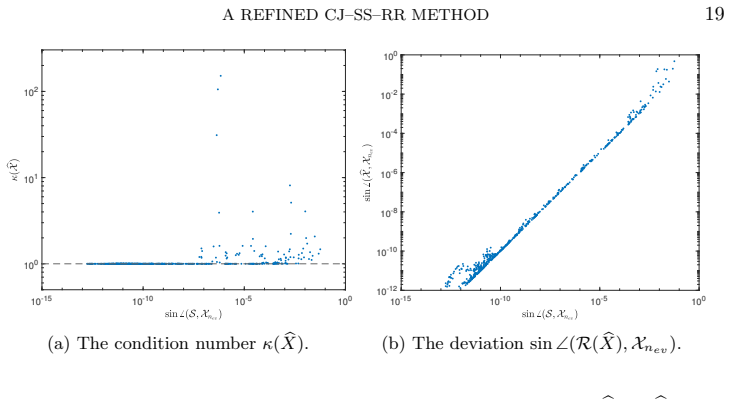
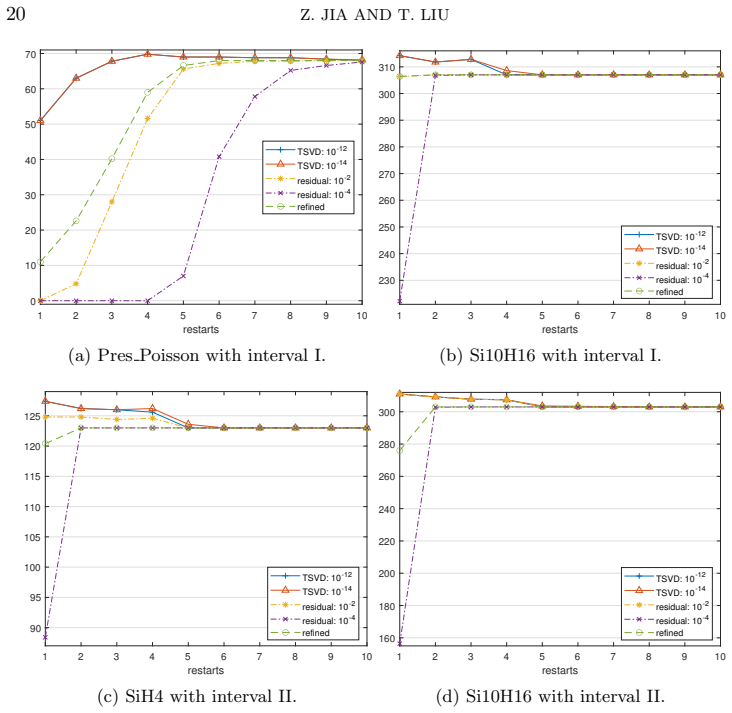
Under the hypothesis that the deviations of the desired eigenvectors of the matrix $A$ from the underlying subspace tend to zero, the Ritz vectors may not converge and have poor or little accuracy. This phenomenon is not unusual and particularly occurs when the associated Ritz values are close, which is independent of the eigenvalue distribution of $A$. For the (block) SS--RR methods, there are possibly {\em more} Ritz values that converge to the same desired eigenvalue(s) counting multiplicity in the region of interest, meaning that some of the Ritz values must be spurious and the corresponding residual norms of the Ritz pairs may not be small. Consequently, the (block) SS--RR methods including the CJ--SS--RR method cannot base on the corresponding residual norms to effectively identify if the Ritz values in the region are genuine or spurious. This paper proposes refined SS--RR, abbreviated as SS--RRR, methods based on the refined Rayleigh--Ritz projection that compute the eigenpairs of large matrices with the eigenvalues located in the given region. We present a new approach to accurately implement the RRR methods more efficiently than ever before for a general subspace.Exploiting the unconditional convergence of the refined Ritz vectors when the subspace is sufficiently accurate, we propose a tune-free removal approach to effectively remove spurious Ritz values with a rigorous theory supported, and develop a restarted CJ--SS--RRR algorithm. Numerical experiments show that the restarted CJ--SS--RRR algorithm is more efficient and effective than the restarted CJ--SS--RR algorithm.
Editorial analysis
A structured set of objections, weighed in public.
Referee Report
Summary. The paper introduces refined SS--RRR methods based on the refined Rayleigh-Ritz projection for computing eigenpairs of large Hermitian matrices with eigenvalues in a specified region. It identifies the limitation of standard (block) SS--RR methods, including CJ--SS--RR, where residual norms cannot reliably distinguish genuine from spurious Ritz values when Ritz values are close. Exploiting the unconditional convergence of refined Ritz vectors under the hypothesis that deviations of desired eigenvectors from the underlying subspace tend to zero, the authors propose a tune-free removal approach for spurious Ritz values, supported by rigorous theory, and develop a restarted CJ--SS--RRR algorithm. Numerical experiments claim this restarted variant is more efficient and effective than the restarted CJ--SS--RR algorithm.
Significance. If the hypothesis holds and the removal criterion proves reliable, the work addresses a known practical difficulty in subspace iteration methods for clustered eigenvalues, potentially improving robustness of eigensolvers without parameter tuning. The emphasis on an efficient implementation of refined projections and the provision of theoretical support for the removal step are positive features that could influence subsequent developments in numerical linear algebra for large-scale Hermitian problems.
major comments (2)
- [Development of the removal approach and restarted CJ--SS--RRR algorithm] The tune-free removal approach for spurious Ritz values is justified by unconditional convergence of refined Ritz vectors once the subspace is sufficiently accurate, under the single hypothesis that deviations of desired eigenvectors from the subspace tend to zero. However, the manuscript provides no explicit bounds, algorithmic enforcement, or practical test to verify when this hypothesis holds in the restarted setting, especially for close Ritz values where standard Ritz vectors are known to fail. This makes the reliability of the removal criterion dependent on an assumption whose satisfaction is not guaranteed by the algorithm.
- [Theoretical justification of refined Ritz vector convergence] The abstract states that the refined approach is supported by rigorous theory, yet the provided description does not include concrete error bounds or a checkable condition linking subspace accuracy to the hypothesis. Without such quantification, it is unclear whether the removal remains effective when the subspace is only marginally accurate or in the presence of multiplicity/clustering.
minor comments (1)
- [Abstract and introduction] The abstract refers to 'a new approach to accurately implement the RRR methods more efficiently than ever before for a general subspace' without specifying the prior implementation or quantifying the efficiency gain; a brief comparison in the introduction would clarify the advance.
Simulated Author's Rebuttal
We thank the referee for the careful reading and constructive comments. We address each major comment below, providing our strongest honest defense of the manuscript while indicating revisions where the presentation can be strengthened.
read point-by-point responses
-
Referee: [Development of the removal approach and restarted CJ--SS--RRR algorithm] The tune-free removal approach for spurious Ritz values is justified by unconditional convergence of refined Ritz vectors once the subspace is sufficiently accurate, under the single hypothesis that deviations of desired eigenvectors from the subspace tend to zero. However, the manuscript provides no explicit bounds, algorithmic enforcement, or practical test to verify when this hypothesis holds in the restarted setting, especially for close Ritz values where standard Ritz vectors are known to fail. This makes the reliability of the removal criterion dependent on an assumption whose satisfaction is not guaranteed by the algorithm.
Authors: The hypothesis is the standard one underlying all subspace iteration methods: the contour integration step is constructed precisely to drive the deviation of desired eigenvectors from the trial subspace toward zero. The restarted CJ--SS--RRR algorithm enforces this progressively by augmenting the subspace with new contour-integrated vectors at each restart and then applying the refined projection. The unconditional convergence theorem for refined Ritz vectors (independent of eigenvalue clustering or closeness of Ritz values) is the key property that justifies the tune-free removal; standard RR lacks this property, which is why residuals fail. While the manuscript does not supply matrix-dependent a priori bounds (typical in this literature), we will add an explicit discussion of the restart mechanism's role in guaranteeing monotonic improvement of subspace accuracy and a practical monitoring test based on the change in refined residual norms between successive restarts. This supplies the algorithmic enforcement requested. revision: partial
-
Referee: [Theoretical justification of refined Ritz vector convergence] The abstract states that the refined approach is supported by rigorous theory, yet the provided description does not include concrete error bounds or a checkable condition linking subspace accuracy to the hypothesis. Without such quantification, it is unclear whether the removal remains effective when the subspace is only marginally accurate or in the presence of multiplicity/clustering.
Authors: The rigorous theory consists of the unconditional convergence result for refined Ritz vectors to the desired eigenvectors as the subspace deviation tends to zero; this result holds without any assumption on the eigenvalue distribution or multiplicity and is the foundation for the removal criterion. We agree that the current write-up would benefit from more explicit quantification. In the revision we will insert concrete error bounds (derived from the refined Rayleigh-Ritz perturbation theory already referenced) that relate the sine of the subspace angle to the error in the refined vector, together with a checkable residual-based condition that can be evaluated after each projection. For marginal accuracy the removal is applied conservatively (only when the refined vector deviates markedly from the standard Ritz vector), and the numerical experiments already demonstrate robustness under clustering; we will add a short remark on this point. revision: yes
Circularity Check
Minor self-citation to prior CJ-SS-RR work; new refined projection and removal logic independent of inputs.
full rationale
The derivation introduces a new refined Rayleigh-Ritz projection (SS-RRR) and a tune-free spurious-value removal criterion based on unconditional convergence of refined Ritz vectors under the explicit hypothesis that eigenvector deviations from the subspace tend to zero. This convergence property and the removal rule are supported by new theory presented in the current manuscript rather than reducing to a self-definition, a fitted parameter renamed as prediction, or a load-bearing self-citation chain. The baseline CJ-SS-RR method is cited for context, but the central algorithmic advance and its supporting analysis remain self-contained against external benchmarks and do not collapse to the paper's own inputs by construction.
Axiom & Free-Parameter Ledger
axioms (1)
- domain assumption Deviations of the desired eigenvectors of A from the underlying subspace tend to zero
Reference graph
Works this paper leans on
-
[1]
Z. Bai, J. Demmel, J. Dongarra, A. Ruhe, and H. A. V an der Vorst,Templates for the Solution of Algebraic Eigenvalue Problems: A Practical Guide, SIAM, Philadelphia, PA, A REFINED CJ–SS–RR METHOD23 2000, https://doi.org/10.1137/1.9780898719581
-
[2]
T. A. Davis and Y. Hu,The University of Florida sparse matrix collection, ACM Trans. Math. Software, 38 (2011), https://doi.org/10.1145/2049662.2049663
-
[3]
E. Di Napoli, E. Polizzi, and Y. Saad,Efficient estimation of eigenvalue counts in an interval, Numer. Linear Algebra Appl., 23 (2016), pp. 674–692, https://doi.org/10.1002/nla.2048
-
[4]
Futamura and T
Y. Futamura and T. Sakurai,z-Pares: Parallel eigenvalue solver, 2014, https://zpares.cs. tsukuba.ac.jp/
2014
-
[5]
G. H. Golub and C. F. V an Loan,Matrix Computations, The John Hopkins University Press, Baltimore, 4th ed., 2013, https://doi.org/10.1137/1.9781421407944
-
[6]
S. G ¨uttel, E. Polizzi, P. T. P. Tang, and G. Viaud,Zolotarev quadrature rules and load balancing for the FEAST eigensolver, SIAM J. Sci. Comput., 37 (2015), pp. A2100–A2122, https://doi.org/10.1137/140980090
-
[7]
T. Ikegami and T. Sakurai,Contour integral eigensolver for non-Hermitian systems: a Rayleigh–Ritz-type approach, Taiwanese J. Math., 14 (2010), pp. 825–837, https://doi.org/ 10.11650/twjm/1500405869
-
[8]
T. Ikegami, T. Sakurai, and U. Nagashima,A filter diagonalization for generalized eigenvalue problems based on the Sakurai–Sugiura projection method, J. Comput. Appl. Math., 233 (2010), pp. 1927–1936, https://doi.org/10.1016/j.cam.2009.09.029
-
[9]
A. Imakura, L. Du, and T. Sakurai,A block Arnoldi-type contour integral spectral projection method for solving generalized eigenvalue problems, Appl. Math. Lett., 32 (2014), pp. 22–27, https://doi.org/10.1016/j.aml.2014.02.007
-
[10]
A. Imakura, L. Du, and T. Sakurai,Error bounds of Rayleigh–Ritz type contour integral-based eigensolver for solving generalized eigenvalue problems, Numer. Algorithms, 71 (2016), pp. 103–120, https://doi.org/10.1007/s11075-015-9987-4
-
[11]
A. Imakura, L. Du, and T. Sakurai,Relationships among contour integral-based methods for solving generalized eigenvalue problems, Jpn. J. Ind. Appl. Math., 33 (2016), pp. 721–750, https://doi.org/10.1007/s13160-016-0224-x
-
[12]
A. Imakura and T. Sakurai,Complex moment-based eigensolver coupled with two Krylov subspaces, J. Comput. Appl. Math., 432 (2023), 115283, https://doi.org/10.1016/j.cam. 2023.115283
-
[13]
L. O. Jay, H. Kim, Y. Saad, and J. R. Chelikowsky,Electronic structure calculations for plane-wave codes without diagonalization, Comput. Phys. Commun., 118 (1999), pp. 21–30, https://doi.org/10.1016/S0010-4655(98)00192-1
-
[14]
Z. Jia,Refined iterative algorithms based on Arnoldi’s process for large unsymmetric eigenprob- lems, Linear Algebra Appl., 259 (1997), pp. 1–23, https://doi.org/10.1016/S0024-3795(96) 00238-8
-
[15]
Jia,A refined iterative algorithm based on the block Arnoldi process for large unsymmetric eigenproblems, Linear Algebra Appl., 270 (1998), pp
Z. Jia,A refined iterative algorithm based on the block Arnoldi process for large unsymmetric eigenproblems, Linear Algebra Appl., 270 (1998), pp. 171–189, https://doi.org/10.1016/ S0024-3795(97)00023-2
1998
-
[16]
Jia,Arnoldi type algorithms for large unsymmetric multiple eigenvalue problems, J
Z. Jia,Arnoldi type algorithms for large unsymmetric multiple eigenvalue problems, J. Comput. Math., 17 (1999), pp. 257–274, https://doi.org/10.1006/jagm.1998.0996
-
[17]
Z. Jia,Polynomial characterizations of the approximate eigenvectors by the refined Arnoldi method and an implicitly restarted refined Arnoldi algorithm, Linear Algebra Appl., 287 (1999), pp. 191–214, https://doi.org/10.1016/S0024-3795(98)10197-0
-
[18]
Jia,A refined subspace iteration algorithm for large sparse eigenproblems, Appl
Z. Jia,A refined subspace iteration algorithm for large sparse eigenproblems, Appl. Numer. Math., 32 (2000), pp. 35–52, https://doi.org/10.1016/S0168-9274(99)00008-2
-
[19]
Jia,Some theoretical comparisons of refined Ritz vectors and Ritz vectors, Sci
Z. Jia,Some theoretical comparisons of refined Ritz vectors and Ritz vectors, Sci. China Ser. A, 47 (2004), pp. 222–233, https://doi.org/10.1360/04za0020
- [20]
-
[21]
Jia and G
Z. Jia and G. W. Stewart,An analysis of the Rayleigh–Ritz method for approximat- ing eigenspaces, Math. Comput., 70 (2001), pp. 637–647, https://doi.org/10.1090/ S0025-5718-00-01208-4
2001
-
[22]
Z. Jia and K. Zhang,A FEAST SVDsolver based on Chebyshev–Jackson series for computing partial singular triplets of large matrices, J. Sci. Comput., 97 (2023), 21, https://doi.org/ 10.1007/s10915-023-02342-y
-
[23]
Z. Jia and K. Zhang,An augmented matrix-based CJ-FEAST SVDsolver for computing a partial singular value decomposition with the singular values in a given interval, SIAM J. Matrix Anal. Appl., 45 (2024), pp. 24–58, https://doi.org/10.1137/23M1547500
-
[24]
Z. Jia and K. Zhang,A CJ-FEAST GSVDsolver for computing a partial gsvd of a large matrix pair with the generalized singular values in a given interval, Numer. Math., 157 (2025), pp. 897–949, https://doi.org/10.1007/s00211-025-01466-7. 24Z. JIA AND T. LIU
-
[25]
Jin,The Finite Element Method in Electromagnetics, Jhon Wiley & Sons, Inc., Hoboken, NJ, 3rd ed., 2014
J.-M. Jin,The Finite Element Method in Electromagnetics, Jhon Wiley & Sons, Inc., Hoboken, NJ, 3rd ed., 2014
2014
-
[26]
J. Kestyn, E. Polizzi, and P. T. Peter Tang,FEAST eigensolver for non-Hermitian problems, SIAM J. Sci. Comput., 38 (2016), pp. S772–S799, https://doi.org/10.1137/15M1026572
-
[27]
R. M. Martin,Electronic Structure: Basic Theory and Practical Methods, Cambridge University Press, Cambridge, UK, 2nd ed., 2020, https://doi.org/10.1017/9781108555586
-
[28]
B. N. Parlett,The Symmetric Eigenvalue Problem, SIAM, Philadelphia, PA, 1998, https: //doi.org/10.1137/1.9781611971163
-
[29]
P. T. Peter Tang and E. Polizzi,FEAST as a subspace iteration eigensolver accelerated by approximate spectral projection, SIAM J. Matrix Anal. Appl., 35 (2014), pp. 354–390, https://doi.org/10.1137/13090866X
-
[30]
Polizzi,Density-matrix-based algorithm for solving eigenvalue problems, Phys
E. Polizzi,Density-matrix-based algorithm for solving eigenvalue problems, Phys. Rev. B, 79 (2009), 115112, https://doi.org/10.1103/PhysRevB.79.115112
-
[31]
E. Polizzi,FEAST eigenvalue solver v4.0 user guide, 2020, https://doi.org/10.48550/arXiv. 2002.04807. [32]T. J. Rivlin,An Introduction to the Approximation of Functions, Dover, New York, 1981
work page internal anchor Pith review doi:10.48550/arxiv 2020
-
[32]
Y. Saad,Iterative Methods for Sparse Linear Systems, SIAM, Philadelphia, PA, 2nd ed., 2003, https://doi.org/10.1137/1.9780898718003
-
[33]
Y. Saad,Numerical Methods for Large Eigenvalue Problems, Revised Edition, SIAM, Philadel- phia, PA, 2011, https://doi.org/10.1137/1.9781611970739
-
[34]
T. Sakurai, Y. Futamura, and H. Tadano,Efficient parameter estimation and implementation of a contour integral-based eigensolver, J. Algorithms Comput. Technol., 7 (2013), pp. 249– 269, https://doi.org/10.1260/1748-3018.7.3.249
-
[35]
T. Sakurai and H. Sugiura,A projection method for generalized eigenvalue problems using numerical integration, J. Comput. Appl. Math., 159 (2003), pp. 119–128, https://doi.org/ 10.1016/S0377-0427(03)00565-X
-
[36]
T. Sakurai and H. Tadano,CIRR: a Rayleigh–Ritz type method with contour integral for generalized eigenvalue problems, Hokkaido Math. J., 36 (2007), pp. 745–757, https://doi. org/10.14492/hokmj/1272848031
-
[37]
G. W. Stewart,Matrix Algorithms, Volume II: Eigensystems, SIAM, Philadelphia, PA, 2001, https://doi.org/10.1137/1.9780898718058
-
[38]
D. B. Szyld,The many proofs of an identity on the norm of oblique projections, Numer. Algor., 42 (2006), pp. 309–323, https://doi.org/10.1007/s11075-006-9046-2
-
[39]
L. N. Trefethen and M. Embree,Spectra and Pseudospectra: The Behavior of Nonnormal Matrices and Operators, Princeton University Press, Princeton, 2005, https://doi.org/10. 1515/9780691213101
2005
-
[40]
H. A. van der Vorst,Computational Methods for Large Eigenvalue Problems, Handbook of Numerical Analysis, Vol. VIII, edited by P. G. Ciarlet and J. L. Lions, Elsvier, 2002, https://doi.org/10.1016/S1570-8659(02)08003-1
-
[41]
G. Yin, R. H. Chan, and M.-C. Yeung,A FEAST algorithm with oblique projection for generalized eigenvalue problems, Numer. Linear Algebra Appl., 24 (2017), e2092, https: //doi.org/10.1002/nla.2092
discussion (0)
Sign in with ORCID, Apple, or X to comment. Anyone can read and Pith papers without signing in.