Recognition: unknown
Never Too LATE: A Fully Stochastic Update to the Potential Outcome Framework
Pith reviewed 2026-05-14 19:07 UTC · model grok-4.3
The pith
The instrumental variable estimand identifies the degree-of-compliance-weighted average treatment effect when potential outcomes are modeled as stochastic Bernoulli parameters.
A machine-rendered reading of the paper's core claim, the machinery that carries it, and where it could break.
Core claim
Stochastic potential outcomes are introduced as Bernoulli parameters in their own small probability spaces and connected to observables via the factorization rule of a causal Bayes net. The paper defines the Degree-of-compliance-weighted Average Treatment Effect (DATE) and shows that, under assumptions analogous to monotonicity, exclusion restriction, and instrument relevance but rewritten for the stochastic parameters, the DATE equals the usual IV estimand. The classic LATE identification result emerges as the deterministic special case, so existing IV practice can be reinterpreted as having estimated the DATE without assuming the unique-parallel-universe view.
What carries the argument
The Degree-of-compliance-weighted Average Treatment Effect (DATE), constructed from stochastic potential outcomes as Bernoulli parameters and identified through causal Bayes net factorization.
If this is right
- Standard IV methods identify the DATE even when potential outcomes remain irreducibly stochastic.
- The classic LATE result is recovered exactly when the Bernoulli parameters become deterministic 0-1 values.
- Existing instrumental-variable applications can be reinterpreted as targeting the DATE without invoking unique parallel universes.
- The framework preserves identification while dropping the requirement that every counterfactual condition settles a single outcome.
Where Pith is reading between the lines
- The approach may extend naturally to domains with intrinsic randomness such as clinical trials with biological variability.
- It offers a way to maintain causal identification while aligning statistical models more closely with philosophical doubts about deterministic counterfactuals.
- Similar weighting constructions could be applied to other estimands such as the stochastic average treatment effect on the treated.
Load-bearing premise
The causal Bayes net factorization rule connects the stochastic Bernoulli parameters to observables, and the monotonicity, exclusion, and relevance conditions continue to hold when restated directly in terms of those parameters.
What would settle it
In a population where individual compliance degrees and potential-outcome probabilities can be measured directly, an IV estimate that systematically deviates from the computed DATE would falsify the claimed equality.
Figures


read the original abstract
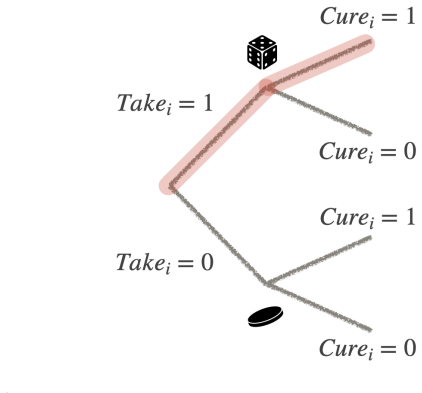
In the classic potential outcome framework, the local average treatment effect (LATE) and its identification via an instrumental variable are stated in a deterministic setting at the individual level: each individual has settled potential outcomes such as ``cured if treated''. Several authors have proposed working instead with \emph{stochastic} potential outcomes -- counterfactual probabilities of the form ``the chance of being cured if treated'' -- but the integration of stochastic potential outcomes with the LATE machinery raises an issue. It is a metaphysical issue: in a stochastic setting, the standard joint-probability definitions of compliers and the LATE assume what I will call the \emph{unique-parallel-universe view}, which asserts that, in any genuinely possible state of the world, every counterfactual condition settles a unique determinate outcome even when the underlying causal disposition is irreducibly chancy. The statistician Dawid (2000) doubts the plausibility of this view; the philosopher Lewis (1973) develops a reductio argument against it. I propose a fully stochastic update to the Rubin causal model that drops the assumption of the unique-parallel-universe view: stochastic potential outcomes are introduced as Bernoulli parameters in their own (small) probability spaces, and are connected to observables via the factorization rule of a causal Bayes net. Within this framework, I define a Degree-of-compliance-weighted Average Treatment Effect (DATE) and prove that, under assumptions analogous to those used for the LATE but rewritten for the fully stochastic setting, the DATE equals the usual IV estimand. The classic LATE identification result emerges as a deterministic special case. Existing IV practice can therefore be reinterpreted: it has been estimating the DATE all along, in a general stochastic setting, without assuming the unique-parallel-universe view.
Editorial analysis
A structured set of objections, weighed in public.
Referee Report
Summary. The paper proposes a fully stochastic update to the Rubin causal model by treating potential outcomes as Bernoulli parameters in small probability spaces, connected to observables via the factorization rule of a causal Bayes net. It defines a Degree-of-compliance-weighted Average Treatment Effect (DATE) as a compliance-degree-weighted average of individual treatment-effect parameters and claims to prove that, under assumptions analogous to monotonicity, exclusion restriction, and instrument relevance but rewritten in terms of the stochastic Bernoulli parameters, the DATE equals the standard IV estimand. The classic LATE identification result is recovered as a deterministic special case, allowing reinterpretation of existing IV practice as estimating the DATE without assuming the unique-parallel-universe view.
Significance. If the central identification result holds rigorously, the work supplies a coherent metaphysical foundation for stochastic potential outcomes within the LATE/IV framework, potentially broadening applicability to settings with irreducible randomness while preserving the validity of standard IV estimators. It explicitly credits the deterministic special case and avoids parameter-fitting or ad-hoc adjustments, which strengthens its claim to unify deterministic and stochastic approaches.
major comments (1)
- [identification theorem / DATE=IV equality] The central identification result (DATE equals IV estimand) is stated to hold under a rewritten monotonicity assumption on the Bernoulli parameters, but the factorization rule of the causal Bayes net does not by itself constrain the population distribution to exclude negative compliance degrees. If stochastic defiers are admitted, the weighted sum can differ from the IV ratio by a term proportional to the negative weights, exactly as in the deterministic case; no derivation is provided showing that an expectation-based monotonicity condition suffices to restore equality.
minor comments (1)
- The abstract and introduction could clarify the precise measure-theoretic construction of the small probability spaces for the Bernoulli parameters to avoid ambiguity about how they factor into the joint distribution.
Simulated Author's Rebuttal
We thank the referee for the careful and constructive report. The central identification result is indeed the heart of the paper, and we welcome the opportunity to clarify the role of the monotonicity assumption in the fully stochastic setting.
read point-by-point responses
-
Referee: The central identification result (DATE equals IV estimand) is stated to hold under a rewritten monotonicity assumption on the Bernoulli parameters, but the factorization rule of the causal Bayes net does not by itself constrain the population distribution to exclude negative compliance degrees. If stochastic defiers are admitted, the weighted sum can differ from the IV ratio by a term proportional to the negative weights, exactly as in the deterministic case; no derivation is provided showing that an expectation-based monotonicity condition suffices to restore equality.
Authors: We agree that the factorization rule of the causal Bayes net alone does not rule out negative compliance degrees; an explicit monotonicity assumption is required, exactly as in the deterministic LATE theorem. In the manuscript this assumption is imposed directly on the individual-level Bernoulli parameters: for each unit i, the treatment probability under Z=1 is at least as large as under Z=0. This condition is stated in terms of the parameters themselves (not their expectations), which by construction excludes negative compliance degrees before any averaging occurs. The DATE is then defined as the compliance-degree-weighted average of the individual treatment-effect parameters, and the identification argument shows that the IV ratio equals this weighted average because the negative-weight terms are absent. We acknowledge that the main-text presentation is concise and that a fully expanded, line-by-line derivation of the expectation step (showing how the parameter-level monotonicity carries through to the population moments) is not spelled out in the current version. We will add this derivation, together with an explicit statement that the monotonicity is imposed on the parameters rather than on their expectations, in the revised manuscript. revision: yes
Circularity Check
No circularity: DATE defined from stochastic parameters and derived equal to IV estimand
full rationale
The paper defines stochastic potential outcomes as Bernoulli parameters in separate probability spaces, connects them to observables via the factorization rule of a causal Bayes net, and defines DATE as the compliance-degree-weighted average of individual treatment-effect parameters. It then derives that DATE equals the IV estimand under assumptions rewritten for the stochastic setting (analogous to monotonicity, exclusion restriction, and relevance). This is a mathematical derivation from the model primitives rather than a self-definitional equivalence, a fitted input renamed as prediction, or a load-bearing self-citation chain. The classic LATE is recovered as a deterministic special case, confirming the result extends the framework without presupposing the target equality by construction. No steps reduce the central claim to its own inputs.
Axiom & Free-Parameter Ledger
axioms (2)
- domain assumption The factorization rule of a causal Bayes net connects stochastic potential outcomes to observables.
- domain assumption Assumptions analogous to monotonicity, exclusion restriction, and relevance hold when rewritten for the stochastic Bernoulli parameters.
invented entities (2)
-
Stochastic potential outcomes as Bernoulli parameters
no independent evidence
-
Degree-of-compliance-weighted Average Treatment Effect (DATE)
no independent evidence
Reference graph
Works this paper leans on
-
[1]
Identification of Causal Effects Using Instrumental Variables
Angrist, J. D., Imbens, G. W., and Rubin, D. B. (1996) “Identification of Causal Effects Using Instrumental Variables”,Journal of the American Statistical Association, 91(434): 444-455
1996
-
[2]
Causal Inference without Counterfactuals
Dawid, A. P. (2000) “Causal Inference without Counterfactuals”,Journal of the American Statistical Association95(450): 407-424
2000
-
[3]
Interpretation and Choice of Effect Measures in Epidemiologic Analysis
Greenland, S. (1987) “Interpretation and Choice of Effect Measures in Epidemiologic Analysis”, American Journal of Epidemiology, 125(5): 761-768. H´ ajek, A. (2014) “Probabilities of Counterfactuals and Counterfactual Probabilities”,Journal of Applied Logic, 12(3): 235-251. 23 H´ ajek, A. (manuscript) “Most Counterfactuals Are False”, Research School of S...
1987
-
[4]
Potential Outcome and Directed Acyclic Graph Approaches to Causality: Relevance for Empirical Practice in Economics
Imbens, G. W. (2020) “Potential Outcome and Directed Acyclic Graph Approaches to Causality: Relevance for Empirical Practice in Economics”,Journal of Economic Literature58(4): 1129-1179
2020
-
[5]
Identification and Estimation of Local Average Treatment Effects
Imbens, G. W. and Angrist, J. (1994) “Identification and Estimation of Local Average Treatment Effects”,Econometrica62, 467-476
1994
-
[6]
Lewis, D. K. (1973)Counterfactuals, Blackwell
1973
-
[7]
The Logic of Counterfactuals and the Epistemology of Causal In- ference
Lin, H. (2025 manuscript) “The Logic of Counterfactuals and the Epistemology of Causal In- ference”, arXiv:2405.11284 [cs.AI].https://arxiv.org/abs/2405.11284
-
[8]
(2009),Causality: Models, Reasoning, and Inference, 2nd Edition, Cambridge Univer- sity Press
Pearl, J. (2009),Causality: Models, Reasoning, and Inference, 2nd Edition, Cambridge Univer- sity Press
2009
-
[9]
The Probability of Causation under a Stochastic Model for Individual Risk
Robins, J. and Greenland, S. (1989) “The Probability of Causation under a Stochastic Model for Individual Risk”,Biometrics, 45(4): 1125-1138
1989
-
[10]
Comment on ‘Causal Inference without Counterfactu- als’ by A. P. Dawid
Robins, J. M. and Greenland, S. (2000) “Comment on ‘Causal Inference without Counterfactu- als’ by A. P. Dawid”,Journal of the American Statistical Association, 95(450): 431-435
2000
-
[11]
Estimating Causal Effects of Treatments in Randomized and Nonrandom- ized Studies
Rubin, D. B. (1974) “Estimating Causal Effects of Treatments in Randomized and Nonrandom- ized Studies”,Journal of Educational Psychology66: 688-701
1974
-
[12]
Probabilities of Counterfactuals Are Counterfactual Probabilities
Santorio, P. (2025) “Probabilities of Counterfactuals Are Counterfactual Probabilities”,Journal of Philosophy
2025
-
[13]
Instrumental Variable Estimation with a Stochastic Monotonicity Assumption
Small, D. S., Tan, Z., Ramsahai, R. R., Lorch, S. A., and Brookhart, M. A. (2017) “Instrumental Variable Estimation with a Stochastic Monotonicity Assumption”,Statistical Science, 32 (4), 561-579
2017
-
[14]
N., & Scheines, R
Spirtes, P., Glymour, C. N., & Scheines, R. (2000)Causation, Prediction, and Search, MIT Press
2000
-
[15]
A Theory of Conditionals
Stalnaker, R. C. (1968) “A Theory of Conditionals”, in Harper, W. L., Pearce, G. A., & Stal- naker, R. C. (eds.)Ifs: Conditionals, Belief, Decision, Chance and Time, Springer Nether- lands: 41-55
1968
-
[16]
A Defense of Conditional Excluded Middle
Stalnaker, R. C. (1981) “A Defense of Conditional Excluded Middle”, in Harper, W. L., Pearce, G. A., & Stalnaker, R. C. (eds.)Ifs: Conditionals, Belief, Decision, Chance and Time, Springer Netherlands: 87-104
1981
-
[17]
Stochastic Counterfactuals and Stochastic Suffi- cient Causes
VanderWeele, T. J. and Robins, J. M. (2012) “Stochastic Counterfactuals and Stochastic Suffi- cient Causes”,Statistica Sinica, 22(1): 379-392. 24
2012
-
[18]
Defending Conditional Excluded Middle
Williams, J. R. G. (2010) “Defending Conditional Excluded Middle”,Noˆ us, 44(4): 650-668. 25
2010
discussion (0)
Sign in with ORCID, Apple, or X to comment. Anyone can read and Pith papers without signing in.