Recognition: unknown
NeuroRisk: Physics-Informed Neural Optimization for Risk-Aware Traffic Engineering
Pith reviewed 2026-05-14 18:54 UTC · model grok-4.3
The pith
NeuroRisk embeds the Sort-and-Select structure of risk-aware traffic engineering into a neural unrolled optimizer to deliver solver accuracy at 100- to 100000-fold speedups.
A machine-rendered reading of the paper's core claim, the machinery that carries it, and where it could break.
Core claim
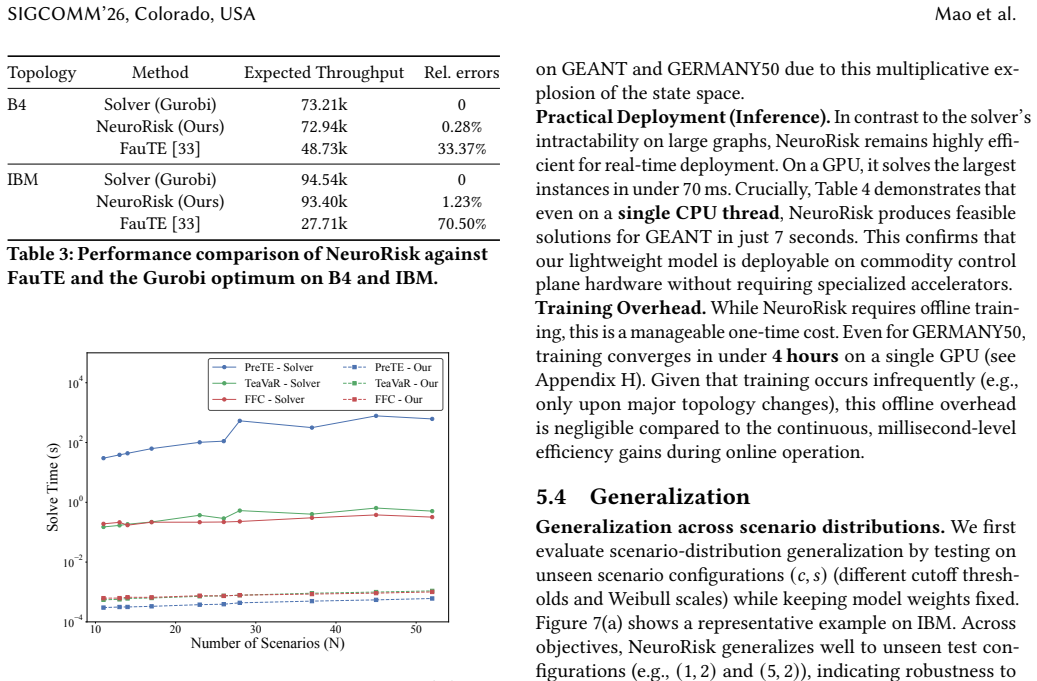
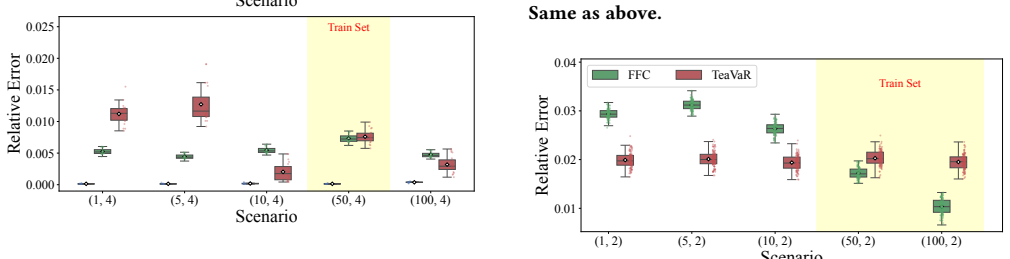
NeuroRisk is a physics-informed deep unrolled optimizer that exploits the Sort-and-Select structure of risk-aware TE. It enforces feasibility via gated edge-local reservations and represents scenario sets through permutation-invariant, gradient-aligned cues. On production-style WANs it achieves small optimality gaps relative to the solver with orders of magnitude speedup (10^2-10^5 ×) on risk objectives while outperforming neural baselines on nominal throughput.
What carries the argument
The Sort-and-Select structure that unifies risk-aware TE formulations, realized inside a neural unrolled optimizer via gated edge-local reservations and permutation-invariant scenario cues.
If this is right
- Risk-aware TE becomes solvable at operational timescales instead of offline batch mode.
- Network operators can reduce safety margins while still meeting availability targets.
- Nominal throughput improves over prior neural TE methods that ignore explicit risk constraints.
- The same gated-reservation and permutation-invariant design pattern applies to any TE variant whose risk model reduces to Sort-and-Select.
Where Pith is reading between the lines
- The same neural unrolling technique could be applied to other selection-structured problems such as virtual network embedding or robust resource allocation under uncertainty.
- Real-time risk-aware routing opens the door to closed-loop systems that continuously adjust reservations as traffic matrices or failure probabilities are observed.
- If the permutation-invariant cues remain effective when scenario counts grow to thousands, the method scales to larger backbone networks without exponential solver blowup.
Load-bearing premise
The Sort-and-Select structure can be faithfully embedded into a neural unrolled optimizer using gated edge-local reservations and permutation-invariant cues so that feasibility is enforced under explicit capacity constraints and scenario-dependent risk.
What would settle it
Run NeuroRisk and an exact solver on the same production-style WAN instance with explicit capacity limits and a fixed set of failure scenarios; if NeuroRisk returns any solution that violates a capacity constraint or selects a suboptimal scenario subset, the embedding claim is falsified.
Figures






read the original abstract
In production Wide-Area Networks (WANs), correlated failures dominate availability losses, forcing operators to reserve large safety margins that leave substantial capacity underutilized. Achieving high utilization under strict availability targets therefore requires risk-aware Traffic Engineering (TE) over dozens to hundreds of probabilistic failure scenarios-yet solving this problem at operational timescales remains elusive. We demonstrate that existing risk-aware formulations can be unified under an embedded Sort-and-Select structure, exposing a fundamental trade-off between expressiveness and tractability: classical optimizers either restrict scenario selection for efficiency or incur prohibitive decomposition costs. While deep learning appears promising, prior Deep TE methods mainly target maximum link utilization and rely on scaling-based feasibility, which fundamentally breaks under explicit capacity constraints and scenario-dependent risk. We present NeuroRisk, a physics-informed deep unrolled optimizer that exploits the structure of Sort-and-Select. NeuroRisk enforces feasibility via gated edge-local reservations and represents scenario sets through permutation-invariant, gradient-aligned cues. Evaluations on production-style WANs show that NeuroRisk achieves small optimality gaps relative to the solver with orders of magnitude speedup $(10^2- 10^5 \times)$ on risk objectives, while outperforming neural baselines on nominal throughput.
Editorial analysis
A structured set of objections, weighed in public.
Referee Report
Summary. The paper claims that risk-aware traffic engineering formulations share an embedded Sort-and-Select structure that trades expressiveness for tractability. It introduces NeuroRisk, a physics-informed unrolled neural optimizer that embeds this structure using gated edge-local reservations to enforce feasibility under explicit capacity constraints and permutation-invariant gradient-aligned cues to represent scenario sets. Evaluations on production-style WANs are reported to yield small optimality gaps versus exact solvers together with speedups of 10^2–10^5× on risk objectives while outperforming prior neural baselines on nominal throughput.
Significance. If the feasibility guarantees and empirical speedups hold, the work would enable operational-scale risk-aware TE that improves utilization under correlated failures without sacrificing availability targets. The structural unification of prior formulations is a useful contribution that could guide future hybrid optimization approaches.
major comments (2)
- [NeuroRisk architecture and feasibility enforcement] The central feasibility claim rests on gated edge-local reservations plus permutation-invariant cues recovering the exact feasible set of the original combinatorial problem under scenario-dependent risk. No derivation, invariant, or post-hoc verification (e.g., maximum capacity violation rates across risk scenarios) is supplied to show that the learned gating provably prevents violations when the unrolling is only approximately aligned with the risk distribution; this directly undermines the risk-aware optimality-gap claims.
- [Experimental evaluation] The evaluation section reports small optimality gaps and large speedups on production-style WANs, yet supplies no concrete details on network sizes, number of probabilistic scenarios, exact solver baselines, feasibility verification procedure, or statistics on capacity violations (e.g., max or 99th-percentile violation rates). Without these, the central empirical claim that NeuroRisk “enforces feasibility” while delivering the stated speedups cannot be assessed.
minor comments (1)
- [Abstract] The abstract states speedups of “10^2-10^5 ×” without indicating whether these are wall-clock times, iteration counts, or per-scenario costs; a brief clarification would improve readability.
Simulated Author's Rebuttal
We thank the referee for the constructive feedback. We agree that the manuscript would benefit from additional details on feasibility enforcement and experimental specifics, and we will revise accordingly to strengthen the presentation of these claims.
read point-by-point responses
-
Referee: [NeuroRisk architecture and feasibility enforcement] The central feasibility claim rests on gated edge-local reservations plus permutation-invariant cues recovering the exact feasible set of the original combinatorial problem under scenario-dependent risk. No derivation, invariant, or post-hoc verification (e.g., maximum capacity violation rates across risk scenarios) is supplied to show that the learned gating provably prevents violations when the unrolling is only approximately aligned with the risk distribution; this directly undermines the risk-aware optimality-gap claims.
Authors: We acknowledge that the current manuscript does not include a formal derivation showing that the gated edge-local reservations exactly recover the feasible set under approximate alignment with the risk distribution. The design relies on local capacity gating to enforce constraints by construction, combined with permutation-invariant cues for scenario representation. In the revision we will add both a short proof sketch of the feasibility invariant under the Sort-and-Select structure and post-hoc empirical verification (maximum and 99th-percentile capacity violation rates across all risk scenarios) to substantiate the zero-violation claim in practice. revision: yes
-
Referee: [Experimental evaluation] The evaluation section reports small optimality gaps and large speedups on production-style WANs, yet supplies no concrete details on network sizes, number of probabilistic scenarios, exact solver baselines, feasibility verification procedure, or statistics on capacity violations (e.g., max or 99th-percentile violation rates). Without these, the central empirical claim that NeuroRisk “enforces feasibility” while delivering the stated speedups cannot be assessed.
Authors: We agree that the experimental section is missing key reproducibility details. The revised manuscript will explicitly report: the network topologies (node/edge counts for each production-style WAN), the exact number of probabilistic failure scenarios per instance, the solver baselines (e.g., Gurobi with the full risk-aware MIP formulation), the feasibility verification procedure (including how capacity violations are measured), and violation statistics (maximum and 99th-percentile rates) confirming that NeuroRisk produces feasible solutions in all reported runs. revision: yes
Circularity Check
No circularity detected in derivation chain
full rationale
The paper presents NeuroRisk as a novel physics-informed unrolled optimizer that identifies and exploits an embedded Sort-and-Select structure in prior risk-aware TE formulations. Feasibility is enforced through a new architectural mechanism (gated edge-local reservations plus permutation-invariant cues) rather than any reduction to fitted parameters, self-citations, or tautological re-derivations. No load-bearing steps reduce by construction to the inputs; the central claims rest on empirical speedups and optimality gaps relative to external solvers and baselines. The derivation is self-contained.
Axiom & Free-Parameter Ledger
free parameters (1)
- neural network weights and hyperparameters
axioms (1)
- domain assumption Existing risk-aware TE formulations can be unified under an embedded Sort-and-Select structure
invented entities (2)
-
gated edge-local reservations
no independent evidence
-
permutation-invariant gradient-aligned cues
no independent evidence
Reference graph
Works this paper leans on
-
[1]
Firas Abuzaid, Srikanth Kandula, Behnaz Arzani, Ishai Menache, Matei Zaharia, and Peter Bailis. 2021. Contracting Wide-area Network Topologies to Solve Flow Problems Quickly. In18th USENIX Sym- posium on Networked Systems Design and Implementation (NSDI 21). USENIX Association, 175–200. https://www.usenix.org/conference/ nsdi21/presentation/abuzaid
work page 2021
-
[2]
Akyildiz, Ahyoung Lee, Pu Wang, Min Luo, and Wu Chou
Ian F. Akyildiz, Ahyoung Lee, Pu Wang, Min Luo, and Wu Chou
-
[3]
A roadmap for traffic engineering in SDN-OpenFlow networks. Comput. Netw.71 (Oct. 2014), 1–30. https://doi.org/10.1016/j.comnet. 2014.06.002
-
[4]
Mohammad Alizadeh, Tom Edsall, Sarang Dharmapurikar, Ramanan Vaidyanathan, Kevin Chu, Andy Fingerhut, Vinh The Lam, Francis Ma- tus, Rong Pan, Navindra Yadav, and George Varghese. 2014. CONGA: distributed congestion-aware load balancing for datacenters. InPro- ceedings of the 2014 ACM Conference on SIGCOMM (SIGCOMM ’14). Association for Computing Machiner...
-
[5]
Rdma over ethernet for distributed training at meta scale,
Abd AlRhman AlQiam, Yuanjun Yao, Zhaodong Wang, Satyajeet Singh Ahuja, Ying Zhang, Sanjay G. Rao, Bruno Ribeiro, and Mohit Tawar- malani. 2024. Transferable Neural WAN TE for Changing Topolo- gies. InProceedings of the ACM SIGCOMM 2024 Conference (ACM SIG- COMM ’24). Association for Computing Machinery, New York, NY, USA, 86–102. https://doi.org/10.1145/3...
-
[6]
David Applegate and Edith Cohen. 2003. Making intra-domain rout- ing robust to changing and uncertain traffic demands: understanding fundamental tradeoffs. InProceedings of the 2003 Conference on Appli- cations, Technologies, Architectures, and Protocols for Computer Com- munications (SIGCOMM ’03). Association for Computing Machinery, New York, NY, USA, 3...
-
[7]
Shivam Arora, Alex Bihlo, and Francis Valiquette. 2024. Invariant physics-informed neural networks for ordinary differential equations. J. Mach. Learn. Res.25, 1, Article 233 (Jan. 2024), 24 pages
work page 2024
-
[8]
Yossi Azar, Edith Cohen, Amos Fiat, Haim Kaplan, and Harald Racke
-
[9]
InProceedings of the Thirty-Fifth Annual ACM Symposium on Theory of Computing (STOC ’03)
Optimal oblivious routing in polynomial time. InProceedings of the Thirty-Fifth Annual ACM Symposium on Theory of Computing (STOC ’03). Association for Computing Machinery, New York, NY, USA, 383–388. https://doi.org/10.1145/780542.780599
-
[10]
Le, Mohammad Norouzi, and Samy Bengio
Irwan Bello, Hieu Pham, Quoc V. Le, Mohammad Norouzi, and Samy Bengio. 2017. Neural Combinatorial Optimization with Reinforcement Learning. In5th International Conference on Learning Representations, ICLR 2017, Toulon, France, April 24-26, 2017, Workshop Track Proceedings. OpenReview.net. https://openreview.net/forum?id=Bk9mxlSFx
work page 2017
-
[11]
Yoshua Bengio, Andrea Lodi, and Antoine Prouvost. 2021. Ma- chine learning for combinatorial optimization: A methodological tour d’horizon.European Journal of Operational Research290, 2 (2021), 405–421. https://doi.org/10.1016/j.ejor.2020.07.063
-
[12]
Theophilus Benson, Ashok Anand, Aditya Akella, and Ming Zhang
-
[13]
MicroTE: fine grained traffic engineering for data centers. InProceedings of the Seventh COnference on Emerging Networking EXperiments and Technologies (CoNEXT ’11). Association for Com- puting Machinery, New York, NY, USA, Article 8, 12 pages. https: //doi.org/10.1145/2079296.2079304
-
[14]
Umair bin Waheed, Ehsan Haghighat, Tariq Alkhalifah, Chao Song, and Qi Hao. 2021. PINNeik: Eikonal solution using physics-informed neural networks.Computers & Geosciences155 (2021), 104833. https: //doi.org/10.1016/j.cageo.2021.104833
-
[15]
Jeremy Bogle, Nikhil Bhatia, Manya Ghobadi, Ishai Menache, Nikolaj Bjørner, Asaf Valadarsky, and Michael Schapira. 2019. TEAVAR: strik- ing the right utilization-availability balance in WAN traffic engineering. 13 SIGCOMM’26, Colorado, USA Mao et al. InProceedings of the ACM Special Interest Group on Data Communi- cation (SIGCOMM ’19). Association for Com...
-
[16]
Luonan Chen and Kazuyuki Aihara. 1995. Chaotic simulated annealing by a neural network model with transient chaos.Neural Networks8, 6 (1995), 915–930. https://doi.org/10.1016/0893-6080(95)00033-V
-
[17]
Khalil, Yuyu Zhang, Bistra Dilkina, and Le Song
Hanjun Dai, Elias B. Khalil, Yuyu Zhang, Bistra Dilkina, and Le Song
-
[18]
Learning Combinatorial Optimization Algorithms over Graphs. (2018). arXiv:cs.LG/1704.01665 https://arxiv.org/abs/1704.01665
work page internal anchor Pith review Pith/arXiv arXiv 2018
-
[19]
B. Fortz and M. Thorup. 2000. Internet traffic engineering by opti- mizing OSPF weights. InProceedings IEEE INFOCOM 2000. Conference on Computer Communications. Nineteenth Annual Joint Conference of the IEEE Computer and Communications Societies (Cat. No.00CH37064), Vol. 2. 519–528 vol.2. https://doi.org/10.1109/INFCOM.2000.832225
-
[20]
Ian Goodfellow, Yoshua Bengio, and Aaron Courville. 2016.Deep Learning. MIT Press. http://www.deeplearningbook.org
work page 2016
-
[21]
Ramesh Govindan, Ina Minei, Mahesh Kallahalla, Bikash Koley, and Amin Vahdat. 2016. Evolve or Die: High-Availability Design Prin- ciples Drawn from Googles Network Infrastructure. InProceedings of the 2016 ACM SIGCOMM Conference (SIGCOMM ’16). Associa- tion for Computing Machinery, New York, NY, USA, 58–72. https: //doi.org/10.1145/2934872.2934891
-
[22]
Karol Gregor and Yann LeCun. 2010. Learning fast approximations of sparse coding. InProceedings of the 27th International Conference on International Conference on Machine Learning (ICML’10). Omnipress, Madison, WI, USA, 399–406
work page 2010
-
[23]
Fei Gui, Songtao Wang, Dan Li, Li Chen, Kaihui Gao, Congcong Min, and Yi Wang. 2024. RedTE: Mitigating Subsecond Traffic Bursts with Real-time and Distributed Traffic Engineering. InProceedings of the ACM SIGCOMM 2024 Conference (ACM SIGCOMM ’24). Association for Computing Machinery, New York, NY, USA, 71–85. https://doi.org/10. 1145/3651890.3672231
-
[24]
Gurobi Optimization, LLC. 2023. Gurobi optimizer reference manual. (2023). https://www.gurobi.com
work page 2023
-
[25]
Chi-Yao Hong, Srikanth Kandula, Ratul Mahajan, Ming Zhang, Vijay Gill, Mohan Nanduri, and Roger Wattenhofer. 2013. Achieving high utilization with software-driven WAN.SIGCOMM Comput. Commun. Rev.43, 4 (Aug. 2013), 15–26. https://doi.org/10.1145/2534169.2486012
-
[26]
Chi-Yao Hong, Subhasree Mandal, Mohammad Al-Fares, Min Zhu, Richard Alimi, Kondapa Naidu B., Chandan Bhagat, Sourabh Jain, Jay Kaimal, Shiyu Liang, Kirill Mendelev, Steve Padgett, Faro Rabe, Saikat Ray, Malveeka Tewari, Matt Tierney, Monika Zahn, Jonathan Zolla, Joon Ong, and Amin Vahdat. 2018. B4 and after: managing hierarchy, partitioning, and asymmetry...
-
[27]
Sushant Jain, Alok Kumar, Subhasree Mandal, Joon Ong, Leon Poutievski, Arjun Singh, Subbaiah Venkata, Jim Wanderer, Junlan Zhou, Min Zhu, Jon Zolla, Urs Hölzle, Stephen Stuart, and Amin Vah- dat. 2013. B4: experience with a globally-deployed software defined wan. InProceedings of the ACM SIGCOMM 2013 Conference on SIG- COMM (SIGCOMM ’13). Association for ...
-
[28]
Chuan Jiang, Zixuan Li, Sanjay Rao, and Mohit Tawarmalani. 2022. Flexile: meeting bandwidth objectives almost always. InProceedings of the 18th International Conference on Emerging Networking EXperiments and Technologies (CoNEXT ’22). Association for Computing Machinery, New York, NY, USA, 110–125. https://doi.org/10.1145/3555050.3569119
-
[29]
Chuan Jiang, Sanjay Rao, and Mohit Tawarmalani. 2020. PCF: Provably Resilient Flexible Routing. InProceedings of the Annual Conference of the ACM Special Interest Group on Data Communication on the Applica- tions, Technologies, Architectures, and Protocols for Computer Commu- nication (SIGCOMM ’20). Association for Computing Machinery, New York, NY, USA, ...
-
[30]
Chuan Jiang, Sanjay G. Rao, and Mohit Tawarmalani. 2021. FloMore: Meeting bandwidth requirements of flows.CoRRabs/2108.03221 (2021). arXiv:2108.03221 https://arxiv.org/abs/2108.03221
-
[31]
Wenjie Jiang, Rui Zhang-Shen, Jennifer Rexford, and Mung Chiang
-
[32]
Cooperative content distribution and traffic engineering in an ISP network. InProceedings of the Eleventh International Joint Conference on Measurement and Modeling of Computer Systems (SIGMETRICS ’09). Association for Computing Machinery, New York, NY, USA, 239–250. https://doi.org/10.1145/1555349.1555377
-
[33]
Srikanth Kandula, Dina Katabi, Bruce Davie, and Anna Charny. 2005. Walking the tightrope: responsive yet stable traffic engineering.SIG- COMM Comput. Commun. Rev.35, 4 (Aug. 2005), 253–264. https: //doi.org/10.1145/1090191.1080122
-
[34]
2018.Combinatorial Optimization: Theory and Algorithms(6th ed.)
Bernhard Korte and Jens Vygen. 2018.Combinatorial Optimization: Theory and Algorithms(6th ed.). Springer Publishing Company, Incor- porated
work page 2018
-
[35]
Praveen Kumar, Yang Yuan, Chris Yu, Nate Foster, Robert Kleinberg, Petr Lapukhov, Chiun Lin Lim, and Robert Soulé. 2018. Semi-Oblivious Traffic Engineering: The Road Not Taken. In15th USENIX Sympo- sium on Networked Systems Design and Implementation (NSDI 18). USENIX Association, Renton, WA, 157–170. https://www.usenix.org/ conference/nsdi18/presentation/kumar
work page 2018
-
[36]
Ximing Lian and Liao Chen. 2026. Gaussian Causal Physics-Informed Neural Networks. InProceedings of the 2025 3rd International Conference on Mathematics and Machine Learning (ICMML ’25). Association for Computing Machinery, New York, NY, USA, 193–199. https://doi.org/ 10.1145/3783779.3783812
-
[37]
Hongqiang Harry Liu, Srikanth Kandula, Ratul Mahajan, Ming Zhang, and David Gelernter. 2014. Traffic engineering with forward fault cor- rection.SIGCOMM Comput. Commun. Rev.44, 4 (Aug. 2014), 527–538. https://doi.org/10.1145/2740070.2626314
-
[38]
Xiyuan Liu, Yang Liu, Jingyi Cheng, Ximeng Liu, and Shizhen Zhao
-
[39]
InProceedings of the 9th Asia-Pacific Workshop on Networking (APNET ’25)
FauTE: Fault-tolerant Traffic Engineering in Data Center Net- work. InProceedings of the 9th Asia-Pacific Workshop on Networking (APNET ’25). Association for Computing Machinery, New York, NY, USA, 214–219. https://doi.org/10.1145/3735358.3735364
-
[40]
Ximeng Liu, Shizhen Zhao, Yong Cui, and Xinbing Wang. 2024. FI- GRET: Fine-Grained Robustness-Enhanced Traffic Engineering. InPro- ceedings of the ACM SIGCOMM 2024 Conference (ACM SIGCOMM ’24). Association for Computing Machinery, New York, NY, USA, 117–135. https://doi.org/10.1145/3651890.3672258
-
[41]
Ximeng Liu, Shizhen Zhao, and Xinbing Wang. 2025. Geminet: Learn- ing the Duality-based Iterative Process for Lightweight Traffic En- gineering in Changing Topologies. (2025). arXiv:cs.NI/2506.23640 https://arxiv.org/abs/2506.23640
work page internal anchor Pith review Pith/arXiv arXiv 2025
-
[42]
Yingming Mao, Qiaozhu Zhai, Ximeng Liu, Zhen Yao, Xia Zhu, and Yuzhou Zhou. 2025. A Fast Solver-Free Algorithm for Traffic Engi- neering in Large-Scale Data Center Network. (Dec. 2025). https: //doi.org/10.48550/arXiv.2504.04027 arXiv:cs/2504.04027
-
[43]
Robin Matzner, Akanksha Ahuja, Rasoul Sadeghi, Michael Doherty, Alejandra Beghelli, Seb J. Savory, and Polina Bayvel. 2025. Topology Bench: systematic graph-based benchmarking for core optical net- works.Journal of Optical Communications and Networking17, 1 (2025), 7–27. https://doi.org/10.1364/JOCN.534477
-
[44]
Congcong Miao, Zhizhen Zhong, Yiren Zhao, Arpit Gupta, Ying Zhang, Sirui Li, Zekun He, Xianneng Zou, and Jilong Wang. 2025. PreTE: Traffic Engineering with Predictive Failures. InProceedings of the ACM SIGCOMM 2025 Conference (SIGCOMM ’25). Association for Computing 14 NeuroRisk: Physics-Informed Neural Optimization for Risk-Aware Traffic Engineering SIGC...
-
[45]
Yarin Perry, Felipe Vieira Frujeri, Chaim Hoch, Srikanth Kandula, Ishai Menache, Michael Schapira, and Aviv Tamar. 2023. DOTE: Rethinking (Predictive) WAN Traffic Engineering. In20th USENIX Symposium on Networked Systems Design and Implementation (NSDI 23). USENIX Asso- ciation, Boston, MA, 1557–1581. https://www.usenix.org/conference/ nsdi23/presentation/perry
work page 2023
-
[46]
M. Raissi, P. Perdikaris, and G.E. Karniadakis. 2019. Physics-informed neural networks: A deep learning framework for solving forward and inverse problems involving nonlinear partial differential equations.J. Comput. Phys.378 (2019), 686–707. https://doi.org/10.1016/j.jcp.2018. 10.045
-
[47]
Tyrrell Rockafellar and Stanislav Uryasev
R. Tyrrell Rockafellar and Stanislav Uryasev. 2000. Optimization of conditional value-at risk.Journal of Risk3 (2000), 21–41. https://api. semanticscholar.org/CorpusID:854622
work page 2000
-
[48]
Matthew Roughan, Albert Greenberg, Charles Kalmanek, Michael Rumsewicz, Jennifer Yates, and Yin Zhang. 2002. Experience in mea- suring backbone traffic variability: models, metrics, measurements and meaning. InProceedings of the 2nd ACM SIGCOMM Workshop on Internet Measurment (IMW ’02). Association for Computing Machinery, New York, NY, USA, 91–92. https:...
-
[49]
Ke Tang and Xin Yao. 2024. Learn to Optimize—a Brief Overview. National Science Review11, 8 (April 2024), nwae132. https://doi. org/10.1093/nsr/nwae132 arXiv:https://academic.oup.com/nsr/article- pdf/11/8/nwae132/58527001/nwae132.pdf
-
[50]
Oriol Vinyals, Meire Fortunato, and Navdeep Jaitly. 2015. Pointer networks. InProceedings of the 29th International Conference on Neu- ral Information Processing Systems - Volume 2 (NIPS’15). MIT Press, Cambridge, MA, USA, 2692–2700
work page 2015
-
[51]
Hao Wang, Haiyong Xie, Lili Qiu, Yang Richard Yang, Yin Zhang, and Albert Greenberg. 2006. COPE: traffic engineering in dynamic networks.SIGCOMM Comput. Commun. Rev.36, 4 (Aug. 2006), 99–110. https://doi.org/10.1145/1151659.1159926
-
[52]
Zhiying Xu, Francis Y. Yan, Rachee Singh, Justin T. Chiu, Alexander M. Rush, and Minlan Yu. 2023. Teal: Learning-Accelerated Optimization of WAN Traffic Engineering. InProceedings of the ACM SIGCOMM 2023 Conference (ACM SIGCOMM ’23). Association for Computing Machinery, New York, NY, USA, 378–393. https://doi.org/10.1145/ 3603269.3604857
-
[53]
yan yang, Jian Sun, Huibin Li, and Zongben Xu. 2016. Deep ADMM-Net for Compressive Sensing MRI. InAdvances in Neural Information Processing Systems, D. Lee, M. Sugiyama, U. Luxburg, I. Guyon, and R. Garnett (Eds.), Vol. 29. Curran Associates, Inc. https://proceedings.neurips.cc/paper_files/paper/2016/file/ 1679091c5a880faf6fb5e6087eb1b2dc-Paper.pdf
work page 2016
-
[54]
Zhizhen Zhong, Manya Ghobadi, Alaa Khaddaj, Jonathan Leach, Yiting Xia, and Ying Zhang. 2021. ARROW: restoration-aware traffic engi- neering. InProceedings of the 2021 ACM SIGCOMM 2021 Conference (SIGCOMM ’21). Association for Computing Machinery, New York, NY, USA, 560–579. https://doi.org/10.1145/3452296.3472921 APPENDIX A FULL NOTATION To facilitate a ...
discussion (0)
Sign in with ORCID, Apple, or X to comment. Anyone can read and Pith papers without signing in.