Recognition: unknown
Ultrafast wide-field 3D topography with extended depth of field
Pith reviewed 2026-05-14 18:54 UTC · model grok-4.3
The pith
A telecentric interferometric microscope extends depth of field to 18 micrometers for single-frame ultrafast 3D topography.
A machine-rendered reading of the paper's core claim, the machinery that carries it, and where it could break.
Core claim
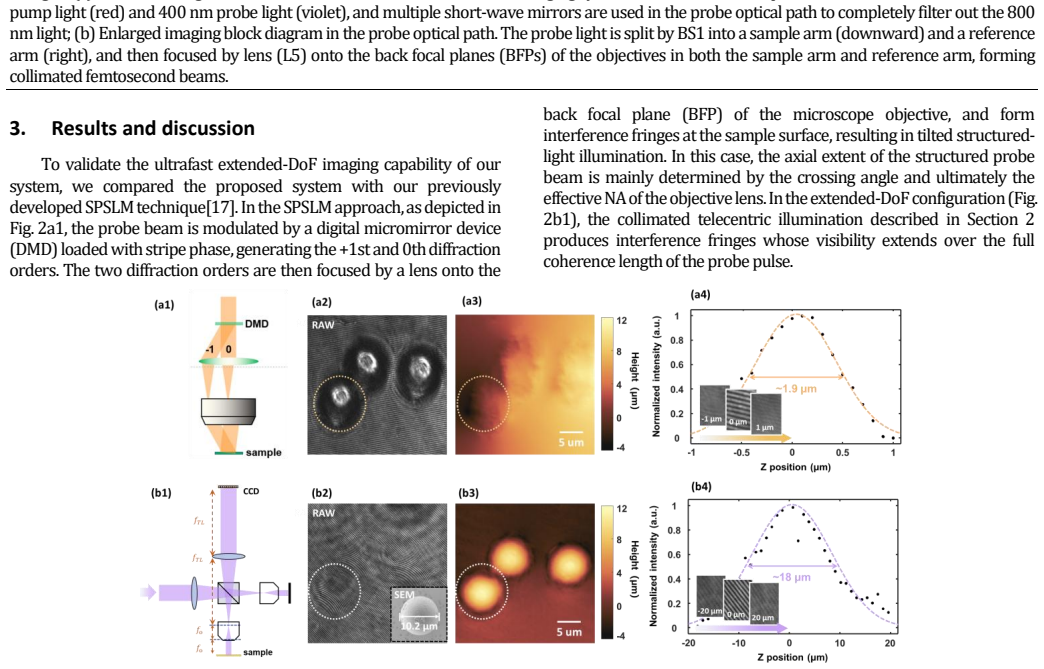
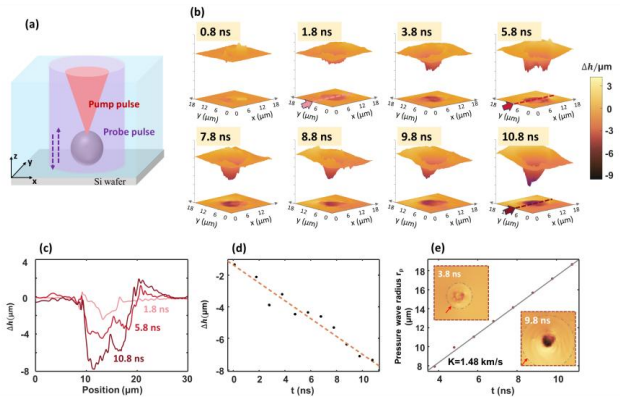
The authors establish that an ultrafast wide-field pump-probe interferometric microscope on a telecentric platform can extend the effective depth of field to approximately 18 micrometers at a high numerical aperture of 0.9. This is achieved while maintaining a spatial resolution down to 235 nanometers and a temporal resolution of about 170 femtoseconds. The configuration supports single-frame 3D topography reconstruction without axial scanning or multi-view acquisition, as shown in experiments tracking axial material flow during laser-induced microsphere melting and azimuthal rotation of ablation lobes in temporal focused spatiotemporal optical vortex pulses.
What carries the argument
Telecentric platform combined with pump-probe interferometry for single-frame phase-based 3D reconstruction.
If this is right
- Ultrafast dynamics involving axial motion can now be observed in 3D at high resolution without scanning hardware.
- Interactions between spatiotemporal optical vortices and matter can be tracked in three dimensions over time.
- Single-frame acquisition simplifies experimental setups for pump-probe studies of surface evolution.
- Effective imaging range increases significantly for high-NA objectives without sacrificing resolution.
Where Pith is reading between the lines
- Similar telecentric designs could be adapted for other types of interferometric or holographic imaging to extend DoF.
- This may open paths to studying 3D ultrafast processes in fields like plasma physics or microfabrication monitoring.
- Reducing the reliance on mechanical scanning could improve speed and stability in time-resolved microscopy experiments.
Load-bearing premise
The phase information extracted from the single-frame interferograms on the telecentric platform uniquely determines the 3D topography heights across the extended depth range without ambiguity or significant artifacts.
What would settle it
A direct comparison of single-frame topography maps against reference measurements obtained by conventional axial scanning on the same dynamic sample, where large discrepancies or missing features in the single-frame results would disprove the accuracy of the extended DoF reconstruction.
Figures


read the original abstract
Ultrafast optical imaging has enabled direct observation of femtosecond-nanosecond dynamics, yet three-dimensional (3D) dynamic measurements at high numerical aperture (NA) remain hindered by the intrinsically shallow depth of field (DoF) of conventional microscopes. Here, we propose an ultrafast, wide-field pump-probe interferometric microscope on a telecentric platform that significantly extends the effective DoF to ~18 micrometer at a high NA of 0.9 while maintaining high spatial resolution (down to 235 nm) and temporal resolution (~170 fs). The system enables single-frame 3D topography reconstruction without axial scanning or multi-view acquisition. We demonstrate these capabilities by capturing axial material flow during laser-induced microsphere melting that remain unobservable with conventional narrow-DoF systems, and by tracking the azimuthal rotation of ablation lobes during axial propagation of temporal focused spatiotemporal optical vortex (TF-STOV) pulses, directly revealing the spatiotemporal evolution of STOV-matter interactions
Editorial analysis
A structured set of objections, weighed in public.
Referee Report
Summary. The manuscript presents an ultrafast pump-probe interferometric microscope on a telecentric platform that extends the effective depth of field to ~18 μm at NA=0.9 while preserving spatial resolution down to 235 nm and temporal resolution of ~170 fs. It enables single-frame 3D topography reconstruction without axial scanning and demonstrates this capability through observations of axial material flow during laser-induced microsphere melting and azimuthal rotation of ablation lobes in TF-STOV pulses.
Significance. If the reconstruction accuracy holds, the work would represent a meaningful advance in ultrafast 3D optical imaging by overcoming the shallow DoF limitation of high-NA systems, enabling direct observation of dynamic axial processes in a single frame. The telecentric interferometric approach and its application to non-reproducible ultrafast events are strengths that could influence pump-probe microscopy techniques.
major comments (2)
- [Results (microsphere melting and TF-STOV demonstrations)] The central claim of accurate single-frame 3D topography recovery across the full ~18 μm DoF at NA=0.9 lacks quantitative support. The results sections on microsphere melting and TF-STOV lobe rotation provide only qualitative images; no RMS height error, direct comparison to axial-scanned ground truth, or simulation of the phase-extraction pipeline on calibrated 3D targets spanning the claimed DoF is reported, leaving open the possibility of artifacts precisely where the DoF extension is asserted.
- [Methods (interferometric reconstruction and phase extraction)] The interferometric reconstruction method must handle steep axial phase gradients (~λ/NA per μm at NA=0.9). The methods section does not supply explicit details, equations, or validation of the phase retrieval algorithm (e.g., carrier-frequency filtering or reference subtraction) regarding unwrapping robustness, contrast preservation, or resolution retention across the extended DoF.
minor comments (2)
- [Abstract] The abstract states spatial resolution 'down to 235 nm' and temporal resolution '~170 fs' without clarifying whether these are best-case, average, or field-dependent values; adding this distinction would improve precision.
- [Figure captions and introduction] Figure captions and text could more explicitly state the conventional DoF value at NA=0.9 for direct comparison with the claimed ~18 μm extension.
Simulated Author's Rebuttal
We thank the referee for their thorough review and constructive feedback on our manuscript. We address each major comment below and have made revisions to strengthen the quantitative validation and methodological details.
read point-by-point responses
-
Referee: [Results (microsphere melting and TF-STOV demonstrations)] The central claim of accurate single-frame 3D topography recovery across the full ~18 μm DoF at NA=0.9 lacks quantitative support. The results sections on microsphere melting and TF-STOV lobe rotation provide only qualitative images; no RMS height error, direct comparison to axial-scanned ground truth, or simulation of the phase-extraction pipeline on calibrated 3D targets spanning the claimed DoF is reported, leaving open the possibility of artifacts precisely where the DoF extension is asserted.
Authors: We agree that quantitative validation strengthens the central claim. In the revised manuscript, we have added RMS height error metrics from comparisons against axial-scanned ground truth on calibrated 3D targets spanning the full ~18 μm DoF. We also include simulations of the phase-extraction pipeline demonstrating reconstruction fidelity and artifact suppression across the extended depth range. These additions are placed in the Results section alongside the microsphere melting and TF-STOV demonstrations. revision: yes
-
Referee: [Methods (interferometric reconstruction and phase extraction)] The interferometric reconstruction method must handle steep axial phase gradients (~λ/NA per μm at NA=0.9). The methods section does not supply explicit details, equations, or validation of the phase retrieval algorithm (e.g., carrier-frequency filtering or reference subtraction) regarding unwrapping robustness, contrast preservation, or resolution retention across the extended DoF.
Authors: We acknowledge the need for greater methodological transparency. The revised Methods section now includes explicit equations for the carrier-frequency filtering, reference subtraction, and phase unwrapping steps. We have added simulation-based validation showing robustness to steep axial phase gradients at NA=0.9, along with metrics for contrast preservation and spatial resolution retention over the extended DoF. These details directly address the handling of phase gradients in the telecentric interferometric reconstruction. revision: yes
Circularity Check
No circularity detected; experimental method relies on standard interferometry without self-referential derivations
full rationale
The manuscript describes an experimental telecentric pump-probe interferometric microscope for single-frame 3D topography. No equations, parameter fits, or derivation chains appear in the provided text that reduce a claimed prediction or result to its own inputs by construction. The DoF extension to ~18 μm at NA 0.9 is presented as an engineering outcome of the platform geometry, validated through qualitative demonstrations (microsphere melting, TF-STOV rotation) rather than any fitted or self-cited uniqueness theorem. Self-citations, if present, are not load-bearing for the central reconstruction claim. The approach remains self-contained against external benchmarks of interferometric phase extraction.
Axiom & Free-Parameter Ledger
axioms (1)
- domain assumption Interferometric phase data from the telecentric platform can be inverted to accurate 3D topography across the full extended DoF in a single frame
Reference graph
Works this paper leans on
-
[1]
C. Jin, Y. Xu, D. Qi, et al., "Single-shot intensity-and phase-sensitive compressive sensing-based coherent modulation ultrafast imaging," Phys. Rev. Lett. 132(17), 173801 (2024)
work page 2024
-
[2]
High-frequency enhanced ultrafast compressed active photography,
Y. Meng, Y. Lu, P. Zhang, et al., "High-frequency enhanced ultrafast compressed active photography," Opto-Electron Adv. 8(1), 240180- 240181-240180-240112 (2025)
work page 2025
-
[3]
Q. Wei, J. Ni, Y. Zhang, et al., "Dual-modal spatiotemporal imaging of ultrafast dynamics in laser-induced periodic surface structures," Light: Advanced Manufacturing 6(1), 1-11 (2025)
work page 2025
-
[4]
P.-T. Lyu, Q.-Y. Li, P. Wu, et al., "Decrypting material performance by wide-field femtosecond interferometric imaging of energy carrier evolution," J. Am. Chem. Soc. 144(30), 13928-13937 (2022)
work page 2022
-
[5]
High ambipolar mobility in cubic boron arsenide revealed by transient reflectivity microscopy,
S. Yue, F. Tian, X. Sui, et al., "High ambipolar mobility in cubic boron arsenide revealed by transient reflectivity microscopy," Science 377(6604), 433-436 (2022)
work page 2022
-
[6]
High-sensitivity visualization of ultrafast carrier diffusion by wide-field holographic microscopy,
M. Hörmann, F. Visentin, A. Zanetta, et al., "High-sensitivity visualization of ultrafast carrier diffusion by wide-field holographic microscopy," Ultrafast Science 3(0032) (2023)
work page 2023
-
[7]
Ultrafast quasi-three-dimensional imaging,
Y. Lian, L. Jiang, J. Sun, et al., "Ultrafast quasi-three-dimensional imaging," Int. J. Extreme Manuf. 5(4), 045601 (2023)
work page 2023
-
[8]
L. Mazzella, T. Mangeat, G. Giroussens, et al., "Extended-depth of field random illumination microscopy, EDF-RIM, provides super-resolved projective imaging," Light-Sci. Appl. 13(1), 285 (2024)
work page 2024
-
[9]
Miniaturized universal imaging device using fluidic lens,
F. S. Tsai, S. H. Cho, Y.-H. Lo, et al., "Miniaturized universal imaging device using fluidic lens," Opt. lett. 33(3), 291-293 (2008)
work page 2008
-
[10]
Extended depth-of- field microscopy with a high-speed deformable mirror,
W. J. Shain, N. A. Vickers, B. B. Goldberg, et al., "Extended depth-of- field microscopy with a high-speed deformable mirror," Opt. Lett.42(5), 995-998 (2017)
work page 2017
-
[11]
Optical-resolution photoacoustic microscopy with a needle-shaped beam,
R. Cao, J. Zhao, L. Li, et al., "Optical-resolution photoacoustic microscopy with a needle-shaped beam," Nat. photonics 17(1), 89-95 (2023)
work page 2023
-
[12]
S. Lin, L. Gong, and Z. Huang, "Super‐resolution two‐photon fluorescence tomography through the phase‐shifted optical beatings of bessel beams for high‐resolution deeper tissue 3D imaging," Laser Photonics Rev. 18(2), 2300634 (2024)
work page 2024
-
[13]
Large depth-of-field ultraviolet-visible photoacoustic histologic and microvascular imaging in vivo,
W. Song, Y. Yang, D. Xie, et al., "Large depth-of-field ultraviolet-visible photoacoustic histologic and microvascular imaging in vivo," Appl. Phys. Lett. 125(20), 203702 (2024)
work page 2024
-
[14]
Y. Wu, Y. Rivenson, Y. Zhang, et al., "Extended depth-of-field in holographic imaging using deep-learning-based autofocusing and phase recovery," Optica 5(6), 704-710 (2018)
work page 2018
-
[15]
Simultaneous whole- animal 3D imaging of neuronal activity using light-field microscopy,
R. Prevedel, Y.-G. Yoon, M. Hoffmann, et al., "Simultaneous whole- animal 3D imaging of neuronal activity using light-field microscopy," Nat. methods 11(7), 727-730 (2014)
work page 2014
-
[16]
EventLFM: event camera integrated Fourier light field microscopy for ultrafast 3D imaging,
R. Guo, Q. Yang, A. S. Chang, et al., "EventLFM: event camera integrated Fourier light field microscopy for ultrafast 3D imaging," Light-Sci. Appl. 13(1), 144 (2024)
work page 2024
-
[17]
J. Xu, C. Min, Y. Zhang, et al., "Imaging ultrafast evolution of subwavelength-sized topography using single-probe structured light microscopy," Photonics Res. 10(8), 1900-1908 (2022)
work page 1900
-
[18]
Fourier transform profilometry for the automatic measurement of 3-D object shapes,
M. Takeda and K. Mutoh, "Fourier transform profilometry for the automatic measurement of 3-D object shapes," Appl. Optics 22(24), 3977-3982 (1983)
work page 1983
-
[19]
W. Chen, S. Feng, W. Yin, et al., "Deep-learning-enabled temporally super-resolved multiplexed fringe projection profilometry: high-speed kHz 3D imaging with low-speed camera," PhotoniX 5(1), 25 (2024)
work page 2024
-
[20]
W. Yin, H. Zhao, Y. Ji, et al., "High-resolution, wide-field-of-view, and real-time 3D imaging based on spatial-temporal speckle projection profilometry with a VCSEL projector array," ACS Photonics 11(2), 498- 511 (2024)
work page 2024
-
[21]
Plasmonic-thermoelectric nanotweezers for immersive SERS mapping,
X. Wang, Y. Zhang, J. Yu, et al., "Plasmonic-thermoelectric nanotweezers for immersive SERS mapping," ACS Nano 16(11), 18621- 18629 (2022)
work page 2022
-
[22]
J. Ni, Q. Wei, Y. Zhang, et al., "Super-resolution three-dimensional structured illumination profilometry for in situ measurement of femtosecond laser ablation morphology," APL Photonics 8(10), 101302 (2023)
work page 2023
-
[23]
Femtosecond laser produced periodic plasma in a colloidal crystal probed by XFEL radiation,
Mukharamova, N., Lazarev, S., Meijer, JM. et al. " Femtosecond laser produced periodic plasma in a colloidal crystal probed by XFEL radiation," Sci. Rep. 10, 10780 (2020)
work page 2020
-
[24]
Comparison of ultrashort pulse ablation of gold in air and water by time-resolved experiments
Spellauge, M., Doñate-Buendí a, C., Barcikowski, S. et al. "Comparison of ultrashort pulse ablation of gold in air and water by time-resolved experiments. " Light-Sci. Appl. 11, 68 (2022)
work page 2022
-
[25]
Optical spatiotemporal vortices,
C. Wan, A. Chong, and Q. Zhan, "Optical spatiotemporal vortices," eLight 3(1), 11 (2023)
work page 2023
-
[26]
A. Y. Bekshaev, Spatiotemporal optical vortices: principles of description and basic properties. APL Photonics 9, 110806 (2024)
work page 2024
-
[27]
Temporal Focusing Enables Distortion- Resistant high-intensity Spatiotemporal Optical Vortices
J. Ni, Y. Zhang, Q. Wei, et al., “Temporal Focusing Enables Distortion- Resistant high-intensity Spatiotemporal Optical Vortices”, arXiv preprint arXiv:2603.25154
discussion (0)
Sign in with ORCID, Apple, or X to comment. Anyone can read and Pith papers without signing in.