Recognition: unknown
Magical Touch: Transforming Raw Capacitive Streams into Expressive Hand-Touchscreen Interaction
Pith reviewed 2026-05-14 18:54 UTC · model grok-4.3
The pith
Raw capacitive data from standard touchscreens can drive natural interaction with arbitrary hand gestures and varying pressure.
A machine-rendered reading of the paper's core claim, the machinery that carries it, and where it could break.
Core claim
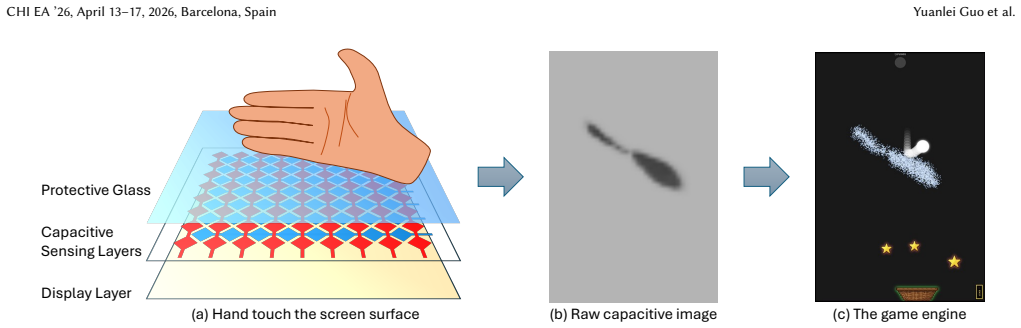
By directly integrating raw touchscreen sensor data into the interaction loop, Magical Touch allows users to interact with the screen naturally and efficiently using arbitrary hand gestures on existing touchscreen devices, demonstrated by a physics-based interactive game in which digital objects respond in real time to both the geometry and contact intensity of the user's hand across single-player, multiplayer collaborative, and pressure-sensitive modes.
What carries the argument
Raw capacitive sensing streams fed directly into real-time interaction logic to extract hand geometry and contact intensity without standard filtering.
If this is right
- Digital objects can respond continuously to hand shape and pressure instead of discrete fingertip events.
- Single-player, collaborative multiplayer, and pressure-sensitive game modes become feasible on unmodified hardware.
- Touchscreen design space expands to embodied, continuous input beyond fingertip-only paradigms.
Where Pith is reading between the lines
- Drawing or manipulation apps could adopt whole-hand input for more natural scaling or rotation controls.
- The same raw-data pipeline could be tested on different touchscreen models to check cross-device consistency without per-device calibration.
- Accessibility tools might let users with limited dexterity choose comfortable hand postures that still produce reliable input.
Load-bearing premise
Raw capacitive readings already contain stable, sufficient information about arbitrary hand geometry and contact intensity to support reliable real-time interaction without extra calibration or hardware changes.
What would settle it
Repeated trials of the same hand posture on the same device produce inconsistent object responses in the physics game because of noise or drift in the raw capacitive values.
Figures


read the original abstract
Modern touchscreens utilize capacitive sensing technology to enable precise and robust multi-touch interaction. However, the broader expressive potential of the human hand remains underutilized, since most existing methods directly filter out larger-area hand-screen contact. This paper introduces Magical Touch, an interaction method based on raw capacitive sensing data. By directly integrating raw touchscreen sensor data into the interaction loop, our method allows users to interact with the screen naturally and efficiently using arbitrary hand gestures on existing touchscreen devices. To demonstrate the feasibility and expressive capacity of this approach, we implement a physics-based interactive game featuring single-player, multiplayer collaborative, and pressure-sensitive modes. These scenarios showcase how digital objects can respond in real-time to both the geometry and contact intensity of the user's hand. Our results indicate that leveraging raw capacitive data can expand the design space of touchscreen interaction, offering an embodied and continuous interaction paradigm beyond existing fingertip-based approaches.
Editorial analysis
A structured set of objections, weighed in public.
Referee Report
Summary. The paper introduces Magical Touch, an interaction technique that uses raw capacitive sensor streams from unmodified touchscreens to support expressive, arbitrary hand gestures rather than filtering them out. Feasibility is demonstrated via a physics-based game with single-player, multiplayer collaborative, and pressure-sensitive modes in which digital objects respond in real time to hand geometry and contact intensity.
Significance. If the core assumption holds, the work could meaningfully enlarge the design space of touchscreen interaction by moving beyond fingertip-only models toward continuous, embodied hand-based input on commodity hardware. The absence of quantitative validation, however, leaves the practical significance and generalizability unclear.
major comments (2)
- Abstract and Results sections: the central claim that raw capacitive readings directly supply stable, device-independent information about arbitrary hand geometry and contact intensity is not accompanied by any quantitative metrics (accuracy, latency, cross-device consistency, or error rates), which is load-bearing for the feasibility assertion.
- Implementation/Method description: no account is given of how raw electrode values are mapped to geometry and intensity estimates, nor of any per-device or per-user normalization steps; this leaves open the question of whether the approach truly operates without calibration as stated.
minor comments (1)
- Abstract: the phrase 'our results indicate' should be replaced by a concrete summary of observed behavior once quantitative data are added.
Simulated Author's Rebuttal
We thank the referee for the constructive feedback. We address each major comment below and indicate where revisions will be made to strengthen the manuscript.
read point-by-point responses
-
Referee: [—] Abstract and Results sections: the central claim that raw capacitive readings directly supply stable, device-independent information about arbitrary hand geometry and contact intensity is not accompanied by any quantitative metrics (accuracy, latency, cross-device consistency, or error rates), which is load-bearing for the feasibility assertion.
Authors: We agree that quantitative metrics would strengthen the claims of stability and device-independence. The current manuscript presents the work as a proof-of-concept demonstration, with feasibility shown through real-time interaction in the physics game where objects respond continuously to hand geometry and contact intensity. Because no formal accuracy or error-rate data were collected, we cannot add such metrics without new experiments. In revision we will add a short paragraph in the results section describing observed latency (sub-frame response) and consistent behavior across the two devices used for development and testing, while clearly framing these as qualitative observations rather than validated metrics. revision: partial
-
Referee: [—] Implementation/Method description: no account is given of how raw electrode values are mapped to geometry and intensity estimates, nor of any per-device or per-user normalization steps; this leaves open the question of whether the approach truly operates without calibration as stated.
Authors: The referee is correct that the current method description is high-level. We will revise the implementation section to include a concise processing pipeline: raw electrode capacitance values are read directly from the touchscreen driver; hand geometry is estimated from the spatial distribution and connectivity of high-capacitance electrodes; contact intensity is computed from the aggregate magnitude of capacitance change across the contact area. No per-user or per-device normalization is applied; the method uses relative changes within each frame and has been shown to function on unmodified commodity devices without calibration steps. revision: yes
Circularity Check
No circularity; direct sensor integration demonstrated via implementation
full rationale
The paper claims that raw capacitive streams can be integrated directly into interaction loops for arbitrary hand gestures, demonstrated through a physics-based game with real-time response to geometry and intensity. No equations, fitted parameters, self-citations, or uniqueness theorems appear in the provided text that would reduce any prediction to an input by construction. The approach is presented as an empirical method on unmodified hardware, with feasibility shown by application rather than derived from prior fitted results or self-referential definitions. This is self-contained against external benchmarks.
Axiom & Free-Parameter Ledger
axioms (1)
- domain assumption Raw capacitive sensor data contains usable information about hand geometry and contact intensity
Reference graph
Works this paper leans on
-
[1]
Karan Ahuja, Paul Streli, and Christian Holz. 2021. TouchPose: hand pose pre- diction, depth estimation, and touch classification from capacitive images. In The 34th Annual ACM Symposium on User Interface Software and Technology. 997–1009. doi:10.1145/3472749.3474801
-
[2]
Robert A Boie. 1984. Capacitive impedance readout tactile image sensor. In Proceedings. 1984 IEEE International Conference on Robotics and Automation, Vol. 1. Magical Touch: Transforming Raw Capacitive Streams into Expressive Hand-Touchscreen Interaction CHI EA ’26, April 13–17, 2026, Barcelona, Spain IEEE, 370–378. doi:10.1109/ROBOT.1984.1087186
-
[3]
Frederick Choi, Sven Mayer, and Chris Harrison. 2021. 3D hand pose estimation on conventional capacitive touchscreens. InProceedings of the 23rd International Conference on Mobile Human-Computer Interaction. 1–13. doi:10.1145/3447526. 3472045
-
[4]
Paul Dietz and Darren Leigh. 2001. DiamondTouch: a multi-user touch technology. InProceedings of the 14th annual ACM symposium on User interface software and technology. 219–226. doi:10.1145/502348.502389
-
[5]
Zeyuan Huang, Cangjun Gao, Haiyan Wang, Xiaoming Deng, Yu-Kun Lai, Cuixia Ma, Sheng-feng Qin, Yong-Jin Liu, and Hongan Wang. 2024. SpeciFingers: Finger Identification and Error Correction on Capacitive Touchscreens.Proceedings of the ACM on Interactive, Mobile, Wearable and Ubiquitous Technologies8, 1 (2024), 1–28. doi:10.1145/3643559
-
[6]
George S. Hurst and James E. Parks. 1970. Electrical sensor of plane coordinates. US Patent US3662105A
work page 1970
-
[7]
Huy Viet Le, Thomas Kosch, Patrick Bader, Sven Mayer, and Niels Henze. 2018. PalmTouch: Using the Palm as an Additional Input Modality on Commodity Smartphones. InProceedings of the 2018 CHI conference on human factors in computing systems. ACM. doi:10.1145/3173574.3173934
- [8]
-
[9]
Mohamed GA Mohamed, Tae-Won Cho, and HyungWon Kim. 2014. Efficient multi-touch detection algorithm for large touch screen panels.IEIE Transactions on Smart Processing and Computing3, 4 (2014), 246–250. doi:10.5573/IEIESPC. 2014.3.4.246
-
[10]
Andreas K Orphanides and Chang S Nam. 2017. Touchscreen interfaces in context: A systematic review of research into touchscreens across settings, populations, and implementations.Applied ergonomics61 (2017), 116–143. doi:10.1016/j.apergo. 2017.01.013
-
[11]
Jun Rekimoto. 2002. SmartSkin: an infrastructure for freehand manipulation on interactive surfaces. InProceedings of the SIGCHI conference on Human factors in computing systems. 113–120. doi:10.1145/503376.503397
- [12]
-
[13]
Martin Schmitz, Florian Müller, Max Mühlhäuser, Jan Riemann, and Huy Viet Le
-
[14]
InProceedings of the 2021 CHI Conference on Human Factors in Computing Systems
Itsy-bits: Fabrication and recognition of 3d-printed tangibles with small footprints on capacitive touchscreens. InProceedings of the 2021 CHI Conference on Human Factors in Computing Systems. 1–12. doi:10.1145/3411764.3445502
-
[15]
Robin Schweigert, Jan Leusmann, Simon Hagenmayer, Maximilian Weiß, Huy Viet Le, Sven Mayer, and Andreas Bulling. 2019. KnuckleTouch: Enabling Knuckle Gestures on Capacitive Touchscreens using Deep Learning. InProceed- ings of Mensch und Computer 2019. ACM, 387–397. doi:10.1145/3340764.3340767
-
[16]
Benedict Steuerlein and Sven Mayer. 2022. Conductive fiducial tangibles for everyone: A data simulation-based toolkit using deep learning.Proceedings of the ACM on Human-Computer Interaction6, MHCI (2022), 1–22. doi:10.1145/3546718
-
[17]
1999.Hand tracking, finger identification, and chordic manip- ulation on a multi-touch surface
Wayne Westerman. 1999.Hand tracking, finger identification, and chordic manip- ulation on a multi-touch surface. University of Delaware
work page 1999
-
[18]
Xinliang Yang, Yuzhuo Wu, Shuang Liu, Kun Ji, and Da Tao. 2025. Interaction with large-screen displays: A comparison of freehand and device-assisted interactions under varied postures and user-to-display distances.International Journal of Industrial Ergonomics110 (2025), 103826. doi:10.1016/j.ergon.2025.103826
discussion (0)
Sign in with ORCID, Apple, or X to comment. Anyone can read and Pith papers without signing in.