Recognition: no theorem link
The mapping index through the lens of the cross-index
Pith reviewed 2026-05-14 18:30 UTC · model grok-4.3
The pith
The cross-index of free G-posets obeys the sharp topological union inequality precisely when G is Z2.
A machine-rendered reading of the paper's core claim, the machinery that carries it, and where it could break.
Core claim
If P is the union of two G-invariant subposets A and B then xind P ≤ xind A + xind B + 1 holds sharply whenever G is Z2. For every G different from Z2 the same inequality fails in general and the optimal general bound becomes xind P ≤ xind A + 2(xind B + 1). As a direct consequence the numerical gap between the cross-index and the topological index can be made arbitrarily large on suitable posets.
What carries the argument
The cross-index of a free G-poset, which functions as a combinatorial analogue of the equivariant topological index and is defined so that its union properties can be compared directly with those of the topological index.
Load-bearing premise
The cross-index is a well-defined combinatorial invariant for free G-posets that faithfully captures the union behavior of the topological index without requiring additional topological structure.
What would settle it
An explicit free Z2-poset that is the union of two invariant subposets A and B with xind P exceeding xind A plus xind B plus 1, or a counterexample to the factor-of-two bound for some other group G.
Figures


read the original abstract
We study the cross-index of free \(G\)-posets as a combinatorial analogue of the equivariant topological index. We demonstrate that the cross-index exhibits many structural properties closely paralleling those of the topological index, while its behavior with respect to unions displays a pronounced dichotomy depending on the acting group. Specifically, if \(P = A \cup B\) is a union of \(G\)-invariant subposets, then for \(G = \mathbb{Z}_2\) we obtain the sharp inequality \[ \operatorname{xind} P \le \operatorname{xind} A + \operatorname{xind} B + 1, \] which is directly analogous to the classical union inequality for the topological index. In contrast, for every group \(G\neq \mathbb{Z}_2\), this phenomenon fails in general, and we establish the best possible weaker estimate \[ \operatorname{xind} P \le \operatorname{xind} A + 2(\operatorname{xind} B+1). \] This reveals a fundamental distinction between the \(\mathbb{Z}_2\)-equivariant and non-\(\mathbb{Z}_2\)-equivariant settings at the purely combinatorial level. As further consequences, we compare the cross-index with both the topological index and the simplicial index, showing in particular that the gap between the cross-index and the topological index can be arbitrarily large. These results clarify the role of the cross-index as a combinatorial analogue of the equivariant topological index and further strengthen the interplay between equivariant topological methods and combinatorial structures endowed with symmetry.
Editorial analysis
A structured set of objections, weighed in public.
Referee Report
Summary. The paper introduces the cross-index (xind) as a combinatorial analogue of the equivariant topological index for free G-posets. It proves that for a union P = A ∪ B of G-invariant subposets, the inequality xind P ≤ xind A + xind B + 1 holds sharply when G = ℤ₂, while for all other groups G the weaker (but best-possible) bound xind P ≤ xind A + 2(xind B + 1) holds. As consequences, the cross-index is compared with the topological index and the simplicial index, with the explicit result that the gap between cross-index and topological index can be made arbitrarily large.
Significance. If the stated combinatorial arguments and constructions are correct, the work isolates a clean group-theoretic dichotomy at the poset level that parallels but is not identical to the topological union inequality. The arbitrary-gap result supplies a concrete, falsifiable distinction between the combinatorial and topological settings, strengthening the dictionary between equivariant topology and symmetric combinatorics.
major comments (2)
- [§3, Theorem 3.4] §3, Theorem 3.4: the proof that the bound xind P ≤ xind A + 2(xind B + 1) is sharp for G ≠ ℤ₂ relies on an explicit family of posets; the construction should be checked to confirm that the factor of 2 is forced and cannot be improved to a +1 term even after re-scaling.
- [§4, Proposition 4.2] §4, Proposition 4.2: the claim that the gap between xind and the topological index is arbitrarily large is supported by a sequence of examples; the verification that these examples remain free G-posets for the chosen non-ℤ₂ groups must be explicit, as freeness is load-bearing for the definition of xind.
minor comments (3)
- [§2] Notation: the symbol xind is introduced without an explicit reminder that it is defined only for free G-posets; a parenthetical note in the first paragraph of §2 would prevent misreading.
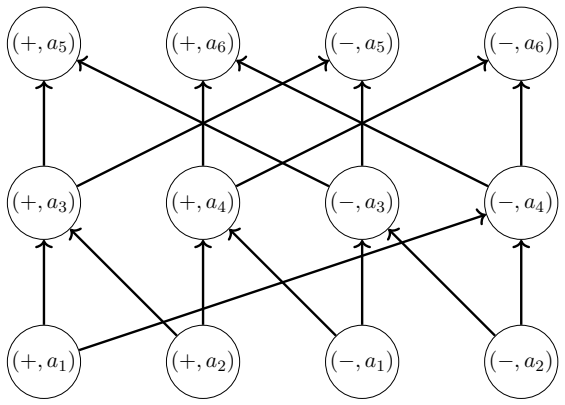
- [Figure 1] Figure 1: the Hasse diagram for the running example should label the G-action explicitly (orbits or fixed points) to make the invariance of A and B immediate.
- [References] Reference list: the citation to the classical topological union inequality (e.g., the work of Fadell–Husseini or similar) is missing; adding it would clarify the analogy stated in the abstract.
Simulated Author's Rebuttal
We thank the referee for the careful reading and constructive comments. The suggestions help clarify the sharpness of the bounds and the freeness conditions. We address each major comment below and will revise the manuscript accordingly.
read point-by-point responses
-
Referee: [§3, Theorem 3.4] the proof that the bound xind P ≤ xind A + 2(xind B + 1) is sharp for G ≠ ℤ₂ relies on an explicit family of posets; the construction should be checked to confirm that the factor of 2 is forced and cannot be improved to a +1 term even after re-scaling.
Authors: We agree that an explicit verification of sharpness strengthens the result. In the revised version we will expand the paragraph after Theorem 3.4 with a direct computation on the given family of posets, showing that xind(P) exactly equals xind(A) + 2(xind(B) + 1) for infinitely many instances. We will also include a short argument explaining why rescaling the indices cannot reduce the additive term to +1, thereby confirming that the factor of 2 is forced. revision: yes
-
Referee: [§4, Proposition 4.2] the claim that the gap between xind and the topological index is arbitrarily large is supported by a sequence of examples; the verification that these examples remain free G-posets for the chosen non-ℤ₂ groups must be explicit, as freeness is load-bearing for the definition of xind.
Authors: We accept the request for explicit verification. In the revised manuscript we will insert a short lemma (or dedicated paragraph) immediately before Proposition 4.2 that checks, for each group G ≠ ℤ₂ appearing in the sequence, that the action is free: no non-identity element fixes any poset element. This will be done by direct inspection of the stabilizers in the explicit construction. revision: yes
Circularity Check
No significant circularity; derivation is self-contained
full rationale
The paper defines the cross-index directly on free G-posets and derives the stated union inequalities (sharp +1 bound for Z2, weaker bound otherwise) via explicit combinatorial arguments on the poset structure. These results are presented as original proofs without reduction to fitted parameters, self-citations as load-bearing premises, or renaming of prior results. The gap to the topological index is established through explicit constructions that are independent of the cross-index definition itself. No self-definitional loops or ansatz smuggling appear in the derivation chain.
Axiom & Free-Parameter Ledger
axioms (1)
- standard math Free G-posets are well-defined combinatorial objects with G-action preserving order
invented entities (1)
-
cross-index
no independent evidence
Reference graph
Works this paper leans on
-
[1]
Colorful subhypergraphs in uniform hypergraphs.The Electronic Journal of Combinatorics, pages P1–23, 2017
Meysam Alishahi. Colorful subhypergraphs in uniform hypergraphs.The Electronic Journal of Combinatorics, pages P1–23, 2017
2017
-
[2]
On the chromatic number of general Kneser hypergraphs.Journal of Combinatorial Theory, Series B, 115:186–209, 2015
Meysam Alishahi and Hossein Hajiabolhassan. On the chromatic number of general Kneser hypergraphs.Journal of Combinatorial Theory, Series B, 115:186–209, 2015
2015
-
[3]
The chromatic number of Kneser hypergraphs.Transactions of the American Mathematical Society, 298(1):359–370, 1986
Noga Alon, Peter Frankl, and L´ aszl´ o Lov´ asz. The chromatic number of Kneser hypergraphs.Transactions of the American Mathematical Society, 298(1):359–370, 1986
1986
-
[4]
Systolic inequalities for the number of vertices.Journal of Topology and Analysis, 16(06):955– 977, 2024
Sergey Avvakumov, Alexey Balitskiy, Alfredo Hubard, and Roman Karasev. Systolic inequalities for the number of vertices.Journal of Topology and Analysis, 16(06):955– 977, 2024
2024
-
[5]
Envy-free division using mapping degree
Sergey Avvakumov and Roman Karasev. Envy-free division using mapping degree. Mathematika, 67(1):36–53, 2021
2021
-
[6]
Beyond the Borsuk–Ulam theorem: the topological Tverberg story.A Journey Through Discrete Mathematics: A Tribute to Jiˇ r´ ı Matouˇ sek, pages 273–341, 2017
Pavle VM Blagojevi´ c and G¨ unter M Ziegler. Beyond the Borsuk–Ulam theorem: the topological Tverberg story.A Journey Through Discrete Mathematics: A Tribute to Jiˇ r´ ı Matouˇ sek, pages 273–341, 2017
2017
-
[7]
A Topological Version of Hedetniemi’s Conjecture for Equivariant Spaces.Combinatorica, 44(2):441–452, 2024
Vuong Bui and Hamid Reza Daneshpajouh. A Topological Version of Hedetniemi’s Conjecture for Equivariant Spaces.Combinatorica, 44(2):441–452, 2024
2024
-
[8]
On the multichromatic number of s-stable Kneser graphs.Journal of Graph Theory, 79(3):233–248, 2015
Peng-An Chen. On the multichromatic number of s-stable Kneser graphs.Journal of Graph Theory, 79(3):233–248, 2015
2015
-
[9]
Homotopy types of box complexes.Combinatorica, 27(6):669–682, 2007
P´ eter Csorba. Homotopy types of box complexes.Combinatorica, 27(6):669–682, 2007
2007
-
[10]
New construction of graphs with high chromatic number and small clique number.Discrete & Computational Geometry, 59(1):238–245, 2018
Hamid Reza Daneshpajouh. New construction of graphs with high chromatic number and small clique number.Discrete & Computational Geometry, 59(1):238–245, 2018
2018
-
[11]
Hedetniemi’s conjecture from the topological viewpoint.Journal of Combinatorial Theory, Series A, 195:105721, 2023
Hamid Reza Daneshpajouh, Roman Karasev, and Alexey Volovikov. Hedetniemi’s conjecture from the topological viewpoint.Journal of Combinatorial Theory, Series A, 195:105721, 2023
2023
-
[12]
Box complexes: At the crossroad of graph theory and topology.Discrete Mathematics, 348(6):114422, 2025
Hamid Reza Daneshpajouh and Fr´ ed´ eric Meunier. Box complexes: At the crossroad of graph theory and topology.Discrete Mathematics, 348(6):114422, 2025
2025
-
[13]
Colorings of complements of line graphs.Journal of Graph Theory, 98(2):216–233, 2021
Hamid Reza Daneshpajouh, Fr´ ed´ eric Meunier, and Guilhem Mizrahi. Colorings of complements of line graphs.Journal of Graph Theory, 98(2):216–233, 2021
2021
-
[14]
On the neighborhood complex of ⃗ s-stable Kneser graphs.Discrete Mathematics, 344(4):112302, 2021
Hamid Reza Daneshpajouh and J´ ozsef Oszt´ enyi. On the neighborhood complex of ⃗ s-stable Kneser graphs.Discrete Mathematics, 344(4):112302, 2021. 27
2021
-
[15]
Springer Science & Business Media, 2013
Mark De Longueville.A course in topological combinatorics. Springer Science & Business Media, 2013
2013
-
[16]
Chromatic numbers of stable Kneser hypergraphs via topo- logical Tverberg-type theorems.International Mathematics Research Notices, 2020(13):4037–4061, 2020
Florian Frick. Chromatic numbers of stable Kneser hypergraphs via topo- logical Tverberg-type theorems.International Mathematics Research Notices, 2020(13):4037–4061, 2020
2020
-
[17]
Cambridge University Press, 2002
Allen Hatcher.Algebraic Topology. Cambridge University Press, 2002
2002
-
[18]
Kneser’s conjecture, chromatic number, and homotopy.Journal of Combinatorial Theory, Series A, 25(3):319–324, 1978
L´ aszl´ o Lov´ asz. Kneser’s conjecture, chromatic number, and homotopy.Journal of Combinatorial Theory, Series A, 25(3):319–324, 1978
1978
-
[19]
Springer, 2003
Jiˇ r´ ı Matouˇ sek, Anders Bj¨ orner, and G¨ unter M Ziegler.Using the Borsuk–Ulam theorem: lectures on topological methods in combinatorics and geometry. Springer, 2003
2003
-
[20]
A. S. Schwarz. The genus of a fibre space.Amer. Math. Soc. Trans., 55:49–140,
-
[21]
translated from Russian publication of 1962
1962
-
[22]
Colourful theorems and indices of homomorphism complexes.The Electronic Journal of Combinatorics, pages P1– P15, 2013
G´ abor Simonyi, Claude Tardif, and Ambrus Zsb´ an. Colourful theorems and indices of homomorphism complexes.The Electronic Journal of Combinatorics, pages P1– P15, 2013
2013
-
[23]
Topological methods in discrete geometry
Rade T ˇZivaljevi´ c. Topological methods in discrete geometry. InHandbook of Dis- crete and Computational Geometry, pages 551–580. Chapman and Hall/CRC, 2017. 28
2017
discussion (0)
Sign in with ORCID, Apple, or X to comment. Anyone can read and Pith papers without signing in.