Recognition: 1 theorem link
· Lean TheoremFully Discrete Active Flux Method based on Transported Acoustic Increments for the Compressible Euler Equations
Pith reviewed 2026-05-14 19:03 UTC · model grok-4.3
The pith
Reconstructing acoustic increments as cellwise quadratic fields and evaluating them at convective feet yields the exact unsplit frozen evolution for the compressible Euler equations.
A machine-rendered reading of the paper's core claim, the machinery that carries it, and where it could break.
Core claim
The paper shows that the acoustic increment, reconstructed as a cellwise Q2 field and evaluated at the convective foot of each target point, produces a point update that reduces exactly to the transported composition of acoustic and advective generators for frozen coefficients. When those generators commute, the update therefore coincides with the true unsplit frozen evolution operator, eliminating the additive-split error that remains in earlier Active Flux formulations.
What carries the argument
The transported acoustic increment: a cellwise quadratic (Q2) reconstruction of the acoustic update that is evaluated at the foot of the characteristic trajectory and then composed with the advective operator.
If this is right
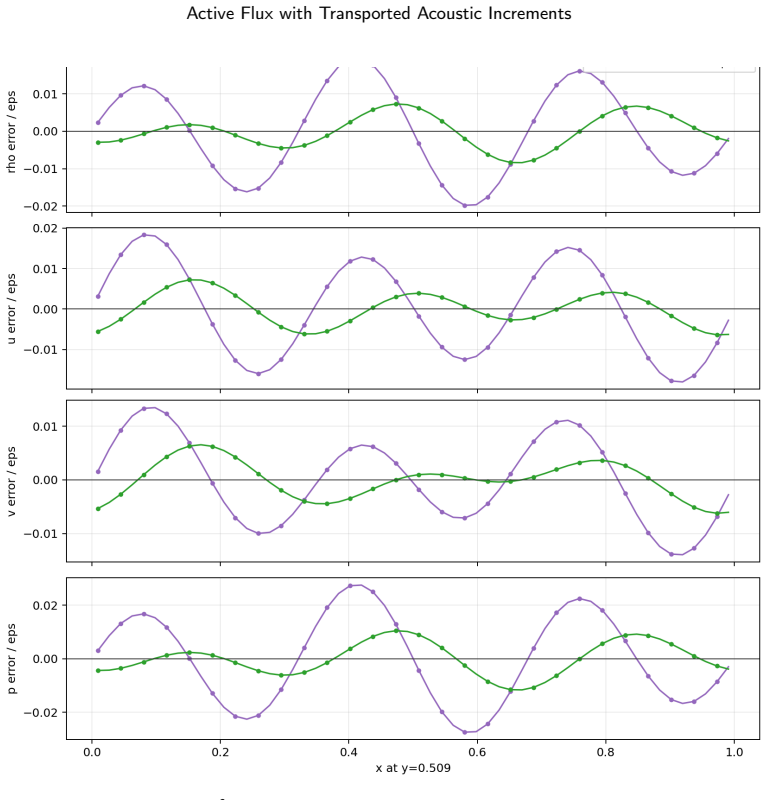
- Third-order point accuracy is recovered for the transported update, while the additive version remains only second-order.
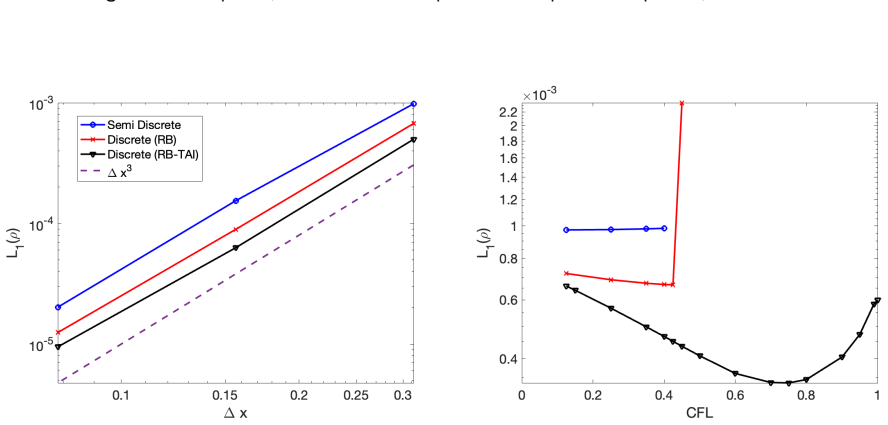
- Isentropic vortex convection tests exhibit third-order convergence, reduced error constants, and an enlarged empirical CFL range.
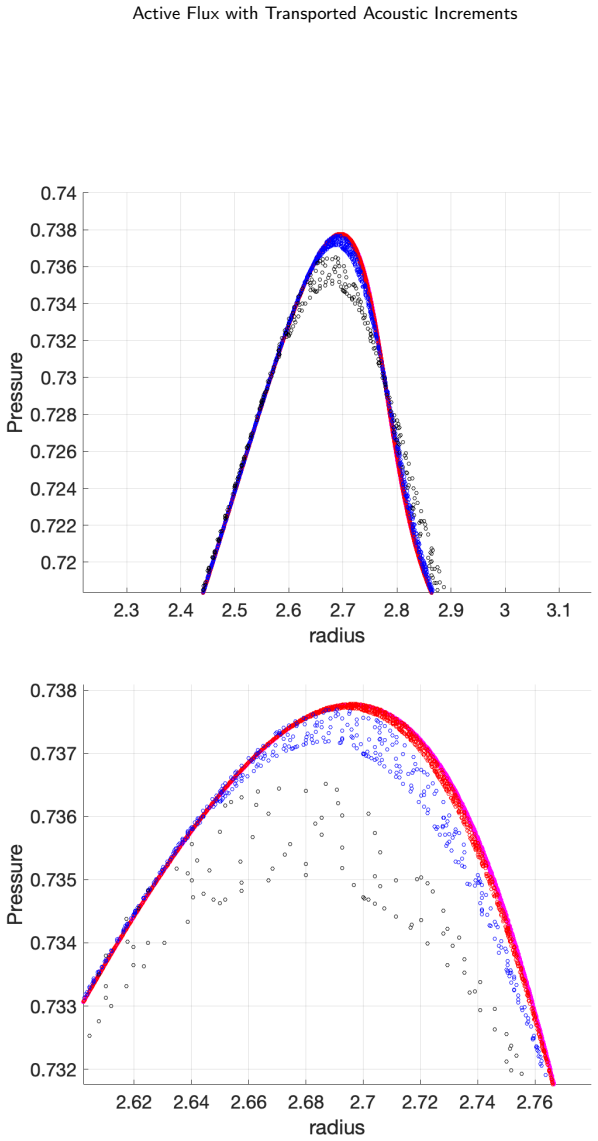
- Nonlinear Gaussian acoustic pulses preserve radial symmetry with near-third-order decay of symmetry error.
- Low-Mach shear layers produce coherent vorticity and ultra-low entropy dissipation without secondary vortices on coarse grids.
- Under-resolved compressible Kelvin-Helmholtz evolution remains stable without limiters and shows consistent entropy dissipation to late times.
Where Pith is reading between the lines
- The same transport construction could be applied to other operator-split hyperbolic schemes to remove splitting errors without enlarging the stencil.
- Because the acoustic operator is kept exact at the linear level, the method may allow larger time steps in low-Mach regimes before acoustic stiffness appears.
- Extending the Q2 reconstruction to higher even degrees would test whether the observed third-order point accuracy can be raised systematically while retaining the compact stencil.
Load-bearing premise
Reconstructing the acoustic increment as a cellwise Q2 field and evaluating it at the convective foot accurately captures the unsplit evolution operator even for the full nonlinear Euler equations.
What would settle it
A direct numerical check on a linear frozen system with non-commuting acoustic and advective operators would show whether the transported point update remains exact; if the error fails to drop to machine zero, the exact-unsplit claim is false.
Figures








read the original abstract
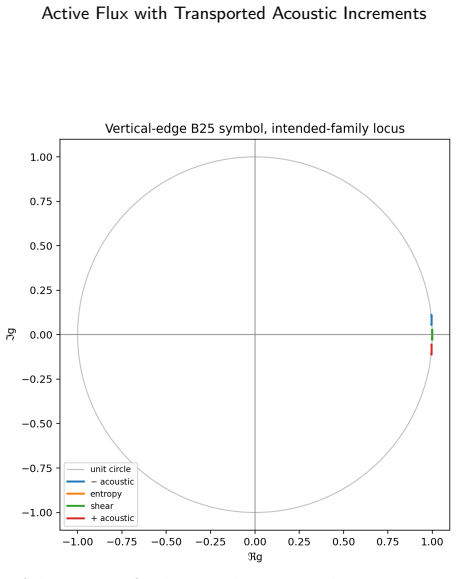
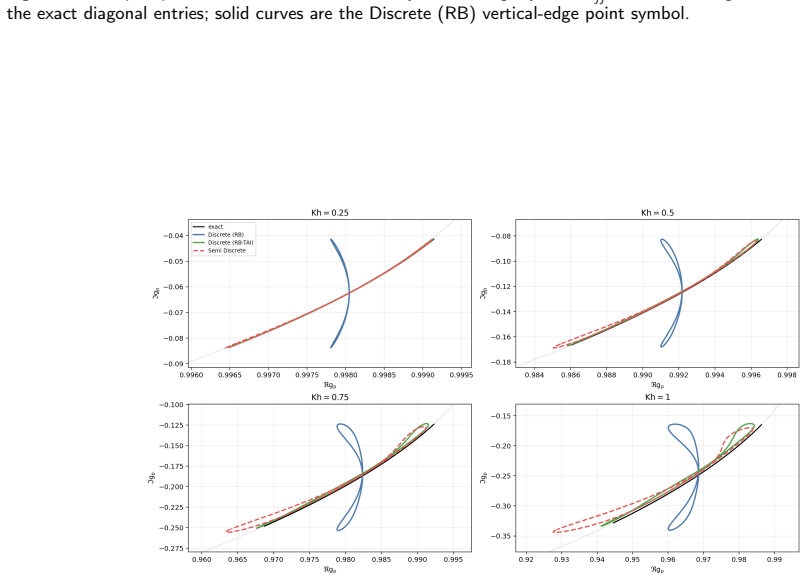
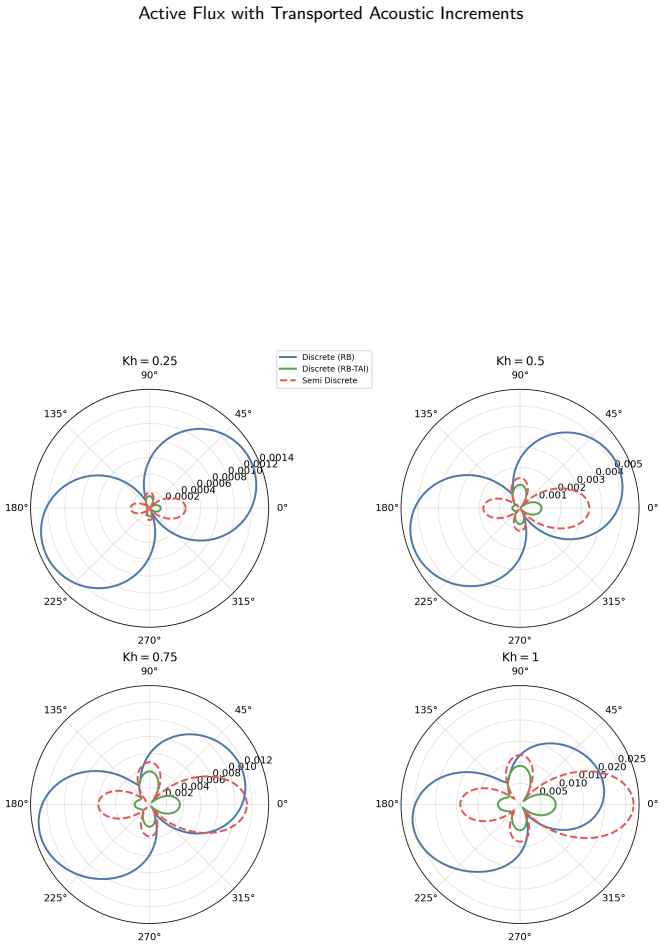
A fully discrete Active Flux method is proposed for the 2D compressible Euler equations. The method builds on the evolution-operator formulation proposed by Roe in which conservative cell averages are updated by unsplit flux quadrature while primitive point values are evolved by acoustic and advective subsolvers. The proposed method reconstructs the acoustic increment as a cellwise Q2 field and evaluates this field at the convective foot of the target point. For constant frozen coefficients, the resulting point update reduces to the transported composition, eliminating the additive split defect and yielding the exact unsplit frozen evolution when the acoustic and advective generators commute. The resulting method preserves the exact locally linearized acoustic evolution operator of Barsukow (2025), the compact stencil, and the conservative one-stage average update. Numerical experiments probe several facets of the numerical method. A mixed Fourier wave packet isolates the split error and shows third-order point accuracy for the transported update, compared with second-order behavior for the additive update. Isentropic vortex convection confirms third-order convergence for the full nonlinear scheme, reduced error constants, and an enlarged empirical CFL range. Nonlinear Gaussian acoustic pulse evolution demonstrates preservation of radial symmetry and near-third-order decay of the symmetry error. Low-Mach shear layer tests show coherent vorticity evolution, ultra-low entropy dissipation, and absence of the coarse-grid secondary vortices seen in displayed DG/CG comparisons. Finally, a compressible under-resolved Kelvin-Helmholtz test demonstrates robust no-limiter evolution to late time with consistent entropy dissipation. Fourier diagnostics of the vertical-edge point operator support the observed improvements in acoustic phase and amplification behavior.
Editorial analysis
A structured set of objections, weighed in public.
Referee Report
Summary. The manuscript proposes a fully discrete Active Flux method for the 2D compressible Euler equations. It reconstructs the acoustic increment as a cellwise Q2 field and evaluates this field at the convective foot of the target point. For constant frozen coefficients, the resulting point update reduces to the transported composition, eliminating the additive split defect and yielding the exact unsplit frozen evolution when the acoustic and advective generators commute. The method preserves the exact locally linearized acoustic evolution operator of Barsukow (2025), the compact stencil, and the conservative one-stage average update. Numerical experiments include a mixed Fourier wave packet showing third-order point accuracy for the transported update (versus second-order for additive), third-order convergence for the isentropic vortex, symmetry preservation for the nonlinear Gaussian acoustic pulse, coherent vorticity in low-Mach shear layers, and robust evolution for the under-resolved Kelvin-Helmholtz instability.
Significance. If the central reduction holds, the work offers a targeted improvement to Active Flux schemes for hyperbolic conservation laws by removing the splitting inconsistency in the point evolution while retaining the exact linearized operator, compact stencil, and conservative update. The reported gains in convergence order, empirical CFL range, radial symmetry, low-Mach vorticity preservation, and absence of spurious secondary vortices relative to DG/CG comparisons indicate practical value. The Fourier diagnostics of the vertical-edge point operator and the direct derivation of the transported reduction for frozen coefficients are particular strengths that support broader adoption in compressible flow computations.
major comments (2)
- [Derivation of the transported point update] The reduction of the point update to the transported composition for constant frozen coefficients (described in the paragraph following the Q2 reconstruction definition) is load-bearing for the claim of eliminating the additive split defect. The manuscript should supply the explicit algebraic steps or a short lemma showing how the Q2 field evaluation at the convective foot produces exact cancellation of the split terms when the generators commute.
- [Numerical experiments, mixed Fourier test] In the mixed Fourier wave packet experiment, the reported third-order point accuracy for the transported update versus second-order for the additive update is key supporting evidence. The error norm (L2 or pointwise), wave-packet parameters, and quantitative convergence rates should be stated explicitly, ideally in a table, to confirm the isolation of the split error and allow independent verification.
minor comments (3)
- [Low-Mach shear layer tests] The phrase 'ultra-low entropy dissipation' in the low-Mach shear layer discussion would be strengthened by a specific quantitative measure, such as the observed entropy decay rate or a direct numerical comparison value.
- [Figure captions] Figure captions for the DG/CG comparisons in the shear layer test should specify the polynomial degree, mesh type, and time-stepping details of the reference schemes to facilitate fair assessment of the observed improvements.
- [Preservation statement] A brief parenthetical reference to the precise equation or property from Barsukow (2025) that is exactly preserved by the new reconstruction would improve clarity without lengthening the text.
Simulated Author's Rebuttal
We thank the referee for the positive assessment and constructive comments. We address each major comment below and will incorporate the requested clarifications in the revised manuscript.
read point-by-point responses
-
Referee: [Derivation of the transported point update] The reduction of the point update to the transported composition for constant frozen coefficients (described in the paragraph following the Q2 reconstruction definition) is load-bearing for the claim of eliminating the additive split defect. The manuscript should supply the explicit algebraic steps or a short lemma showing how the Q2 field evaluation at the convective foot produces exact cancellation of the split terms when the generators commute.
Authors: We agree that an explicit derivation strengthens the presentation. In the revised manuscript we will insert a short lemma right after the Q2 reconstruction definition. The lemma will derive the algebraic cancellation: when the frozen coefficients are constant and the acoustic and advective generators commute, evaluating the cellwise Q2 acoustic-increment polynomial at the convective foot x - u Δt recovers exactly the transported composition, with the additive split terms cancelling identically. This leaves the stencil, the exact linearized acoustic operator, and the conservative average update unchanged. revision: yes
-
Referee: [Numerical experiments, mixed Fourier test] In the mixed Fourier wave packet experiment, the reported third-order point accuracy for the transported update versus second-order for the additive update is key supporting evidence. The error norm (L2 or pointwise), wave-packet parameters, and quantitative convergence rates should be stated explicitly, ideally in a table, to confirm the isolation of the split error and allow independent verification.
Authors: We will add a dedicated table to the mixed Fourier wave-packet subsection. The table will report the L2 error norms on the point values, the precise wave-packet parameters (wave numbers kx, ky, amplitudes, and phase), the sequence of grid resolutions, and the measured convergence rates (approximately 3.0 for the transported update and 2.0 for the additive update). This will make the isolation of the split error fully verifiable. revision: yes
Circularity Check
Minor self-citation of prior formulation; central reconstruction step is independent
full rationale
The paper introduces a new reconstruction of the acoustic increment as a cellwise Q2 field evaluated at the convective foot. For constant frozen coefficients this directly yields the transported composition by explicit construction from the reconstruction procedure, eliminating the additive split defect when generators commute. This step is self-contained and does not reduce to a fitted parameter or self-defined input. The method references Roe's evolution-operator formulation and preserves Barsukow's linearized operator, but these are contextual citations rather than load-bearing reductions; the mixed Fourier test and nonlinear experiments supply independent numerical confirmation of the accuracy improvement. No derivation step collapses to its own inputs by construction.
Axiom & Free-Parameter Ledger
axioms (2)
- domain assumption The compressible Euler equations are the governing system.
- domain assumption Acoustic and advective generators commute under frozen coefficients.
Lean theorems connected to this paper
-
IndisputableMonolith/Foundation/RealityFromDistinctionreality_from_one_distinction unclearFor constant frozen coefficients, the resulting point update reduces to the transported composition, eliminating the additive split defect and yielding the exact unsplit frozen evolution when the acoustic and advective generators commute.
Reference graph
Works this paper leans on
- [1]
- [2]
- [3]
-
[4]
Journal of Computational Physics , volume =
van Leer, Bram , title =. Journal of Computational Physics , volume =
- [5]
- [6]
- [7]
-
[8]
Journal of Computational Physics , volume =
Barsukow, Wasilij , title =. Journal of Computational Physics , volume =
-
[9]
Journal of Scientific Computing , volume =
Barsukow, Wasilij , title =. Journal of Scientific Computing , volume =
-
[10]
Barsukow, Wasilij and Edelmann, Philipp V. F. and Klingenberg, Christian and Miczek, Fabian and R. A Numerical Scheme for the Compressible Low-. Journal of Scientific Computing , volume =
-
[11]
Fan, Duoming , title =
-
[12]
Maeng, Jungyeoul , title =
-
[13]
ESAIM: Mathematical Modelling and Numerical Analysis (M2AN) , volume =
Barsukow, Wasilij and Klingenberg, Christian , title =. ESAIM: Mathematical Modelling and Numerical Analysis (M2AN) , volume =
- [14]
-
[15]
Abgrall, R. Extensions of. ESAIM: Mathematical Modelling and Numerical Analysis , volume =
- [16]
-
[17]
Chudzik, Erik and Helzel, Christiane and Luk. Active. Journal of Scientific Computing , volume =
-
[18]
On the Behaviour of Upwind Schemes in the Low
Guillard, Herv. On the Behaviour of Upwind Schemes in the Low. Computers & Fluids , volume =
- [19]
-
[20]
International Journal for Numerical Methods in Fluids , volume=
High-order CFD methods: current status and perspective , author=. International Journal for Numerical Methods in Fluids , volume=. 2013 , publisher=
work page 2013
-
[21]
Computer Physics Communications , volume=
: A high-order discontinuous Galerkin solver for flow simulations and multi-physics applications , author=. Computer Physics Communications , volume=. 2023 , publisher=
work page 2023
-
[22]
Annual Review of Fluid Mechanics , volume=
A perspective on the state of aerospace computational fluid dynamics technology , author=. Annual Review of Fluid Mechanics , volume=. 2023 , publisher=
work page 2023
-
[23]
Journal of Computational Physics , volume=
Generalized upwind summation-by-parts operators and their application to nodal discontinuous Galerkin methods , author=. Journal of Computational Physics , volume=. 2025 , publisher=
work page 2025
-
[24]
Journal of Computational Physics , volume=
On the robustness of high-order upwind summation-by-parts methods for nonlinear conservation laws , author=. Journal of Computational Physics , volume=. 2025 , publisher=
work page 2025
-
[25]
Journal of Scientific Computing , volume=
Stable volume dissipation for high-order finite-difference and spectral-element methods with the summation-by-parts property , author=. Journal of Scientific Computing , volume=. 2026 , publisher=
work page 2026
-
[26]
2018 AIAA aerospace sciences meeting , pages=
Comparing active flux and discontinuous Galerkin methods for compressble flow , author=. 2018 AIAA aerospace sciences meeting , pages=
work page 2018
-
[27]
arXiv preprint arXiv:2603.18160 , year=
On the equivalence of semi-discrete Active Flux and Discontinuous Galerkin methods and a comparison of their performance , author=. arXiv preprint arXiv:2603.18160 , year=
-
[28]
arXiv preprint arXiv:2508.15017 , year=
Semi-discrete Active Flux as a Petrov-Galerkin method , author=. arXiv preprint arXiv:2508.15017 , year=
-
[29]
arXiv preprint arXiv:2508.06273 , year=
A Fully Discrete Truly Multidimensional Active Flux Method For The Two-Dimensional Euler Equations , author=. arXiv preprint arXiv:2508.06273 , year=
discussion (0)
Sign in with ORCID, Apple, or X to comment. Anyone can read and Pith papers without signing in.